
This poem has an interesting connection with the city and region of Fukushima as we shall see:
| Japanese | Romanization | Translation |
|---|---|---|
| みちのくの | Michinoku no | Whose fault is it |
| しのぶもぢずり | Shinobu mojizuri | that my feelings have begun to tangle |
| たれゆゑに | Tare yue ni | like the tangle-patterned prints |
| 乱れそめにし | Midare some ni | of Shinobu from the distant north? |
| 我ならなくに | Ware naranaku ni | Since it is not mine, it must be… |
The author, Kawara no Sadaijin (河原左大臣, 822 – 895), “Riverbank Minister of the Left”. His personal name was Minamoto no Toru, renowned for his courtly elegance, and Professor Mostow thinks he may have served as a partial role-model for the famous hero of the Tale of Genji.
The poem is thought to be Toru’s defense to his wife or lover about his faithfulness, but he uses some interesting imagery to convey how upset he is that his faithfulness is questioned. Mostow points out that the poem is a subject of debate because it’s also been interpreted as an expression of secret love to someone else (i.e. “why did you make me feel this way”?).
The place referenced, Shinobu in Michinoku, is the old name for what is now the city of Fukushima in Fukushima Prefecture. Although it is now known for last year’s earthquake and nuclear disaster, the area was originally a frontier area during the time of the Nara and Heian periods, and as evinced in the poem above, famous for it’s patterned cloth called shinobu mojizuri.
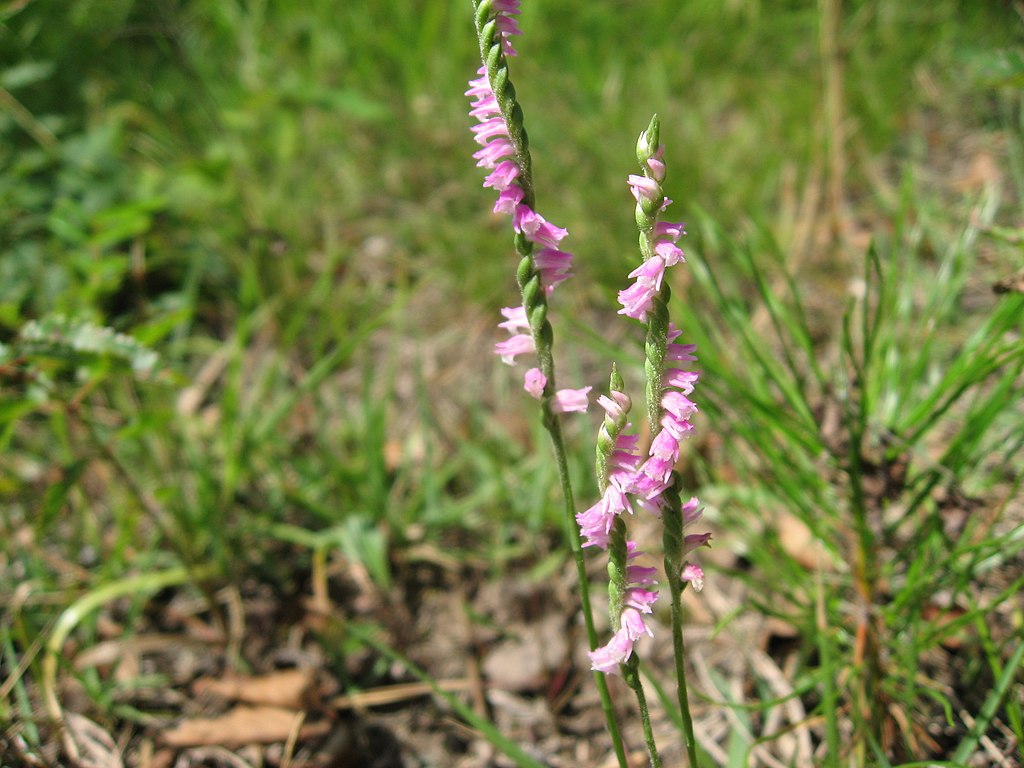
The term mojizuri refers to a type of plant, Spiranthes sinensis var. amoena pictured above (photo by Qwert1234, CC BY-SA 4.0, via Wikimedia Commons), a variety of orchid found in east Asia. It’s also called nejibana in modern Japanese. However, mojizuri also refers to a kind of dyed-cloth pattern made from the plant. The method involves pressing a cloth between the plant and a rock, forming dyed patterns like the ones shown here. This the context that Minamoto no Toru is using in the poem.
 The Hyakunin Isshu
