I can’t believe this thing has kept going for so long. When I made my first post (here is the first poem I posted), I never imagined that fifteen years later I would still be fascinated by the Hyakunin Isshu, or that I would have so many wonderful readers from around the world, including some in my own backyard. ❤️
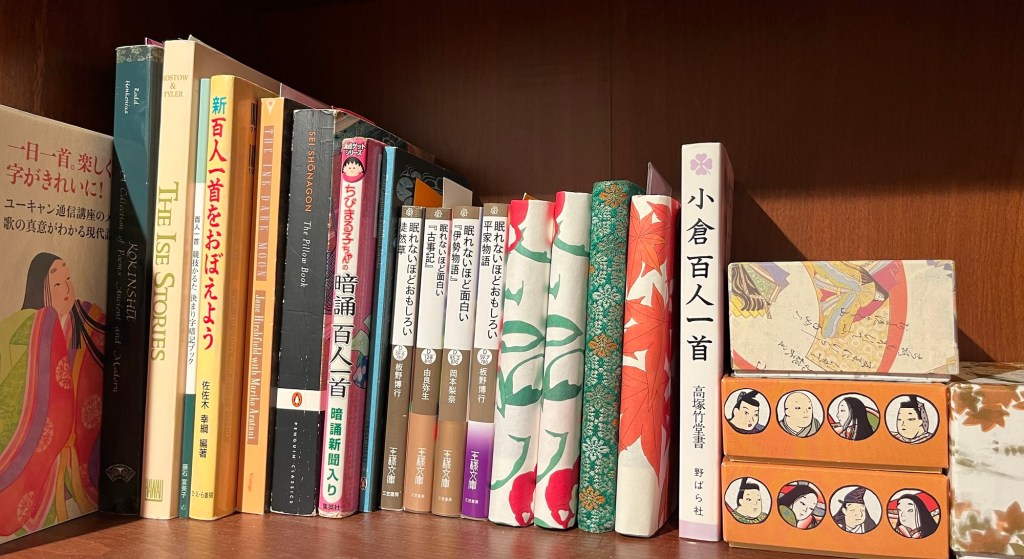
My bookshelf collection, minus a few items too large to fit. The book in yellow on the left belonged to my late mother-in-law (RIP). A few books are wrapped in book covers too.
Thank you all for your support and interest over the years. 🥰 With luck, this blog will hopefully stay around for a long time to come.
Hello readers and happy 2026! Today I wanted to share something that is both familiar and yet new: Iroha Karuta (イロハカルタ).
I’ve talked about the game of karuta before, but this is in the context of Hyakunin Isshu poetry (which is the main topic of this blog 😉).
However karuta (from Portuguese carta) includes many similar games, not just the Hyakunin Isshu poetry. Many such games use a format called Iroha Karuta.
The iroha poem is a very famous poem, possibly composed by Kakinomoto Hitomaro (poem 3, あし) which uses exactly one of each Japanese kana syllable to form a lovely waka poem. It’s frequently used to alphabetize things in Japan, assign seats, etc.
So, in the same way, karuta cards can be organized by Iroha letters too. This is an easier game than Hyakunin Isshu karuta because instead of learning the poems, their verses, etc., you just need to know the basic Hiragana syllabary. Then, when cards are read, you are listening for the first syllable and find the matching card.
Over the years, my in-laws have sent us various karuta sets to my kids:
… but we didn’t really use them until recently. My youngest child understands enough Japanese now that we can play as a family.
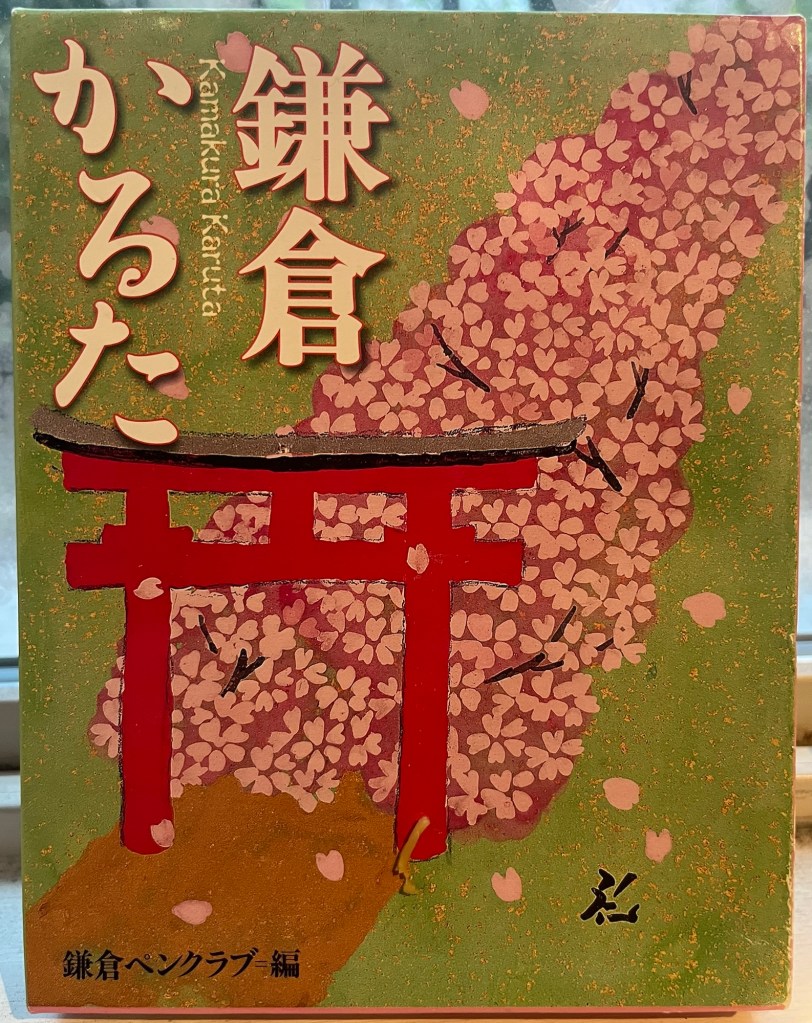
Karuta in general is often played just after Japanese new year, so this year we finally opened some of our old sets and played them one by one. My favorite set is this one:
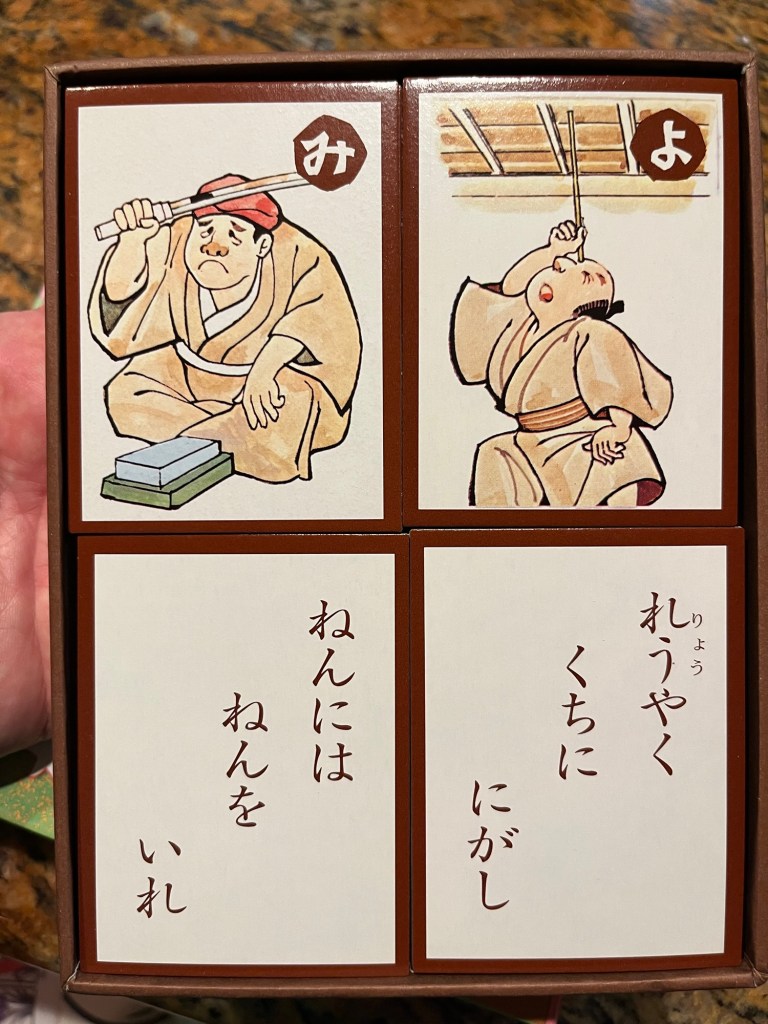
This set features the city of Kamakura, both past and present, using amazing artwork contributed by local artists. Sadly it is not sold anymore. The contents are below:
Similar to Hyakunin Isshu karuta, the cards are divided between “reading” cards (yomifuda, 読み札), and cards to take (torifuda, 取り札), with some short verses written on them. You lay out the cards like in chirashi-dori style (i.e. just spread around between players), and someone reads the cards (a.k.a. yomite 読み手) while other players try to find and take the card based on the first syllables.
The difference is that the artwork is on the torifuda cards, and you don’t have to memorize kimariji. The two cards on the left are related by the letter う (“u”) for uguisu, a famous bird in Japan.
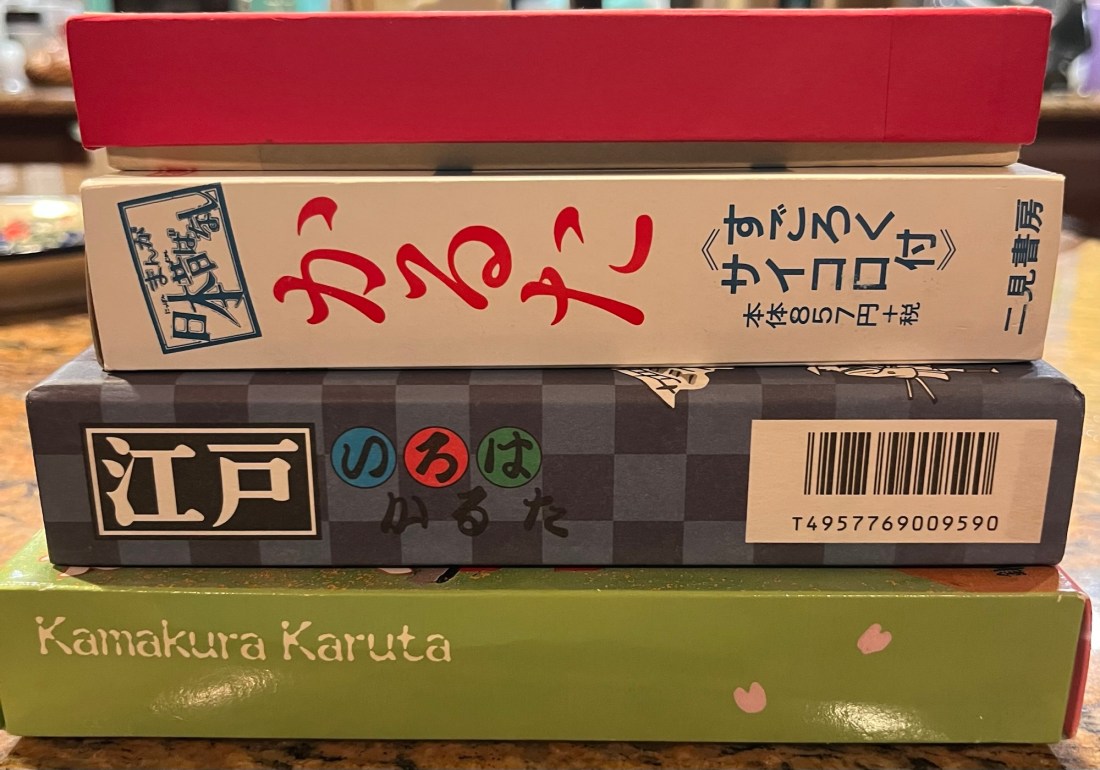
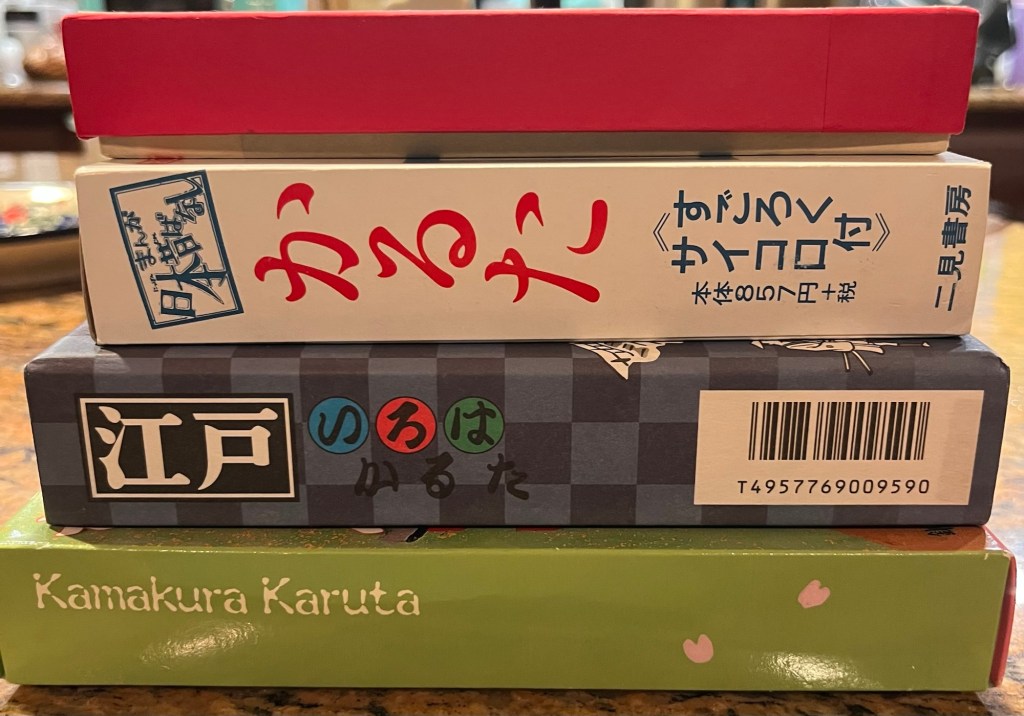
Some other examples we (apparently 😅) own:
The theme of this one is old Tokyo (Edo 江戸) and features proverbs from back then.
This set above features famous Japanese fairy tales from an old NHK series, and surprisingly includes romaji letters (maybe to help foreign players). It also includes dice for a sugoroku style game. We own the related book series, published by Kodansha with English translation, and I used to read them to my kids when they were little. So, these illustrations are very nostalgic.
One nice thing about Iroha karuta is that you can use any possible theme. A quick Google search shows many sets, with themes such as Kyoto (京), old proverbs, and modern silly ones too. I even found a karuta set for the Manyoshu (!).
Hyakunin Karuta, by comparison, has a more refined image but also has a steeper learning curve, even when playing casual style. So, if you’re looking to play a quick game of Karuta and can read hiragana (or find a set with romaji), Iroha Karuta might be a suitable game for you. Since I own both, I like switching between the quick-and-easy Iroha karuta games, and the more refined and ambient Hyakunin Isshu karuta.
Many of the samestores that sell Hyakunin Isshu sets also sell Iroha sets, so don’t hesitate to look. Happy gaming!
For the end of the year, I wanted to share a poem compsed by Otomo no Yakamochi, the compiler of the Manyoshu:
Original Manyogana
Modern Japanese
Romanization
Rough Translation
新
新しき
Aratashiki
Just as the
年乃始乃
年の初めの
Toshi no hajime no
new-fallen snow
波都波流能
初春の
Hatsu haru no
of this New Year’s day
家布敷流由伎能
今日降る雪の
Kyo furu yuki no
piles up, so too do
伊夜之家餘其騰
いやしけ吉事
Iyashike yogoto
auspicious tidings.
Poem 4516, chapter 20, rough translation by me.
The headline of the poem explains that that particular New Year’s day experienced record snowfall, and so Yakamochi recited this poem for the occasion.
Also, a note on translation: the poem as written in Japanese doesn’t say “new year”, but actually says “first spring”. This is because in the traditional Chinese calendar (which Japan used for many centuries) the New Year began early Spring, not mid-winter as we do in the West (i.e. January 1st). This is true even now in Chinese culture: Lunar New Year usually begins in late January or February depending on lunar cycles. Thus, many traditional phrases related to New Year in Japan literally say “Spring”, for example shinshun (新春, “new spring”) or geishun (迎春, “welcoming spring / new year”). This poem is no exception.
So with that, I wish you all a wonderful 2026, and a happy, joyous new year. May your good fortune pile up like snow!
P.S. According to Japanese tradition, if you dream about Mount Fuji, an eagle, or eggplant during the first sleep after New Year, you will have an extra good year.
Recently, I finally finished my book on the Manyoshu. I can’t read Japanese fast, so it took me a year to finish, but it was satisfying to finish an adult-level book in another language, even if I relied heavily on dictionaries. I learned a lot! I hope you enjoyed some of the related posts here too.
Anyhow, the end of the book explored some miscellaneous poems, and this one really stood out to me for its Buddhist theme, and the unusual format. This is poem 3852:
Original Manyogana
Modern Japanese
Romanization
Rough Translation
鯨魚取
鯨魚取り
Isanatori
While fishing, I wonder
海哉死為流
海や死にする
Umi ya shinisuru
if the seas will die,
山哉死為流
山や死にする
Yama ya shinisuru
and the mountains die
死許曽
死ぬれこそ
Shinure koso
They will surely die
海者潮干而
海は潮干て
Umi wa shiohite
for the tides recede,
山者枯為礼
山は枯れすれ
Yama wa karesure
and the mountains wither.
This poem is a rare example of a Japanese sedōka-style ( 旋頭歌 ) poem, which has 5-7-7-5-7-7 syllables. Compare this to the later waka style poem of the Hyakunin Isshu (and the vast majority of the poems in this blog) which are 5-7-5-7-7, and haiku which are 5-7-5. Sedoka poems are an early stage of Japanese poetry that wasn’t used much beyond that as Waka (then later Haiku) became more popular.
Still, this poem is quite interesting. In fact, it was used in a famous Japanese pop song a few generations ago.
Nonetheless, the Buddhist themes of impermanence are hard to miss here, even with my amateur translating skills. The poet asks if even the seas and mountains will wither and die, and indeed, since the tides come in and out, and the mountains dry up (during the summer?), this can only mean “yes”, they won’t last forever.
Similarly, there is another Buddhist poem in the Manyoshu worth looking at:
The two oceans maybe an allusion that mirrors Shandao’s Parable of the Two Rivers (in my other blog), or the general Japanese-Buddhist concept of Ohigan. We also see the theme of mountains drying up, and seas receding again.
But if you thought this was vague, poem 3850 is even more straightforward in its meaning:
This poem alludes to another place, which again can mean the world of peace or enlightenment, or allude to the notion of a Buddha’s Pure Land. It doesn’t specify which Buddha (Amida, Shakyamuni, etc), but I am inclined toward this latter interpretation. I suppose it doesn’t really matter. The sentiment is the same: this world is impermanent and troublesome, and the author longs for something better, but is unsure of the path to follow.
I think we can all empathize with this at some point in our lives…
Poetry in Japan covers the subject of romance a lot. Like, A LOT. But while I was reading the Ise Stories recently, I stumbled upon this commentary by Dr Joshua Mostow that made me curious:
Modern commentators have felt the need to explain the erotic tone of this poem sent by one man to another. For Takeoka, such phraseology is no more than an affectation (kyoshoku) derived ultimately from Chinese poetry. Tsukahara Tetsuo and, following him, Paul Schalow, see this episode as one of five (16, 38, 46, 82, and 83) that portray deep, perhaps even homosexual, relationships between men.
page 107
This comment is in reference to poem 46 in the Ise Stories:
The story behind this poem is that our anonymous gentleman protagonist had a good friend, but they were later separated when the friend went to another province. The friend sent a letter saying that “it’s been too long”, and worried our protagonist had forgotten him. The man sent back the above poem as a reply.
Another example is poem 38, where our protagonist visits the residence of one Ki no Aritsune who was out and took too long to come home, leaving the protagonist waiting. Our protagonist sends this poem.
This brings up a subject that we don’t normally cover here on the blog, and one that admittedly I am not an expert on: is this poem, and others like it in the Ise Stories, simple affection (a.k.a. a “bromance”), or did these two men also have a romantic relationship?
The love poetry that we normally cover is heterosexual. The nobility of the Heian-Period court were constantly sleeping around, as marriages were primarily political. Attitudes about marriage were influenced by Confucian thought, so establishing a family and raising the next generation were filial duties one should fulfill. So, heterosexual relationships were expected. And yet, perhaps men also had romantic (or quasi-romantic) relationships with close male friends too.
It’s somewhat difficult to grasp this, because the way Japanese aristocracy at the time viewed romance and marriage differs from 21st century Western attitudes. So, interpreting such poems isn’t always easy, as Mostow alludes to. Different scholars will have different interpretations.
I should also add that this kind bromance/homoerotic poetry isn’t limited to the Ise Stories. Dr Mostow cites poems in the official Imperial Anthology, the Kokinshu, as well. This is one example, poem 978:
Original Japanese
Romanization
Translation
君が思ひ
Kimi ga omoi
If your thoughts of me
雪とつもらば
Yuki to tsumoraba
“gather thick as snow” I should
たのまれず
Tanomarezu
not rely on them
春よりのちは
Haru yori nochi wa
for once spring has come I know
あらしとおもへば
Araji to omoeba
the drifts will vanish from sight.
Translation by Laurel Rasplica Rodd and Mary Catherine Henkenius from Kokinshū: A Collection of Poems Ancient and Modern
This poem was composed by Ōshikōchi no Mitsune (poem 29 in the Hyakunin Isshu, こころあ) in response to a friend, Muneoka no Ōyori who had arrived at the capital and saw snow falling.
Again, it’s hard to be sure exactly how Mitsune and Oyori relate to one another, and if this is indeed romantic or just affectionate, but it’s a fascinating look at cultural norms at the time among the aristocrats of Japan.
P.S. It’s even harder to know what the attitudes of commoners, since we have so little historical information. The aristocrats of the Court may have had more liberal attitudes about love than commoners, or maybe commoners imitated the trends of the aristocracy. It’s hard to be certain.
In the Hyakunin Isshu poetry anthology, the subject of this blog for almost 15 years (!), there are many poems about love, nature, sadness, etc. But none about death. There are poems on betrayal, but in the context of infidelity, not on stabbing others in the back.
…. and yet, beneath the surface there are other stories to be told.
In the seventh century, with the death of Emperor Kōtoku in 654 CE, another power struggle erupted. One one side was the emperor’s son, Prince Arima (有間皇子, 640-658), and on the other was the emperor’s older sister and reigning sovereign Emperess Saimei. Empress Saimei had her own son named Prince Naka-no-ōe (中大兄皇子) and was a rival to Prince Arima, Because his mother was the reigning sovereign, Naka-no-ōe would be next in line for the throne, not cousin Prince Arima who was left in the cold.
According to historical accounts, Arima was quietly approached by one Soga no Akae (蘇我赤兄), grandson of the influential Soga no Umako, who promised to help him overthrow Empress Saimei and support his ascension to the throne. Initially, Arima was interested, but later got cold feet. He swore Soga no Akae not to tell anyone, and to call the whole thing off.
But what Arima didn’t know, was that the whole thing was a setup. Prince Naka-no-ōe had planned the whole thing, and Akae told him what happened.
Prince Arima was soon arrested, and taken outside the capitol for interrogation. On his way there, at a place called Iwashiro no Hama (“Iwashiro Beach”),1 he tied a cord, or a piece of grass to a pine branch. This was evidentially a tradition at the time to pray for good luck on one’s journeys.
Once the interrogations were complete, Prince Arima was sent back toward the capital, but was executed en route by hanging at a place called Muro no Yu (牟婁の湯), which is now a seaside resort town. He was 19 at the time, the year was 658 CE.
Forty-three years later (701 CE), Kakinomoto Hitomaro (poem 3 in the Hyakunin Isshu, あし) was serving the current Emperor Monmu, grandson of Empress Jito (poem 2, はるす), and during an an imperial outing they came to Muro no Yu. By now, Prince Arima’s demise was well-known, including the story of him tying cord to a pine tree branch. Hitomaro, remembering what happened, composed the following poem (poem 146 in the Manyoshu):
Original Manyogana
Modern Japanese
Romanization
Rough translation
後将見跡
後見むと
Nochi mimu to
That pine branch that
君之結有
君が結べる
Kimi ga musuberu
you were going to visit
磐代乃
磐代の
Iwashiro no
after tying a cord:
子松之宇礼乎
小松がうれを
Komatsu ga ure wo
I wonder if you ever did
又将見香聞
またも見むかも
Mata mo mimu kamo
see it again…
Rough translation by me, apologies for any mistakes or nuance issues
Kakinomoto Hitomaro is reminiscing whether Prince Arima got to see the pine branch again one his way back, before he was executed. It’s a sad poem on the tragically short-lived prince.
But there’s more to the story.
Soga no Akae and his clan, the Soga were frequent troublemakers at this time, and both Empress Saimei and her son Prince Naka-no-ōe executed or assassinated multiple members of the clan at the instigation of the Nakatomi. The Nakatomi were later renamed “Fujiwara”, and if you look at the list of poems in the Hyakunin Isshu, you see a lot Fujiwara poets. There’s a very good reason for this. The final straw for the Soga Clan was in 672 when yet another power struggle put the Soga on the losing side of the war. Akae was among those exiled. The Soga permanently lost power.
And finally: what happened to the powerful and conniving Prince Naka-no-ōe?
He eventually ascended the throne as Emperor Tenji, poem 1 of the Hyakunin Isshu (あきの) and instigator of conflicts of his own.
So, it’s interesting to read his poem in the Hyakunin Isshu and its rosy picture of a fall harvest, knowing that the man had some blood on his hands too…
P.S. featured photo is a 17th century depiction of the power struggle between Empress Saimei and the Soga Clan. Courtesy of Wikipedia.
P.P.S. another post on the dark political history behind some poets of the Hyakunin Isshu.
1 You can see modern photos of the place here. It is in Wakayama Prefecture.
Interesting historical fact that I learned recently.
A long, long time ago in this blog, I wrote about the Six Immortals of Poetry: a list of eminent poets devised by Ki no Tsurayiki (poem 35 in the Hyakunin Isshu, ひさ). This list was in the preface to the Kokinshu imperial anthology, wherein he raised up these six poets, as prime examples of poetry at the time ….. then promptly tore them down for one reason for another.
However, my book about the Manyoshu explains that in the same preface, Tsurayuki elevates two other poets as being above reproach:
Kakinomoto Hitomaro (poem 3 in the Hyakunin Isshu, あし) and
Together they were revered as Yamakaki no Mon (山柿の門) meaning the “Gate of Yama(be) and Kaki(nomoto)”. In modern terms, we can call them the Super Poetry Brothers…
I used to watch this show as a kid, every day after school. 😆
But I digress.
Kakinomoto and Yamabe were not exactly contemporaries. They were about a generation apart, and their poetry had different styles, but together they were seen as the epitome of poetic skill. So much so, that even Ki no Tsurayuki could find no fault in them.
Let’s look at each one.
Kakinomoto Hitomaro focused on expressing inner feelings. His poem in the Hyakunin Isshu shows his worry about sleeping alone one night, while this poem shows his passion for the one he loves. Or this one from the Manyoshu (poem 48):
Original Manyogana
Modern Japanese
Romanization
Rough Translation
東
東の
Himugashi no
To the east I
野炎
野にかぎろひの
No ni kagirohi no
see the rising sun
立所見而
立つ見えて
Tatsumiete
over the fields,
反見為者
かへり見すれば
Kaeri misureba
but if I look back [west]
月西渡
月かたぶきぬ
Tsuki katabukinu
I see the moon setting.
Translation by me, apologies for any mistakes or nuance problems.
This poem has a hidden meaning, and was both a memorial to one Prince Kusakabe who was the only child of Empress Jito (poem 2 in the Hyakunin Isshu, はるす), and praise of Prince Kusakabe’s son, who later was crowned Emperor Monmu. Thus, the poem expresses both sadness at the passing one of beloved figure, and hopes for a bright future for his son.
Meanwhile, Yamabe Akahito was more focused on the beauty of nature. His poem in the Hyakunin Isshu about the snow on Mount Fuji is a good example. He wrote many poems on various subjects, but often did so through simile with nature. Or this one from the Manyoshu (poem 1424):
Original Manyogana
Modern Japanese
Romanization
Rough Translation
春野尓
春の野に
Haru no no ni
I went to go
須美礼採尓等
すみれ摘みにと
Sumire tsumi ni to
pick some violets for
来師吾曽
来し我そ
Koshiware so
you in a spring field,
野乎奈都可之美
野を懐かしみ
No wo natsukashimi
but it was so charming
一夜宿二来
一夜寝にける
Hitoyo nenikeru
I slept there all night.
Here, Yamabe is talking about a wonderful, charming violet field and how it made him so sleepy and relaxed that he slept all night there. There’s less of the heavy, emotional pull of Hitomaro, but it paints a really lovely scene that’s timeless.
That’s a very brief look at the Super Poetry Brothers!
The compiler of the Manyoshu poetry anthology, Ōtomo no Yakamochi (大伴家持, 718 – 785), who also composed poem 6(かさ) in the Hyakunin Isshu, had a girlfriend named Kasa no Iratsumé (笠女郎, sometimes called “Lady Kasa” in English ) who was very devoted to him. She was second only to Yakamochi’s stepmother1 in her poetic contributions to the Manyoshu, and wrote many lovely poems to Yakamochi, including this one:
Rough translation by me, apologies for any mistakes
This is a nice, touching poem about someone who misses her far away lover. Not unusual in the Manyoshu, because even a journey to a neighboring province was a lengthy affair, let alone a remote one.
So, why do I highlight this poem when Kasa no Iratsume contributed many others?
In the late 19th and early 20th centuries was a Japanese author named Mori Ōgai (森 鷗外, 1862 – 1922), who during Japan’s rapid modernization period, spent some time in Germany learning Western medicine. Ogai was also an excellent writer, and wrote several stories, including a famous short story Maihime (舞姫, “The Dancing Girl”) about a young German woman who fell in love with a Japanese man studying there. After the man returns to Japan, the German woman (now pregnant) pines for him, and eventually meets a tragic end even as he prepares to return to Japan. The story is, according to Ogai, not autobiographical, but taken from anecdotes of other Japanese students studying abroad.
What’s interesting is that Ogai was definitely fascinated by Iratsume’s poem and even borrowed the obscure term 面影 (omokagé) in the title of the work Omokagé (於母影): a collection of Western poems translated into Japanese by Ogai and other members of the Shinseisha Society (新声社) in 1889. The related story of a young woman pining for the one she loves in a remote place is not hard to miss either in Dancing Girl, so perhaps that was a source of inspiration.
Nonetheless, it’s amazing how one writer or poet can inspire another 1,000+ years later.
… then again, I suppose that’s how this blog got started. 😏
1 Yakamochi’s birth mother died when Yakamochi was very young, and so he was raised by his stepmother, Ōtomo no Saka no Ue no Iratsume (大伴坂上郎女). She herself was on her third marriage after her previous two husbands both died. This underscores how short the average lifespan was in those days, even for the wealthy, as a woman in her 20’s or 30’s might be on her third marriage by then. Something almost unthinkable in the 21st century. Lady Izumi (poem Poem 56 of the Hyakunin Isshu あらざらん) had a similar string of bad luck.
I learned a neat little cultural facet from watching the historical drama about Lady Murasaki, but also from the anime Onmyoji.1 Since people in Heian-Period Japan did not have the technology to play Super Smash Brothers Ultimate,2 they passed the time in other ways.
One such pasttime, besides poetry contests and court music, was a neat little game originally called Kai-ōi (貝覆い, “Shell hiding”), but came to be more commonly known as Kai-awase (貝合わせ, “Shell matching”). Using shells from the common Meretrix lusoria or “Asiatic hard clam” (hamaguri in Japanese), the insides of the shells were painted so that both halves of the shell had the same picture. Then the shells would be put face down alongside many other similar shells for a matching game. In art, the game seems to be played mostly by women, and in later generations it was used as a wedding gift to upper-class brides.
The designs of shells started out fairly simple in the 11th and 12 centuries (i.e. the late Heian Period which we focus on so much here), but by the Edo Period, the designs were increasingly elaborate, and tended to hark back to the earlier period in history. Here’s a set of shells featuring scenes from Lady Murasaki’s novel The Tales of Genji:
The idea of a matching game is easy to find in many cultures, but the idea of painting the inside of shells, featuring scenes from a 12th century novel is awfully clever, and shows how the brilliance of the Heian Period culture still shines through even into modern times.
1Onmyoji was pretty good, but I didn’t get very far. To be honest, I don’t watch anime very much. Even Chihayafuru; I only watched the first season.
2 Who would be the “main” for each poet in SSBU? My guess is:
Lady Murasaki – Sephiroth (dark and brooding)
Sei Shonagon – Samus
Lady Izumi – Bayonetta or Zero-suit Samus
Fujiwara no Teika – Metaknight (loyal to Gotoba-in)
Ono no Komachi – Peach
Ariwara no Narihira – Marth or Link (dashing guy)
Gotoba-in – King Dedede
Fujiwara no Mototoshi – Bowser (demanding)
Kakinomoto no Hitomaro – Kirby
Kanké – Dr Mario (scholarly guy)
As for me, I usually play “best dad” Chrom or his daughter Lucina. Byleth is fun to play sometimes, but kind of sluggish in the game.
P.S. I think I spent more time making this SSBU list than writing the rest of the post. 🤦🏼♂️
Courtly life in the Heian Period of Japanese history wasn’t limited to poetry and love trysts. Music was an important part of the culture too, but Japanese music at the time was considerably different than we might expect. This kind of Court music is called gagaku (雅楽).
You can see a good example of Gagaku music here:
It may not seem obvious at first, but this style preserves many cultural aspects of the Heian Period (which the Hyakunin Isshu was a part of too): the costumes, music, songs of the time, and so on. The music takes a bit of getting used to for modern audiences (it is kind of screechy at times), but it was common then for such music to accompany important dances such as the yearly Go-sechi dance (see poem 12 of the Hyakunin Isshu, あまつ). When Lady Murasaki talks about concerts and dances in her diary or Sei Shonagon in her Pillow Book, this kind of music was played.
Gagaku music still lives on in Japan in traditional theater, and some religious services. It also makes a nice cover for Led Zeppelin’s Stairway to Heaven, too:
Enjoy!
Special thanks to Mr Togi for this awesome video. 東儀さん、ありがとうございます!





 The Hyakunin Isshu

.jpg)