
Waka poetry, including the Hyakunin Isshu has a lot of conventions and symbols used to express certain seasons or sentiments. This is not so unusual. For example, if someone in the US writes a poem about the smell of cinnamon, it definitely brings to mind late autumn or winter.
One common example in the Hyakunin Isshu of poetic symbolism are birds. Birds have distinctive calls, and different species tend to be prominent at different times of year, among other things. For this post, I included a lot of poetry from the Imperial anthology, the Kokin Wakashu, which is much larger than the 100 poems of the Hyakunin Isshu, and thus easier to find examples.
Spring
The most prominent bird in Spring is the uguisu, the Japanese Bush Warbler, also called the Japanese Mountain Thrush:

The uguisu’s distinctive bird call is very emblematic of the season.
The bird call of the uguisu sounds like ho-ho-ke-kyo, which to Japanese people sounds similar to a famous Buddhist text called the Lotus Sutra (hokekyo in Japanese). I’ve written much about the Lotus Sutra in my other blog, so I do not need to repeat here. Needless to say, when Spring comes, people in Japan inevitably hear this lovely sound, even in urban areas.
Oddly, there are no poems in the Hyakunin Isshu about the uguisu, however, I found many poems in the official anthology, the Kokin Wakashu. Here are a few of my favorites thus far. This first one is poem 4 by Fujiwara no Takako (藤原高子; 842–910) later Nijo-kisaki (二条后, “Nijō Consort”):
| Japanese | Romanization | Translation |
|---|---|---|
| 雪の内に | Yuki no uchi ni | Spring has come amidst |
| 春はきにけり | Haru wa kinikeri | the icy lingering snows |
| うぐひすの | Uguisu no | of winter |
| こほれる涙 | Kōreru namida | surely now the frozen of the |
| 今やとくらむ | Ima ya toku ran | mountain thrush will melt away |
and this one, poem 10, by one Fujiwara no Kotonao:
| Japanese | Romanization | Translation |
|---|---|---|
| はるやとき | Hana ya toki | Has spring come early— |
| 花やおそきと | Hana ya osoki to | or are the plum blossoms late— |
| ききわかむ | Kiki wakan | I would like to know |
| 鶯だにも | Uguisu dani mo | but not even the song of the |
| なかずもあるかな | Nakazu mo aru kana | mountain thrush trills the answer |
and finally this one by Mibu no Tadaminé whom we know from poem 30 in the Hyakunin Isshu (ありあ):
| Japanese | Romanization | Translation |
|---|---|---|
| 春来ぬと | Haru kinu to | Already they say |
| 人はいへども | HIto wa iedomo | Spring is here but as for me |
| うぐひすの | Uguisu no | while yet there is no |
| なかぬかぎりは | Nakanu kagiri wa | song from the mountain thrush |
| あらじとぞ思ふ | Araji to zo omou | I cannot believe spring has come |
Summer
In summer, the most iconic bird is the hototogisu, the Lesser Cuckoo.

And it’s call sounds like so:
We’ve seen the Lesser Cuckoo in poem 81 (ほ) of the Hyakunin Isshu by Gotokudaiji no Sadaijin.
It is also found in Imperial anthologies such as the Kokin Wakashu by an anonymous source:
| Japanese | Romanization | Translation |
|---|---|---|
| 郭公 | Hototogisu | When nightingales sing |
| 鳴くや五月の | Naku ya satsuki no | in the sweet purple iris |
| あやめ草 | Ayamegusa | of the Fifth Month |
| あやめも知らぬ | Ayame mo shiranu | I am unmindful of the warp on |
| 恋もするかな | Koi mo suru kana | which we weave love’s pattern |
Apparently, the bird was highly praised during the aristocratic court culture of the Heian Period, and Sei Shonagon (poem 62) mentions an expedition in her Pillow Book:
[94] …it had been overcast and tending to rain since the first day of the [fifth] month. Some of us were sitting about at a loose end, when I came up with the suggestion that it would be fun to go off on an expedition to hear the hototogisu….
[ later ] … and as for the hototogisu, they were indeed calling back and forth, so loudly in fact that they made almost too much of a din for comfort.
Translation by Dr Meredith McKinney
The anecdote is quite long, but Sei Shonagon and the other ladies-in-waiting do encounter the hototogisu, and meant to write poetry about them, but then through a series of interactions forgot the poetry entirely and came back to the Empress empty handed, followed by various witty comments back and forth.
Autumn
Unlike the Spring, where the call of the bird is highly praised in poetry, in the Autumn, the Hyakunin Isshu Daijiten lists a few birds that were revered in poetry. For example, migratory birds, such as the Wild Goose (kari):

Or birds with autumnal colors such as the Quail (uzura):
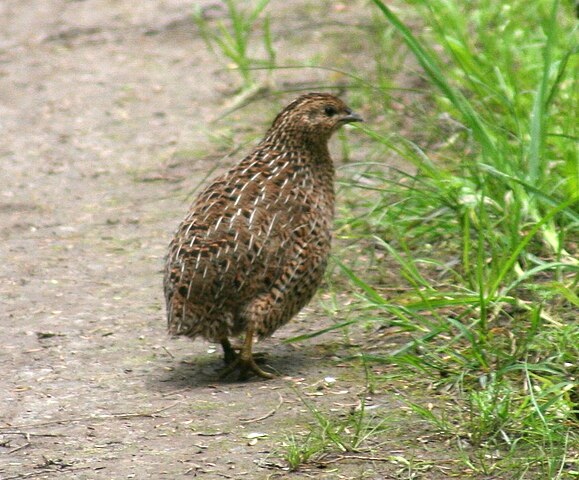
Or the swift Shrike (mozu):

I had some trouble finding poems for the fall birds listed in either the Hyakunin Isshu or the Kokin Wakashu anthology, but there seems to be a lot in the later Shin-Kokin Wakashu anthology. I don’t have a reliable translation of the Shin-Kokin Wakashu, so I may update later.
I did find this poem under the section “Miscellany 2” in the Kokin Wakashu, poem 497 by an anonymous poet:
| Japanese | Romanization | Translation |
|---|---|---|
| 野とならば | No to naraba | If all becomes dense fields |
| うづらとなきて | Uzura to nakite | I will pass my years |
| 年はへむ | Toshi wa hen | crying like a quail— |
| かりにだにやは | Kari ni dani ya wa | for surely you will come |
| 君がこざらむ | Kimi wa kozaran | if only for a few days’ hunt. |
Winter
The birds associated with winter, were birds whose cries were melancholy and said. First and foremost is the plover, which we saw in poem 78 (あわじ) of the Hyakunin Isshu:

Or the Black-headed Gull (miyako-dori, meaning “bird of the capital”):
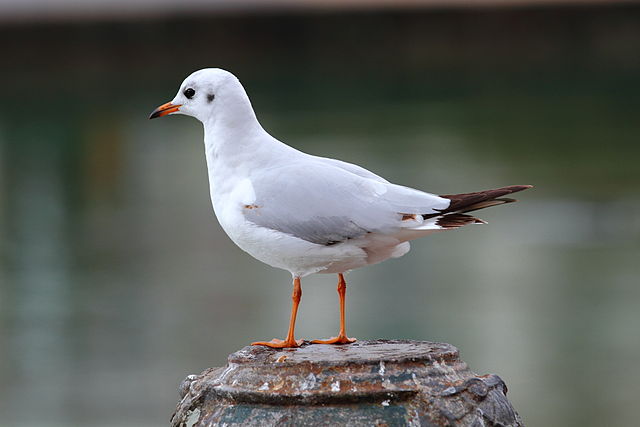
The miyakodori in particular stood out due to its unusual name. The Hyakunin Isshu Daijiten lists a poem from the official Kokin Wakashu anthology of note, poem 411 under the section “Travel Poems”:
| Japanese | Romanization | Translation |
|---|---|---|
| 名にしおはば | Na ni shi owaba | Oh capital bird |
| いざ言問はむ | Iza koto towan | if you are true to your name |
| 都鳥 | Miyako-dori | you will know |
| わが思ふ人は | Waga omou hito wa | tell me if the one whom I love is |
| ありやなしやと | Ari ya nashi ya to | still in this world of partings |
The headline for this poem explaining the backstory is unusually long, but basically the poet, Ariwara no Narihira (who also wrote poem 17, ちはやふる, in the Hyakunin Isshu) was away in eastern Japan with some companions, and longing for home in the capital, they saw a miyako-dori bird (lit. “capital bird”) and recited this poem.
And finally there is the Mallard (kamo):

The Mallard in particular had dual-association with romance and with the melancholy of winter. This poem in the Kokin Wakashu, number 533, by an anonymous author illustrates this:
| Japanese | Romanization | Translation |
|---|---|---|
| 葦鴨の | Ashigamo no | No more than do |
| 騒ぐ入江の | Sawagu irie no | White waves dancing across the |
| 白浪の | Shiranami no | inlet, where reed ducks |
| 知らずや人を | Shirazu ya hito wo | cry out noisily, no more |
| かく恋ひむとは | Kaku koin to wa | does my love know my yearning. |
Other Birds
Certain birds were also used in Japanese poetry for symbolic purposes, but not necessarily for seasonal expression.
We’ve talked about birds associated with seasons thus far, but there’s a couple worth calling out that are an important part of Japanese poetry, but not related to seasons. The first is the Copper Pheasant, called yamadori, which we saw in poem 3 of the Hyakunin Isshu (あしびきの).

In antiquity, it was thought that Copper Pheasants mated for life (true), but slept in separate nests at night. Thus, the poet Kakinomoto no Hitomaro likened himself to a Copper Pheasant sleeping alone at night part from his lover.
And finally we come to the magpie. In poem 6 of the Hyakunin Isshu (かさ), the poet Chūnagon Yakamochi describes frost growing under moonlight on the so-called Magpie Bridge of the Imperial Palace. The magpie (kasasagi) was associated with a Chinese myth that evolved into the Qīxī Festival (七夕), celebrated as Tanabata in Japan.

In this tale, two star-crossed lovers, a celestial princess and a cowherd, were forcibly separated in the heavens by her father the Jade Emperor, but allowed to reunite one night a year. It was said they would reunite by crossing a bridge made of magpie birds who put their outstretched wings together. Thus, the magpie was always associated with this famous tale.
 The Hyakunin Isshu
.JPG)

.jpg)


_W_IMG_0104.jpg)

