Nonomiya Shrine, Charms and Thank You

Happy Holidays, Dear Readers!

As I noted in my other blog, I am taking time off the rest of the year to rest, and catch up on nerd projects.

One last post before end of the year: I forgot to share this previously, but during the trip to Japan this summer, and on the same day we both visited the shrine to Sei Shonagon, and the site where the Hyakunin Isshu was compiled, I made one more stop: Nonomiya Shrine. The official website is here (English).

Nonomiya Shrine (nonomiya-jinja, 野宮神社) is a Shinto shrine that has been around since antiquity in west Kyoto within the bamboo forests. You can see it here on Google Maps:

While it is not related to the Hyakunin Isshu, it is related to Lady Murasaki (poem 57, め), whom I wrote about here. You see, one of the most iconic chapters of the Tales of Genji, Lady Murasaki’s famous novel, the “Heartvine” (Aoi, 葵) takes place at Nonomiya Shrine. Here, Genji the protagonist meets Lady Aoi his future wife. So, Nonomiya Shrine is associated with romance and falling in love, or meeting one’s soulmate, and since it was already a fixture in Kyoto culture at the time, Lady Murasaki used it as the backdrop for this romantic encounter.

Even now, many people (both Japanese and tourists) come here to pray for love, and many of the omamori charms are focused on romance too. It’s nestled within the famous bamboo forests in the area:

I stumbled upon it by accident after leaving the aforementioned site where the Hyakunin Isshu site was compiled. My family was waiting for me, it was late in the day, and it was very hot and humid, so I didn’t stay very long, but I wanted to at least grab a few photos, and get an omamori charm.1

Anyhow, that’s it for the blog for 2024.

I wanted to end this post by saying thank you to readers. The blog has been been around since 2011 (with some major gaps in content), and with plenty of twists and turns, but I am happy to see that people are still actively reading it, and discovering the Hyakunin Isshu, Heian-period culture, and Japanese poetry overall.

See you all next year!

P.S. Not far away was an exhibit for the historical drama about Lady Murasaki as well.

1 Most of the charms are for en-musubi (縁結び), meaning finding a partner in life, but since I am already happily married, I looked for something general. I picked up a omamori for kai-un (開運), meaning “good luck”, but it showed the famous scene from the Tales of Genji where Genji and Lady Aoi meet at Nonomiya Shrine. I wish I remembered to take a photo sooner, but I already gave it to someone, and have no photos to show. 🤦🏼‍♂️

You can see it on the website here, the charm on the upper-right corner.
The Final Days and Legacy of Lady Murasaki

At last, the historical drama about Lady Murasaki has come to an end this week, and sadly I watched the last episode. The drama was slower than other past Taiga Drama on NHK, but it was a lovely tribute to an amazing woman. Lady Murasaki, author of the Tales of Genji, her eponymous diary, and a famous poem in the Hyakunin Isshu left a lasting mark on Japanese culture and world literature.

The final title card for the Japanese historical drama “Hikaru Kimi E”.
The concluding title card for the historical drama: hikaru kimi é (光る君へ, “to you, my radiant one”).

Details of Lady Murasaki’s final years are pretty sketchy, but it seems that she eventually retired from service in Fujiwara no Michinaga’s household, and gradually took up travel. She was born in the year 973, but some scholars believe she may have passed away in 1014 at the age of 41. Others believe she may have lived to the year 1025 (age 52). For the premodern era, this is a pretty typical lifespan for many people, including nobility. Still, as someone who’s older than her, it’s hard to imagine her dying so young.1

Her grave is located in Kita-ku ward of Kyoto:

With her passing, a couple attempts were made to preserve and edit her magnum opus. Fujiwara no Teika (poem 97, こぬ) who compiled the Hyakunin Isshu itself undertook one of these efforts, creating the Aobyōshibon (青表紙本) edition. At this time in Japan, manuscripts had to be hand-copied, and so across several centuries, limited efforts were made to hand-copy works from Lady Murasaki’s time, which helped preserve them across the medieval period, but were inaccessible to general audiences.

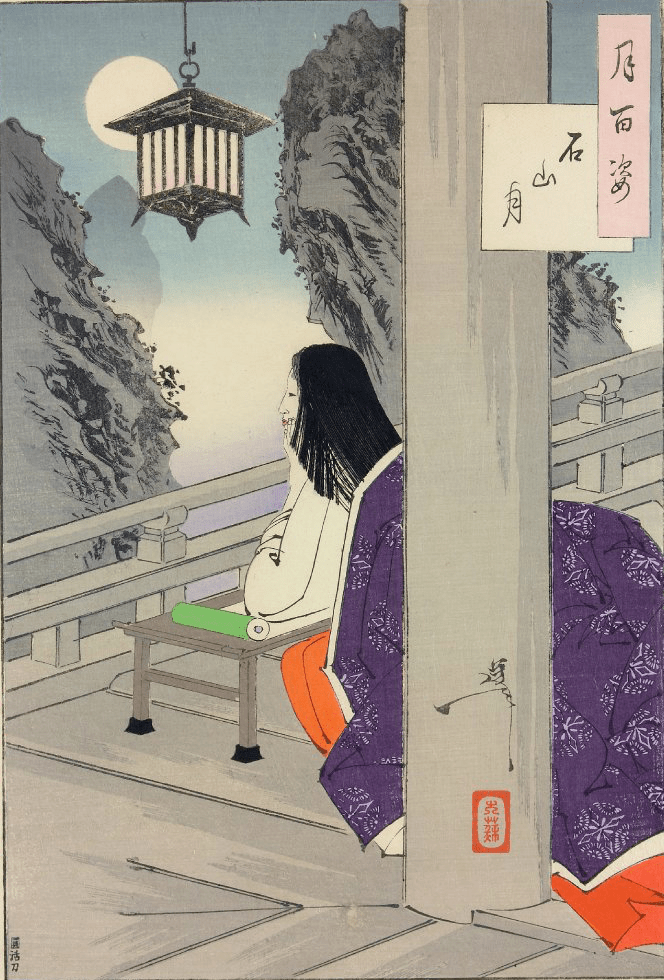
A woodblock print of Lady Murasaki from 1889 made by Yoshitoshi, Public domain, via Wikimedia Commons

By the Edo Period, 17th century, block printing and a flourishing of “book culture” greatly expanded the audience of the Tales of Genji, and Lady Murasaki enjoyed a surge in popularity, rescued from obscurity, and even today is high revered. Lady Murasaki is to Japanese culture what Shakespeare is to the English-speaking world. The historical drama that concluded is arguably an extension of this revival.

Finally, I wanted to explore the relationship between Lady Murasaki and her patron, Fujiwara no Michinaga. In the historical drama, they shared a relationship since childhood (historically improbable), and even had a love child together even though they never married. Political marriages were common among the nobilty at the time, as was infidelity, and so Fujiwara no Michinaga having an official marriage yet carrying a number of romantic trysts would not be surprising. The Hyakunin Isshu poetry is rife with such romances.

And the real, historical relationship between Lady Murasaki and Michinaga is unclear. It’s widely believed that the main character of the Tales of Genji was patterned from Michinaga. Her diary also shows her flirting with Michinaga somewhat. And yet, it’s also implied that she fended off his romantic advances too. The fact that she worked under him, the most powerful political figure in Japan at the time, made their relationship even more complicated. If her daughter, Daini no Sanmi (poem 58 of the Hyakunin Isshu, ありま) was indeed Michinaga’s, as the drama depicts, it may help explain how she was brought into the court inner circle too, alongside her mother. And yet, evidence one way or another is pretty limited, so one can only speculate.

Lady Murasaki herself was woman perpetually out of place in the courtly life of the late Heian Period. Her diary shows her frequently introverted, melancholy, out of place, and exhausted by the back-biting of other women, or the rowdiness of drunk men. Her father had lamented that in spite of her literary talents, her being born a woman in that era meant her talents would go to waste. Such was the period of the time.

One can easily imagine a brilliant woman like Lady Murasaki in modern times sitting in cafe, writing a romance novel, feeling alone, yet observing the world around her in a way that is beautiful and poetic, pouring her heart into her work. What Lady Murasaki conveyed through her writing was something can we can appreciate even today, eleven centuries later.

Out of all the literature of the time, nothing quite epitomizes the sentiments and milieu of the Heian Period, an era now lost to time, yet strangely familiar, quite like Lady Murasaki did.

P.S. The drama definitely took some historical liberties for the sake of drama, but I have to admit that it did a nice job of showing Lady Murasaki as a complex person, and all the different challenges she had to deal with. The last several episodes were really touching and brought tied up things nicely. I might try to purchase the drama next year if I can, but it’s quite expensive ($300-$500 USD), so time will tell.

1 As someone who also spent some time in the ER earlier this year with emergency surgery, I can imagine that I too would have likely died in my 40’s without modern medical care. Modern people often forget how brutal and short life was for the average person before medical science, and how many people never lived past 50, or did so with crippling conditions.