Shell Matching Game

I learned a neat little cultural facet from watching the historical drama about Lady Murasaki, but also from the anime Onmyoji.1 Since people in Heian-Period Japan did not have the technology to play Super Smash Brothers Ultimate,2 they passed the time in other ways.

One such pasttime, besides poetry contests and court music, was a neat little game originally called Kai-ōi (貝覆い, “Shell hiding”), but came to be more commonly known as Kai-awase (貝合わせ, “Shell matching”). Using shells from the common Meretrix lusoria or “Asiatic hard clam” (hamaguri in Japanese), the insides of the shells were painted so that both halves of the shell had the same picture. Then the shells would be put face down alongside many other similar shells for a matching game. In art, the game seems to be played mostly by women, and in later generations it was used as a wedding gift to upper-class brides.

The designs of shells started out fairly simple in the 11th and 12 centuries (i.e. the late Heian Period which we focus on so much here), but by the Edo Period, the designs were increasingly elaborate, and tended to hark back to the earlier period in history. Here’s a set of shells featuring scenes from Lady Murasaki’s novel The Tales of Genji:

Photo by Sailko, CC BY-SA 4.0, via Wikimedia Commons

This nice blog post below shows kids painting their own shells at the Toy Museum in Hyogo Prefecture:

The idea of a matching game is easy to find in many cultures, but the idea of painting the inside of shells, featuring scenes from a 12th century novel is awfully clever, and shows how the brilliance of the Heian Period culture still shines through even into modern times.

1 Onmyoji was pretty good, but I didn’t get very far. To be honest, I don’t watch anime very much. Even Chihayafuru; I only watched the first season.

2 Who would be the “main” for each poet in SSBU? My guess is:

  • Lady Murasaki – Sephiroth (dark and brooding)
  • Sei Shonagon – Samus
  • Lady Izumi – Bayonetta or Zero-suit Samus
  • Fujiwara no Teika – Metaknight (loyal to Gotoba-in)
  • Ono no Komachi – Peach
  • Ariwara no Narihira – Marth or Link (dashing guy)
  • Gotoba-in – King Dedede
  • Fujiwara no Mototoshi – Bowser (demanding)
  • Kakinomoto no Hitomaro – Kirby
  • Kanké – Dr Mario (scholarly guy)

As for me, I usually play “best dad” Chrom or his daughter Lucina. Byleth is fun to play sometimes, but kind of sluggish in the game.

P.S. I think I spent more time making this SSBU list than writing the rest of the post. 🤦🏼‍♂️

The Kōrin Karuta Collection

On a quiet Saturday afternoon, the first in a long time, I caught up on some reading and continued to read through my book about the Hyakunin Isshu (mentioned here): the Hyakunin Isshu Daijiten.

In one chapter, the book discussed a special artistic collection of the Hyakunin Isshu called the Kōrin Karuta collection (kōrin karuta, 光琳カルタ) which was painted by the famous artist Ogata Kōrin (尾形光琳, 1658-1716). The featured image above is one of his famous paintings depicting irises in a field (Public domain, via Wikimedia Commons).

I had a hard time finding available images of the Ogata Kōrin collection of cards, but you can see an example at the Tengu-do homepage. There’s a few things that make this collection noteworthy among the long history of the Hyakunin Isshu….

First, the cards use a gold background, instead of white or off-color white. If you look at Ogata’s other paintings, this is a common technique that he used, so it makes sense.

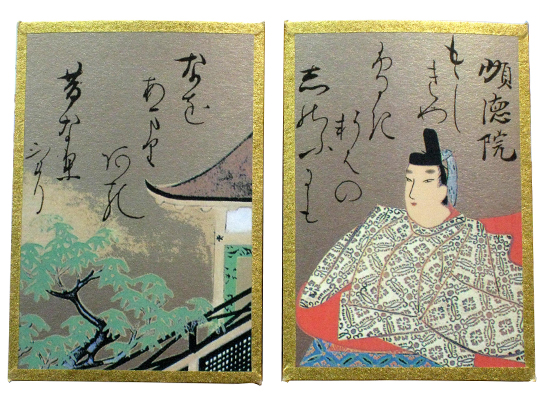
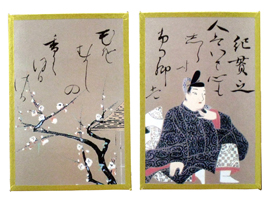
Second, and more significantly, the torifuda cards are painted as well. Whereas the yomifuda cards have portraits of the poets (with some subtle details we’ll talk about below), modern torifuda cards only have the text on them. Ogata decorated the torifuda cards using scenes that matched the poem.

For example, poem 100 (ももしきや) is shown here on the Tengu-do website. The corresponding torifuda card shows the eaves of a palace since the poem is about the declining condition of the Imperial palace amidst political strife. Poem 35 (ひとはいさ) is shown here. Since the poem is about the first cherry blossoms in spring, the torifuda card depicts cherry blossoms. And so on.

Third, the cards were larger in size than a standard karuta card used today. Perhaps the cards were not meant for playing, but as a medium of art.

Also, I realized that the illustrations of the poets looked awfully familiar. My first karuta set uses the same Ogata illustrations, even though the torifuda are not illustrated, and the card background is plain white versus the original gold color.

Even the paintings of the authors has some pretty interesting qualities to them. Using my own set, let’s take a look at a few notable quirks.

First, the “emperor” cards (cards where the poet was a reigning or retired emperor) have them seated on a straw mat with a brocade edge, a sign of authority. None of the other poets have this, even if the poet was a high ranking officials in the court. Here are the cards for Kōkō Tennō (“Emperor Koko”, poem 15) and Juntoku-in (“Retired Emperor Juntoku”, poem 100):

Second, while most poets’ faces are visible, the card for Shokushi Naishinnyo (“Imperial Princess Shokushi”, poem 89) completely hides her face. Why is that?

Evidentially, Princess Shokushi was quite beautiful, and Ogata didn’t want to leave her open to criticism or scrutiny, so he hid her face to protect. In some versions of the Kōrin Karuta set, Ono no Komachi’s (poem 9) face is also hidden.

The Kōrin Karuta collection isn’t the only famous illustration of the Hyakunin Isshu, and in time I hope to highlight others.