The 101st Poem of the Hyakunin Isshu

While watching competitive karuta online, and in person, I noticed that there is a certain poem that is read at the outset of a match, but what’s interesting is that this is a poem that is not actually part of the Hyakunin Isshu.

This poem is called the joka (序歌), or preliminary poem, and reads:

JapaneseRomanizationTranslation
難波津にNaniwazu niIn Naniwa Bay,
咲くやこの花Sakuya kono hananow the flowers are blossoming.
冬ごもりFuyugomoriAfter lying dormant all winter,
いまを春べとIma o harubé tonow the spring has come
咲くやこの花Sakuya kono hanaand the flowers are blossoming.
Translation courtesy of Chihayafuru Fandom Wiki

What’s interesting from a historical standpoint is that this poem was composed by a 3rd century immigrant to Japan named Wani (王仁), who came from the Korean kingdom of Baekje1 and is credited with introducing the Analects of Confucius and the Thousand-Character Classic to Japan at a time when it was actively trying to import knowledge and culture from the mainland. I’ve talked about Japan and Baekje here as well.

The poem by Wani was so highly-praised it was felt in antiquity that if you were going to know any Waka poem, you had to at least know this one. Hence over time it became the opening poem for karuta competitions. Like many poems of the Hyakunin Isshu, it was originally preserved in the official Imperial anthology, the Kokinshū.

In karuta matches, the poem is always read before the match begins. My guess is that reciting this poem helps to calibrate or warm-up the players before the match actually begins. Apparently, the last two verses, the shimo no ku (下の句) in karuta, are repeated twice. Once it’s read twice, the match begins.

It’s fascinating to note that this poem has been in existence for 1,700 years, and is still going strong!

P.S. Photo is Osaka (Naniwa) Bay at sunset, Quelgar’s photos, CC BY-SA 2.0, via Wikimedia Commons

1 A time when the Korean peninsula was divided into three warring kingdoms. Baekje probably had the closest relationship with the early Yamato Court of Japan due to proximity and mutually beneficial relations.

An Offering To The Gods: Poem Number 24

Hi folks, after a long break due to work obligations, I am back and happy to post this excellent poem by my favorite author in the Hyakunin Isshu:

JapaneseRomanizationTranslation
このたびはKono tabi waThis time around
ぬさもとりあNusa motori aezuI couldn’t even bring the
sacred streamers
手向山Tamuke yama—Offering Hill—
もみのにしきMomiji no nishikibut if this brocade of leaves
神のまにまにKami no mani maniis to the gods’ liking….
Translation by Dr Joshua Mostow

The poem is signed as Kanké (菅家, 845 – 903), which is the Sinified (Chinese) way to read the Sugawara Family name (lit. “House of Sugawara”). You see similar names used for the Taira Clan (e.g. Heike 平家) and Minamoto Clan (e.g. Genji 源氏) in later times. Anyhow, the author is none other than the famous poet/scholar Sugawara no Michizane who in later generations was deified as a sort of god of learning named “Tenjin” after he was wrongfully exiled through political intrigue.

The term nusa (幣) means a special wand used in Shinto religious ceremonies. The photo above is an example of a nusa, more formally a gohei (御幣) “wand” used in Shinto religious ceremonies, with the paper streamers used for purification (photo by nnh, Public domain, via Wikimedia Commons). At this time in history, according to the Hyakunin Isshu Daijiten, small nusa were often made from thin strips of paper and cloth and offered to the gods for a safe journey.

The poem was composed by Michizane after going on an excursion with his patron, Emperor Uda. Compare with another outing made years later by (then retired) Emperor Uda later in poem 26. In this case, Michizane had little time to prepare, and couldn’t make a proper offering to the gods for a safe trip. However, admiring the beautiful autumn scene on Mount Tamuke, he hopes that this will make a suitable offering instead. Sadly Michizane would be disgraced and exiled only a short time later.

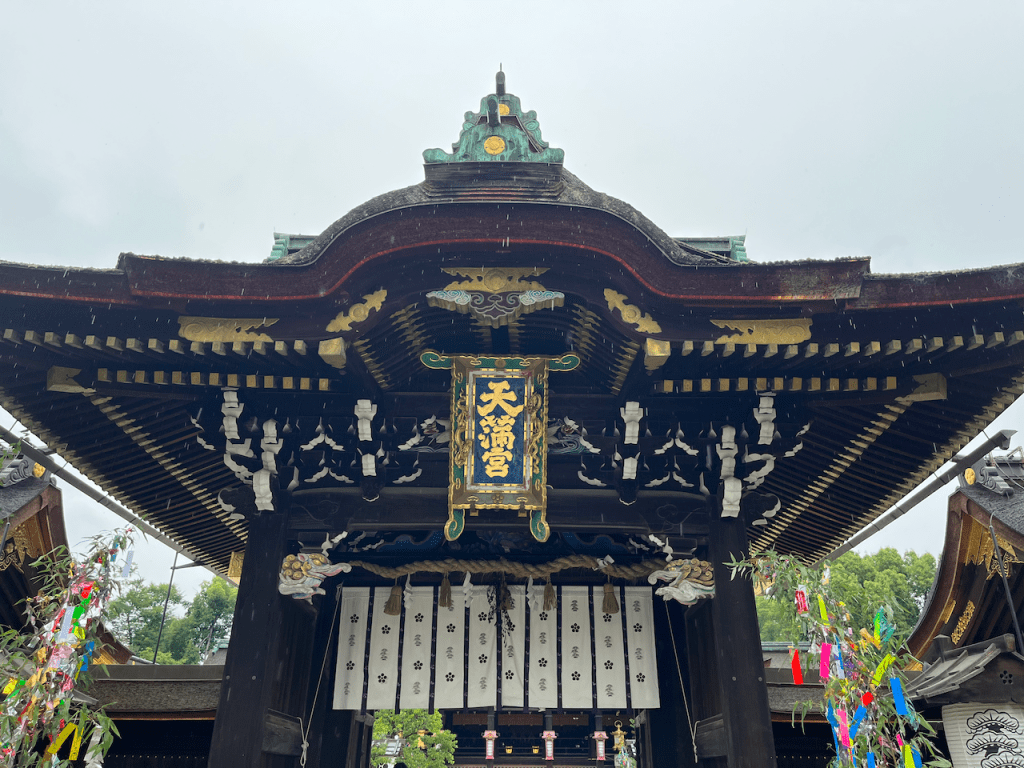
My interest in Sugawara no Michizane mostly comes because I admire him as a fellow scholar. I visited one of his shrines in Tokyo a couple times over the years, and usually try to pay respects. In July 2023, I visited the home shrine of Kitano Tenmangu as well.

Kitano Tenmangu shrine in Kyoto, Japan. Taken in July 2023.

The real life Michizane was no god of learning, but his real-life contributions to poetry and Chinese literature in Japan helped the culture flourish at that time, and earned his place as a trusted adviser to the Emperor, despite his more humble background. This also helped explain his status centuries later as a god of learning. Every year in Japan in April, students pay respects hoping that they can pass entrance exams, and it’s nice to see his legacy carry on so many years later.

A Full Moon Night: Poem Number 7

As tonight is a Worm Moon, but also one where the moon is the closest in its orbit to Earth in 19 years, I thought this was a fitting poem, and also one of my favorite:

JapaneseRomanizationTranslation
天の原Ama no haraAs I gaze out, far
ふりさけ見ればFurisake mirebaacross the plains of heaven
春日なるKasuga naruah, at Kasuga,
三笠の山にMikasa no yama nifrom behind Mount Mikasa,
出でし月かもIdeshi tsuki kamoit’s the same moon that came out then!
Translation by Dr Joshua Mostow

According to historical accounts, Abé no Nakamaro (阿倍仲麻呂, 701 – 770), the author, went to China to study at the age of 16. This was part of the yearly mission made by Japan to the Imperial Tang Court in China. The missions to China from Japan (or Kentō-shi 遣唐使) were perilous undertakings due to poor ship construction and storms from the south, so they didn’t come often, and sometimes got shipwrecked.

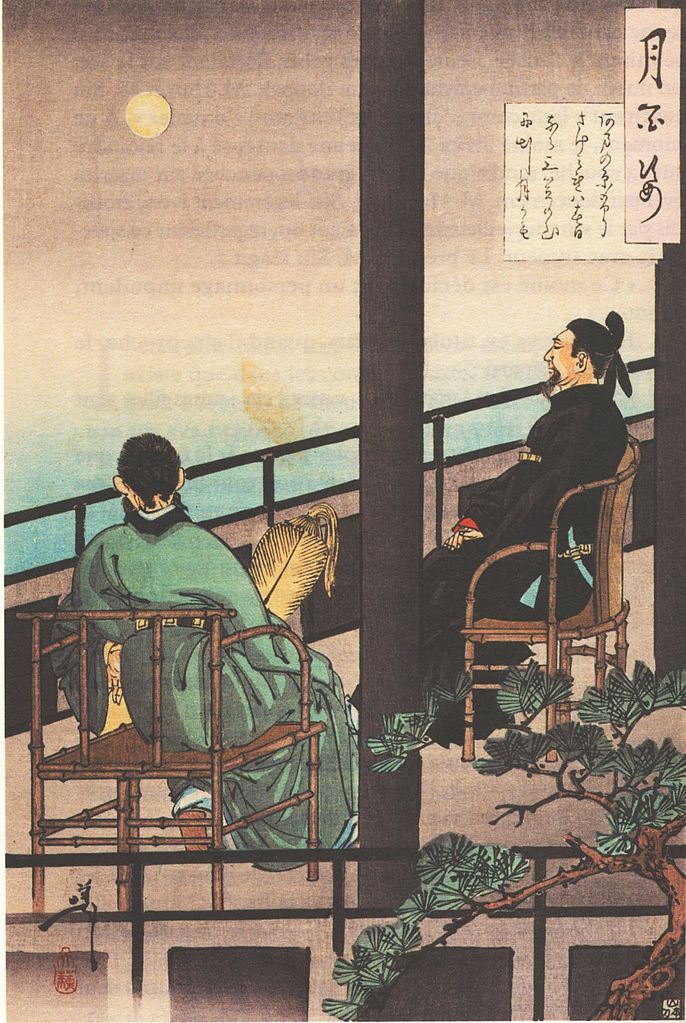
He spent many years in China and became friends with famous poets at the time such as Li Bo and Wang Wei, and was in the service of the Chinese emperor Xuan-Zong for a time. But after so many years of service, it was time for Nakamaro to return to Japan, and according to the story, on the night before he departed, his friends in China threw him a farewell feast. That evening, he looked up and saw a beautiful moon, and composed this poem. It was at Mount Mikasa many years before that Nakamaro prayed for safe return someday from China, and he remembered that same moon so many years ago. This is depicted in the featured photo above from a woodblock print collection (print number 64) called the One Hundred Aspects of the Moon by Yoshitoshi.

Sadly, his return trip failed, and the ship was blown off course to the land of Annam, where he then trekked back to China and eventually passed away never seeing his homeland again.