Memorization Progress, February 2023

Hello dear readers,

My progress in memorizing the Hyakunin Isshu poems, for the sake of learning to play karuta, continues, but since returning to the US, it has taken some twists and turns.

When I got back home, it became clear how busy my day to day life is compared to Japan, where I didn’t have to worry about work commitments, and had fewer natural distractions from hobbies, projects, etc. So, my original strategy of learning one poem a day quickly unraveled.

Further, as the number of cards I memorized has grown (38 out of 100 as of writing), the effort to review them all has grown too. As the number grows even larger, it gets harder and harder to review all of them daily.

So, I started switching to a spaced-repetition style of learning to help manage the load. This means I focus more on the cards I still need to improve on, and focus less on the ones I know well, while still reviewing periodically. To accomplish this, I needed a way to not only organize my cards, but also manage the progress of each one.

I brushed off one of my old Legion brand deck boxes from when I used to actively play Magic the Gathering (yes, I am a giant nerd).

Inside, I used a few card dividers (some borrowed from other deck boxes) into sections. The section in the back represents cards that I know well and can recite with little or no effort. The section in the middle represents cards I am still struggling with. The section in the front is the “new” queue: cards I have yet to learn but have lined up next.

I mostly focus on the middle queue, since I am actively learning them, but not comfortable enough yet to move them to the “back” queue. I also review the back queue from time to time, and occasionally have to move cards from there to the middle queue in situations where I feel a poem needs a bit more active review. I also try to add a new card from the “front” queue every 1-2 days.

This process took some trial and error to get right, and it may not work for everyone, but it has helped me regain my pace in memorizing the Hyakunin Isshu after some interruptions after coming back to the States.

My original goal was to finish by end of April, and this is still possible, but I have lost some time and now I am hopeful I can memorize all one hundred poems by June.

But, time will tell…

My SECOND Karuta Set and More!

While here in Japan for a couple weeks, I picked up my first karuta set of the Hyakunin Isshu at the local bookstore when I realized that getting to the more famous store was harder than I expected, and I just won’t be here long enough for local delivery.

However, my interest in the Hyakunin Isshu was not sated with a single set, and so, when the family I went to a local Kinokuniya bookstore (we have them in the US too), I found another set that I liked, shown above.

This set, by Silverback, linked here, is another set of karuta cards, but this one includes a CD of someone reciting the poems (読み手, yomité) just like in a karuta game. As you can see from the linked product description, this set has the cards color-coded. The illustrated cards (yomifuda) have a beige background, while the verses cards (torifuda) are blank white for easy searching.

When I got back home, I imported the CD into my iTunes playlist, so I can shuffle the album. That allows me to practice the karuta game since the next card read out loud will be random.

I can’t decide with of the two sets I like better. The artistic detail on the Kyoto set (the first purchase) is really quite amazing, while the character illustration on the Silverback set is more what I am familiar with. The CD the Silverback set is quite handy (and sounds very nice), while the box and presentation on the Kyoto set is more sturdy.

I suspect I will probably continue collecting sets over time. Each one is a work of art by itself. I also learned alot how and where to purchase karuta sets and will be updating my blog post about it as a result.

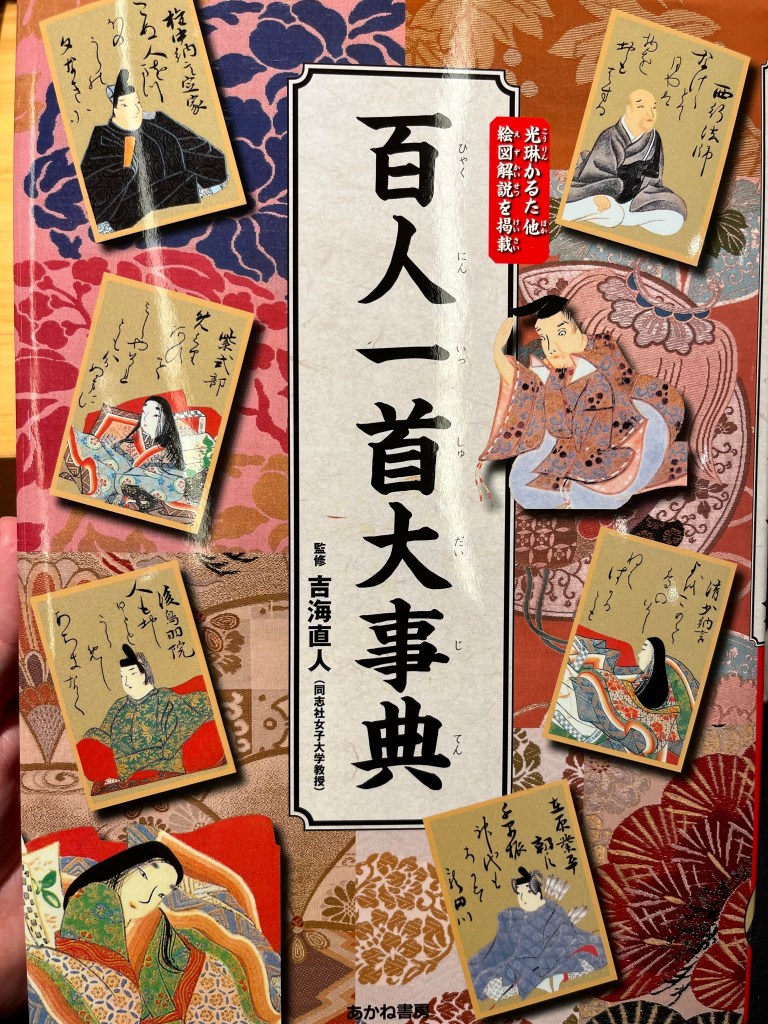
Separately, while at Kinokuniya though, my wife noticed this fascinating book (publisher’s link):

This is a comprehensive book (大辞典, daijiten) all about the Hyakunin Isshu. I like this book because it’s geared for younger audiences, so it’s easier to read, but it’s very comprehensive in detail about each poem, old vocabulary, famous places mentioned in the anthology and so on. I will likely be drawing on this book in the future.

One other interesting note about the book is that it does not present the poems in the usual numerical order, instead it sorts by topic (love, spring, autumn, etc) which is (coincidentially?) closer to how Waka poems were organized in official Imperial anthologies.

Anyhow, it’s been a very lucrative haul, and gives me plenty to admire and practice with. I have been busy memorizing poems of the Hyakunin Isshu over the past few weeks and will write more about how to accomplish that.

My First Karuta Purchase

I finally did it! I got my very own karuta set of the hyakunin isshu.

Since we came to Japan earlier this week (just ahead of snowy weather, no less), my original plan was to go to the famous karuta shop in Tokyo: Okuno Karuta.

However, since we are here primarily for family matters, we are here for a narrow window of time, and because it’s fairly deep in Tokyo (and thus far removed from my in-laws home), getting there is probably not feasible. Plans might change, but I don’t think I will be able to visit this time around.

On the other hand, at a local bookstore I found a really nice, affordable set!

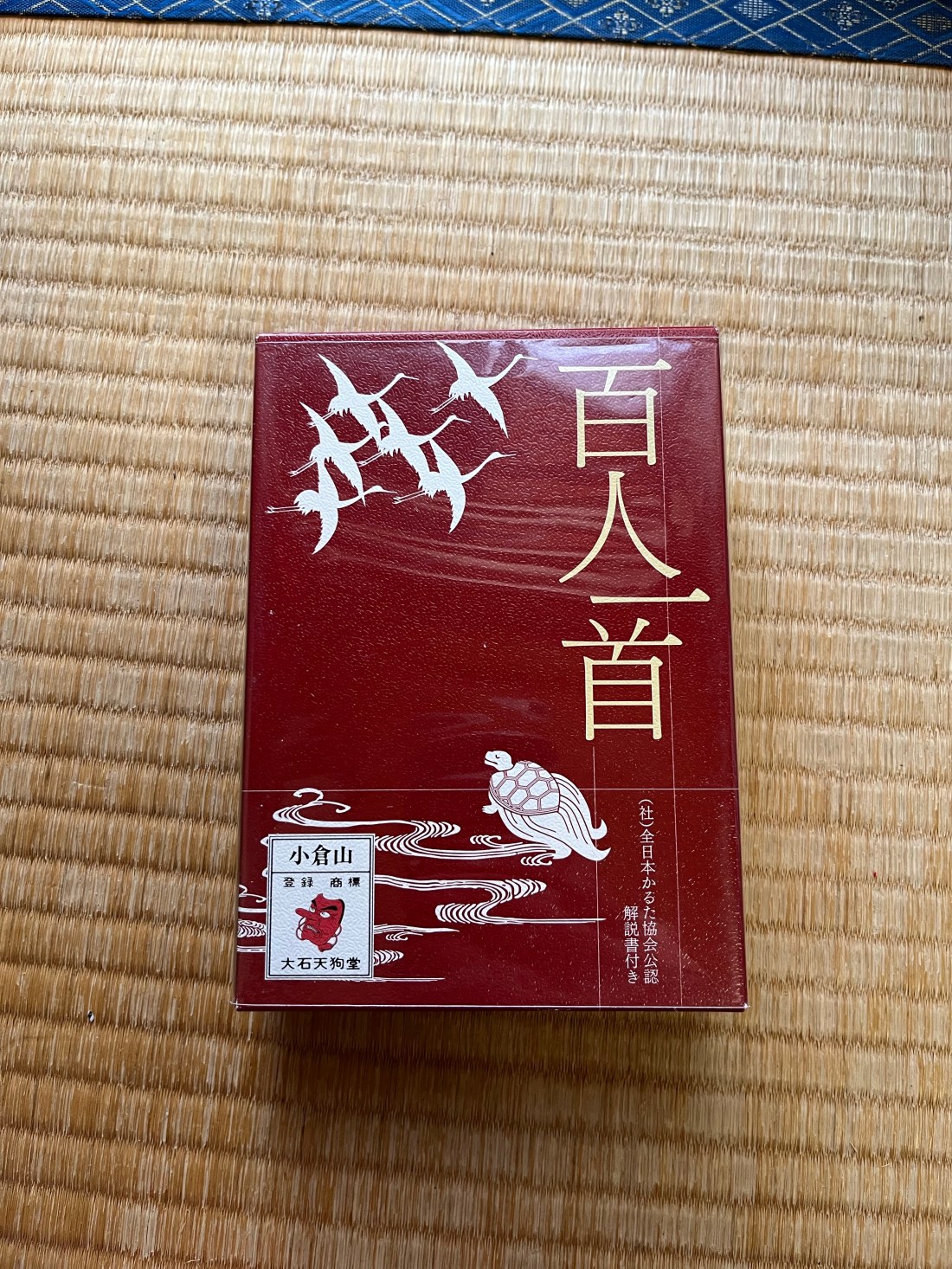
This set is made by Kyoto Tengu-dō, another famous karuta company. I love the box design. Inside, you can see the full set of yomifuda and torifuda cards:

As the product link shows, this set was designed for beginners to karuta games, and the torifuda cards (the ones without pictures) are written in a very legible font, so they’re easier to newcomers to find cards on the fly.

The illustrations are different than what I normally see on karuta cards, but I found out later that this is more typical of handicrafts from Kyoto, versus more Tokyo-style art. Also, the more I look at them, the more I appreciate the amazing detail, such as the clothing patterns, curtains, etc. It’s really fun just to flip through the cards and look.

This set cost me ¥1700, so about $12-15 (depending on exchange rate), which as a gorgeous starter set is quite good deal in my opinion.

Also, I suspect that this won’t be the last set I collect either. 😜

P.S. I had also thought about ordering from Okuno Karuta, but I can’t be sure it would arrive at my in-laws house in time due to holidays and our short schedule. Like I said, I am in no rush and will visit another time.