My progress in memorizing the Hyakunin Isshu poems, for the sake of learning to playkaruta, continues, but since returning to the US, it has taken some twists and turns.
When I got back home, it became clear how busy my day to day life is compared to Japan, where I didn’t have to worry about work commitments, and had fewer natural distractions from hobbies, projects, etc. So, my original strategy of learning one poem a day quickly unraveled.
Further, as the number of cards I memorized has grown (38 out of 100 as of writing), the effort to review them all has grown too. As the number grows even larger, it gets harder and harder to review all of them daily.
So, I started switching to a spaced-repetition style of learning to help manage the load. This means I focus more on the cards I still need to improve on, and focus less on the ones I know well, while still reviewing periodically. To accomplish this, I needed a way to not only organize my cards, but also manage the progress of each one.
I brushed off one of my old Legion brand deck boxes from when I used to actively play Magic the Gathering (yes, I am a giant nerd).
Inside, I used a few card dividers (some borrowed from other deck boxes) into sections. The section in the back represents cards that I know well and can recite with little or no effort. The section in the middle represents cards I am still struggling with. The section in the front is the “new” queue: cards I have yet to learn but have lined up next.
I mostly focus on the middle queue, since I am actively learning them, but not comfortable enough yet to move them to the “back” queue. I also review the back queue from time to time, and occasionally have to move cards from there to the middle queue in situations where I feel a poem needs a bit more active review. I also try to add a new card from the “front” queue every 1-2 days.
This process took some trial and error to get right, and it may not work for everyone, but it has helped me regain my pace in memorizing the Hyakunin Isshu after some interruptions after coming back to the States.
My original goal was to finish by end of April, and this is still possible, but I have lost some time and now I am hopeful I can memorize all one hundred poems by June.
While here in Japan for a couple weeks, I picked up my first karuta set of the Hyakunin Isshu at the local bookstore when I realized that getting to the more famous store was harder than I expected, and I just won’t be here long enough for local delivery.
However, my interest in the Hyakunin Isshu was not sated with a single set, and so, when the family I went to a local Kinokuniya bookstore (we have them in the US too), I found another set that I liked, shown above.
This set, by Silverback, linked here, is another set of karuta cards, but this one includes a CD of someone reciting the poems (読み手, yomité) just like in a karuta game. As you can see from the linked product description, this set has the cards color-coded. The illustrated cards (yomifuda) have a beige background, while the verses cards (torifuda) are blank white for easy searching.
When I got back home, I imported the CD into my iTunes playlist, so I can shuffle the album. That allows me to practice the karuta game since the next card read out loud will be random.
I can’t decide with of the two sets I like better. The artistic detail on the Kyoto set (the first purchase) is really quite amazing, while the character illustration on the Silverback set is more what I am familiar with. The CD the Silverback set is quite handy (and sounds very nice), while the box and presentation on the Kyoto set is more sturdy.
I suspect I will probably continue collecting sets over time. Each one is a work of art by itself. I also learned alot how and where to purchase karuta sets and will be updating my blog post about it as a result.
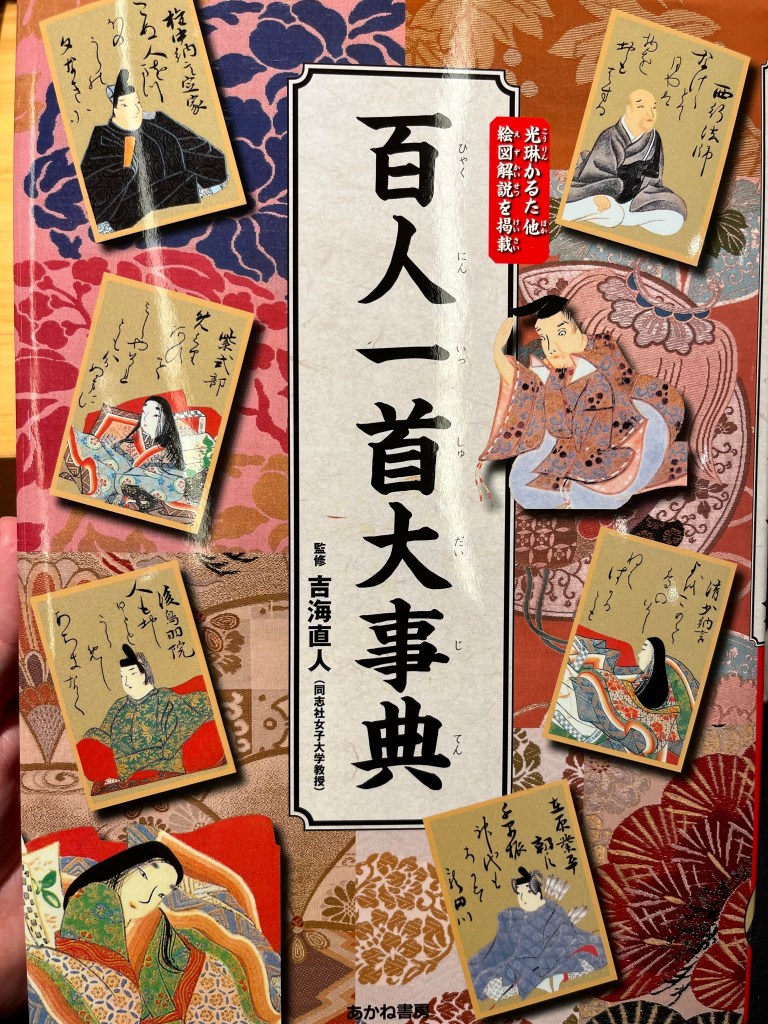
Separately, while at Kinokuniya though, my wife noticed this fascinating book (publisher’s link):
This is a comprehensive book (大辞典, daijiten) all about the Hyakunin Isshu. I like this book because it’s geared for younger audiences, so it’s easier to read, but it’s very comprehensive in detail about each poem, old vocabulary, famous places mentioned in the anthology and so on. I will likely be drawing on this book in the future.
One other interesting note about the book is that it does not present the poems in the usual numerical order, instead it sorts by topic (love, spring, autumn, etc) which is (coincidentially?) closer to how Waka poems were organized in official Imperial anthologies.
Anyhow, it’s been a very lucrative haul, and gives me plenty to admire and practice with. I have been busy memorizing poems of the Hyakunin Isshu over the past few weeks and will write more about how to accomplish that.
I finally did it! I got my very own karuta set of the hyakunin isshu.
Since we came to Japan earlier this week (just ahead of snowy weather, no less), my original plan was to go to the famous karuta shop in Tokyo: Okuno Karuta.
However, since we are here primarily for family matters, we are here for a narrow window of time, and because it’s fairly deep in Tokyo (and thus far removed from my in-laws home), getting there is probably not feasible. Plans might change, but I don’t think I will be able to visit this time around.
On the other hand, at a local bookstore I found a really nice, affordable set!
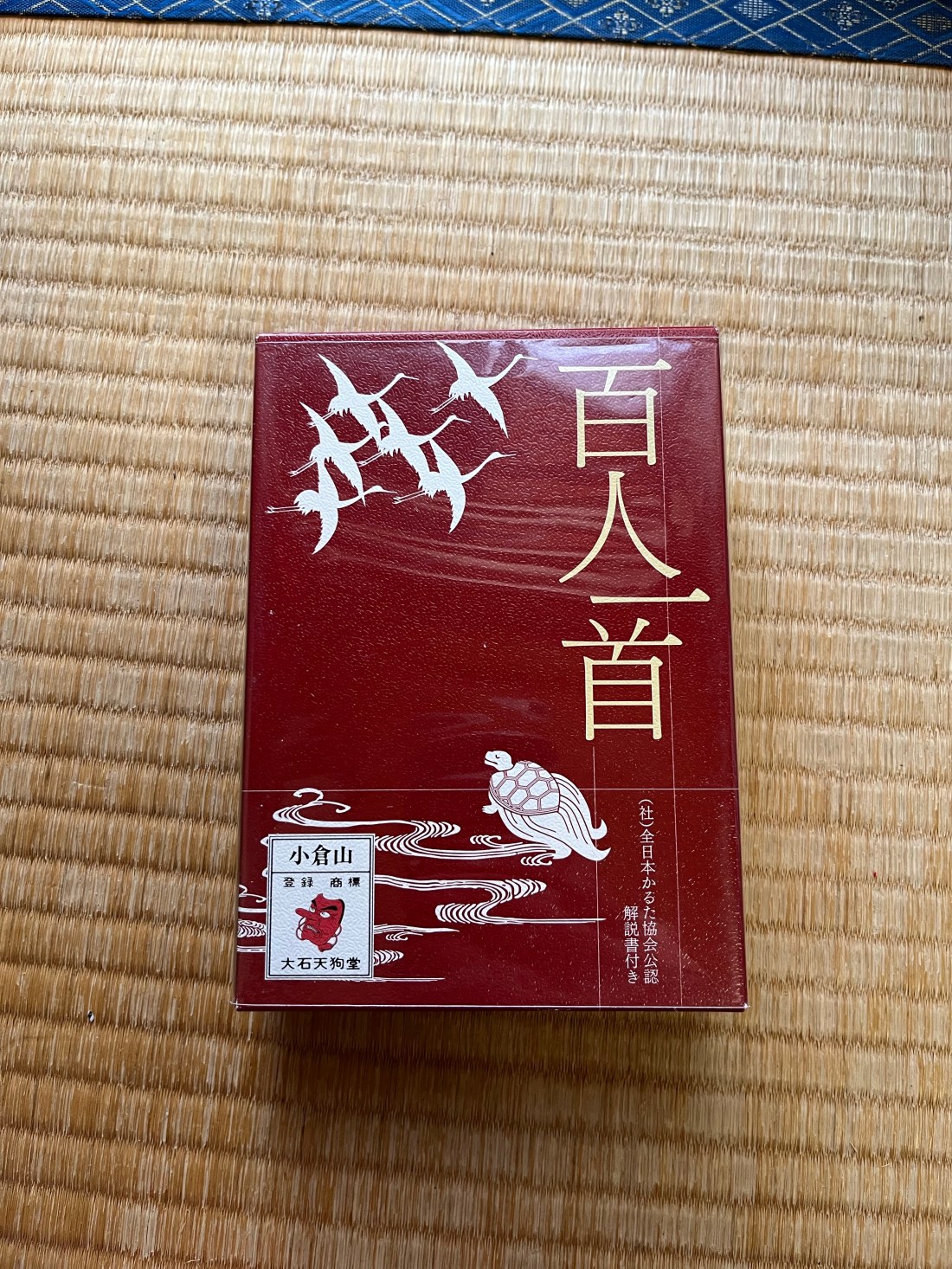
This set is made by Kyoto Tengu-dō, another famous karuta company. I love the box design. Inside, you can see the full set of yomifuda and torifuda cards:
As the product link shows, this set was designed for beginners to karuta games, and the torifuda cards (the ones without pictures) are written in a very legible font, so they’re easier to newcomers to find cards on the fly.
The illustrations are different than what I normally see on karuta cards, but I found out later that this is more typical of handicrafts from Kyoto, versus more Tokyo-style art. Also, the more I look at them, the more I appreciate the amazing detail, such as the clothing patterns, curtains, etc. It’s really fun just to flip through the cards and look.
This set cost me ¥1700, so about $12-15 (depending on exchange rate), which as a gorgeous starter set is quite good deal in my opinion.
Also, I suspect that this won’t be the last set I collect either. 😜
P.S. I had also thought about ordering from Okuno Karuta, but I can’t be sure it would arrive at my in-laws house in time due to holidays and our short schedule. Like I said, I am in no rush and will visit another time.
Since initially making this blog way back in 2011, I have learned that you can now find karuta competitions (競技かるた kyōgi karuta) online on the official Youtube channel!
Here’s a recent high school playoff competition in 2022 for men:
and ladies playoff competition:
As you can see, it’s a very formal, elegant affair, with traditional clothing, customs, etc. Good manners and sportsmanship are emphasized.
Hyakunin Isshu karuta sets, such as those used in games and competitions, are always divided by two sets of cards:
yomifuda (読み札) cards, illustrated cards with entire poem on them, and
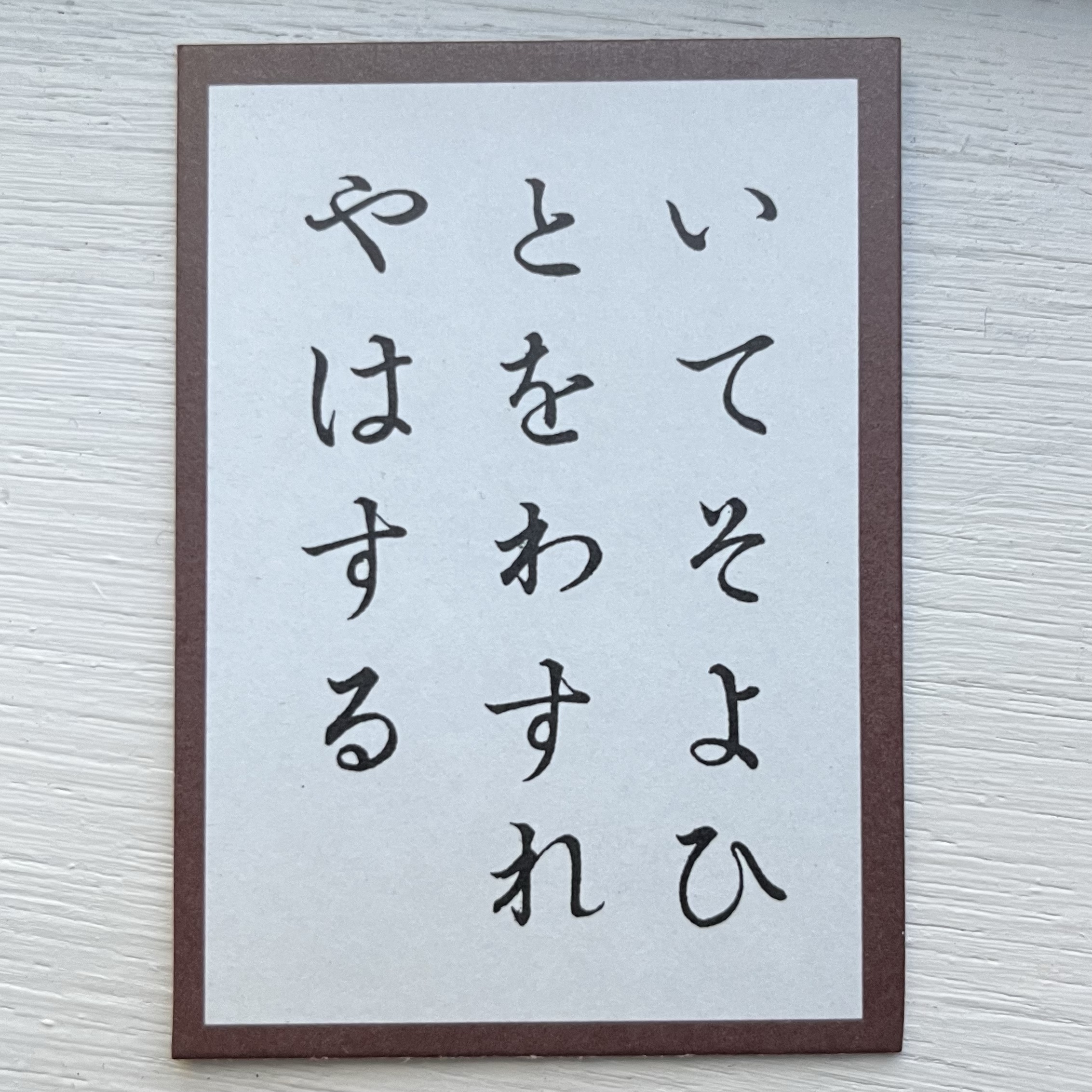
torifuda (取り札) cards that only contain the last only the last 2 verses. Illustrations below.
The yomifuda card for poem 58, with the last two verses circled in blue. These correspond to the matching torifuda card on the right.
The matching torifuda card with the last two verses. Torifuda cards are always written in simple hiragana script for easy reading.
I admit that I am still learning the rules, but the gist is that 50 of the 100 total torifuda cards are laid out in a set pattern of cards on the floor, half (25) of them on one player’s side, the other half (25) with the other player.
A diagram of the play field that I made using LibreOffice
The yomité (読手, “reciter”) reads a randomly select poem in full using the illustrated yomifuda cards above.
The yomifuda card for poem 58, from my wife’s karuta set.
The players have to wait until the first 3 verses are completed, then if the matching torifuda cards on the field (i.e. the last 2 verses of the poem), the players can try to take that card. Whoever touches it first wins that round, and the card is taken off the field. Usually, players will swat the card aside because it’s just faster and keeps the other player from touching it.
If the card had been on the opponent’s side (相手陣, aitejin), then not only is the card taken off the field, but you also select a card from your side (自陣, jijin), and send it over to their side. Usually the players will raise their hand to pause the match while they decide which card to send over. The end result is that the cards on your side are reduced by 1, the opponent’s remain unchanged. If the card you took was on your side, then your side is reduced by 1 anyway. No transfer needed. When watching the videos, the player will the lower number of cards is winning.
Side note, if the matching torifuda card was not on the board anyway, then it’s considered karafuda (空札, “empty card”), and the game moves onto the next round.
The player who removes all cards from their side is the winner.
Anyhow, it’s pretty interesting to watch, even if the competitions can take an hour or more. You can see how explosively fast the players are.
Finally, I’d like to give a shout out to groups such as the Boston Karuta Club and Seattle Karuta Club. They have plenty of helpful links in English on getting started with karuta, rules and training resources, among many other great resources!
Edit: Revamped this page in January 2023 with a lot more information, updated Google Maps links and so on.
Edit 2: Revamped again in August 2023 with even more information.
One of the best ways to appreciate and celebrate the Hyakunin Isshu anthology (besides reading and reciting the poetry) is to play the traditional card game called karuta. I’ve written about it here, here and here before, but for a long time I never owned a set. My wife, who is Japanese, owns a set from when she was young, complete with a cassette tape for reciting the poems, but I wanted to own my own set while respecting her property.
It turns out that purchasing a karuta set can be reallyeasy or somewhat hard, depending on whether you are in Japan or overseas. In Japan, they are easy to find in any local bookstore because kids in Japan often grow up learning the anthology and playing games (even if they lose interest later).
The good news is that you can get a set for relatively cheap (shipping might be pricey though) and there are plenty of good choices. A basic set, minus shipping, is about ¥1800 or $15 USD at current rates, while fancier sets get much more expensive.
This guide is to help folks who are interested in owning a karuta set navigate their options. If you are living outside of Japan, feel free to jump down to the “Purchasing Online” section.
In Tokyo
A while back, I found a good article on the Japan Times about a famous karuta store in Tokyo that has been selling karuta cards for 90 years named Okuno Karuta (奥野カルタ). This is the premiere place to go if you are in Tokyo, particularly in the Chiyoda Ward. You can find it here (Google Maps link):
According to their website they are:
3-min walk from Tokyo Metro Jimbocho Station, A4 exit. This is usually done using the Hanzomon train line.
The Jinbocho Station is the nearest one, and speaking from limited experience the Hanzomon Line is pretty easy to find and covers much of Tokyo.
I did contact Okuno Karuta about ordering online, and while they do have an online store, it usually only ships from within Japan. Your best bet is to simply visit the store in person, or plan to purchase online and ship to some place in Japan you can then pickup.
In Kyoto
If you are closer to the western half of Japan, or traveling through the Kyoto Area, there’s many great karuta shops to visit since it is essentially the home of the Hyakunin Isshu anthology.
My personal favorite is Tengudo (大石天狗堂), founded in 1800. This is the company that made the first karuta set that I purchased, and are located in the Fushimi ward of Kyoto (Google Maps link):
According to their website, the easiest ways to get there by train are:
Similar to Okuno Karuta, you can also order online, but it ships only within Japan.
Local Bookstores in Japan
Further, if you are in Japan, but not near Tokyo or Kyoto (as was my case in December 2022), you can also just visit any local bookstore and find karuta sets there. The selection can be more limited than a dedicated store. The first shop I went to had only one set, but Kinokuniya had several to choose from.
This is a nice middle-ground between big online sites like Amazon or Rakuten, and the smaller but hard to access mom-and-pop stores.
However, again, the shipping options will almost always be limited to Japan only.
Purchasing Online
And finally we come to the last, but most likely option: purchasing online.
If you can’t afford to go to Japan, and just want to get a set of Hyakunin Isshu cards for yourself, there are options for purchasing online.
If you only plan to play, and not read the cards, Tengu-do provides a minimal, tournament-standard set of torifuda cards, available on Amazon JP and Amazon US.1 English is available on Amazon JP.
The torifuda set from Tengu-do. It is a basic, no-nonsense set but still very nice.
But if you’re looking for a full set, maybe with a CD other things, Seattle Karuta Club has other helpful recommendations.
In some countries, Kinokuniya Bookstore has international online stores as well (example link for the USA) which can also ship karuta sets. The USA store can ship to Canada, USA and Mexico for example.
Finally, another option is proxy-buying. This is a niche option that lets you buy Japanese goods from smaller shops like Okuno Karuta or Tengudo, while still being accessible overseas. Japan Rabbit (formerly White Rabbit Express) is one such choice, Rakuten Global Express is another. I haven’t personally use either one, however.
If you go the Rakuten route, they usually have some English translations available, but it’s probably simplest to search for 百人一首カルタ to get accurate results, and then go from there.
Good luck and happy card hunting!
1 These Amazon links are “associate” links, so any purchases made through them give me a small amount of credit in the future.
Edit: you can read a more up to date and detailed post about how to play karutahere.
On a recent Saturday, my daughter, wife and I were stuck at home and a little bored, so we decided to play a little game. I took out a box of Hyakunin Isshu karuta or “cards” in Japanese my wife had since she was a young, and my daughter and I set them up. This is a game known in Japanese as uta-garuta or “poetry cards” featuring the Hyakunin Isshu. I’ve mentioned it before here and here. Usually, it’s played on or around Japanese New Year’s, but as the links above show, there are youth clubs devoted to it too as an extra-curricular activity. To play, you need minimum 3 people: one to read the poems, and the others to compete at collecting them.
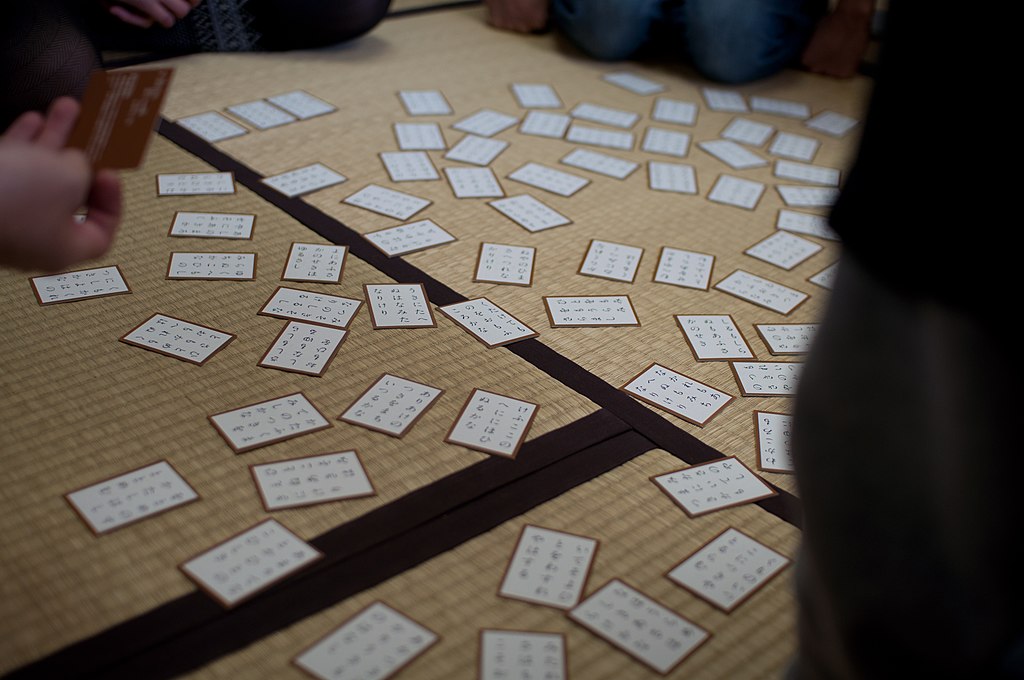
As you can see in the photo, the cards are all laid on a table. Those ones only have the last 2 verses of each poem, and no pictures, while someone “reads” a card from the other stack with pictures. This stack has the full poems plus pictures of each poet as you can see above. Here’s a photo for clarity:
The card on the left is the full poem, plus illustration, while the card on the right shows on the last 2 lines of verse.
Anyhow, as the reader recites the poem out loud, the other people try to find the card that matches the last half of the poem, hopefully before their opponent person does. Since my daughter is 5 years old, and Japanese is my second language, it was slow going, and there were only 2 of us playing. One of us would read the illustrated card awkwardly, and then we’d both try to find the one that had the last 2 verses of the same poem. It was fun, but took a little while, especially with 100 poems to wade through.
Later, my wife joined us. Since she’s a native Japanese speaker, she could recite the poems faster, freeing up my daughter and I to find the related card. Mommy and daughter teamed up together, but we all took turns reading cards so that my wife would have a chance too. By the end of the game, they won by a ratio of 2:1, but I am happy to still found some cards. 😉
It was my first time playing uta-garuta and we had a great time. If you are in Japan and/or can read Japanese well enough, you may want to pick up a deck yourself. They look great because of the illustrated cards, and are fun for a rainy afternoon. Especially if you 3 or more people, and one of them happens to be a native speaker.
P.S. Have been busy with other projects related to other blog, but hoping to get back into this one soon. My goal is to get to 50 poems or halfway in the near future.
One subject I haven’t covered here much is the subject of the Hyakunin Isshu is the karuta card-game. I’ve talked about it on my other blog, but I saw this recent article on the Asahi Shinbun newspaper and wanted to talk this one in particular.
As the article explains, the Hyakunin Isshu card-game is one of many extra-curricular activities in Japan for kids, though usually not as popular as sports or other activities. Still it has a small, venerable tradition, and like many school activities, it can be pretty competitive, but a great team-building activity.
I was surprised to hear about the new comic about this sport though, titled “Chihayafuru“, which is related to poem 17 in the Hyakunin Isshu (the opening line), which also happens to be a famous pillow word too. I was thinking it might be interesting to read, except the cover implies that it’s a young ladies novel, and I am too old, and too much of a male neanderthal for that kind of thing. 😉






 The Hyakunin Isshu
