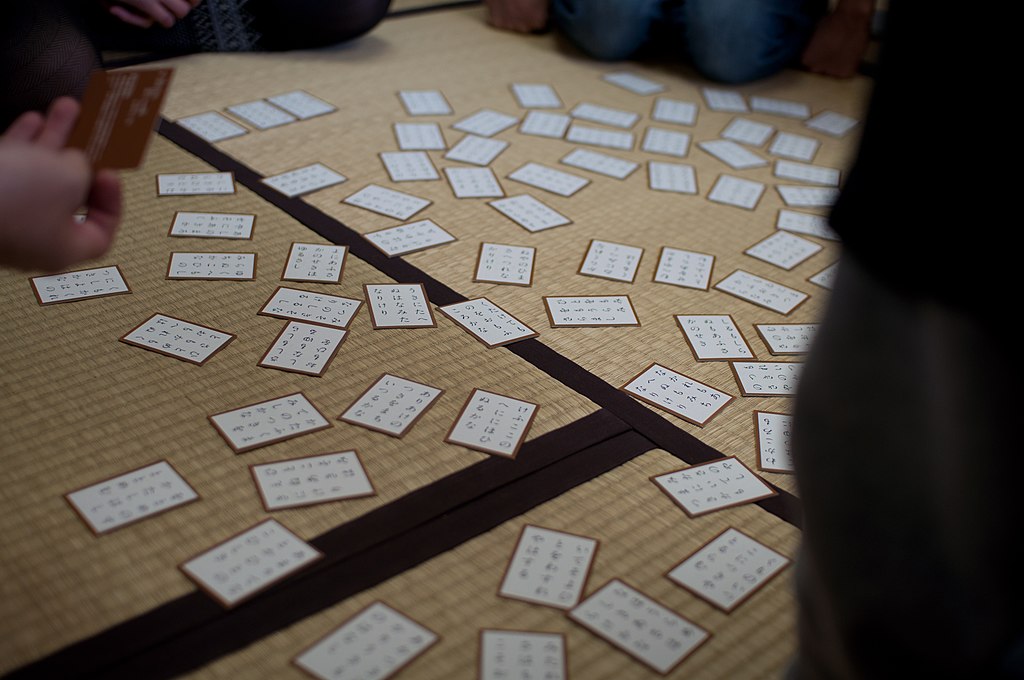
One subject I haven’t covered here much is the subject of the Hyakunin Isshu is the karuta card-game. I’ve talked about it on my other blog, but I saw this recent article on the Asahi Shinbun newspaper and wanted to talk this one in particular.
As the article explains, the Hyakunin Isshu card-game is one of many extra-curricular activities in Japan for kids, though usually not as popular as sports or other activities. Still it has a small, venerable tradition, and like many school activities, it can be pretty competitive, but a great team-building activity.
I was surprised to hear about the new comic about this sport though, titled “Chihayafuru“, which is related to poem 17 in the Hyakunin Isshu (the opening line), which also happens to be a famous pillow word too. I was thinking it might be interesting to read, except the cover implies that it’s a young ladies novel, and I am too old, and too much of a male neanderthal for that kind of thing. 😉
In our last episode, we talked about a famous poetry contest in 960 which pitted two excellent poems against one another. For fans of the anime Chihayafuru, this contest is also mentioned in season one episode 23. Poem 40 by Taira no Kanemori was judged the winner, and this poem was the loser, though only just barely:
The author Mibu no Tadami (壬生忠見, dates unknown), son of Mibu no Tadamine (poem 30) was not a high-ranking or successful member of the Court. It is said that Tadami often appeared in provincial clothes and behaved like a country bumpkin. Even so, like his father, his skills as a poet earned him acclaim. Thus he was included among the Thirty Six Immortals of Poetry.
Mostow points out that even though the poem won 2nd place, it has been highly prized throughout the ages, just as poem 40 has been. According to my new book, what made this poem so prized is the way it inverts things between the upper verses (unrequited love) and lower verses (I have to hide it anyway from public eye). The ni keri in the third verse is an archaic way of expressing regret (poem 40 uses it too), or grumbling.
Mibu no Tadami was said to be so distraught over losing the contest that he wasted away and died, though this story may not have actually happened. Mostow points out that additional poems by the author in later collections, suggest that he was alive and active for many years to come. Nonetheless, although the story of Tadami’s death is a fabrication, it is likely, given his prospects, that Tadami was bitter over the loss.
According to Mostow’s book, this poem by Taira no Kanemori (平兼盛, ? – 990) was part of a famous poetry contest in 960, and was pitted against Mibu no Tadami (poem 41). Both were recited under the theme of hidden love. For fans of the anime Chihayafuru, this contest is also mentioned in season one episode 23.
The judges couldn’t decide which poem was the winner, so after consulting with other poetry experts (who also couldn’t decide), they came before Emperor Murakami and sought his opinion about which poem was superior. According to the story, the Emperor hummed to himself the verses from this poem under his breath, tactfully judging Taira no Kanemori’s poem the winner.
My new book points out that what makes this poem highly prized (along with Tadami’s poem) is the excellent use of prose. It isn’t just that the character is hiding love, but that it’s become painfully obvious to everyone around them, and they are compelled to ask. The ni keri in the second verse is an archaic way of expressing regret (poem 41 uses it too), or grumbling so it has a natural sound to it. Mostow’s opinion agrees with the excellent style, mixed with a more natural style at the end. Anyone who’s been secretly in love before can certainly sympathize.
Taira no Kanemori is also one of the Thirty-Six Immortals of Poetry (sanjūrokkasen, 三十六歌仙), and was friends with Egyo Hoshi (poem 47). According to my new book, there is a theory that his daughter is Akazomé Emon (poem 59). He had divorced Emon’s mother, but she was already pregnant. Further, after she remarried and gave birth to Emon, Kanemori petitioned to have parental rights but ultimately failed.
The Taira Clan or Heike (平家), which Kanemori belongs, was not particular powerful at this time, but would later dominate Japanese politics centuries later under Taira no Kiyomori, only to be tragically swept aside in the disastrous Genpei War by their rivals, the Minamoto.
The author, Fujiwara no Okikaze (藤原興風, dates unknown), was one of the Thirty-Six Immortals of Poetry according to Mostow, but few other details about his life are known. He is the great-grandson of nobleman Fujiwara no Hamanari, and is thought to have lived around the same time as Kii no Tsurayuki (poem 35) and Kii no Tomonari (poem 33).
Takasago is a famous city on Harima Bay in Japan, in what is now modern-day Hyōgo Prefecture. Since antiquity, Takasago was famous known for its pine forests. The featured photo above is a sacred pine tree at Takasago Shrine (photo by 弥, Public domain, via Wikimedia Commons). Takasago is also mentioned in poem 71. The most famous sacred pine tree at Takasago Shrine is the Aioi no Matsu (相生の松), which has been growing since the temple’s foundation. The pine trunk splits into two, and thus has become a symbol of marital harmony between husband and wife.
Further, my new book states that Takasago was such a iconic place, associations were often drawn between it and Sumi-no-e Bay (poem 18), with Sumi-no-e being the “husband” and Takasago the “wife”.
Even so, this poem takes as different turn and reflects on the loneliness of growing older. Given that Fujiwara no Teika (poem 97) was 79 at the time of compiling the Hyakunin Isshu, perhaps he felt a sense of kindred spirits when selecting this poem?



 The Hyakunin Isshu

