Heavenly Maidens: Poem Number 12

Speaking of moments that we don’t want to end, I thought this poem was an interesting read, and is also one of the more famous ones:

JapaneseRomanizationTranslation
あまつ風Ama tsu kazeO heavenly breeze,
雲のかよKumo no kayoijiblow so as to block
吹きとFuki toji yotheir path back through
the clouds!
とめの姿Otome no sugataFor I would, if but for a moment,
しばしとどめShibashi todomendetain these maidens’ forms.
Translation by Dr Joshua Mostow

This poem was composed by Sōjō Henjō, (僧正遍昭, 816 – 890), “Bishop Henjo”, who served in the Heian Court until the death of Emperor Nimmyo. It was then that he took tonsure as a Buddhist priest. He is one of the original Six Immortals of Poetry as well as the Thirty-Six Immortals.

The poem was composed during the time that Henjo was in the service of the Emperor (and not yet a priest). The occasion for this was the famous Gosechi Dance or gosechi no mai (五節の舞), more formally known as the toyono akari no sechi-é (豊明の節会), a dance that took place in the Imperial Court during the middle of the eleventh month of the old Japanese calendar (roughly December in modern times) to celebrate the harvest.

During the final months of the year, the Imperial Court held several important events to celebrate the yearly harvest, starting with the niiname no matsuri (新嘗祭) when the Emperor would offer part of the harvest to the gods.1 The following day, the Court would celebrate the Gosechi dance at the Shishinden Palace, and the Emperor would partake of the new harvested rice. According to Richard Bowring, the Gosechi festivities last up to four days.

The Gosechi dance involved 4 “heavenly” maidens called otomé (をとめ) from high-ranking noble families, and is mentioned by several authors from the era, including Sei Shonagon (poem 62) in the Pillow Book:

[87] At the time of the Gosechi Festival somehow everything in the palace, even the people you see every day, becomes simply delightful. There’s the unusual sight of the bits of coloured fabric that the groundswomen wear in their ceremonial hair combs, rather like abstinence tags. When they seat themselves along the arched bridgeway from the Senyōden, the dapple-dye pattern on the ribbons that bind up their hair stands out beautifully, and the whole effect is somehow quite marvelous. It’s perfectly understandable that the serving women and those who attend the dancers should find it all a splendid honour.

trans. Meredith McKinney

And from the eponymous diary of Lady Murasaki (poem 57):

The Gosechi dancers arrived on the twentieth….I knew full well how hard the young dancers had prepared this year in comparison to normal years when things were worse it must have been for them this year, I thought; I was both apprehensive and eager to see them. As they fully stepped forward together I was, for some reason, overcome with emotion and felt dreadfully sorry for them….And with all those young nobles around and the girls not allowed so much as a fan to hide behind in broad daylight, I felt somehow concerned for them, convinced that, although they may have been able to deal with the situation both in terms of rank and intelligence, they must surely have found the pressures of constant rivalry daunting; silly of me, perhaps. (pg. 39-40)

trans. Richard Bowring

Further, even artwork depicts the Gosechi as shown by the featured photo, painted by Hokusai.

Even now, the Gosechi dance is still performed for the Emperor, at least for special occasions:
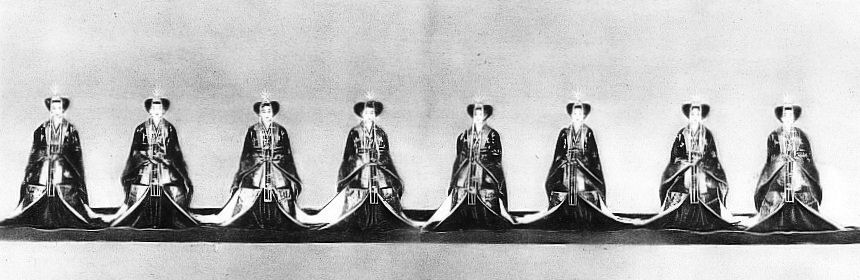
Dancers of the Gosechi dance performed in 1928, for the ascension of the Showa Emperor. See page for author, Public domain, via Wikimedia Commons

But I digress, Henjo was so mesmerized by their dance, he compared them with heavenly maidens, and hoped that the breeze would keep them on the earth a bit longer. As Professor Mostow notes, the Gosechi dance had a legendary origin involving Emperor Temmu who beheld heavenly maidens in the sky one night, so Bishop Henjo isn’t just making this up.

However, his playful simile has lasted through the ages.

1 This is still observed today in the form of Labor Day in Japan.

No Refuge In This World: Poem Number 83

This is a well-known poem in the Hyakunin Isshu, and I felt worth posting here:

JapaneseRomanizationTranslation
世の中よYo no naka yoWithin this world
道こそなけれMichi koso nakerethere is, indeed, no path!
入るOmoi iruEven deep in this mountains
山の奥にもYama no oku ni moI have entered, heart set,
鹿ぞ鳴くなるShika zo naku naruI seem to hear the deer cry!
Translation by Dr Joshua Mostow

The author, Kōtai Gōgū no Daibu Toshinari (皇太后宮大夫俊成, 1114 – 1204), or “Master of the Grand Empress’s Palace, Shunzei”. He is also known as Fujiwara no Shunzei, or Fujiwara no Toshinari (俊成 can be read either way), the father of Fujiwara no Teika . Additionally, a surprising number of other poets in the Hyakunin Isshu were associated with (poem 81, 86 and 87), studied under Shunzei (poem 89 and 98), or were directly in opposition to him (poem 79). Shunzei is probably the second most important person in the Hyakunin Isshu after his son of course. 😏

This poem is both moving and technically strong. For example, according to Mostow, the phrase omoi iru is a “pivot word”, meaning that both the words before and after hinge on its double meanings: omoi-iru “to set one’s heart on” and iru “to enter”.

Again, as Mostow explains, the poem generates quite a bit of debate because it’s not clear what concerned him so much. Was it melancholy, a sense of his mortality, or was the state of society at the time (i.e. the decline of the Heian Period)?

Speaking of a deer’s cry, I found this video one of the famous “Nara deer”:

The Nara deer are more domesticated versions of the wild deer in Japan, but it gives you an idea what Shunzei must have heard deep in the woods 900 years ago.

P.S. See poem 5 for something similar.

Contentment: Poem Number 8

An early poem by an obscure and mysterious figure:

JapaneseRomanizationTranslations
わがいWaga io waMy hut is to
都のたつみMiyako no tatsumithe capital’s southeast
しかぞすむShika zo sumuand thus I live. But
世をう山とYo wo ujiyama topeople call it “Uji, hill
人はいなりhito wa iu nariof one weary of the world,” I hear.
Translation by Dr Joshua Mostow

The poem was composed by a Buddhist monk named Kisen Hōshi (喜撰法師, dates unknown), in English lit. “Dharma master Kisen”. Kisen Hōshi lived in the mid-9th century, and this is the only poem known to be his, though others may exist. He is considered one of the original Six Immortals of Poetry and is mentioned in the preface of the official anthology, the kokin wakashū.

The location is a place called ujiyama (宇治山), located on the Tatsumi region southeast of Kyoto, which in turn is named after the twelve animals of the Chinese zodiac. In this context, tatsumi (辰巳) meaning literally “dragon-snake” refers to the direction (southeast) relative to the capitol of Kyoto, then Heian-kyō.

Due to word-play of “uji” meaning either 宇治 (“uji”) or 喜し[つらい] (“ushi[tsurai]”), this place was associated with sorry or grief, so few poeple chose to live here. Since that time, it has been renamed in honor of its resident and is now called kisenzan (喜撰山). Someone did a really nice write-up on their visit to Kisen-zan with photos and a view of what is purported to be Kisen’s original hut. Also, the famous Buddhist temple of Byōdōin also can be found there. It was located south of the capital at the time, Kyoto.

The poem is a tricky one and lends itself to two possible interpretations according to Professor Mostow. One interpretation has been that Kisen came there out of grief and weariness of the world, and made it his home. Mostow provides evidence that instead, Kisen lived there contentedly, and only heard from others that it was called brief mountain.

As there is a Buddhist tradition since the time of the Buddha to withdraw from the entanglement of the world, and find peace of mind. This tradition has led to the Buddhist monastic community that exists today in various parts of the world. Kisen is one of many who sought solace in places like Ujiyama. Question is, did he find only sorrow, or did he find contentedness?

Maybe only Kisen will ever know that.

Summer is Back: Poem Number 81

As spring turns into summer, I thought this poem seemed really appropriate and a great topic for discussion:

JapaneseRomanizationTranslation
ほととぎすHototogisuThe hototogisu:
鳴きつる方をNakitsuru kata wowhen I gaze out towards where
ながむればNagamurebahe was singing,
ただ有明のTada ariake noall that remains is the moon,
月ぞ残れるTsuki zo nokorerupale in the morning sky.
Translation by Dr Joshua Mostow

This poem was composed by Gotokudaiji no Sadaijin (後徳大寺左大臣, 1139 – 1191), the “Later Tokudaiji Minister of the Left Sanesada”. His personal name was Fujiwara no Sanesada, and he was the first cousin of Fujiwara no Teika (poem 97), as well as the nephew of Shunzei (poem 83). He left behind an extensive poetry collection as well as his personal diary.

According to Professor Mostow, the poem was composed on the topic of staying up all night, to hear one cry.

The hototogisu (ホトトギス), is called the “lesser cuckoo” in English, or, is Cuculus poliocephalus. The featured photo was taken by Kunming Institute of Botany. Sun Jiao (Interaccoonale), CC BY 4.0, via Wikimedia Commons.

The hototogisu in Japan is a famous bird known for its early summer call, and is thus an emblematic bird of the season. Compare with the plover in poem 78.

You can see a video of its call below:

According to the Hyakunin Isshu Daijiten, the hototogisu is an elusive bird. It flies from branch to branch often, so by the time you hear its distinctive call, it probably has flown elsewhere. Hence, they are easy to hear, but hard for birdwatchers to observe.

In any case, as Professor Mostow explains, the author is waiting all night to hear the first call of the hototogisu as the first sign of summer.

One other note is the term 有明 (ariake), which is one of many poetic terms for the moon. Specifically it means the moon that remains in the morning, after daybreak. This normally occurs on the 16th day of the lunar cycle according to the old Japanese calendar.

P.S. Like the title, I’m back too. 😉