Poem 45 of the Ise Stories is an unusual anecdote, and includes some great poetry about summer. According to the story, there was a young woman who was hopelessly in love with someone (probably the protagonist of the Ise Stories, it is unclear), but she endured this unrequited love alone. In time, she fell very ill, and confessed to her parents her love for the young man. The parents called the young man over, but by the time he arrived, she had already passed away.
That evening, during the hot days of summer, the young man watched fireflies rise from the grasses, and recited these poems:
I admit the idea that a young maiden pining for someone so much that she falls ill and dies feels more like a trope than reality (“girl, he’s just not that into you”). But, it should be noted that this was an era in Japan when death was seen as ritual pollution, so it’s noteworthy that he came nonetheless.
But also, there is another connection here: the summer tradition of Obon. Obon in Japan, roughly around July to August, is similar to the Mexican tradition of the Day of the Dead, and has Buddhist origins. Hence, the first poem and its symbolism of fireflies, can also be seen as the souls of the recent dead flitting in the summer night.
Recently, I finally finished my book on the Manyoshu. I can’t read Japanese fast, so it took me a year to finish, but it was satisfying to finish an adult-level book in another language, even if I relied heavily on dictionaries. I learned a lot! I hope you enjoyed some of the related posts here too.
Anyhow, the end of the book explored some miscellaneous poems, and this one really stood out to me for its Buddhist theme, and the unusual format. This is poem 3852:
Original Manyogana
Modern Japanese
Romanization
Rough Translation
鯨魚取
鯨魚取り
Isanatori
While fishing, I wonder
海哉死為流
海や死にする
Umi ya shinisuru
if the seas will die,
山哉死為流
山や死にする
Yama ya shinisuru
and the mountains die
死許曽
死ぬれこそ
Shinure koso
They will surely die
海者潮干而
海は潮干て
Umi wa shiohite
for the tides recede,
山者枯為礼
山は枯れすれ
Yama wa karesure
and the mountains wither.
This poem is a rare example of a Japanese sedōka-style ( 旋頭歌 ) poem, which has 5-7-7-5-7-7 syllables. Compare this to the later waka style poem of the Hyakunin Isshu (and the vast majority of the poems in this blog) which are 5-7-5-7-7, and haiku which are 5-7-5. Sedoka poems are an early stage of Japanese poetry that wasn’t used much beyond that as Waka (then later Haiku) became more popular.
Still, this poem is quite interesting. In fact, it was used in a famous Japanese pop song a few generations ago.
Nonetheless, the Buddhist themes of impermanence are hard to miss here, even with my amateur translating skills. The poet asks if even the seas and mountains will wither and die, and indeed, since the tides come in and out, and the mountains dry up (during the summer?), this can only mean “yes”, they won’t last forever.
Similarly, there is another Buddhist poem in the Manyoshu worth looking at:
The two oceans maybe an allusion that mirrors Shandao’s Parable of the Two Rivers (in my other blog), or the general Japanese-Buddhist concept of Ohigan. We also see the theme of mountains drying up, and seas receding again.
But if you thought this was vague, poem 3850 is even more straightforward in its meaning:
This poem alludes to another place, which again can mean the world of peace or enlightenment, or allude to the notion of a Buddha’s Pure Land. It doesn’t specify which Buddha (Amida, Shakyamuni, etc), but I am inclined toward this latter interpretation. I suppose it doesn’t really matter. The sentiment is the same: this world is impermanent and troublesome, and the author longs for something better, but is unsure of the path to follow.
I think we can all empathize with this at some point in our lives…
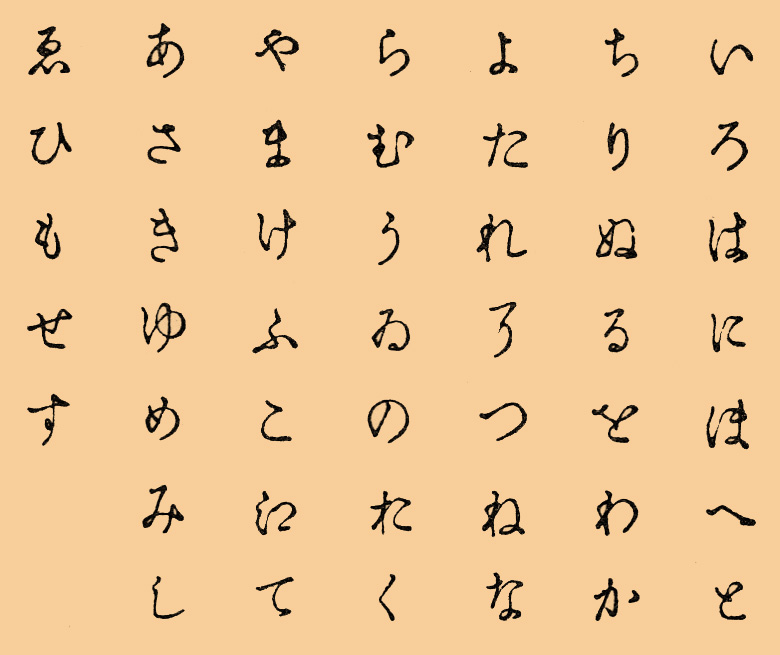
One of the most famous waka poems across Japanese history and even contemporary culture is a poem called the Iroha. The name “iroha” comes from the first three letters of the poem “i”, “ro” and “ha”. What makes this poem famous is that it uses each hiragana syllable exactly once, and still makes an intelligible, not to mention lovely, poem.
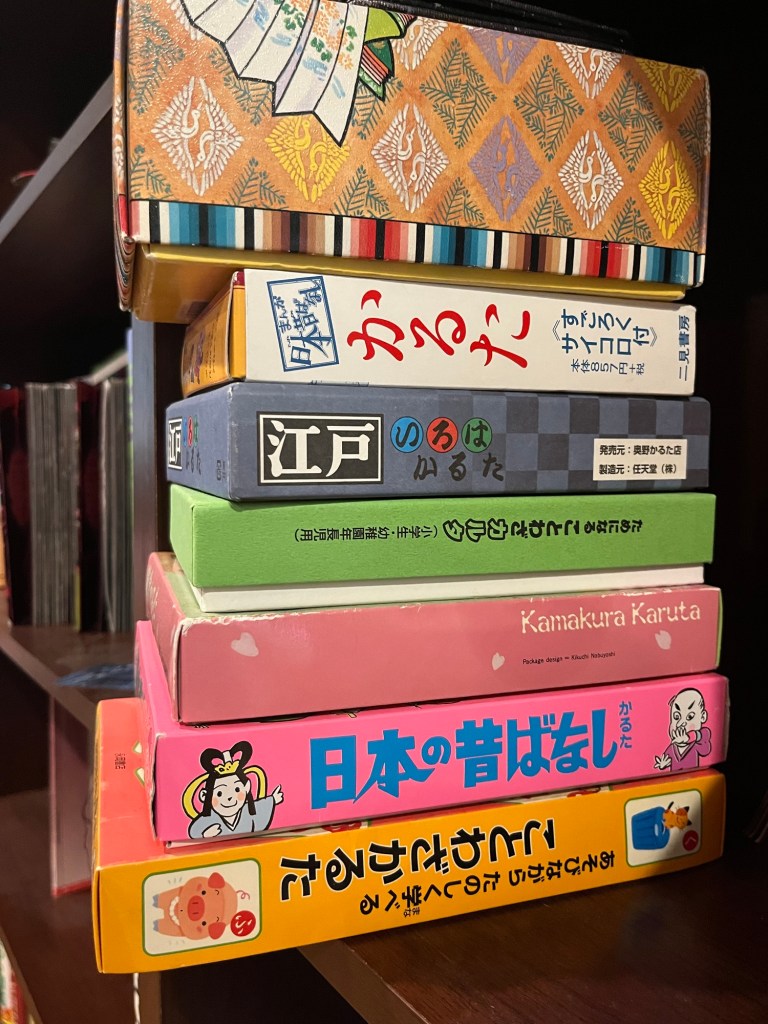
Because of this, it was often used in pre-industrial Japan as a way to organize things. Theater rows would be organized by the order in the Iroha letters, and so were firefighter brigades in pre-modern Tokyo (a.k.a. Edo). Even modern karuta sets are organized by iroha order. I don’t mean the Hyakunin Isshu karuta that I often discuss in the blog, but more informal karuta games that kids often play. We have a few sets here at home, given to us by my in-laws for the grandkids. You can see a nice selection of Iroha karuta sets on the Okuno Karuta online store, too.a
Various karuta sets my in-laws in Japan sent us. The top one is my wife’s original Hyakunin Isshu she had from grade-school.
But I digress.
The Iroha poem’s author is unknown (more on that later), but it was originally composed in old Manyogana script, like other poems of the early Manyoshu anthology, then later in hiragana. It includes many old spellings, so it’s a bit hard to render in modern Japanese.
The poem is as follows:
Manyogana
Modern Japanese
Romanization
Translation1
以呂波耳本部止
いろはにほへと
I ro ha ni ho he to
Even the blossoming flowers
千利奴流乎和加
ちりぬるをわか
chi ri nu ru o wa ka
will eventually scatter
餘多連曽津祢那
よたれそつねな
yo ta re so tsu ne na
Who in this world shall
良牟有為能於久
らむうゐのおく
ra mu u i no o ku
remain unchanged? Let us today2
耶万計不己衣天
やまけふこえて
ya ma kyo (ke fu) ko e te
cross the mountains of impermanence
阿佐伎喩女美之
あさきゆめみし
a sa ki yu me mi shi
and no longer have superficial
恵比毛勢須
ゑひもせす
e hi mo se su
dreams, nor be deluded
1 adapted translation from Wikipedia, plus a few modifications of my own 2 有為 (u i) meaning “viccisitudes of life” or the impermanence of all phenomena
This poem has strong Buddhist allusions to such concepts as samsara (“the aimless wandering lifetime after lifetime”), the delusions that bindus to this existence, awakening to these delusions (e.g. “enlightenment”), and finally nirvana (“unbinding”). The poem itself shows considerable familiarity with earlier Buddhist texts such as the Perfection of Wisdom sutras, including the Heart Sutra, as well.
But I digress. Again. 😅
There are some really interesting aspects of this poem that are worth sharing. First, authorship. Given the strongly Buddhist undertones of the poem, it’s often been attributed to a famous Buddhist monk named Kukai (a.k.a. Kobo Daishi) who was a talented poet and calligrapher. Another theory states that this poem may attributed to none other than the famous court poet Kakinomoto no Hitomaro, who composed poem 3 in the Hyakunin Isshu (あしびきの).
But things get even more interesting.
Scholars have noted that if you take the last syllable of each line (highlighted above for convenience) it spells another sentence: toka (ga) nakute shisu (咎[が]無くて死す) meaning “he/she died without fault or blemish”. Another theory, mentioned in my new book, points out that the 5th column spells out ho(n) wo tsu no ko me (本を津の小女), which could mean “deliver this book to my wife in the town of Tsu”, which if taken together with the 7th column implies that “I will die without blemish, please deliver this poem to my wife”.
So, is the poem a tribute to someone else? Perhaps Kukai or Hitomaro? If so, then who wrote it, and why? Was the poem a coded message to someone who was executed for political reasons? Or was the poem simply an attempt at word-play?
We will never know, but the impact of the Iroha on Japanese poem can still be easily seen today.
a Although things like Chihayafuru and this blog tend to emphasize the competitive karuta of the Hyakunin Isshu, in reality that’s only a small subset of karuta gaming culture. Most of it is much more informal stuff you play at home with family, much like board games in Western culture, and often times doesn’t even relate to the Hyakunin Isshu. Maybe I’ll post about it some time, but thanks to grandparents in Japan, we have 4-5 sets here ranging from such subjects as places in the city of Kamakura, old folks-sayings, Japanese fairy-tales, and just really basic words in Japanese. Most of these list the cards using iroha-order, and are not related to the Hyakunin Isshu. We’ve played them with our kids from time to time, and they’re much easier than competitive karuta, though it’s still assumed you know at least some basic Japanese.
In a lesser-known Imperial poetry anthology called the Shui Wakashu (拾遺和歌集), poem 1342, is recorded what is believed to be Lady Izumi’s1 final poem:
Japanese
Romanization
Translation
暗きより
Kuraki yori
The way I must enter
暗き道にぞ
Kuraki michi ni zo
leads through darkness to darkness —
入りぬべき
Irinu beki
O moon above the mountains’ rim
はるかに照らせ
Haruka ni terase
please shine a little further
山の端の月
Yama no wa no tsuki
on my path.
Translation by Jane Hirshfield and Mariko Aratani in “The Ink Dark Moon“
This poem was addressed to a Buddhist monk named “Shoku” and includes several Buddhist allusions. The most important is the phrase “darkness to darkness”, which comes from chapter seven of the Lotus Sutra:
….from darkness they [living beings] enter into darkness, to the end never hearing the Buddha’s name [hear the Dharma].
This refers to the Buddhist notion of Samsara, the near-infinite, aimless wandering that living beings undergo lifetime after lifetime, like a cosmic rat race. Such beings, who have yet to hear the Dharma [the teachings] of the Buddha, will continue to wander lifetime after lifetime without rest.
Thus, Lady Izumi is asking Shoku to help shine a light in the darkness for her, so that she may find the way [follow the Buddhist path].
I had trouble deciding which blog to put this in, since it covers both themes, but I decided to post here since the poem was introduced in the new historical drama about Lady Murasaki, Izumi’s contemporary.
Lady Izumi was, to put it mildly, a complex woman. She had incredible talent, and found herself in one scandal3 after another as powerful men fell at her feet, plus she earned scorn from other women such as Lady Murasaki. And yet, she was also very kind, devout and struggled to balance both the religious and worldly aspects of her life, while raising her orphaned granddaughter.
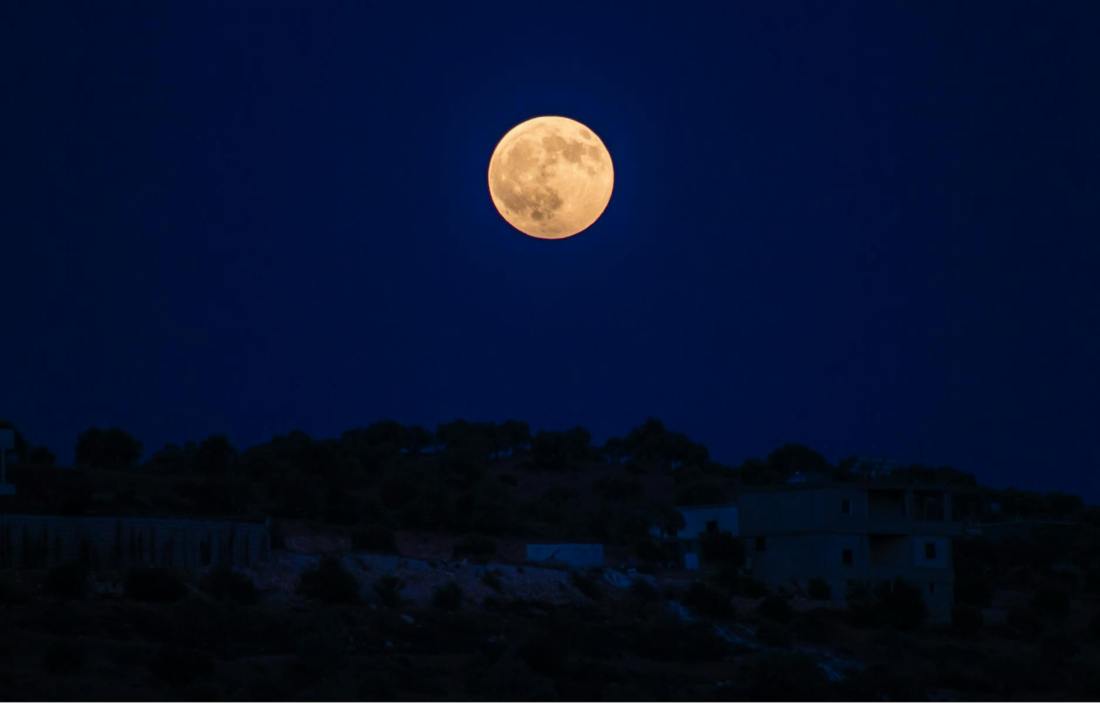
Hirshfield and Aratani note that if this poem is indeed her last, the final word she ever wrote was tsuki (月), “moon”.
2 alternate translation by Murano reads: …they go from darkness to darkness, and do not hear of the names of the Buddhas.
3 this was a conservative, narrow, aristocratic society where men frequently had affairs, but it was much more scandalous if women did. The idea that women could want, and enjoy sex, was not something people really accepted at the time.
I’ve written before about Empress Teishi, the ill-fated first wife of Emperor Ichijō, and patron of Sei Shonagon who wrote poem 62 of the Hyakunin Isshu (よを). Her family lost a power-struggle to a rival faction of the Fujiwara clan, and under pressure Ichijō took a second wife from the winning faction: Empress Shoshi. Teishi was sidelined, and although she did give birth to an heir, she soon died from illness and presumably humiliation and stress.
While watching the historical drama about Lady Murasaki, it showed Teishi’s untimely death, and revealed that she had left a final deathbed poem to her beloved husband. The poem really exists and is actually recorded in an imperial anthology, the lesser-known Goshūishū (後拾遺), number 536:
Japanese
Romanization
Rough Translation
夜もすがら
Yo mo sugura
If you should remember
契りしことを
Chigirishi koto wo
that vow we made
忘れずは
Wasurezu wa
in the deep of night,
恋ひむ涙の
Koimu namida no
then I long to see
色ぞゆかしき
Iro zo yukashiki
the color of your tears…
In the drama, Emperor Ichijo and Teishi are portrayed as being sincerely in love, yet ultimately they are a victim of politics and forced apart more and more over time. The vow alluded to here was portrayed in the drama as a promise by Emperor Ichijo to always love Teishi no matter what.
Rokuharamitsu-ji Temple in Kyoto, where Teishi was laid to rest. Photo by 663highland, CC BY-SA 3.0, via Wikimedia Commons
Later, Teishi was buried (not cremated in typical Buddhist fashion) at a temple called Roku-haramitsu-ji, near an area of Kyoto called Toribeno no Misasagi (鳥戸野陵). Legend says that on the night of her funeral it snowed. Emperor Ichijo, who was unable to attend, was said to have stayed up all night mourning for her at the palace. Later he composed a poem for her, preserved in the Eiga Monogatari, which is as follows:
Japanese
Romanization
Rough Translation
野辺までに
Nobe made ni
My heart yearns
心ばかりは
Kokoro bakari wa
for you all the way
通へども
Kayoe domo
in Toribeno,
わが行幸とも
Waga miyuki tomo
and yet I worry if
知らずやあるらん
Shirazuya aruran
you are aware of my coming.
Later, Sei Shonagon who retired from the Court, was said to have taken up residence near Toribeno no Misasagi, particularly near a temple named Sennyu-ji. You can see some photos of these places in the video posted here. It was looking back in her later years that Sei Shonagon wrote the Pillow Book as a subtle memorial to her beloved patron, looking back fondly on happier days together.
This poem was composed by Jakuren Hōshi (寂蓮法師, 1139 – 1202), “Dharma-master Jakuren”, whose name was originally Fujiwara no Sadanaga before he took tonsure. He is a nephew of Shunzei (poem 83) and according to Professor Mostow a leading poets in the house of Mikohidari. He helped to compile the official poetry anthologies at the time, but died before completion.
Professor Mostow points out that Fujiwara no Teika (poem 97), his cousin and fellow member of the House of Mikohidari, didn’t praise this poem at first, and it made the “cutting floor” of the Imperial anthology that Jakuren helped compile, the Shin-Kokinshū, or in other anthologies. And yet, years later, it appears here in the Hyakunin Isshu by Fujiwara no Teika. The poem is generally viewed as a simple, straightforward descriptive poem, which is perhaps why it wasn’t as highly revered as other more subtle poems, or poems with more of a backstory.
Still, I think anyone can appreciate the scenery painted in this poem even today.
Interestingly, the poetic verse kiri tachinoboru (霧立ち上る) or “the mist is already rising”, was coined by Jakuren and was associated with him by later poets and commentators.
P.S. I’ve been away from the blog for a couple months raising our new little boy and keeping up with holidays. Now that things are finally quieting down, I hope to complete the final 7 poems (aside from this one). I’m still debating on further topics for this blog, and suggestions or requests are always appreciated.
The author is a Buddhist monk named Shun’e Hōshi (俊恵法師, 1113 – ?), or “Dharma Master Shun’e” who was the son of Minamoto no Toshiyori (poem 74) and grandson of Minamoto no Tsunenobu (poem 71). Though he had taken tonsure, Shun’e was quite a social figure and gathered many poets and writers around him and his residence called the Karin’en (歌林苑, “Garden in the Poetic Woods”). According to Professor Mostow, one of his students was a famous writer named Kamo no Chōmei who wrote the “Account of a Ten Foot Hut” or Hōjōki.
This poem is another example of when a poem expressing a woman’s anguish is written by a man, presumably on a set topic for a poetry contest. Other examples include poem 18 and poem 21. Obviously being able to express a woman’s feelings, namely that of a jilted lover, so well from a male author was not an easy task, and was a mark of excellent poetic skill, and not surprisingly Shun’e is counted among the Later Six Immortals of Poetry.
The respect that male actors in later Kabuki theater who specialize in female roles earn probably has a similar origin.
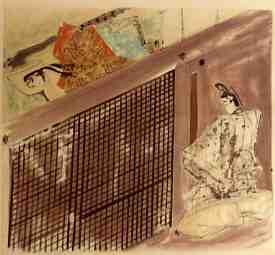
P.S. Featured photo is a scene from the illustrated Murasaki Shikibu Nikki Emaki, Public domain, via Wikimedia Commons
This poem was composed by the Saigyō Hōshi (西行法師, 1118 – 1190), or “Dharma Master Saigyō” a famous Buddhist monk and poet from the era. Saigyo’s story is interesting in of itself, and I blogged more about it on the other blog, including additional poetry, but let me post a summary here.
However, Norikiyo grew disillusioned with the nasty politics and infighting in the Court, and abruptly decided to throw it all away. He left behind his career, his wife and children, and became a wandering mendicant. He took on the Buddhist name Saigyo (西行) and stayed at the famous mountain-monastery of Koyasan for monastic training. Later, he returned to the capitol to find everything had changed. The Hogen Rebellion had destroyed much of the capitol, Emperor Sutoku was exiled (having lost), and Kiyomori ruled as a warlord. A few years later, Kiyomori and the entire Heike clan were utterly destroyed in the famous Genpei War, which also spelled the end of the historical Heian Period. What might have happened had Norikiyo stayed and followed his career, rather than leave the capitol?
In any case, with the new samurai government at Kamakura (thus, the Kamakura Period of Japanese history), things settled down in Japan and Saigyo traveled around. He devoted his life to writing poetry, lamenting the loss of his former patrons, admiring the beautiful nature in Japan, and about life in general. He finally settled down in the outskirts of Osaka, and passed away at the age of 73. It was said that when he passed away, the cherry blossoms were in full bloom and that he died on the same day that Shakyamuni Buddha died (February 15th according to solar calendar).
He was also friends with Shunzei (poem 83), according to Professor Mostow.
Anyhow, this poem is, according to Professor Mostow, possibly inspired by a poem by famous Chinese poet Bo Juyi centuries earlier, and is supposed the express the feelings of a resentful lover. Is the moon making him/her tearful? Maybe, maybe not, but gazing up at the moon brings them such sadness anyway.
Saigyo’s talent with poetry and his interesting life story have certainly helped him earn a place in the Hyakunin Isshu, but also inspired many later poets such as Basho and others. Basho the Haiku master, in his travels, went to visit places frequented by Saigyo among others.
The author, Nōin Hōshi (能因法師, 988 – ?) or “Dharma Master Nōin” was originally Tachibana no Nagayasu until the age of 26 when he took tonsure. From there, he traveled the provinces, composing poetry and contributed to various anthologies at the time. Because he was not tied to a politically prominent temple, he had more freedom than other monks in the Capitol to roam the countryside and write in his travels. My new book points out that he was eventually emulated by Saigyō Hōshi (poem 86) generations later.
Professor Mostow notes that this poem is unusual because it’s very straightforward with no hidden wordplay or anything. It’s just a nice, solid poem about Autumn.
As for the geography, Mt. Mimuro (三室山, mimuroyama) is in Nara Prefecture in Ikoma-gun, Ikaruga Village, while the famous Tatsuta-gawa River (竜田川) flows beside it. It was said in the old days that the gods would dwell at the mountain from time to time. In fact, you might recall hearing this river mentioned before all the way back in Poem 17. 😉
Mt Mimuro (Mimuroyama) and the Tatsuta-gawa River, photo by Kansai explorer, CC BY 3.0, via Wikimedia Commons
In those days, travel to places like Mimuro Mountain were generally hard to do for people, even the nobility. A day-hike into the mountains to see such a river was an expensive and exhausting affair as one had to bring their retinue, plan for food and supplies, etc.
So, many poems in the Hyakunin Isshu allowed contemporary people in those days to at least imagine what it would be like to visit even if they couldn’t afford to actually see it in person. Like a poetic “guidebook” in a sense. This is what makes poems like Nōin Hōshi’s so impactful, and why his travel writings were valued so highly: not only could he describe a place he had visited, but do skillfully using poetic verse. It helped to stir the imagination, just as it does for people living outside Japan today. 😏
P.S. For some reason, the last part of the Hyakunin Isshu has a lot of poems about Autumn in particular, so expect to see these soon amidst other things.
The author, Dainagon Kintō (大納言公任, 966 – 1041), better known as Major Counselor Fujiwara no Kintō, was one of the top poets of the Heian Period, and the grandson of Tadahira (poem 26) and father of Sadayori (poem 64).
Kinto was more than just a good poet, he was something of a genius renaissance man for his era. There is a famous anecdote taken from a historical text of the time called the Ō-kagami (大鏡, “great mirror”). In this anecdote his kinsman, the statesman Fujiwara no Michinaga, had three boats docked for a party, and invited the literati of the time to board one of three boats: one for Japanese poetry (waka, 和歌), one for Chinese poetry (kanshi, 漢詩), and one for wind and string music (kangen, 管弦) according to their skill. Michinaga then realized that Kinto was so multi-talented he could board any of the three boats so he let Kinto decide. Thus, Kinto earned the nickname Sanshū-no-sai (三船の才, “three boat genius”).
As a side note, when he considered the “waka” boat, he recited the following verses:
My own translation, apologies for any mistakes or clumsy translations
This was recorded in the aforementioned Ō-kagami as an example of his cleverness.
Among other accomplishments, Kintō was a respected critic who compiled the Thirty Six Immortals of Poetry list. Kinto compiled imperialanthologies that still represent Japanese Waka poetry of that era. In short, Kinto was the ultimate cultural authority of his time. He is also credited by Lady Murasaki (poem 57, め) or “Lady Purple” for giving her that nickname according to her diary. This was a playful allusion to her Tales of Genji that was circulating at the time and a major nod by Kinto.
Finally, Kinto also served in the Imperial court under the aforementioned Michinaga, and proved to be an able administrator. While he mostly stayed out of the power struggle at the time, he benefitted nonetheless.
But I digress.
According to Mostow, the poem itself was composed after a number of people visited a famous Buddhist temple called Daikakuji, which is in the western part of the capitol of Kyoto. Interestingly, Mostow also points out that this poem is found nowhere else despite the fact that Kinto was a famous poet and had an extensive collection for Fujiwara no Teika to draw from. One suggestion is that Daikakuji is in the same area as Mount Ogura, which is where Teika’s villa resided. The full name of the Hyakunin Isshu anthology is actually the Ogura Hyakunin Isshu by the way.
In any case, this poem is pretty interesting because of the sense of change over time. The waterfall that existed long ago still exists, but in name only. In the same way, life as we know it know will become a dim memory or a misplaced name for future generations. Although Japanese culture has been influenced by Buddhism and its notion of transience since early history, I think this is a point that anyone, anywhere can appreciate.
Also, Kinto’s ability to express this sense of change and impermanence to life seems to me to demonstrate his poetic talent all too well. 🙂








.jpg)

