
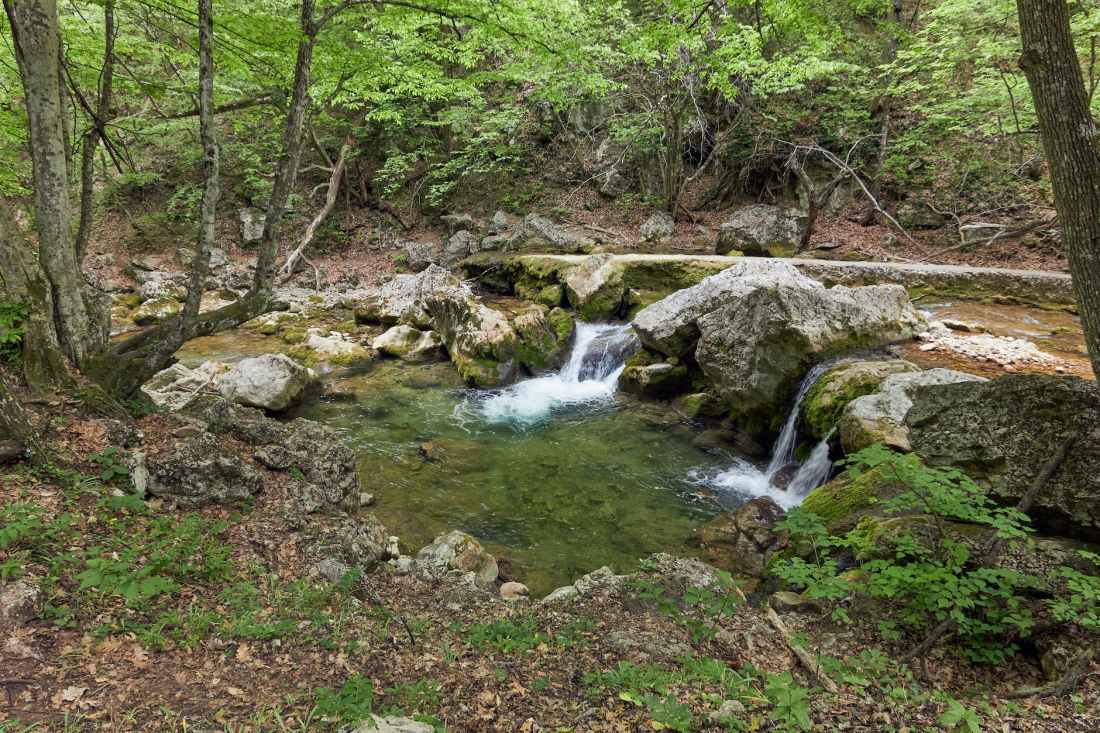
In honor of my wife’s birthday, I thought I’d write about her favorite poem from the Hyakunin Isshu:
| Japanese | Romanization | Translation |
|---|---|---|
| 瀬をはやみ | Se wo hayami | Because the current is swift, |
| 岩にせかるる | Iwa ni sekaruru | even though the rapids, |
| 滝川の | Takigawa no | blocked by a boulder, |
| われてもすゑに | Warete mo sue ni | are divided, like them, in the end, |
| 逢はむとぞ思ふ | Awan to zo omou | we will surely meet, I know. |
This poem was composed by Sutoku-in (崇徳院, 1119 – 1164), of “Retired Emperor Sutoku“. My new book notes that Sutoku had very tragic fortune in life. Sutoku was the son of Emperor Toba, but there were persistent rumors, and some limited historical evidence that his real father was Toba’s grandfather, Emperor Shirakawa. 😮😮 This strained Sutoku’s relationship with his father Toba, and so Toba did not step down as emperor until 23, despite installing Sutoku as the next emperor at age 5. Though his reign was long, and oversaw many poetry competitions, it ended poorly when he was forced to abdicate, and later exiled.
You see, his father Toba was infatuated with one of his other wive, Fujiwara no Nariko, and designated her son, Konoe as the next Emperor after Sutoku at age 3. Konoe however died at age 17 before ascending, and Nariko believed that a jealous Sutoku had cursed her son. This scandal eventually forced Sutoku off the throne, and his younger brother, Go-Shirakawa was installed next.
After Toba passed away, the bitter Sutoku became embroiled in a succession dispute with the regent Tadamichi (poem 76) that boiled over into the Hōgen Rebellion in 1156. The Rebellion was a disaster, and being on the losing side of the conflict, Sutoku was exiled to Sanuki Province, lived a monastic life until he died in 1164.
Coincidentally, the Hōgen Disturbance marks the beginning of the end of the Heian Court,1 and the rise of the samurai class, so legends existed that Sutoku’s angry spirit helped bring down the Court. A related legend is that while in exile, Sutoku lived a monastic life and sometimes sent poetry back to the Court, but the Court refused them on the grounds that they might be cursed. Evidentially, rumors of his curse from the death of Konoe, plus his ill-will from rebellion and exile, dogged him even later in life.
Sutoku was said to have taken great offense at this:

I mention all this because this poem on its own is quite lovely, and because it’s signed as “Retired Emperor Sutoku” it’s quite possible he wrote this while in exile, pining for someone he left behind in the capitol. Was it rejected as the legend says? If so, it’s a tragic waste of great poetry, and fuel for supernatural speculation. But if not, then this poem is still a lovely read and a reminder that old friends and loved ones will reunite again someday.
In any case, Happy Birthday, honey!
1 This is reflected quite a bit in the “mood” of the later poems of the Hyakunin Isshu, especially in the 90’s onward. Some of them have a sense of lost glory as the Heian Period ends, and the Court nobles become utterly powerless to the samurai class.

 The Hyakunin Isshu
