
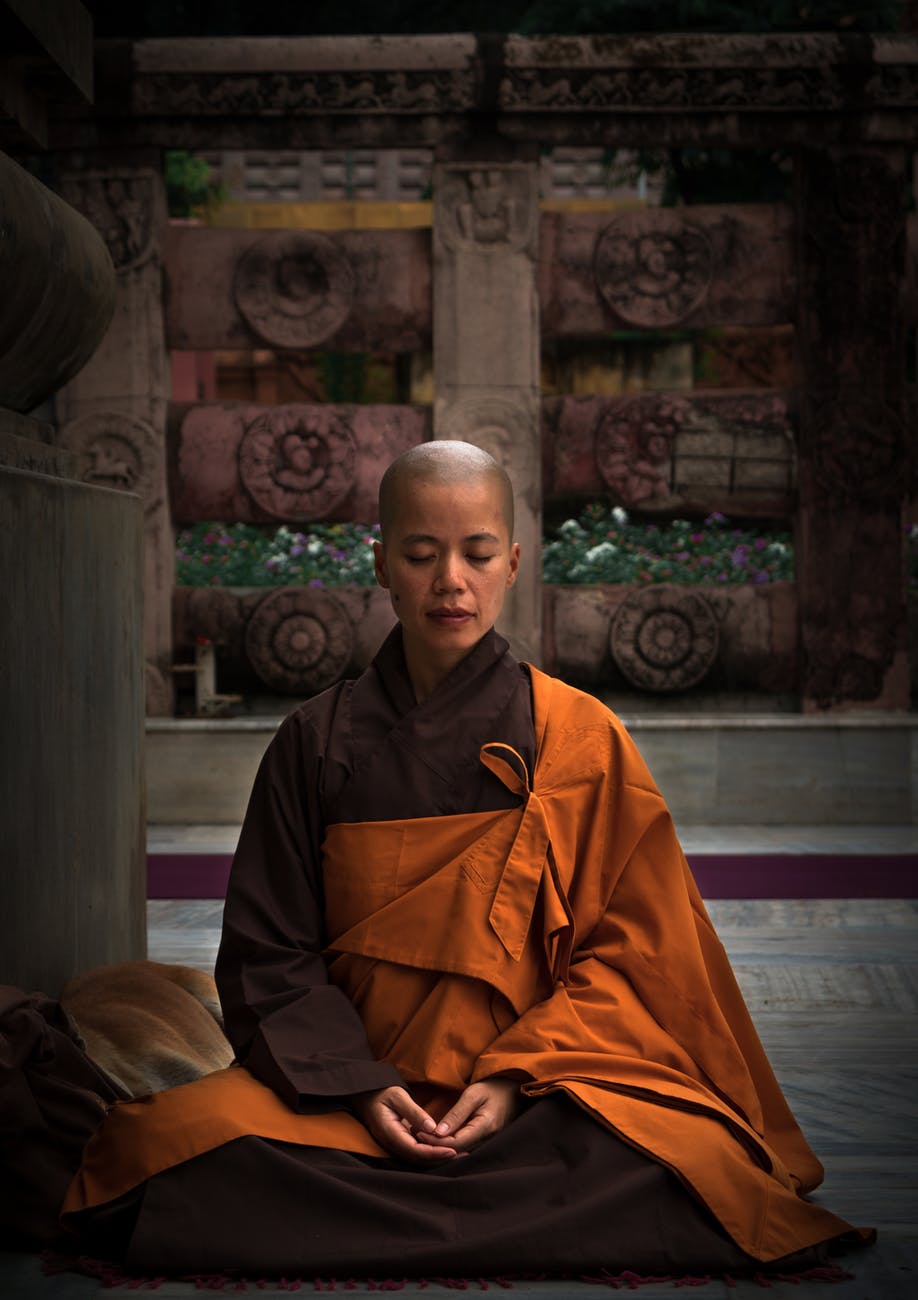
Since today is the Buddhist holiday of Bodhi Day, the Enlightenment of the Buddha, I felt this poem would be very suitable:
| Japanese | Romanization | Translation |
|---|---|---|
| おほけなく | Ōkenaku | Inadequate, but |
| うき世の民に | Ukiyo no tami ni | they must shelter the folk |
| おほふかな | Ōu kana | of this wretched world— |
| わがたつそまに | Waga tatsu soma ni | my ink-black sleeves, having begun to live |
| 墨染の袖 | Sumizome no sode | “in this timber forest that I enter”. |
The author of the poem is by a priest of the Tendai sect of Buddhism named Saki no Daisōjō Jien (先の大僧正慈円, 1155-1225), or “Former Archbishop Jien”. He was the son of the powerful Fujiwara no Tadamichi (poem 76) and nephew of fellow poet Yoshitsune (poem 91) as well as Fujiwara no Teika (poem 97) himself. Although he was from an elite family, he was the 10th son of Tadamichi, and thus extraneous. Like many powerful medieval families in both Europe and Asia, the extraneous kid was sent to a monastery. In this case, the prestigious monastery of Mount Hiei (homepage here), one of two powerful centers of the Tendai sect.
Interestingly, Professor Mostow suspects the poem may actually be an allusion to Emperor Daigo, who was said to have taken off his robe one winter night to suffer the same cold as the people did.
In any case, the last line of the poem is noteworthy because it is a direct quote from the founder of Tendai Buddhism in Japan, Saichō who lived centuries before. So, for many, this has been interpreted as Jien’s vow as a monk to carry on this tradition of compassion for all beings in a world that is transient and marked by suffering. Here, the “ink-black” or sumizome no sodé (墨染の袖) literally means “ink-black sleeves” (sumi is Japanese ink), and is the traditional color that Buddhist priests in East Asia wear. Compare the black sleeves with the orange-ochre robes in Southeast Asia, or red robes in Tibet.
This notion of compassion for all beings is exemplified by the Buddhist notion of a bodhisattva who is a being who is highly advanced on the Buddhist path and has turned outward to help and teach all beings before becoming a Buddha (i.e. enlightened) themselves. An example is a bodhisattva named Kannon (Avalokiteshvara), “who hears the cries of the world”.

Tendai Buddhism, in particular, reveres the Bodhisattva ideal and practices, and not surprisingly the poem reflects this. In any case, the notion of goodwill and compassion for others is something I hope others find inspiring.
 The Hyakunin Isshu