The author of this poem is Taikenmon-in no Horikawa (待賢門院堀川, dates unknown), or “Lady Horikawa of the household of Empress Taiken”. Empress Taiken was the consort to Emperor Toba, and was the mother of Emperor Sutoku (poem 77) who was later exiled.
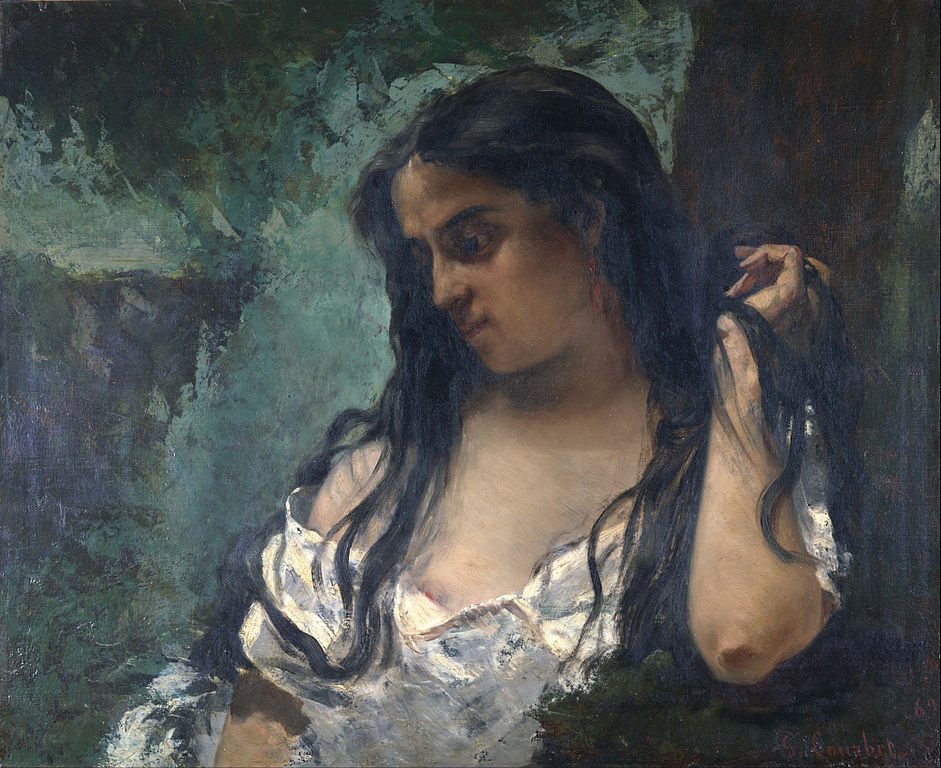
The use of imagery of “disheveled hair” was a common device often used by women, or writing poetry about women, to express feelings of frustration or anxiety.
Aswe’veseenbefore, morning-after poems were very popular at this time in Japan as many of the aristocracy of the Heian Court would have love trysts between each other. Often the first meeting was the morning important, not surprisingly. It set the tone for the rest of the relationship, so a meeting like this was often celebrated in poetry.
Of course, there was another side to these trysts in the Heian Period too.
P.S. Featured photo is Gypsy in Reflection, by Gustave Courbet, Public domain, via Wikimedia Commons
This poem was composed by the Saigyō Hōshi (西行法師, 1118 – 1190), or “Dharma Master Saigyō” a famous Buddhist monk and poet from the era. Saigyo’s story is interesting in of itself, and I blogged more about it on the other blog, including additional poetry, but let me post a summary here.
However, Norikiyo grew disillusioned with the nasty politics and infighting in the Court, and abruptly decided to throw it all away. He left behind his career, his wife and children, and became a wandering mendicant. He took on the Buddhist name Saigyo (西行) and stayed at the famous mountain-monastery of Koyasan for monastic training. Later, he returned to the capitol to find everything had changed. The Hogen Rebellion had destroyed much of the capitol, Emperor Sutoku was exiled (having lost), and Kiyomori ruled as a warlord. A few years later, Kiyomori and the entire Heike clan were utterly destroyed in the famous Genpei War, which also spelled the end of the historical Heian Period. What might have happened had Norikiyo stayed and followed his career, rather than leave the capitol?
In any case, with the new samurai government at Kamakura (thus, the Kamakura Period of Japanese history), things settled down in Japan and Saigyo traveled around. He devoted his life to writing poetry, lamenting the loss of his former patrons, admiring the beautiful nature in Japan, and about life in general. He finally settled down in the outskirts of Osaka, and passed away at the age of 73. It was said that when he passed away, the cherry blossoms were in full bloom and that he died on the same day that Shakyamuni Buddha died (February 15th according to solar calendar).
He was also friends with Shunzei (poem 83), according to Professor Mostow.
Anyhow, this poem is, according to Professor Mostow, possibly inspired by a poem by famous Chinese poet Bo Juyi centuries earlier, and is supposed the express the feelings of a resentful lover. Is the moon making him/her tearful? Maybe, maybe not, but gazing up at the moon brings them such sadness anyway.
Saigyo’s talent with poetry and his interesting life story have certainly helped him earn a place in the Hyakunin Isshu, but also inspired many later poets such as Basho and others. Basho the Haiku master, in his travels, went to visit places frequented by Saigyo among others.
This poem was composed by Fujiwara no Kiyosuke Ason (藤原清輔朝臣, 1104 – 1177), “Sir Fujiwara no Kiyosuke”, who was the second son of Fujiwara no Akisuke (poem 79). Kiyosuke’s grandfather, Fujiwara no Akisué (藤原顕季) had founded the Rokujo School of poetry, and passed it along to Akisuke. However, there is evidence that Akisuke and his son Kiyosuke got along poorly. Real poorly.
The Rokujo School published an Imperially-sponsored anthology titled the Shikashiyū (詞花集), Kiyosuke was snubbed and not a single poem of his was included. Ouch. Further, in Kiyosuke’s career ambitions, Akisuke went out of his way to hinder his son finding lucrative positions in the Imperial Court. Thus, Kiyosuke never succeeded in the Court bureaucracy.
Ironically, Professor Mostow states that after his father Akisuke died, Kiyosuke inherited his position as head of the Rokujo School anyway. From here, he officiated poetry contests, and the Rokujo School took in success, so much so that it eventually developed a rivalry with Fujiwara no Shunzei (poem 83). Sadly, his efforts to publish another anthology, the Shokushikashu (続詞花集) dried up after Emperor Nijo died.
At heart, this poem is about nostalgia, how bitter things now somehow soften over time. It is thought that Kiyosuke may have recited this poem around the age of 60, and was thus looking back. Given his harsh upbringing, you can probably imagine why. But even the modern reader can think of a bitter time in their life, but when looking back nostalgia makes it seem sweeter than it was at the time. It’s also a reminder that if we are going through a hard time now, it won’t always be that way in the future.
Professor Mostow points out that some commentators think this may have, more concretely, alluded to the decline of the times, and in particular the disastrous Hōgen Rebellion, mentioned also in poem 76 and poem 77, and poem 86. That same rebellion ultimately began the rapid decline of the aristocratic Heian Period, epitomized in poem 100.
But even if that were true, it’s interesting how we tend to look back on this era with a kind of bitter-sweet nostalgia, far removed from the pain and destruction caused at the time.



 The Hyakunin Isshu
