
Since initially making this blog way back in 2011, I have learned that you can now find karuta competitions (競技かるた kyōgi karuta) online on the official Youtube channel!
Here’s a recent high school playoff competition in 2022 for men:
and ladies playoff competition:
As you can see, it’s a very formal, elegant affair, with traditional clothing, customs, etc. Good manners and sportsmanship are emphasized.
Hyakunin Isshu karuta sets, such as those used in games and competitions, are always divided by two sets of cards:
- yomifuda (読み札) cards, illustrated cards with entire poem on them, and
- torifuda (取り札) cards that only contain the last only the last 2 verses. Illustrations below.

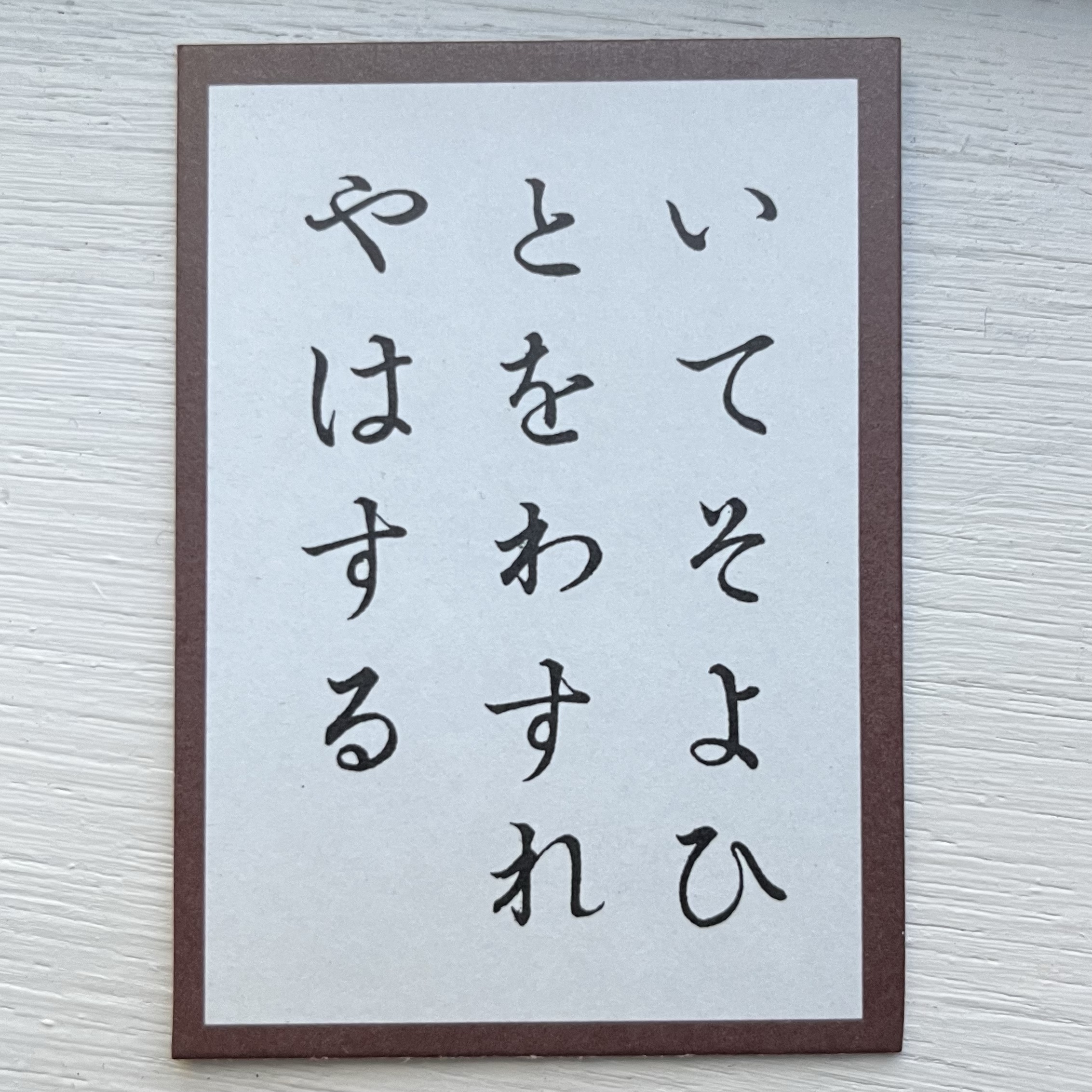
I admit that I am still learning the rules, but the gist is that 50 of the 100 total torifuda cards are laid out in a set pattern of cards on the floor, half (25) of them on one player’s side, the other half (25) with the other player.

The yomité (読手, “reciter”) reads a randomly select poem in full using the illustrated yomifuda cards above.

The players have to wait until the first 3 verses are completed, then if the matching torifuda cards on the field (i.e. the last 2 verses of the poem), the players can try to take that card. Whoever touches it first wins that round, and the card is taken off the field. Usually, players will swat the card aside because it’s just faster and keeps the other player from touching it.
If the card had been on the opponent’s side (相手陣, aitejin), then not only is the card taken off the field, but you also select a card from your side (自陣, jijin), and send it over to their side. Usually the players will raise their hand to pause the match while they decide which card to send over. The end result is that the cards on your side are reduced by 1, the opponent’s remain unchanged. If the card you took was on your side, then your side is reduced by 1 anyway. No transfer needed. When watching the videos, the player will the lower number of cards is winning.
Side note, if the matching torifuda card was not on the board anyway, then it’s considered karafuda (空札, “empty card”), and the game moves onto the next round.
The player who removes all cards from their side is the winner.
Anyhow, it’s pretty interesting to watch, even if the competitions can take an hour or more. You can see how explosively fast the players are.
Finally, I’d like to give a shout out to groups such as the Boston Karuta Club and Seattle Karuta Club. They have plenty of helpful links in English on getting started with karuta, rules and training resources, among many other great resources!
Discover more from The Hyakunin Isshu
Subscribe to get the latest posts sent to your email.
 The Hyakunin Isshu