
I’ve been running this blog since 2011, but until very recently I had no idea other non-Japanese people around me even knew about the Hyakunin Isshu, let alone play the competitive version. I honestly thought I was the only one around.
Enter the local karuta club called the Seattle Karuta Club (homepage).
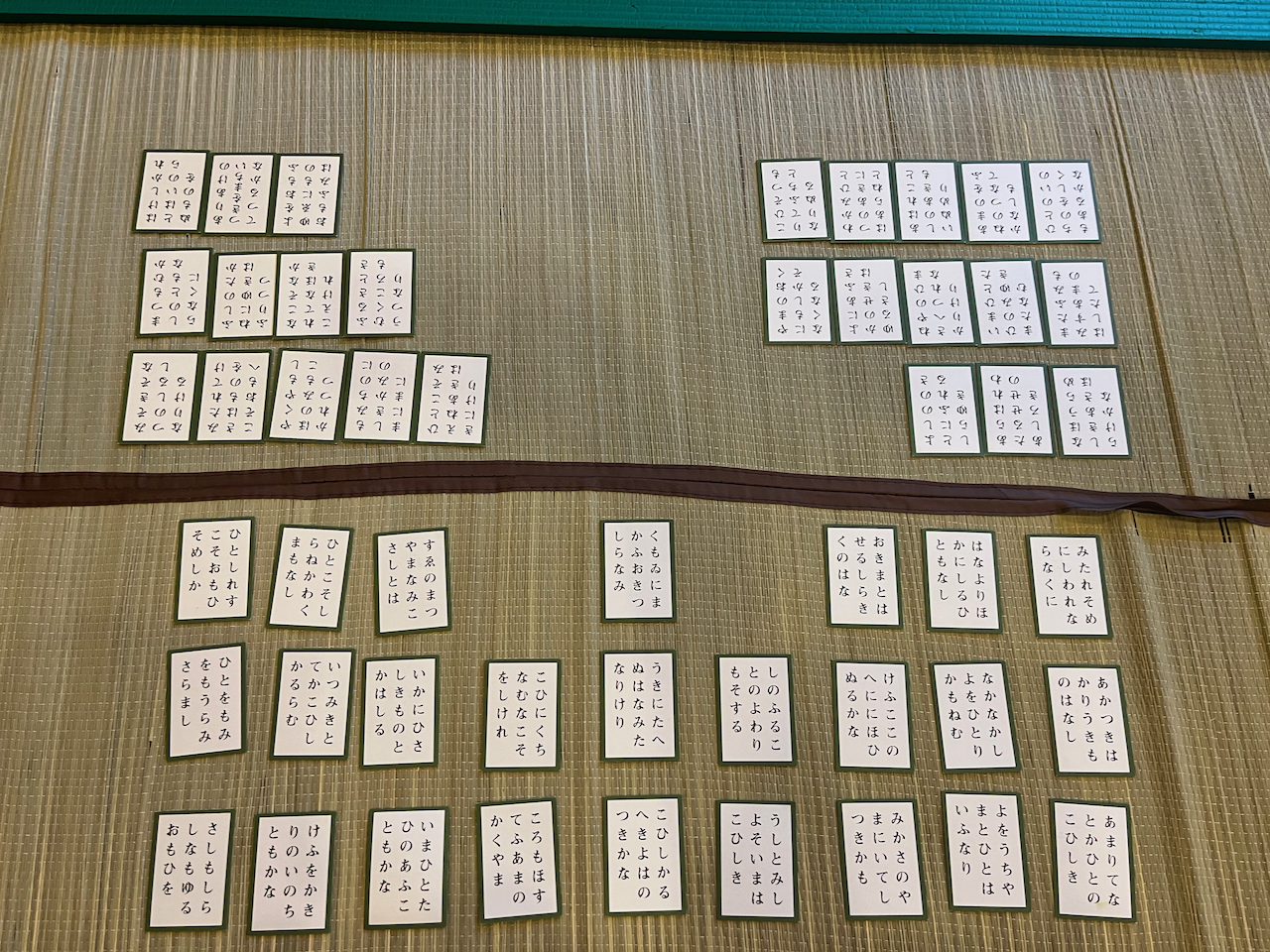
I stumbled upon their website last month, and being intrigued, came to a recent session. The people at Seattle Karuta Club were super nice and helped me get acquainted with my first game. My first opponent was Lore, one of the founding members. Above, you can see a view of my side of the board as we were setting up. I call this arrangement the “chaos strategy” because I had noooo idea what I was doing. 😅

One of the things that immediately struck me was that the torifuda (取り札), that is the cards you take, have no marks to distinguish hiragana て versus で, or ち versus ぢ, etc. I presume this is by design, and yet after all this time I had simply never noticed before. 😅 In any case, my brain struggled to make sense of my board for the first few minutes until I started to pick out verses I knew. But it was too little, too late.

Further, I realized quickly that knowing a poem, and being able to listen to a poem are two different skills. If your ears aren’t tuned to the reading, you’ll totally miss a poem you might otherwise know. For example, poem 24 is near and dear to my heart, but when it did come up in a match, my brain registered it much too slow.
So, in the end, I lost 25-0. Lore was amazing. They really knew their stuff, and not only helped me through etiquette and good arrangement strategy, but also some pointers about what to listen for, mnemonics, etc.
Afterwards, the club members and I had a fun chat about all things related to the Hyakunin Isshu, how folks met, and so on. I was surprised by how many people were inspired but the Japanese anime Chihayafuru (which embarrassingly, I never watched 😅), and how useful that anime is for learning strategy.
Then, abruptly, we had to relocate venues due to shutting down from inclement heat, and club member Rachel gave us all a ride. Thanks Rachel!
For my second match, I played again Kiri, another founding member. As with Lore, Kiri was another sharp player and super nice. Kiri also drew amazing illustrations on the back of their cards. This is recommended by the club to help keep track of one’s own deck versus others, but Kiri definitely went the extra mile. 😊

My match with Kiri was similarly 25-0, but this time around, my brain had adjusted somewhat to the rhythm of poetry recitation, and I could pick out a cards I could now recognize. Further, I started to develop a crude strategy for arranging my cards. I haven’t covered the concept of kimari-ji in this post but have one coming up soon. That’s a topic worth its own blog post (or three).
I knew going into this I’d be poorly prepared, but I also really wanted the experience, because I knew reading about and watching YouTube videos just wasn’t enough. Even if I got clobbered, I’d learn a lot and the Seattle Karuta Club did not disappoint. I genuinely had a great time and was fired up about learning Karuta for next time.
After I got home, I busted out my decks from Japan and starting practicing a few things, including listening, kimari-ji and so on. Also, my daughter had some old copies of the manga Chihayafuru in Japanese which I am borrowing.


All in all, competitive karuta was super fun. Compared to my days playing Magic the Gathering where it was all about money, and competitive dude-bros, “grifters”, “grinders”, etc, the karuta scene, by contrast, was much more about fun.
Rachel, Kiri and Lore were all solid, no-nonsense players, but they knew how to have fun and make people feel welcome too. I can’t tell you the last time I was at something like this that didn’t make you feel dumb or awkward. Everyone is learning together.
Further, compared to a hobby like Magic, Karuta has more cost upfront (for a deck, goza mat, etc) plus memorizing the kimari-ji, but then that’s it. It becomes something you just enjoy and perfect over a lifetime. Further, the deeper you go, the more you get out of it.
So, I am already thinking ahead toward the next meeting, and practicing for my next game.
Thank you Seattle Karuta Club!!
Discover more from The Hyakunin Isshu
Subscribe to get the latest posts sent to your email.
 The Hyakunin Isshu
Get down on your knees! That’s the one thing I just wouldn’t be able to do anymore.
Having a yoga mat or something helps a bunch. After this match, someone kindly lent me a cushion to use.
I am kind of use to “sitting seiza” like that, so I can keep up for at least short durations.
Absolutely wonderful! I wish there was something like this in my (woefully rural) area!
Hello and thanks for replying!
Talk to the Seattle Karuta Club or other such orgs. There are Discord groups and such as well, surprisingly.
Also, try the online Karuta game. It’s a great intro.