Traditional Colors in Japan

Japanese, as a distinctive language, has developed a wide variety of colors to describe the world around it. Consider the lines of the iconic poem 17:

Chihayaburu kamiyo kikazu tatsuta-gawa kara kurenai ni mizu kukuru to wa

Unheard of even in the legendary age of the awesome gods: Tatsuta River in scarlet and the water flowing under it.

Translation by Dr Joshua Mostow

In the book Hyakunin Isshu Daijiten, which I mentioned here, it explains that the fourth verse, karakurenai (唐紅), is in fact a traditional color word in Japanese. The Chinese characters read something like “Chinese (lit. Tang Dynasty China) scarlet or vermillion”. There is no one-to-one equivalent in English.1

You can see an example of what karakurenai looks like on this amazing website, among other tradition colors. You can also see a list of colors on Wikipedia as well. Both sites also include the HTML codes (a # sign, followed by 6 alpha-numeric characters) if you want to reproduce yourself. For example using the HTML hex code #C91F37 I get:

karakurenai

In truth, many of these colors would be obscure to modern audiences, except in some literary circles, but some, such as yamabuki-iro (山吹色, “golden yellow”) are still used in common vernacular. Further, as is common with other Asian languages, colors green and blue are often conflated (e.g. 信号は青, shingō wa ao, “the traffic light is blue/green”).

In any case, try it out the website above, and see what other colors you might find!

P.S. Photo by Pixabay on Pexels.com

Update: I decided to update the blog appearance and apply a new background color based on the HTML codes above. For the blog background color, I am using Haizakura (灰桜, code #d7c4bb).

1 Similarly, I bet some English tradition colors would have no translation in Japanese. Such is the way with language and cultures.
Odd Spellings in the Hyakunin Isshu

A blog reader recently left a comment about this, and I realized that this would make a good topic for discussion, especially if are you are trying to memorize the Hyakunin Isshu, or learn karuta. If you know even a little modern Japanese, you may soon start to notice that the hiragana spellings for some words aren’t always what you expect. For example, the fourth verse of poem 2 reads:

ころもほすてふ

But it reads as:

koromo hosu chou (not te-fu)

Another verse that threw me off recently was poem 44:

逢うことの

In modern Japanese, this would read as au koto no, but in the Hyakunin Isshu it is read as ou koto no.

Then there are other examples throughout, too many to list. The issue is that Japanese language, like any language, changes over time. People don’t speak or pronounce things the same as they did 1,000+ years ago.1 English language, for example, has undergone some dramatic sound-changes in the last 500 years, and yet the spelling was never updated. Hence, English spelling is confusing now.

Japanese underwent a similar change. Hiragana script at the time when it was first adopted was probably phonetic and intuitive to native speakers. However, fast-forward 1,000 years and it has long since diverged from the way people pronounce it.

This was finally fixed after World War II when the modern Hiragana spelling system was used, but old literature such as the Hyakunin Isshu remained as is. Hence, spelling of words in the Hyakunin Isshu differs from the modern Japanese equivalents.

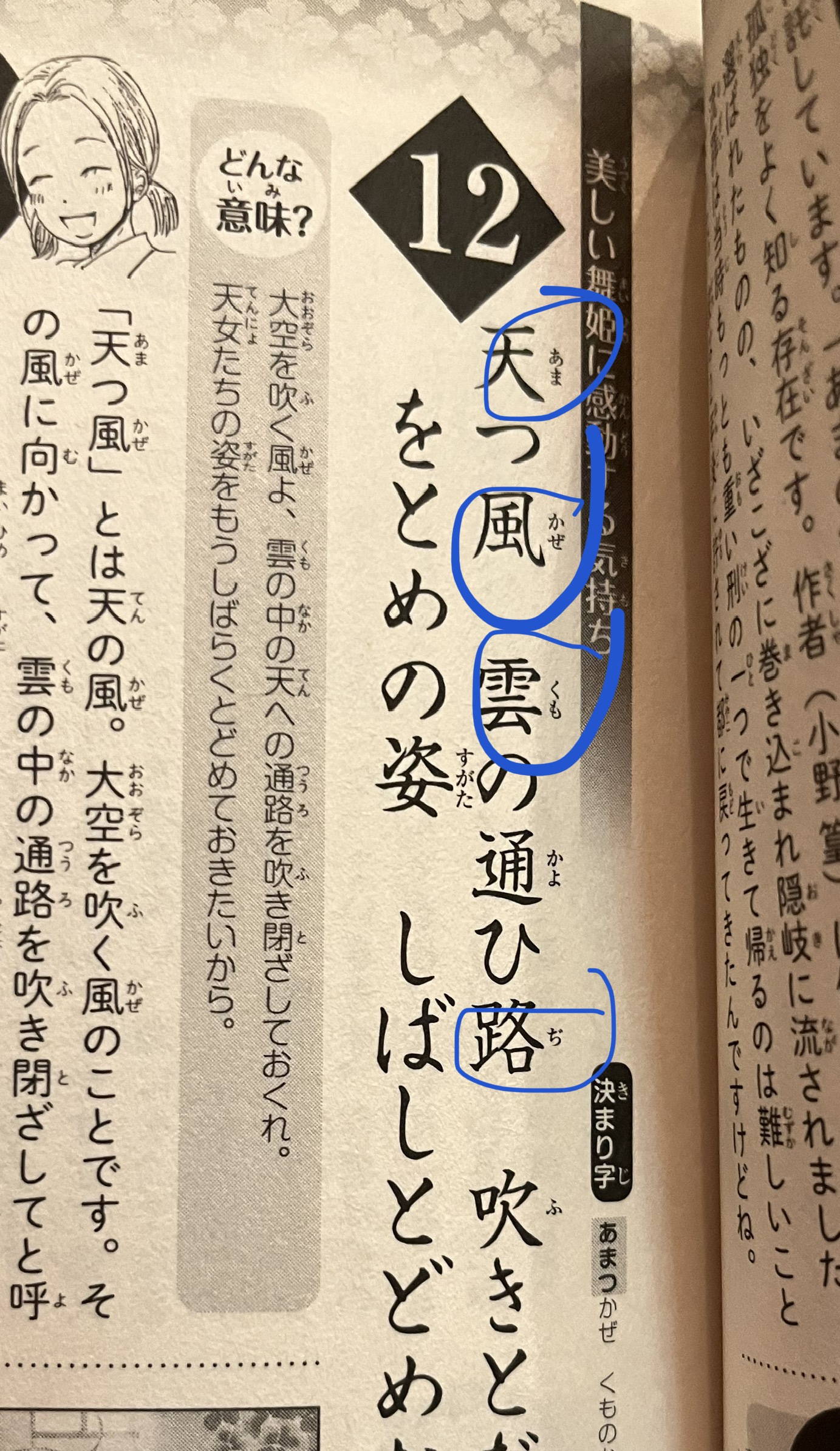
For this reason, Japanese students of the Hyakunin Isshu often rely on furigana pronunciation guides when reading about the Hyakunin Isshu. For example, this excerpt from a Chihayafuru manga my daughter has shows examples of furigana usage:

From the manga ちはやと覚える百人一首
(“Remember the Hyakunin Isshu with Chihaya”)

Further, some hiragana themselves are pronounced differently:

  • ひ (modern “hi”) is pronounced like い (“i”), see poem 12.
  • The aforementioned てふ (modern “te-fu”) is pronounced like ちょう (“cho-u”), see poem 2.
  • Similarly, けふ (modern “ke-fu”) is pronounced like きょう (“kyo-u”), see poem 54 and poem 61.
  • ぢ is pronounced the same as じ (“ji”), see poem 12.
  • おもふ (modern “o-mo-fu”) is pronounced as おもう (“o-mo-u”), see poem 85.
  • Archaic hiragana ゑ (“weh”) and ゐ (“wi”) are pronounced as え (“eh”) and い (“i”), see poem 5 or poem 14.
  • を (“wo”) is pronounced the same as お (“o”), see poem 12.
  • む (modern “mu”) is often pronounced as ん (“n”), but only if it’s at the end of a word, see poem 3.

And so on. If unsure, just listen to audio readings of the Hyakunin Isshu and you’ll often get a feel for how it’s pronounced anyway. Or, note the furigana text above the letter, as this provides a visual cue for native Japanese speakers. Whatever the furigana says is correct. Just be aware that the spellings differ from modern, standard Japanese, and that this is a common feature of pre-modern Japanese literature. There are patterns to this, and once you get used to it, you don’t even think about it anymore.

P.S. if you think the history of hiragana script is confusing, the history of romaji (Roman alphabet for Japanese) is even nuttier.

1 I always find it mildly amusing (or annoying) when time-travel movies have everyone speaking perfect English, often British-accented English. I get that it’s hard to work in another language, especially finding actors who can pronounce it reliably, but still….