

As part of my efforts to improve my practice routine and make small, incremental gains, I got some helpful advice from the Seattle Karuta Club, and was pointed toward this website. This Karuta Club, the Akita Kohohana Karuta Club, in Akita Prefecture demonstrates how to practice Karuta using a method called fuda-waké (札分け), meaning “distributing cards” or “dividing up cards”, etc.
This technique takes a bit of setup at first but is a great way to both reinforce kimari-ji and also positioning your cards (tei’ichi 定位置).
First, you need to make a chart large enough to place your cards on a 7×4 grid, like so:
Then fill in the Japanese hiragana like so. I’ve added both romaji (Roman alphabet) and kiriji (Cyrillic alphabet) for convenience.
| や ya я | み mi ми | は ha ха | た ta та | さ sa са | か ka ка | あ a a |
| ゆ yu ю | む mu му | ひ hi хи | ち chi ти | し shi си | き ki ки | い i и/й |
| よ yo ё | め me мэ | ふ fu фу | つ tsu цу | す su су | う u у | |
| わ wa ва | も mo мо | ほ ho хо | な na на | せ se сэ | こ ko ко | お o o |
I wanted to try out this method, so I used my old battle-map from Dungeons and Dragons, and drew the same chart on there:
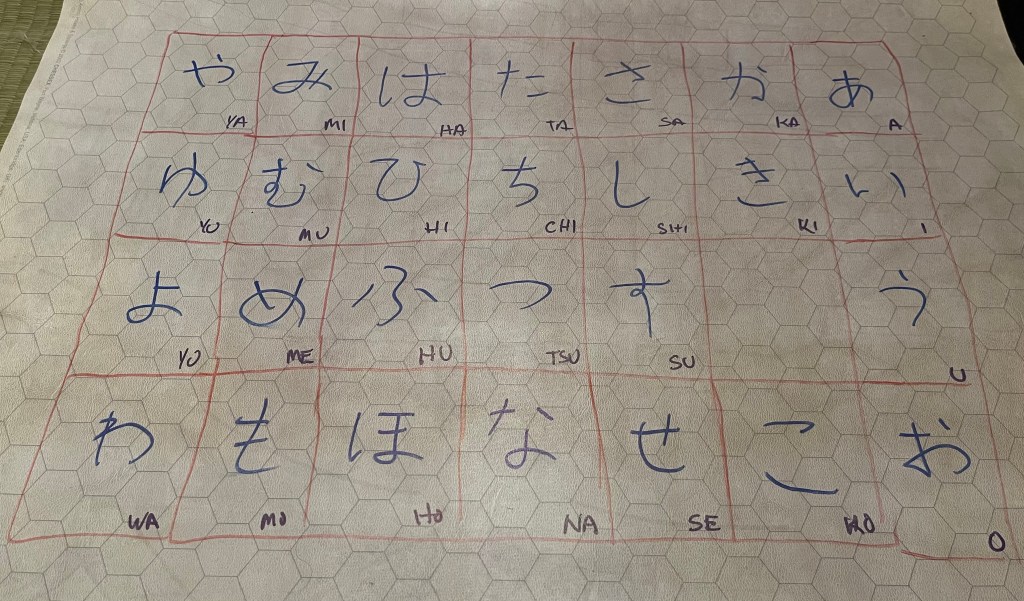
My handwriting is terrible, but hopefully legible. You can see a close-up here:

To be honest, I made my grid a bit too small, so as I piled cards, I couldn’t see which space was which. If you make something similar, make sure the squares are extra big.
Anyhow, the method for fudawaké is to pile up your torifuda cards to the side, then time yourself:
- Grab a handful (doesn’t matter how many)
- One by one, put them in the right square based on the first letter of their kimari-ji.
- Grab more cards as needed.
- When you place all 100 cards, stop the timer.
According to the Akita Konohana Karuta Club website, their team standard is 1:40, which is quite fast. You can see that some members finish in less than one minute!
When I tried it the first time, it took me 8:05, and then on my second try, it took 6:07. Not even close to their standard, but it was a fun exercise. It is more challenging than fuda-nagashi, but still teaches many of the same skills. It also helps with the initial board setup too, because you can correctly remember where to group your cards based on common kimari-ji.
Try it out and let me know what you think!

 The Hyakunin Isshu