The Return of the Hyakunin Isshu Crackers!

The Hyakunin Isshu Cracker trilogy continues! Way back in 2011, when I first wrote this blog, I posted about some neat Japanese senbei (deep fried crackers made from rice dough), featuring poems of the Hyakunin Isshu. The pictures were lost however, and so I can’t really show what they looked like.

Then in 2022, I wrote another post about a different set of Hyakunin Isshu crackers we got in Japan. However, I only had a couple examples, not the complete set.

This time, I have the complete set. My father-in-law sometimes receives them as periodic gifts during the summer (a.k.a. Ochūgen, お中元) from business partners and such. The company website for these crackers is here.

There are six varieties in the set, each featuring a poem of the Hyakunin Isshu.

These first two are poems 98 (left, かぜそ) which has a spicy, wasabi (?) flavor, and 36 (right, なつ) which has baked shrimp flavor.

These two are poems 2 (left, はるす) which has leaf-shaped crackers with a salty taste, and 81 (right, ほ) is baked with nori seaweed.

The one on the left is also written with poem 98 (left, かぜそ), but has a light salty cracker flavor. This one is my favorite. The one on the right didn’t have a poem written on the front, but the back was printed with poem 97 (こぬ), and has some lightly flicked baked seaweed on it.

There might be more poems and/or flavors, but this is what I got from the boxed set we brought back to the US. Anyhow, it’s neat to see the poems written in a traditional cursive script (rather than standard printed Japanese), and I wonder if there’s some association between certain poems and certain flavors but I don’t see a connection yet.

As with the handwriting book, it’s interesting to see how the Hyakunin Isshu lives on in Japanese culture in fun, friendly ways like this.

Hyakunin Isshu Crackers, Redux!

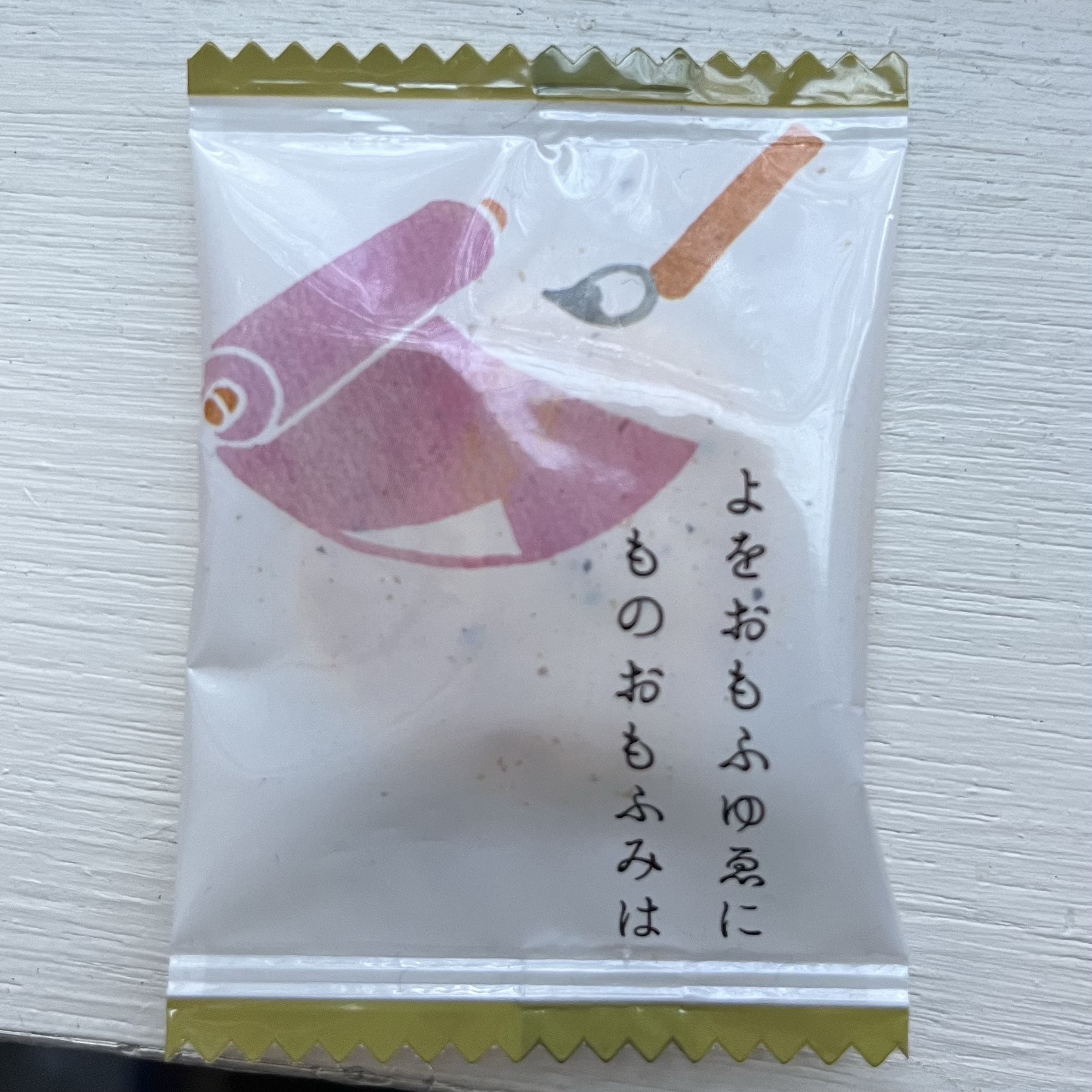
In Japan, gift-giving (omiyagé お土産) among friends and relatives is a common tradition, and recently a friend returned from Japan and gave us some special crackers (senbei) featuring poems from the Hyakunin Isshu. The crackers come in different flavors, and the wrapper each has a random poem.

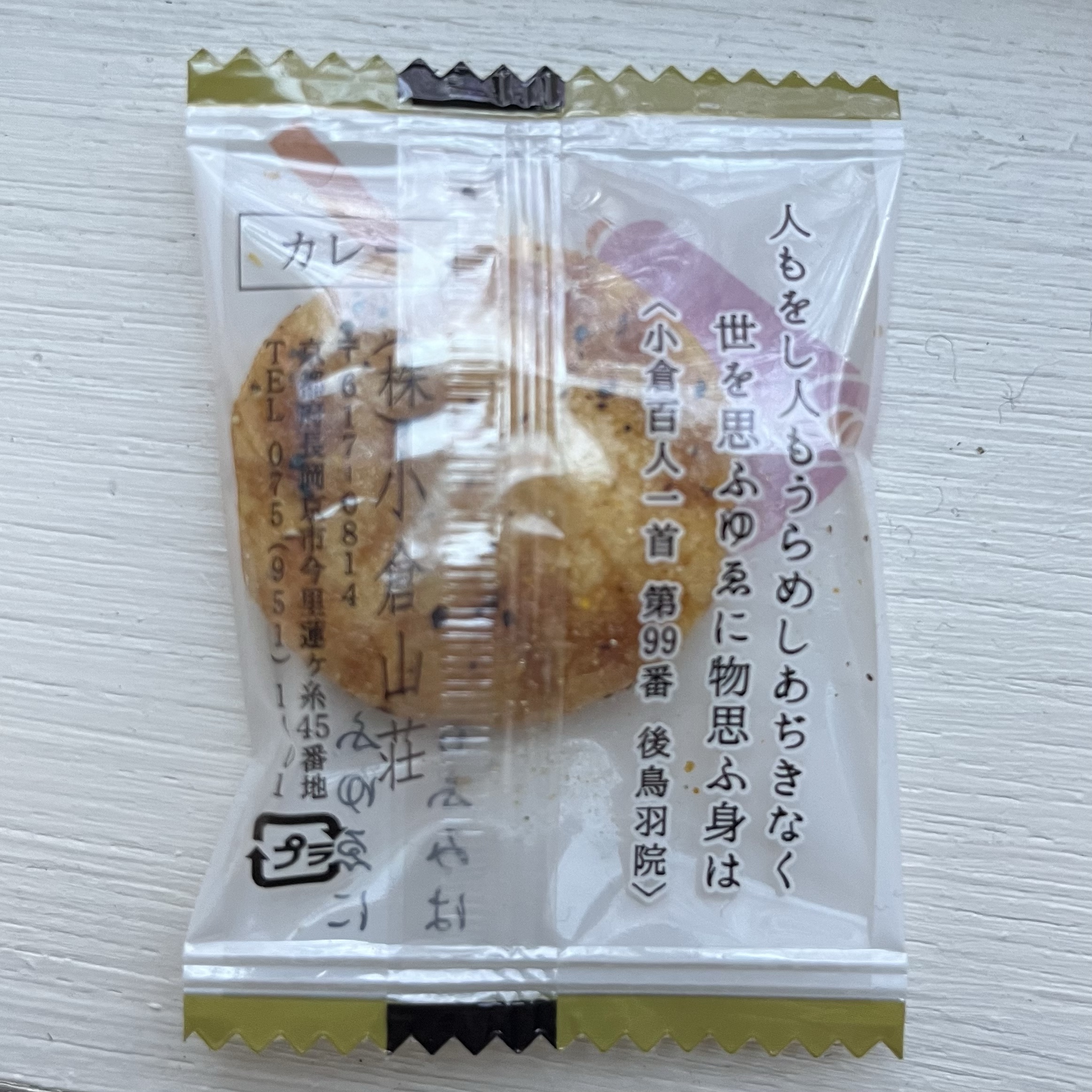
I got a curry-flavored one:

The first two verses of the poem, poem 99, are written on the front. On the back are the remaining verses:

Hyakunin Isshu-themed crackers are sold here and there, and I’ve posted about it in the past, but it’s still nice to get them from time to time.

P.S. This vendor sells Hyakunin Isshu themed senbei crackers as well (it was the vendor featured in the original post).

A Good Harvest: Poem Number 1

This is another iconic poem about Autumn and also happens to be the first poem in the Hyakunin Isshu:

JapaneseRomanizationTranslation
秋の田のAki no ta noIn the autumn fields
かりのいKario no io nothe hut, the temporary hut,
とまのあらみToma no aramiits thatch is rough
わが衣出はWaga koromo de waand so the sleeves of my robe
つゆにふりつつTsuyu ni furitsutsuare dampened night
by night with dew.
Translation by Dr Joshua Mostow

This, the opening poem of the Hyakunin Isshu, was composed by Tenji Tennō (天智天皇, 626 – 671), known in English as Emperor Tenji. Emperor Tenji helped oversee Taika Reforms as Crown Prince from the new capitol in Otsu, home of Omi Shrine, and was responsible for promulgating important historical texts in early Japanese history such as the Nihon Shoki and Kojiki. Further, he was a pretty ambitious guy and needed to strengthen his family lineage, so he compelled his younger brother to marry his own daughter, after marrying his younger brother’s former wife, Princess Nukata.

Complicated.

This poem is unique in the anthology because it deals with subjects that related to peasant life, rather than life in the Court, and later commentators explain that this was because of Emperor Tenji’s image as a benevolent ruler. It’s also possibly because of this image, that Fujiwara Teika chose this as the first poem.

In any case, the poem gives a window into the life of the peasants in Japan during this era. Like elsewhere in the world, the harvest was a very important time of the year, and in each village, someone had to guard the grain overnight from theft or from animals. They would often stay in small thatched huts, and stay awake overnight. As night fell, the temperatures would get cold and their sleeves wet with dew, while the smell of dried grains permeated the air.

Outside the aristocratic court, this was the life that many led to feed their family and it was this labor that Emperor Tenji sought to praise.

Hyakunin Isshu crackers!

Edit: the pictures in his post are now lost unfortunately. There is a more up to date post here though if you would still like to read.

My wife often gets sembei crackers from her family in Japan in the mail, and especially a package of these crackers in particular:

Hyakunin Isshu: the crackers!

These are Hyakunin Isshu themed crackers! In each container is 6 different sembei crackers: salty, sweet, sesame flavored, seaweed-wrapped, shrimp flavored and one with nuts. They’re all quite good.

But the clever part is what’s under the crackers:

Hyakunin Isshu crackers 2

Each package contains a different poem from the Hyakunin Isshu! The one on the left is poem 36, written in cursive, poetic script, while the one on the right is poem 26, also in cursive style.

A very nice snack, I think. 🙂 You can check out the company’s website too if you would like to learn more.