Short As A Reed: Poem Number 88

If you like word-play, you’ll enjoy this poem quite a bit:

JapaneseRomanizationTranslation
江のNaniwa-e noDue to that single night
あしのかりねのAshi no karine noof fitful sleep, short as a
reed’s joint cut at the root
一よゆHitoyo yuefrom Naniwa Bay,
みをつくしてやMi wo tsukushite yaam I to exhaust myself,
like the channel markers
わたるべきKoi wataru bekipassing my days in longing?
Translation by Dr Joshua Mostow

This poem was composed by Lady Bettō (dates unknown), known in the Anthology as Kōkamon’in no Bettō (皇嘉門院別当). Lady Bettō served in the house of Empress Seishi, wife of Emperor Sutoku (poem 77). Lady Bettō was also the daughter of Minamoto no Yoshitaka.

Although the life of Lady Bettō is relatively unknown, and she doesn’t appear in many anthologies, Professor Mostow points out that her poem is quite a technical feat. There are not one, but three “pivot words”, or words that carry multiple meanings, and lend multiple interpretations to the poem:

  1. karine can mean cutting a root (刈り根) or a brief nap (仮寝) such as when traveling.
  2. hitoyo can mean either a single segment of a reed (一節) or a single night (一夜).
  3. mi wo tsukushi can mean either to exhaust one’s body (身を尽くし) or one of the famous barriers in Osaka Bay (澪標, see also poem 20)

The poem itself uses many familiar themes too. We’ve seen a lot of poems that feature Osaka Bay, called Naniwa in ancient times, including poem 20, poem 19 and poem 72 among others. Similarly, we see references to reeds, just as we do in poem 39 and poem 19 (again).

What makes this poem stand out is the excellent use of word-play throughout. On the surface, it looks like just another love poem, but Lady Bettō knew what she was doing. 😌

P.S. Featured photo is of reeds (species Phragmites) in Amsterdam, photo by PersianDutchNetwork, CC BY-SA 3.0, via Wikimedia Commons

New Blog Page

Hello,

I’ve been making small updates to the blog apart from the poems themselves. The main change is that I’ve added a new “page” that talks about the history of Imperial poetry anthologies. Poetry collections were very popular in the “classical age” of Japanese history, when Court nobles cultivated the finer arts and wrote lots and lots of poetry for social reasons, as well as for career advancement.

The Hyakunin Isshu is an example of a “private” collection in that it was not commissioned by the government. Fujiwara no Teika (poem 97) compiled the Hyakunin Isshu in the later years of his life after his lord, Emperor Gotoba (poem 99), was exiled and the samurai government in Kamakura had won the civil war.

However, many of the poets in the Hyakunin Isshu were also contributors to official anthologies or helped compile them. So, I finally got around to explaining what these anthologies were and why the’re important to this blog.

Also, resources permitting, I may want to try and post poetry from some of those anthologies, starting with the Kokin Wakashū.

Enjoy!

Mists and Rain: Poem 87

It’s been a while, but I wanted to start off with a nice, descriptive poem:

JapaneseRomanizationTranslation
むら雨のMurasame noWhile the raindrops of
つゆもまだ干ぬTsuyu mo mada hinuthe passing shower have
not yet dried from
まきの葉にMaki no ha ninear the leaves of the
evergreens,
きり立ちのぼるKiri tachinoboruthe mist is already rising, on
秋のゆうぐれAki no yugurethis evening in autumn.
Translation by Dr Joshua Mostow

This poem was composed by Jakuren Hōshi (寂蓮法師, 1139 – 1202), “Dharma-master Jakuren”, whose name was originally Fujiwara no Sadanaga before he took tonsure. He is a nephew of Shunzei (poem 83) and according to Professor Mostow a leading poets in the house of Mikohidari. He helped to compile the official poetry anthologies at the time, but died before completion.

Professor Mostow points out that Fujiwara no Teika (poem 97), another member of the House of Mikohidari, didn’t praise this poem at first, and it made the “cutting floor” of the Imperial anthology that Jakuren helped compile, the Shin-Kokinshū, or in other anthologies. And yet, years later, it appears here in the Hyakunin Isshu by Fujiwara no Teika. The poem is generally viewed as a simple, straightforward descriptive poem, which is perhaps why it wasn’t as highly revered as other more subtle poems, or poems with more of a backstory.

Still, I think anyone can appreciate the scenery painted in this poem even today.

Interestingly, the poetic verse kiri tachinoboru (霧立ち上る) or “the mist is already rising”, was coined by Jakuren and was associated with him by later poets and commentators.

P.S. I’ve been away from the blog for a couple months raising our new little boy and keeping up with holidays. Now that things are finally quieting down, I hope to complete the final 7 poems (aside from this one). I’m still debating on further topics for this blog, and suggestions or requests are always appreciated.

Sleepless Nights: Poem Number 85

Whereas the last love poem expressed love and anxiety after a first-meeting, this poem is quite a different story:

JapaneseRomanizationTranslation
夜もすがらYo mo sugaraAll through the night
もの思ころはMono omou koro warecently, as I dwell on things,
明けやらでAke yaradeeven the gap between
the doors
ねやのひまさNeya no hima saeof my bedroom, which
does not lighten,
つれなかりけりTsure nakari keriseems cruel and heartless
to me.
Translation by Dr Joshua Mostow

The author is a Buddhist monk named Shun’e Hōshi (俊恵法師, 1113 – ?), or “Dharma Master Shun’e” who was the son of Minamoto no Toshiyori (poem 74) and grandson of Minamoto no Tsunenobu (poem 71). Though he had taken tonsure, Shun’e was quite a social figure and gathered many poets and writers around him and his residence called the Karin’en (歌林苑, “Garden in the Poetic Woods”). According to Professor Mostow, one of his students was a famous writer named Kamo no Chōmei who wrote the “Account of a Ten Foot Hut” or Hōjōki.

This poem is another example of when a poem expressing a woman’s anguish is written by a man, presumably on a set topic for a poetry contest. Other examples include poem 18 and poem 21. Obviously being able to express a woman’s feelings, namely that of a jilted lover, so well from a male author was not an easy task, and was a mark of excellent poetic skill, and not surprisingly Shun’e is counted among the Later Six Immortals of Poetry.

The respect that male actors in later Kabuki theater who specialize in female roles earn probably has a similar origin.

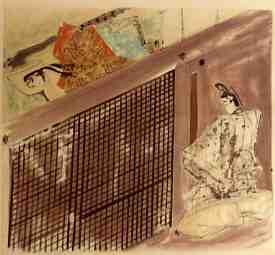
P.S. Featured photo is a scene from the illustrated Murasaki Shikibu Nikki Emaki, Public domain, via Wikimedia Commons

The Plovers’ Cry: Poem Number 78

As the weather gets colder, I’ve been saving this one for a time like this:

JapaneseRomanizationTranslation
淡路あわじAwaji shimaThe crying voices
かよ千鳥のKayou chidori noof the plovers who visit
鳴くこえNaku koe nifrom Awaji Island—
いく夜ねざめぬIkuyo nezamenuhow many nights have
they awakened him,
須磨の関守Suma no sekimorithe barrier-keepers of Suma?
Translation by Dr Joshua Mostow

The author of the poem, Minamoto no Kanemasa (源兼昌, dates unknown) was a frequent participant in poetry contests of the day, but overall very little is known about him, and it doesn’t appear he had any poetry collections of his own.

The first time I read this poem, in Japanese, I misunderstood the phrase chidori (千鳥) to literally mean 1,000 birds (in other words, a lot of birds). But in fact, chidori refers specifically to plover birds. The featured photo above shows a Western Snowy Plover bird on Morro Strand State Beach, Morro Bay, CA, “Mike” Michael L. Baird, CC BY 2.0, via Wikimedia Commons.

In Japanese poetry plover represented winter, and for other seasons, other birds typically were frequently used:

The location, Awaji Island, is a well known part of Japan’s inland sea, and is culturally significant since antiquity. Though at this time in history, it felt a bit remote from the capitol.

Professor Mostow notes that this poem uses some strange grammar though. For example nezamenu would normally mean to not wake up, but in this context means “have they awakened” instead. Also, he notes that this poem apparently alludes to the Tales of Genji, specifically the “Suma” chapter, when the prince Genji was in exile.

All told, this poem paints a sad, somber picture that fits well with wintry days.

Disheleved: Poem Number 80

A clever morning-after love poem that I felt was fun to share:

JapaneseRomanizationTranslation
長からNagakaranI do not even know
心も知らずKokoro mo shirazuhow long your feelings
will last.
黒髪のKurokami noMy long black hair
乱れてけさはMidarete kesa wais all disheveled and,
this morning,
ものをこそ思Mono wo koso omoemy thoughts too are
in a tangle!
Translation by Dr Joshua Mostow

The author of this poem is Taikenmon-in no Horikawa (待賢門院堀川, dates unknown), or “Lady Horikawa of the household of Empress Taiken”. Empress Taiken was the consort to Emperor Toba, and was the mother of Emperor Sutoku (poem 77) who was later exiled.

The use of imagery of “disheveled hair” was a common device often used by women, or writing poetry about women, to express feelings of frustration or anxiety.

As we’ve seen before, morning-after poems were very popular at this time in Japan as many of the aristocracy of the Heian Court would have love trysts between each other. Often the first meeting was the morning important, not surprisingly. It set the tone for the rest of the relationship, so a meeting like this was often celebrated in poetry.

Of course, there was another side to these trysts in the Heian Period too.

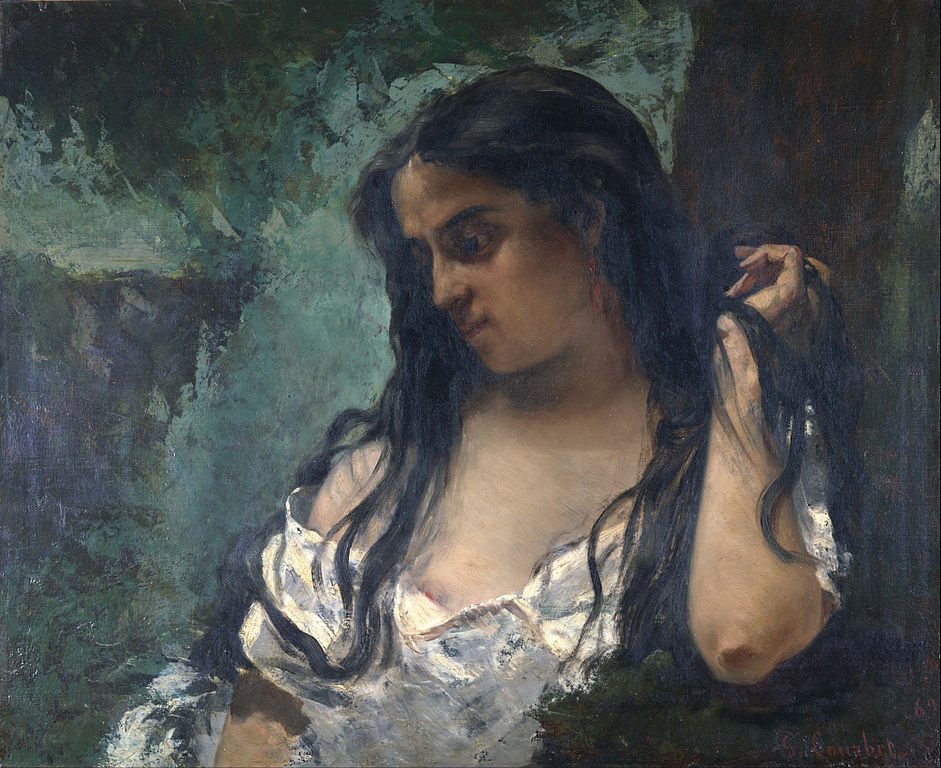
P.S. Featured photo is Gypsy in Reflection, by Gustave Courbet, Public domain, via Wikimedia Commons

Lamentations: Poem Number 86

Another Autumn moon poem, but with an interesting twist:

JapaneseRomanizationTranslation
なげけとてNageke tote“Lament!” does it say?
月やは物をTsuki ya wa mono woIs it the moon that makes me
するOmowasurudwell on things? —No,
and yet,
かこちがおなるKakochi gao narulook at the tears flowing
down
わがなみだかなWaga namida kanamy reproachful face!
Translation by Dr Joshua Mostow

This poem was composed by the Saigyō Hōshi (西行法師, 1118 – 1190), or “Dharma Master Saigyō” a famous Buddhist monk and poet from the era. Saigyo’s story is interesting in of itself, and I blogged more about it on the other blog, including additional poetry, but let me post a summary here.

In his youth, his name was Sato no Norikiyo and he was a promising young man in the Heian Court, and caught the attention of Emperor Toba, Emperor Sutoku (poem 77) and also Taira no Kiyomori, the most powerful man at the time and who later featured as a villain in the famous Tales of the Heike and a many dramas on Japanese TV.

However, Norikiyo grew disillusioned with the nasty politics and infighting in the Court, and abruptly decided to throw it all away. He left behind his career, his wife and children, and became a wandering mendicant. He took on the Buddhist name Saigyo (西行) and stayed at the famous mountain-monastery of Koyasan for monastic training. Later, he returned to the capitol to find everything had changed. The Hogen Rebellion had destroyed much of the capitol, Emperor Sutoku was exiled (having lost), and Kiyomori ruled as a warlord. A few years later, Kiyomori and the entire Heike clan were utterly destroyed in the famous Genpei War, which also spelled the end of the historical Heian Period. What might have happened had Norikiyo stayed and followed his career, rather than leave the capitol?

In any case, with the new samurai government at Kamakura (thus, the Kamakura Period of Japanese history), things settled down in Japan and Saigyo traveled around. He devoted his life to writing poetry, lamenting the loss of his former patrons, admiring the beautiful nature in Japan, and about life in general. He finally settled down in the outskirts of Osaka, and passed away at the age of 73. It was said that when he passed away, the cherry blossoms were in full bloom and that he died on the same day that Shakyamuni Buddha died (February 15th according to solar calendar).

He was also friends with Shunzei (poem 83), according to Professor Mostow.

Anyhow, this poem is, according to Professor Mostow, possibly inspired by a poem by famous Chinese poet Bo Juyi centuries earlier, and is supposed the express the feelings of a resentful lover. Is the moon making him/her tearful? Maybe, maybe not, but gazing up at the moon brings them such sadness anyway.

Saigyo’s talent with poetry and his interesting life story have certainly helped him earn a place in the Hyakunin Isshu, but also inspired many later poets such as Basho and others. Basho the Haiku master, in his travels, went to visit places frequented by Saigyo among others.

Nostalgia: Poem Number 84

This is kind of a cool, unusual poem to find in the Hyakunin Isshu, but something we can all appreciate:

JapaneseRomanizationTranslation
ながらNagaraebaIf I live on longer,
またこのごろやMata kono goro yashall I again, I wonder,
しのばれShinobarenyearn for these days?
うしと見し世ぞUshi to mishi yo zoThe world that I once saw as
今はこいしきIma wa koishikibitter, now, is dear to me.
Translation by Dr Joshua Mostow

This poem was composed by Fujiwara no Kiyosuke Ason (藤原清輔朝臣, 1104 – 1177), “Sir Fujiwara no Kiyosuke”, who was the second son of Fujiwara no Akisuke (poem 79). Kiyosuke’s grandfather, Fujiwara no Akisué (藤原顕季) had founded the Rokujo School of poetry, and passed it along to Akisuke. However, there is evidence that Akisuke and his son Kiyosuke got along poorly. Real poorly.

The Rokujo School published an Imperially-sponsored anthology titled the Shikashiyū (詞花集), Kiyosuke was snubbed and not a single poem of his was included. Ouch. Further, in Kiyosuke’s career ambitions, Akisuke went out of his way to hinder his son finding lucrative positions in the Imperial Court. Thus, Kiyosuke never succeeded in the Court bureaucracy.

Ironically, Professor Mostow states that after his father Akisuke died, Kiyosuke inherited his position as head of the Rokujo School anyway. From here, he officiated poetry contests, and the Rokujo School took in success, so much so that it eventually developed a rivalry with Fujiwara no Shunzei (poem 83). Sadly, his efforts to publish another anthology, the Shokushikashu (続詞花集) dried up after Emperor Nijo died.

At heart, this poem is about nostalgia, how bitter things now somehow soften over time. It is thought that Kiyosuke may have recited this poem around the age of 60, and was thus looking back. Given his harsh upbringing, you can probably imagine why. But even the modern reader can think of a bitter time in their life, but when looking back nostalgia makes it seem sweeter than it was at the time. It’s also a reminder that if we are going through a hard time now, it won’t always be that way in the future.

Professor Mostow points out that some commentators think this may have, more concretely, alluded to the decline of the times, and in particular the disastrous Hōgen Rebellion, mentioned also in poem 76 and poem 77, and poem 86. That same rebellion ultimately began the rapid decline of the aristocratic Heian Period, epitomized in poem 100.

But even if that were true, it’s interesting how we tend to look back on this era with a kind of bitter-sweet nostalgia, far removed from the pain and destruction caused at the time.

Waves and Clouds: Poem Number 76

This is a kind of continuation of the last poem, and is one of the most vivid in the Hyakunin Isshu:

JapaneseRomanizationTranslation
わたの原Wata no haraAs I row out into
こぎ出でて見ればKogi idete mirebathe wide-sea plain and look
久方のHisakata noall around me—
にまがうごうKumoi ni magouthe white waves of the offing
おきつしらなみOkitsu shiranamicould be mistaken for clouds!
Translation by Dr Joshua Mostow

The author of this poem has the rather grandiose name of Hosshōji Nyūdō Saki no Kanpaku Daijōdaijin (法性寺入道前関白太政大臣, 1097 – 1164), which means “Buddhist novice of Hosshoji Temple, and former Chief Adviser to the Emperor, and Chancellor of the Realm”. His personal name was Fujiwara no Tadamichi. Tadamichi was the recipient of Mototoshi’s complaint in poem 75, but my new book implies that Tadamichi was no saint.

The role of chief adviser (kanpaku 関白), was an increasingly common ploy in the 10th and 11th centuries used by members of the Fujiwara clan to control the Emperor. The cycle was to have the reigning emperor marry a daughter of a particular Fujiwara sub-clan. If an imperial heir was born, the head of that sub-clan of the Fujiwara would insinuate themselves as the regent (sesshō, 摂政) for the new child heir, while pushing out the old emperor using one excuse or another to justify their retirement. We see this very clearly in the Diary of Lady Murasaki, but also the struggle that affected Sadayori (poem 64) and Sei Shonagon (poem 62). Emperor Sanjō (poem 69) was one such emperor who was pushed out by his regent so his heir could take over early (with the Regent the power behind the throne).

Further, once the child heir is old enough to take the throne as emperor, the regent could seamlessly transition to chief adviser (kanpaku). With this process, the Fujiwara practically had a lock on the Imperial family, with few emperors able to resist this cycle.

Tadamichi as regent, was thus a literal king-maker, but was embroiled in a nasty succession dispute between the future Emperor Go-Shirakawa and the retired Emperor Sutoku (poem 77). This dispute spiraled out of control, resulting in the disastrous Hōgen Rebellion of 1156. The Rebellion in turn started the rapid decline of the Heian Court aristocracy, and the eventual rise of a series of samurai(not nobility)-led, military regimes until 1868. Saigyō Hōshi (poem 86) was devoted to Emperor Sutoku even after he took tonsure, and lamented the Emperor’s passing as a result of his failed rebellion.

The poem itself uses a lot of vivid imagery and pillow words that we’ve seen in other poems. For example the phrase, hisakata no was also found in poem 33. Other notable phrases:

  • wata no hara – field of cotton (the sky)
  • okitsu shiranami – the white waves offshore

It’s an interesting image to imagine: somewhere offshore where the clouds and the white waves blend together in the horizon.

Professor Mostow notes that this poem also has a possible political interpretation by some medieval commentators, because of the allusion “clouds” to “heaven” in the Confucian sense. In such interpretations, it implies that the author is confused by the affairs of the state. However, this interpretation is not shared by other commentators who believe this poem is literal, not allegorical.

In any case, a great poem.

A Peeking Moon: Poem Number 79

Because this is the Harvest Moon, I felt this poem was perfect for the occasion:

JapaneseRomanizationTranslation
秋風にAkikaze niFrom between the breaks
たなびく雲のTanabiku kumo noin the clouds that trail
たえまよりTaema yorion the autumn wind
もれ出る月のMore izuruleaks through the moon-
かげのさやけさKage no sayakesalight’s clear brightness!
Translation by Dr Joshua Mostow

The author is Sakyō Dayū Akisuke (左京大夫顕輔, 1090 – 1155), or “Grand Master of the West Akisuke”. His personal was Fujiwara no Akisuké, and he served as the administrator of the western “left” half of the capitol of Kyoto. In those days, the capitol was modeled off of the Chinese capitol of Chang-an of the illustrious Tang Dynasty, and was divided into a “western” and “eastern” half with an administrator for each one.

Additionally, Professor Mostow explains that Akisuke was the father of Kiyosuke (poem 84) with whom he had a poor relationship. Akisuke also inherited the Rokujō School of poetry in opposition to Shunzei (poem 83)’s Miko-Hidariké (御子左家) School. Although Akisuke was the rival of the father of Fujiwara no Teika (poem 97), the compiler of the Hyakunin Isshu, Teika apparently didn’t mind including his poems in the anthology anyway. Being a pre-eminent poet, Emperor Sutoku (poem 77) also commissioned him to compile a new anthology, the Shika Wakashū.

The poem itself is somewhat unusual in the Hyakunin Isshu, because the poem is completely straightforward. The poem literally paints a wonderful image of a hazy autumn moon-lit night, with no additional allusions. When you compare other poems in the Hyakunin Isshu about the moon, usually they have some additional meaning. This poem is unusually genuine and still well-composed.

So, as you enjoy the Harvest Moon this evening, take a moment to enjoy this poem if you can. If you’re in Japan, happy o-Tsukimi!