A Cold Mat: Poem 91

A fitting poem for late fall and those who somehow missed out on Valentine’s Day recently:

JapaneseRomanizationTranslation
きりぎりすKirigirisuWhen the crickets
鳴くや霜夜のNaku ya shimoyo nocry in the frosty night,
さむしろにSa mushiro nion the cold reed-mat,
衣かたしきKoromo katashikispreading out my robe
just for one,
ひとりかも寝Hitori kamo nenmust I sleep all alone?
Translation by Dr Joshua Mostow

This sad, miserable poem was ironically composed by a famous poet of his era named Gokyōgoku Sesshō Saki no Daijōdaijin (後京極摂政前太政大臣, 1169-1206) or ”The Gokyōboku Regent and Former Chancellor”, also known as Fujiwara no Yoshitsune. He was the grandfather was Jien (poem 95). He was another member of the elite poetry family, the Mikohidari (see Jakuren poem 87) and was very well-represented in the Shin Kokin Wakashū poetry anthology which he was an editor. Elsewhere, as a scion of the Fujiwara family, he served as regent to the young Emperor Tsuchimikado, but unexpectedly died at the age of 36.

Astute readers may have noticed that this poem sounds similar, especially in Japanese, to a very early poem in the anthology by Hitomaro (poem 3). Even the last line is the same.

But part of the poem also seems similar to another poem in the Shin Kokin Wakashū anthology according to Professor Mostow, which relates to cold reed-mats and waiting alone. So, in a sense, this poem blends two famous poems and adds the novelty of crickets (kirigirisu) which symbolize autumn.

But as we’ve seen with poem 90, it was an accepted practice at the time to write poetry which allude to older poems in the poems. Indeed, as the author of the blog, I admit I kind of enjoyed this poem more when I noticed the final line and realized I had heard it before. So, I guess the amusement is not limited to 11th century Japanese aristocrats. 😉

Yoshitsune certainly never had to spend a night in the cold as a member of the elite Fujiwara family, but his ability to weave old poetry verses together and paint such a sad picture help explain why he was such a famous poet.

Mists and Rain: Poem 87

It’s been a while, but I wanted to start off with a nice, descriptive poem:

JapaneseRomanizationTranslation
むら雨のMurasame noWhile the raindrops of
つゆもまだ干ぬTsuyu mo mada hinuthe passing shower have
not yet dried from
まきの葉にMaki no ha ninear the leaves of the
evergreens,
きり立ちのぼるKiri tachinoboruthe mist is already rising, on
秋のゆうぐれAki no yugurethis evening in autumn.
Translation by Dr Joshua Mostow

This poem was composed by Jakuren Hōshi (寂蓮法師, 1139 – 1202), “Dharma-master Jakuren”, whose name was originally Fujiwara no Sadanaga before he took tonsure. He is a nephew of Shunzei (poem 83) and according to Professor Mostow a leading poets in the house of Mikohidari. He helped to compile the official poetry anthologies at the time, but died before completion.

Professor Mostow points out that Fujiwara no Teika (poem 97), another member of the House of Mikohidari, didn’t praise this poem at first, and it made the “cutting floor” of the Imperial anthology that Jakuren helped compile, the Shin-Kokinshū, or in other anthologies. And yet, years later, it appears here in the Hyakunin Isshu by Fujiwara no Teika. The poem is generally viewed as a simple, straightforward descriptive poem, which is perhaps why it wasn’t as highly revered as other more subtle poems, or poems with more of a backstory.

Still, I think anyone can appreciate the scenery painted in this poem even today.

Interestingly, the poetic verse kiri tachinoboru (霧立ち上る) or “the mist is already rising”, was coined by Jakuren and was associated with him by later poets and commentators.

P.S. I’ve been away from the blog for a couple months raising our new little boy and keeping up with holidays. Now that things are finally quieting down, I hope to complete the final 7 poems (aside from this one). I’m still debating on further topics for this blog, and suggestions or requests are always appreciated.

The Plovers’ Cry: Poem Number 78

As the weather gets colder, I’ve been saving this one for a time like this:

JapaneseRomanizationTranslation
淡路あわじAwaji shimaThe crying voices
かよ千鳥のKayou chidori noof the plovers who visit
鳴くこえNaku koe nifrom Awaji Island—
いく夜ねざめぬIkuyo nezamenuhow many nights have
they awakened him,
須磨の関守Suma no sekimorithe barrier-keepers of Suma?
Translation by Dr Joshua Mostow

The author of the poem, Minamoto no Kanemasa (源兼昌, dates unknown) was a frequent participant in poetry contests of the day, but overall very little is known about him, and it doesn’t appear he had any poetry collections of his own.

The first time I read this poem, in Japanese, I misunderstood the phrase chidori (千鳥) to literally mean 1,000 birds (in other words, a lot of birds). But in fact, chidori refers specifically to plover birds. The featured photo above shows a Western Snowy Plover bird on Morro Strand State Beach, Morro Bay, CA, “Mike” Michael L. Baird, CC BY 2.0, via Wikimedia Commons.

In Japanese poetry plover represented winter, and for other seasons, other birds typically were frequently used:

The location, Awaji Island, is a well known part of Japan’s inland sea, and is culturally significant since antiquity. Though at this time in history, it felt a bit remote from the capitol.

Professor Mostow notes that this poem uses some strange grammar though. For example nezamenu would normally mean to not wake up, but in this context means “have they awakened” instead. Also, he notes that this poem apparently alludes to the Tales of Genji, specifically the “Suma” chapter, when the prince Genji was in exile.

All told, this poem paints a sad, somber picture that fits well with wintry days.

A Peeking Moon: Poem Number 79

Because this is the Harvest Moon, I felt this poem was perfect for the occasion:

JapaneseRomanizationTranslation
秋風にAkikaze niFrom between the breaks
たなびく雲のTanabiku kumo noin the clouds that trail
たえまよりTaema yorion the autumn wind
もれ出る月のMore izuruleaks through the moon-
かげのさやけさKage no sayakesalight’s clear brightness!
Translation by Dr Joshua Mostow

The author is Sakyō Dayū Akisuke (左京大夫顕輔, 1090 – 1155), or “Grand Master of the West Akisuke”. His personal was Fujiwara no Akisuké, and he served as the administrator of the western “left” half of the capitol of Kyoto. In those days, the capitol was modeled off of the Chinese capitol of Chang-an of the illustrious Tang Dynasty, and was divided into a “western” and “eastern” half with an administrator for each one.

Additionally, Professor Mostow explains that Akisuke was the father of Kiyosuke (poem 84) with whom he had a poor relationship. Akisuke also inherited the Rokujō School of poetry in opposition to Shunzei (poem 83)’s Miko-Hidariké (御子左家) School. Although Akisuke was the rival of the father of Fujiwara no Teika (poem 97), the compiler of the Hyakunin Isshu, Teika apparently didn’t mind including his poems in the anthology anyway. Being a pre-eminent poet, Emperor Sutoku (poem 77) also commissioned him to compile a new anthology, the Shika Wakashū.

The poem itself is somewhat unusual in the Hyakunin Isshu, because the poem is completely straightforward. The poem literally paints a wonderful image of a hazy autumn moon-lit night, with no additional allusions. When you compare other poems in the Hyakunin Isshu about the moon, usually they have some additional meaning. This poem is unusually genuine and still well-composed.

So, as you enjoy the Harvest Moon this evening, take a moment to enjoy this poem if you can. If you’re in Japan, happy o-Tsukimi!

Thanks for Nothing: Poem Number 75

This is another autumn-themed poem, but with an interesting story behind it:

JapaneseRomanizationTranslation
ちぎりをきしChigiri okishiDepending with my life
させもがつゆをSasemo ga tsuyu woon promises that fell thick
命にてInochi ni teas dew on sasemo plants—
れことしのAware kotoshi noalas! the autumn of
this year too
秋もいぬめりAki mo inumeriseems to be passing.
Translation by Dr Joshua Mostow

The author of the poem, Fujiwara no Mototoshi (藤原基俊, 1060 – 1142), was a leading poet of the famous Insei Period of Japanese history, along with his contemporary Toshiyori (poem 74), but according to my new book, was never particularly successful as a bureaucrat.

According to both Professor Mostow and my new book, this poem was written as a complaint to the former Chancellor and Buddhist lay-novice (upasaka) named Tadamichi, the same man who composed poem 76.

Mototoshi’s complaint is that his son, better known as Bishop Kōkaku of Kofukuji Temple, wanted to preside over the annual lecture on the Vimalakirti Sutra, an important Buddhist text. This occasion was known as the yuima-e (維摩会) and was rather prestigious within the bureaucratic monastic system of the time. Being the chosen lecturer would have fast-tracked Mototoshi’s son to other opportunities. In spite of Tadamichi’s promises to help, year after year Mototoshi’s son was passed up, and so Mototoshi sent this poem as a complaint.

The term sasemo is another way of saying sashimo, which in modern Japanese is the yomogi (ヨモギ) plant. In English, this is better known as the Japanese mugwort, pictured above. We saw the use of mugwort as well back in poem 51, though for a very different reason. The featured photo above shows Japanese Mugwort (yomogi, ヨモギ) leaves, photo by Sphl, CC BY-SA 3.0, via Wikimedia Commons.

Sasemo plants inspired an earlier, more Buddhist poem, which Mototoshi alludes to:

JapaneseRomanizationTranslation
なお頼めNao tanomeStill rely on me!
しめぢが原のShimeji ga hara nofor I will help those of
させも草Sasemo-gusathis world for as long
わが世の中にWa ga yo no naka nias there are sasemo-plants
あらむ限りはAramu kagiri wain the fields of Shimeji
Translation by Dr Joshua Mostow

This was attributed to Kannon, the Buddhist deity (bodhisattva) of compassion who promised to rescue all beings in the world. This poem was in the Shinkokin wakashū, number 1917.

Thanks to Professor Mostow for the double-translation this week. If you haven’t already, definitely show him some love and check out his excellent translations. 🙂

The Autumn Wind: Poem Number 71

Another great poem for Autumn:

JapaneseRomanzationTranslation
ゆうさればYū sarebaAs evening falls,
門田の稲葉Kadota no inabathrough the rice-plants before the gate,
おとれてOtozureteit comes visiting, and rustling
あしのまろやにAshi no maroya nion the reeds of the simple hut—
秋風ぞふくAkikaze zo fukuthe autumn wind does blow!
Translation by Dr Joshua Mostow

The poet, Dainagon Tsunenobu (大納言経信, 1016 – 1097) or “Major Counselor Tsunenobu”, also known as Minamoto no Tsunenobu, had a number of poets in his family. He was the father of Toshiyori (poem 74) and grandfather of Shun’e (poem 85), contributed a number of poems to the official anthologies and had a rival or two in his time.

Rice fields in Chiba prefecture, taken while aboard a moving train in 2019 by author

According to Mostow, this poem was composed by Tsunenobu when he was visiting the villa of his friend, Minamoto no Morokata. Unlike other poems of the era which are often composed for poetry contests, apparently he composed this while watching the view from the villa. The villa in question was in a place called Umezu (梅津), on the outskirts of Kyoto the capital. Nowadays, you can find Umezu within the suburbs of Kyoto now, but it’s interesting to imagine an earlier time when it was a country villa surrounded by rice fields, and to imagine a cold autumn wind blowing across them.

This poem catches the spirit of autumn better than many others, I feel. 🙂

A Brocade of Leaves: Poem Number 69

My favorite season, Autumn, is fast approaching so I thought this would be a good poem:

JapaneseRomanizationTranslation
あらし吹くArashi fukuIt’s the autumn leaves
三室の山のMimuro no yama noof the hills of Mimuro,
もみ葉はMomijiba wawhere the tempests blow,
龍田のがわTatsuta no kawa nothat are the woven
brocade floating
にしきなりけりNishiki nari kerion the waters of Tatsuta River!
Translation by Dr Joshua Mostow

The author, Nōin Hōshi (能因法師, 988 – ?) or “Dharma Master Nōin” was originally Tachibana no Nagayasu until the age of 26 when he took tonsure. From there, he traveled the provinces, composing poetry and contributed to various anthologies at the time. Because he was not tied to a politically prominent temple, he had more freedom than other monks in the Capitol to roam the countryside and write in his travels. My new book points out that he was eventually emulated by Saigyō Hōshi (poem 86) generations later.

Professor Mostow notes that this poem is unusual because it’s very straightforward with no hidden wordplay or anything. It’s just a nice, solid poem about Autumn.

As for the geography, Mt. Mimuro (三室山, mimuroyama) is in Nara Prefecture in Ikoma-gun, Ikaruga Village, while the famous Tatsuta-gawa River (竜田川) flows beside it. It was said in the old days that the gods would dwell at the mountain from time to time. In fact, you might recall hearing this river mentioned before all the way back in Poem 17. 😉

Mt Mimuro (Mimuroyama) and the Tatsuta-gawa River, photo by Kansai explorer, CC BY 3.0, via Wikimedia Commons

In those days, travel to places like Mimuro Mountain were generally hard to do for people, even the nobility. A day-hike into the mountains to see such a river was an expensive and exhausting affair as one had to bring their retinue, plan for food and supplies, etc.

So, many poems in the Hyakunin Isshu allowed contemporary people in those days to at least imagine what it would be like to visit even if they couldn’t afford to actually see it in person. Like a poetic “guidebook” in a sense. This is what makes poems like Nōin Hōshi’s so impactful, and why his travel writings were valued so highly: not only could he describe a place he had visited, but do skillfully using poetic verse. It helped to stir the imagination, just as it does for people living outside Japan today. 😏

P.S. For some reason, the last part of the Hyakunin Isshu has a lot of poems about Autumn in particular, so expect to see these soon amidst other things.

Long Summer: Poem Number 98

As Summer starts to wind down, I thought this would be a good poem. In fact, it’s one of the few about Summer in the Hyakunin Isshu:

JapaneseRomanizationTranslation
風そよぐKaze soyoguIn the evening
ならの小川おがわNara no ogawa nowhen the wind rustles the oaks
ゆうぐれはYugure waat Nara-no-Ogawa,
みそぎぞ夏のMisogi zo natsu noit is the ablutions that are
しるしなりけるShirushi narikeruthe only sign it’s still summer!
Translation by Dr Joshua Mostow

The author of this poem is Ju-ni-i Ietaka (従二位家隆, 1158 – 1237), or “Ietaka of Junior Second Rank”. His personal name was Fujiwara no Ietaka, and that he was the son-in-law of Jakuren (poem 87), and studied poetry under Fujiwara no Shunzei (poem 83). In fact he was so talented that he became the tutor for a young Emperor Gotoba (poem 99). After the Emperor’s exile following the Jokyu War, Ietaka and Gotoba still corresponded and shared poems.

My new book suggests that this might be why Teika (poem 97), compiler of the Hyakunin Isshu, put them next to one another (poems 98 and 99) numerically.

The notion of ablution or misogi (禊ぎ) is a Shinto ritual involving purification through cold water, prayer, etc. The practice is still alive and well today, and is often done in the summer months, but it varies depending on the particular Shinto shrine. In Shinto, people accumulate impurities through bad actions or traumatic events, and have to expunge them through ritual to balance their lives. As Professor Mostow explains, it was also popular in the author’s time as a well of making up for carrying on illicit affairs too. 😉

According to the Hyakunin Isshu Daijiten, the second verse of the poem is a good example of a kakekotoba ( 掛詞) wordplay, in that it has two meanings. First, nara can mean an oak tree (楢), especially Quercus serrata trees. The second meaning, nara no ogawa, refers to the font at the upper Kamo Shrine also called the Kamigamo Shrine (kamigamo-jinja, 上賀茂神社). The homepage can be found here.

The nara-no-ogawa next to the Kamigamo Shrine. Photo courtesy of 663highland, CC BY-SA 3.0, via Wikimedia Commons

Another concept in late summer is the notion of zansho (残暑) which is the long, hot, humid summer that comes after the monsoon season in June-July. Speaking from first-hand experience, it’s stifling hot, but here the poem implies that the summer is nearly over, and only the ablutions remain.

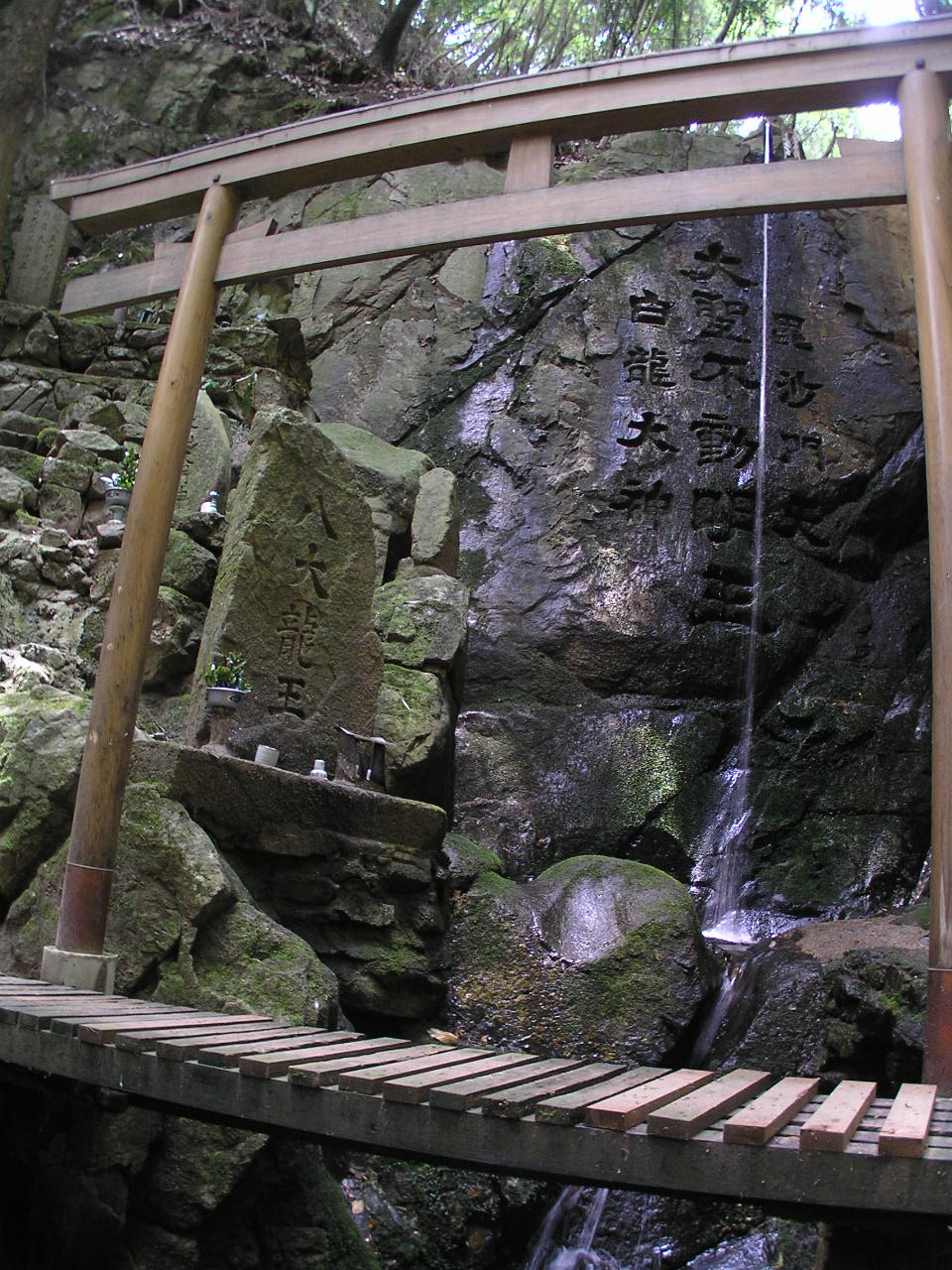
P.S. Featured photo is of Iyagatani (伊屋ヶ谷) waterfall, of Ryujuin (龍樹院) Temple. Photo by 松岡明芳, CC BY-SA 3.0, via Wikimedia Commons

Backfired: Poem Number 74

Even the Hyakunin Isshu has its comedic moments:

JapaneseRomanizationTranslation
うかりけるUkarikeru“Make that heartless
人をはつせのHito wo hatsuse nowoman, O mountain storm
山おろしよYama oroshiyoof Hatsuse Temple—
はげしかれとはHageshikareto wacrueller still!”—this is not
祈らぬものをInoranu mono wowhat I prayed for, and yet…
Translation by Dr Joshua Mostow

The author is Minamoto no Toshiyori Ason (源俊頼朝臣, 1055 – 1129), “Sir Minamoto no Toshiyori”, who is the son of Tsunenobu (poem 71) and father of Shun’e (poem 85) and was also a leading poet of his era, along with Mototoshi (poem 75). Toshiyori’s talents were not limited to poetry. According to my new book, he excelled at playing an instrument called the hichiriki, enough that he was invited to serve in the Imperial court under Emperor Horikawa. We went on to serve three Emperors in this capacity, and helped compile the unusually eclectic Imperial Anthology the Kinyō Wakashū, as well as many poems of his own in various anthologies.

The poem above was actually composed during a poetry contest held at the residence of Fujiwara no Toshitada, grandfather of Fujiwara no Teika (poem 97) who compiled the Hyakunin Isshu. The topic of the contest was “unfulfilled love so strong that one even prays to the gods”. The poem expresses frustration after having prayed to be able to meet a certain woman, and somehow she became even more resistant. As Professor Mostow explains, Teika valued this poem very highly because of its depth of feeling, excellent word choices, and clever story-telling (see below).

The name “Hatsuse Temple” is another name for a famous Buddhist temple in Nara, Japan called Hasedera. Hasedera is very well-known in Japan, and apparently was a frequent pilgrimage site for lovers and those with romantic interests. If you ever do happen to be in Japan, especially in the Nara area, I’d highly recommend visiting Hasedera temple.

This poem is listed as a “winter” poem, but I was really confused why this is since the topic sounds more like unrequited love. I checked my source, which explains that Toshiyori went up to Hatsuse Temple to pray, and then came back down (yama-oroshi, 山おろし) in the third verse. This symbolism of coming back down the mountain is evidentially considered a powerful symbol of winter. Perhaps this relates to New Year’s prayers and such. This third verse is also a neat dividing technique between the first half, praying at the temple, and the second half, the girl he was fond of despising him even more.

A Foggy Winter’s Morn: Poem Number 64

This is a great poem for the deep of winter:

JapaneseRomanizationTranslation
朝ぼらけAsaborakéAs the winter dawn
がわぎりUji no kawagiribreaks, the Uji River mist
たえだえにTaedae nithings in patches and
あられわたるArawaré watarurevealed, here and there, are
せぜの網代木Seze no ajirogiall the shallows’ fishing stakes.
Translation by Dr Joshua Mostow

The author of this poem known by the lofty title of Gonchūnagon Sadayori (権中納言定頼, 995 – 1045), or “Supernumerary Middle Counselor Sadayori”, was also known as Fujiwara no Sadayori, son of the eminent poet and critic of the era, Fujiwara no Kintō (poem 55).

Sadayori was also a respectable poet in his own right. According to my new book, when father and son took part in the Imperial precession by Emperor Ichijo to the Ōi River (大堰川, ōi-gawa), part of the modern Katsura River, he was tasked with composing a poem for the occasion and came up with this:

JapaneseRomanizationRough Translation
水もなくMizu mo nakuHow can one possibly
見えこそわたれMiekoso watarelook out over
大堰川Ōi-gawathe Oi River,
岸の紅葉はKishi no momiji wawhen the fall leaves
雨と降れどもAme to furedomorain down on the shore?
Translation by myself

It was a clever way to point out the beauty of fall, and both Kintō and the Emperor were impressed. Later, Sadayori was supposedly flummoxed by Lady Izumi’s daughter, Koshikibu no Naishi in a famous poetry contest (namely poem 60).

In any case, back to the Hyakunin Isshu poem. The phrase asaboraké is apparently short for asa ga oboroge ni aketekuru koro (朝がおぼろげに明けてくる頃) meaning “that time at dawn when things are hazy”, particularly in autumn or winter. It is also used in poem 31, and a challenge for karuta players as a result.

Sadayori’s usage of the Uji River (宇治川, uji-gawa), now known as the Yodo River (淀川, yodo-gawa), may not seem like much to modern audiences, but it carries much meaning in Japanese antiquity. The Uji River was frequently cited Japanese poetry, and runs through the Osaka metropolitan area. It is mentioned in the earliest Japanese poem anthology, such as the Manyoshu, and others. It was a pivotal place at the end of the Tales of Genji, written by Lady Murasaki (poem 57), when the heroine Ukifuné attempts to take her own life, but is rescued from the river and takes tonsure as a Buddhist nun instead. The Uji River was often deeply associated with turbulent relationships between men and women. In a more practical sense, it was also a place where the nobility of Kyoto often had second villas, and was a popular meeting place.

I actually had to look up what “fishing stakes” are. The term, ajirogi (網代木), refers to stakes in the water, like a fence or weir. Fish swim into these places and they were easier to catch with nets because they had fewer places to escape. You can see an illustration here. Side note: the Salish people here in the Pacific Northwest had a particularly ingenious system of fishing stakes as well.

Professor Mostow notes that the combination of the Uji River and the fishing stakes was a very famous image in ancient Japanese poetry, and this coupled with the image of a cold winter’s dawn make this a powerful poem. Unlike other poems in the Hyakunin Isshu which might be hypothetical, exaggerated or talk about something abstract such as love, Mostow points out that this poem likely was written exactly as Sadayori saw it. I can only wonder what it was like watching the fishermen go to work early that icy morning.

P.S. The featured photo is the Kennebunk River during fog, photo by David Lounsbury, CC BY-SA 2.0, via Wikimedia Commons