January 2024 Blog Update!

Hello Dear Readers,

After a fun discussion with some fellow members of the Seattle Karuta Club, I decided it was time to go and make some much-needed updates to the Hyakunin Isshu poems in the blog. I did this for several reasons:

  1. The blog had grown organically since 2011, so some poems used a different format than others. They were not internally consistent. Further, spellings of the same word were not consistent between poems either.
  2. Back then, I had no access to Japanese resources (and couldn’t understand them anyway), so I used my own convention for naming the authors, based loosely on Dr. Joshua Mostow’s book. This was a problem with the Index page in particular which people use a lot.
  3. The odd spellings in the Hyakunin Isshu were glossed over, which has become a problem for people learning karuta, who need the furigana clues on how to read them.
  4. The poems here did not match how they’re recorded in Japanese sources. Subtle differences with using kanji (Chinese characters) vs. using hiragana. While the poem is the same, Japanese books on the Hyakunin Isshu tend to write the poems a certain way, and my blog posts didn’t match this. Back then, I didn’t know better. 😅
  5. Some blog posts were thin on biographical information due to lack of English sources. My new book really helped fill in the blanks. I tried to add more content for some of the thinner blog posts. This is still a work in progress, as I read Japanese slow, and am a working parent.
  6. The blog was composed starting in 2011, and the WordPress blog templates have changed over time. Differences in template code over time meant that some poems didn’t render their photos properly. Other photos just looked terrible, or didn’t match the theme of the poem upon closer inspection.
  7. WordPress tags were applied inconsistently, making searching some poems difficult.

So, as a “type-A” nerd, I’ve spent the last two weeks going poem by poem, cleaning things up, and applying a consistent format, author names and poem texts that match Japanese sources, added furigana, and fixed the blog code for pictures, plus replacing a few pictures here and there. Consistent blog tags have been applied too.

Many of these updates and fixes are subtle, so you might not notice at first, but I hope you the reader will get a cleaner, more accurate experience as you explore the Hyakunin Isshu. Enjoy!

As for me, I am taking a break and going back to playing Fire Emblem: Three Houses.

P.S. my desk, shown above in the featured photo, has been even more messier than usual. 😅

Stay Focused, Keep Trying

After taking up karuta with the local community, I was soon introduced to the international Karuta Discord group (Discord invite link here). The international karuta community is great, and you get to meet people from places like Brazil, Russia, Germany, etc. If you are even casually interested in karuta, or the hyakunin isshu, it’s a nice community and worth joining.

Further, the community has been organizing periodic tournaments using the online Karuta app. I started learning karuta 2-3 months ago, and finally got to the point where I know (more or less), the 100 kimari-ji. So, I decided to throw my hat into the ring and register for the October competition.

Right away, I realized that I might be in over my head.

I lost a couple matches, both very decisively, and felt pretty of embarrassed. At the end of that day, I played poorly. In addition to slow reaction time to take cards, I tilted (in Magic: the Gathering speak) and fell apart under pressure.

I was pretty disheartened by this and I wondered if maybe I am just hopeless. Since I am starting karuta pretty late in life, I feared that maybe I am just getting too old for the game.

But, then I got to thinking. In my spare time, I’ve been playing a game called Fire Emblem: Three Houses (mentioned in my other blog here, among other places). The game, at its core, is about taking a team of amateur students and gradually turning them into an elite force through training, trial, etc. The instructor and main character, Byleth (catchphrase: “stay focused”), develops their individual talents, addressing weaknesses, taking them on training missions, etc.

I kind of felt inspired by this (and frankly, it’s an awesome game), so I got to thinking: I really do want to improve. However, if I want to improve at karuta, I need to get back to basics, stay focused, and work towards small improvements at a time:

  • Get back to basics – practice memorizing kimariji. I sometimes recalled the cards too slowly, or incorrectly. Also, card placement at the beginning of the match (tei’ichi 定位置) is important.
  • Stay focused – learning to stay calm, no matter what situation, and just pay attention to where each card is on the board. When I do get flustered, take a moment to calm myself and re-focus.
  • Work towards small improvements – I can’t expect to win tournaments overnight. But if I focus on making small, incremental improvements, inevitably my game play will improve. Things such as:
    • Better card placement on the board for easier recall / taking.
    • Cutting down on penalties
    • Small improvements to taking cards faster.
    • Getting better acquainted with rules and etiquette. The online app handles most of that, but it’s still essential to learn.

So, if you’re playing karuta, or any competitive game, and you’ve been crushed in defeat, take heart. Given enough time and dedication you will definitely improve. Don’t worry how well other people play, focus on how well you’re playing now.

Edit: if you are a fellow Three Houses fan, I challenge you to boldly declare “I am Ferdinand von Aegir” during your next Karuta match and swipe half the cards from the board Chihayafuru style.

Either you’ll make a new friend (since they are a fan), or they’ll think you’re nutty.

P.S. Featured image source is from Nintendo, and depicts both genders of Byleth (you can play either one, which is neat).

Playing Karuta Online

Edit: after publishing this article, a kind reader “Kiri”, pointed out that an English-language option exists, so I re-wrote much of this post to focus on that. Thanks Kiri!

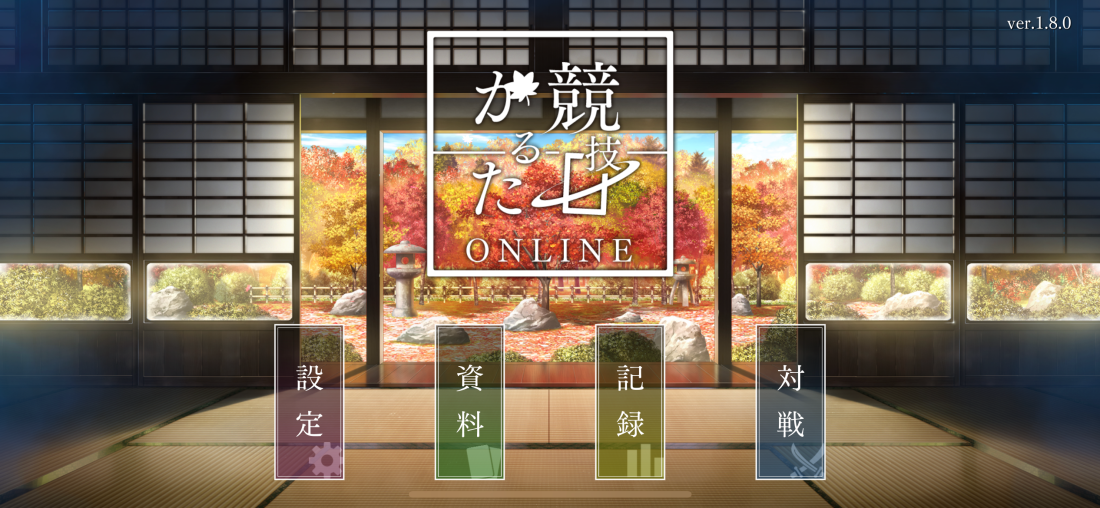
If you are interested in learning how to play karuta, and especially if you live outside of Japan, it can be hard to find ways to practice, and learn the basics of karuta. The good news is that there is a great smartphone app for this. The Kyōgi Karuta Online (homepage), is available for both IOS and Google Android, and is a well-developed that lets you either play against a computer (great for training) or against opponents online (usually in Japanese time zones).

If you want to switch to English from Japanese, you can just follow this sequence of options (among other possible methods):

Battling

Battling of course is the point of the game, and there are two options available. The computer (CPU) option allows you to play anytime, anywhere without finding an opponent. I also find it very useful for training purposes.

Playing online of course is a more realistic experience, but requires finding opponents, and sometimes the skill levels do not always match.

Let’s look at each…

Computer Play

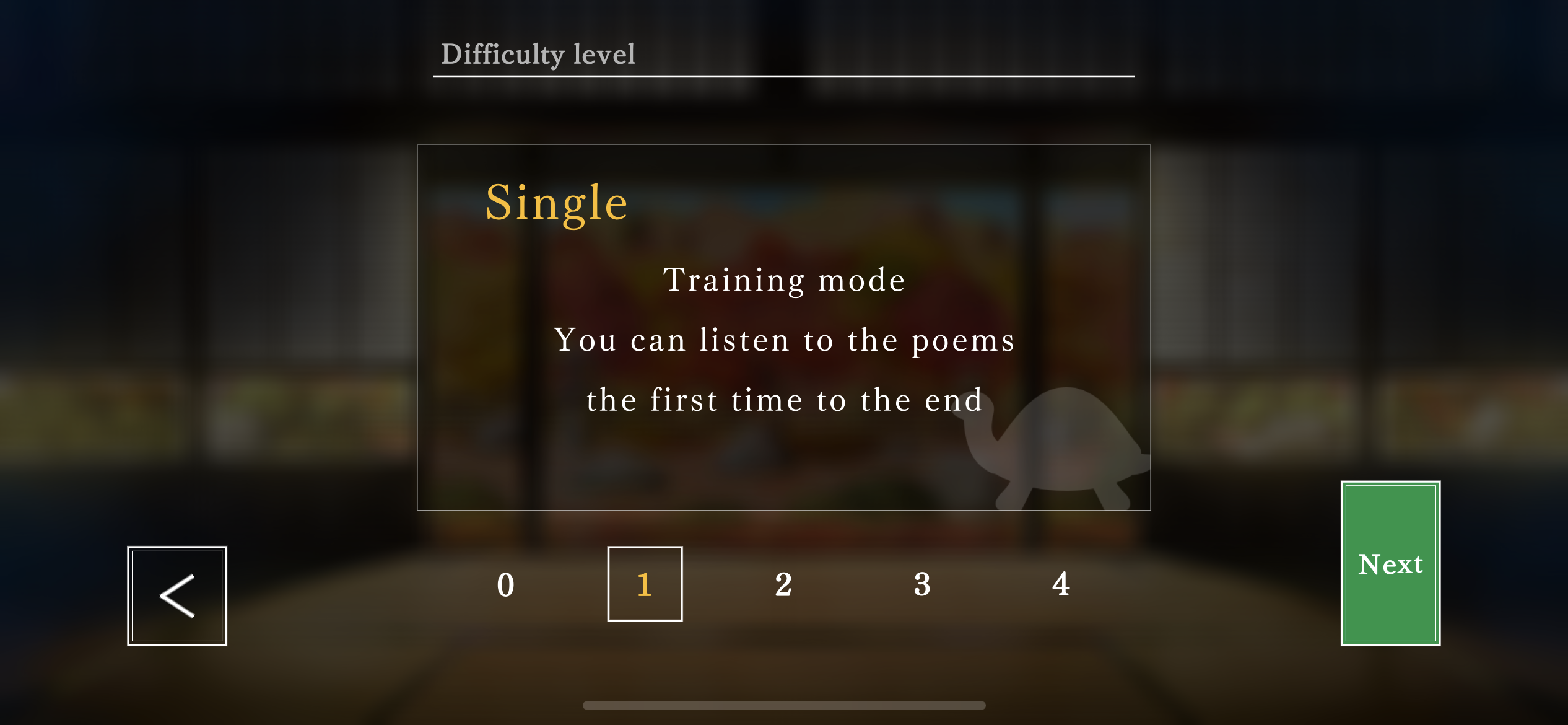
The computer play offers five modes, from left to right:

  • 0 – short for tutorial
  • 1 – single, this is basically a “goldfish” opponent, an opponent who is entirely passive allowing you to play at your own pace.
  • 2 – easy
  • 3 – normal
  • 4 – hard

Even if you are somewhat familiar with the game of karuta, the tutorial is great and provides helpful tips and explanations of the rules of the game, plus you still get to play a match at the end.

I found, at first, that playing oneself (i.e the “goldfish” option) is a great, safe way to play and get the feel for the game before moving into easy mode.

Playing Online

At some point you will want to try online.

The vast majority of karuta players are in Japan and so Japanese daylight hours, especially weekends, are the best time to find an opponent. On the upper-right corner of the screenshot above you can change your gamer tag from “guest” to whatever you want. As of writing, my tag is SpockHere (not shown above), so maybe you might find me online.

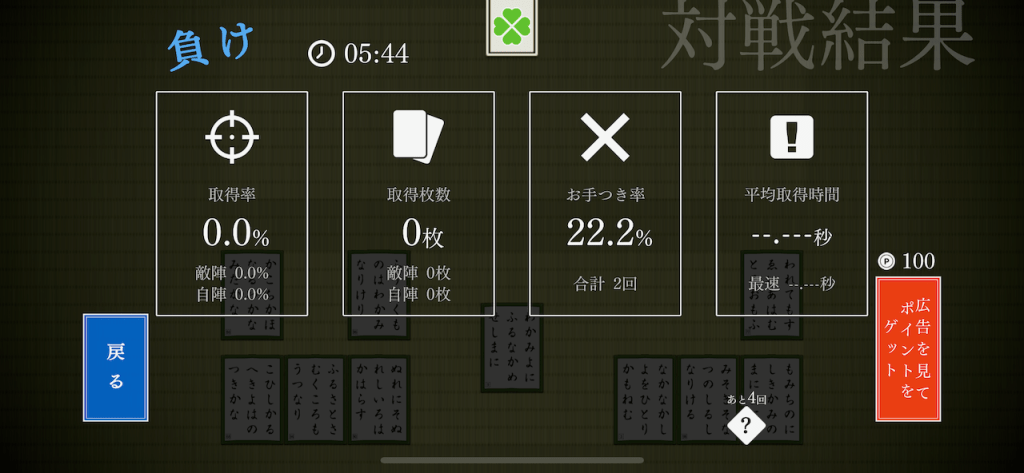
My first match online with a Japanese player was a complete disaster:

(I’ve been playing in Japanese partly to help with my reading, partly because I didn’t know the English-language option even existed until recently 🤦🏽‍♂️)

I took 0 cards and had 22.2% penalties because I was panicking. My opponent was so fast and aggressive that I failed miserably.

My second opponent was less experienced, but I still did poorly:

Here I did get 1 card, but still got 14.3% penalties.

That said, experience is the best teacher, so if you’re willing to take a few lumps early on, you can gain valuable experience that will help in the competitive scene. Eventually, the more you play, the better prepared you will be.

Mini Games

Note: special thanks to “Kiri” and “Lore” for pointing me to this feature. I totally overlooked it.

In the battle section, the game also includes some mini games which you can find here:

These games are a handy method for building basic skills.

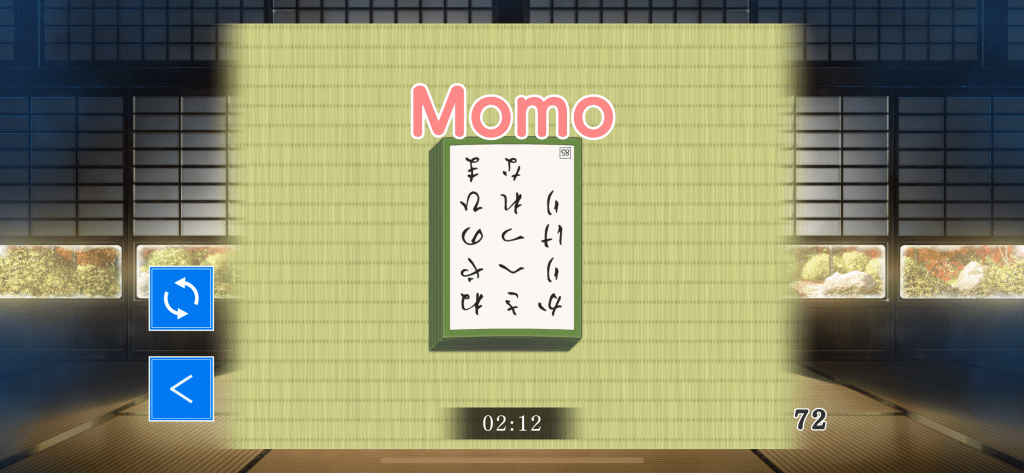
The “FlashCards” game (fudanagashi, 札流し in Japanese) will take you through all 100 torifuda cards and you guess the kimari-ji :

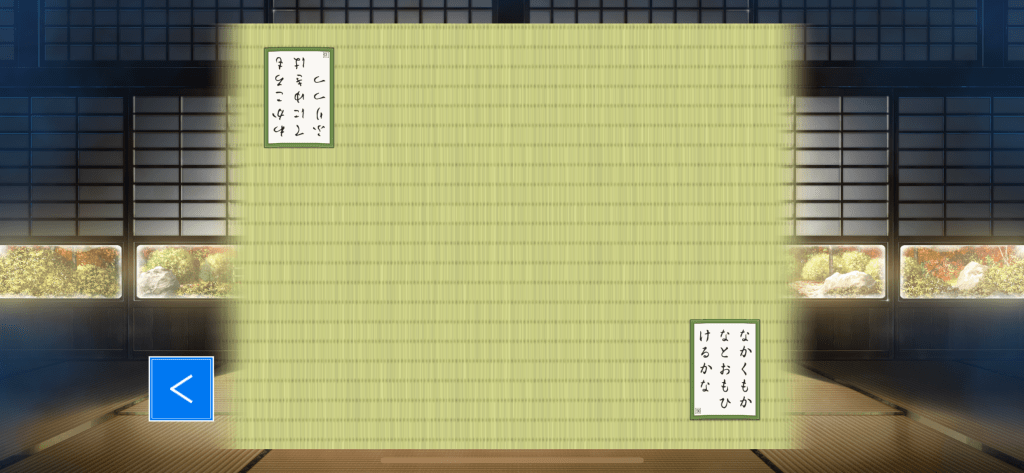
Sometimes the cards appear upside-down, just like in a real game.

The other game, Branching Cards (kikiwake, 聞き分け), helps you distinguish cards with similar sounding kimari-ji. This is important in avoiding painful penalties.

One of these cards has a kimari-ji of きみがためは and the other has きみがためお. You have to listen carefully and take the correct one.

Conclusion

Karuta Online is a great app for easing into playing karuta without having to make a big commitment upfront, but also a way for experienced players to hone their skills too. Non-Japanese players, who are otherwise scattered around the globe, use it to organize tournaments too.