I can’t believe this thing has kept going for so long. When I made my first post (here is the first poem I posted), I never imagined that fifteen years later I would still be fascinated by the Hyakunin Isshu, or that I would have so many wonderful readers from around the world, including some in my own backyard. ❤️
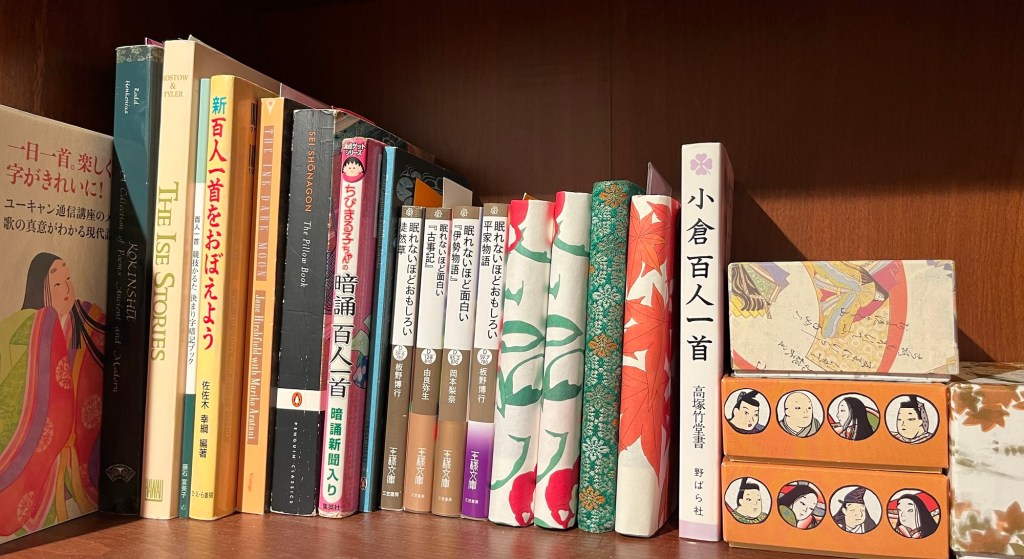
My bookshelf collection, minus a few items too large to fit. The book in yellow on the left belonged to my late mother-in-law (RIP). A few books are wrapped in book covers too.
Thank you all for your support and interest over the years. 🥰 With luck, this blog will hopefully stay around for a long time to come.
I have been quietly doing a number of updates to existing blog content. This includes fixing some inconsistent formatting, and fixing broken or outdated links. Tags and categories were cleaned up and standardized as well. This was long overdue.
In addition, all references to Amazon.com have been removed.
Finally, it’s that time again: cherry blossom season. It is still a bit early where I live, but if you are planning to view cherry blossoms (ohanami, お花見), then feel free use my handy guide.
Thanks everyone and happy spring to readers in the Northern Hemisphere!
First, I appreciate the feedback recently about challenges finding a suitable poem for an occasion. I’ve experienced this problem too, so I decided to update the poem index, and sort it three ways: by traditional, numerical order, by poetry topic, and also by the kimari-ji syllables. Different readers come to this site for different reasons, and hope this will make everyone’s life easier. Some of these lists already existed, but I tried to collect them in one, convenient place.
Second, I took a few months from the blog to focus on other things, and get some much-needed rest. Now that I am picking up the blog again, I decided that I want to focus more on the Hyakunin Isshu specifically. That was the original focus of the blog, but over time I branched out to other poetry anthologies and other topics. It was fun to explore, but I’d like to get back to the blog roots and narrow the focus again. It means fewer blog posts in the short-term, but I think I will make the blog more enjoyable in the long-run.
Thanks for reading, and feel free to continue dropping feedback and such.
Welcome to the New Year and Happy 2025 to you all. The blog also celebrates its blogoversary on January 26th, 2011! The blog is 14 years old. 🥳
The first posts, posted on the same day, are here and here. At the time this blog was meant to be a side project. However it outlasted my other blogs.
The blog has had its periods of activity, and periods of quiet. Lately, the blog has been quiet as I have been preoccupied with holidays, family, and other hobbies. I haven’t played karuta in months, and haven’t been reading any pertinent books lately either.
However, I am working quietly on the back-end to make some improvements to searching the blog and making certain information more easily accessible (based on recent feedback), and shuffling a few pages around.1 What happens after that, time will tell.
But it has also been nice to just recharge and take a break.
Nonetheless, I am happy to celebrate this blog lasting as long as it has, inactivity notwithstanding. And of course, thank you readers and Hyakunin Isshu for your support and encouragement.
As for 2025, best wishes to everyone, and may the new year bring you many smiles.
1 It’s interesting to look at anonymous blog stats and see people’s viewing habits. Oftentimes, they surprise me: what I think people will want to read versus what people are actually looking for.
As I noted in my other blog, I am taking time off the rest of the year to rest, and catch up on nerd projects.
One last post before end of the year: I forgot to share this previously, but during the trip to Japan this summer, and on the same day we both visited the shrine to Sei Shonagon, and the site where the Hyakunin Isshu was compiled, I made one more stop: Nonomiya Shrine. The official website is here (English).
Nonomiya Shrine (nonomiya-jinja, 野宮神社) is a Shinto shrine that has been around since antiquity in west Kyoto within the bamboo forests. You can see it here on Google Maps:
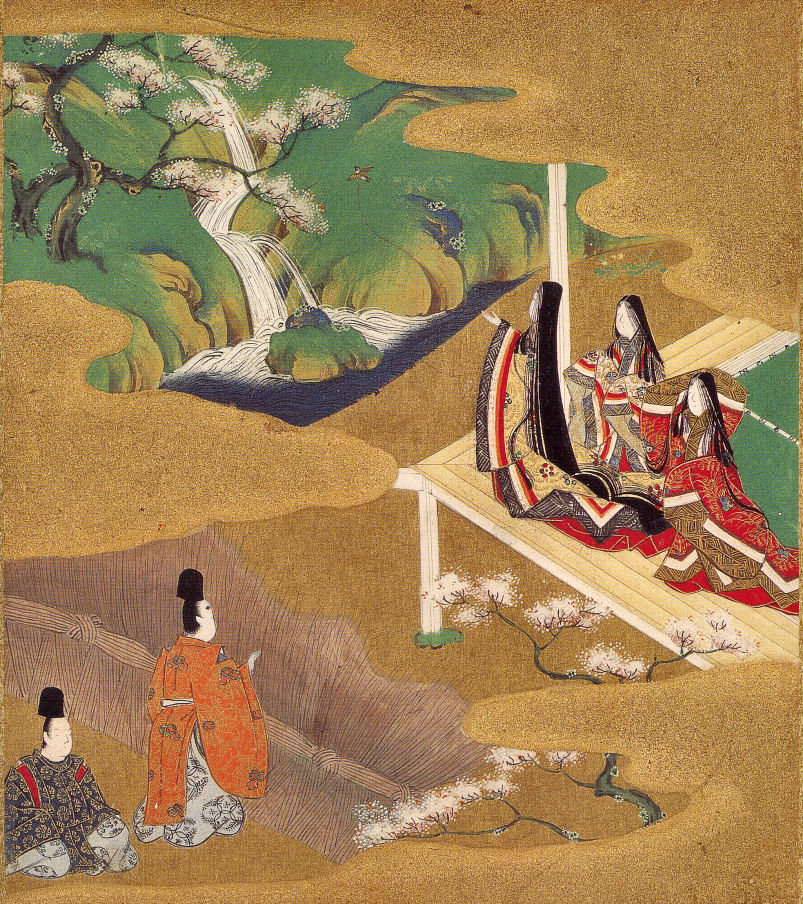
While it is not related to the Hyakunin Isshu, it is related to Lady Murasaki (poem 57, め), whom I wrote about here. You see, one of the most iconic chapters of the Tales of Genji, Lady Murasaki’s famous novel, the “Heartvine” (Aoi, 葵) takes place at Nonomiya Shrine. Here, Genji the protagonist meets Lady Aoi his future wife. So, Nonomiya Shrine is associated with romance and falling in love, or meeting one’s soulmate, and since it was already a fixture in Kyoto culture at the time, Lady Murasaki used it as the backdrop for this romantic encounter.
Even now, many people (both Japanese and tourists) come here to pray for love, and many of the omamori charms are focused on romance too. It’s nestled within the famous bamboo forests in the area:
I stumbled upon it by accident after leaving the aforementioned site where the Hyakunin Isshu site was compiled. My family was waiting for me, it was late in the day, and it was very hot and humid, so I didn’t stay very long, but I wanted to at least grab a few photos, and get an omamori charm.1
Anyhow, that’s it for the blog for 2024.
I wanted to end this post by saying thank you to readers. The blog has been been around since 2011 (with some major gaps in content), and with plenty of twists and turns, but I am happy to see that people are still actively reading it, and discovering the Hyakunin Isshu, Heian-period culture, and Japanese poetry overall.
See you all next year!
P.S. Not far away was an exhibit for the historical drama about Lady Murasaki as well.
1 Most of the charms are for en-musubi (縁結び), meaning finding a partner in life, but since I am already happily married, I looked for something general. I picked up a omamori for kai-un (開運), meaning “good luck”, but it showed the famous scene from the Tales of Genji where Genji and Lady Aoi meet at Nonomiya Shrine. I wish I remembered to take a photo sooner, but I already gave it to someone, and have no photos to show. 🤦🏼♂️
You can see it on the website here, the charm on the upper-right corner.
You may have noticed the blog looks a bit different now. I have been struggling since the big blog refresh I started in December 2022 to get the appearance just right. Design isn’t my forte (I am a history nerd), so I’ve struggled with finding the right design for this blog. The original blog template on WordPress was so old (this blog was started in 2011) that it was no longer supported by WordPress, so I had to find something else that works. After dabbling with a few designs this past year, I’ve settled on current blog template as of last week and I am pretty happy with it. I hope you all like the new design. I liked it so much I applied the same template to the other blog.
Next news: I will be off to Japan again this summer … though only briefly. The family and I will visit the ancient capitol of Kyoto, just like last year,1 but the visit overall is much more limited and I probably won’t get to see many things related to this blog. I won’t have time to visit Oishi Tengudo again, or Kitano Tenmangu Shrine, but I do however plan to make a stop at Kurumazaki Shrine (mentioned here) to pick up one of those Sei Shonagon (poem 62, yo wo komete) charms. I may try to work in a few other tourist spots related to the Lady Murasaki drama given that it’s popular right now. I also expect to melt under 35C(95F)-degree weather with 75% humidity again like last year.2
I have a few more posts coming up between now and the trip (late July), and I hope you will find them interesting.
Finally, just as a fun bonus, I wanted to share a one-off poem by Lady Izumi (poem 56, arazan) that I recently heard on a different Japanese historical drama. Lady Izumi is one of my personal favorite figures in the Hyakunin Isshu, and this poem was first recorded in an Imperial anthology, the Goshūi Wakashū (後拾遺和歌集), poem 755:
It’s not clear from this poem which lover she is referring to, since she had a number of relationships over the years, nonetheless it is a very sincere, romantic poem and expresses her passionate style nicely.
Happy Summer!
P.S. speaking of history nerd, I’ve debated about making a Japan / history podcast (like many other fine podcasts I follow), but have struggled to find a good theme. I might simply do the “history of the hyakunin isshu” podcast someday. It’s a bit commitment though, so we shall see.
1 While we do visit Japan yearly so my kids can spend the summer with their grandparents and extended family, visits to Kyoto are rare because of cost, time, and so on. Our last visit was almost 15 years ago. It just so happens that we could make two trips in two years. After that, who knows when we will visit next?
2 Without going into too many details, the humidity, heat and fluid loss aggravated an old medical issue I have. A reminder to stay hydrated, and avoid junk food. I like getting older in many ways, except at times like this. 😋



 The Hyakunin Isshu