The Final Days and Legacy of Lady Murasaki

At last, the historical drama about Lady Murasaki has come to an end this week, and sadly I watched the last episode. The drama was slower than other past Taiga Drama on NHK, but it was a lovely tribute to an amazing woman. Lady Murasaki, author of the Tales of Genji, her eponymous diary, and a famous poem in the Hyakunin Isshu left a lasting mark on Japanese culture and world literature.

The final title card for the Japanese historical drama “Hikaru Kimi E”.
The concluding title card for the historical drama: hikaru kimi é (光る君へ, “to you, my radiant one”).

Details of Lady Murasaki’s final years are pretty sketchy, but it seems that she eventually retired from service in Fujiwara no Michinaga’s household, and gradually took up travel. She was born in the year 973, but some scholars believe she may have passed away in 1014 at the age of 41. Others believe she may have lived to the year 1025 (age 52). For the premodern era, this is a pretty typical lifespan for many people, including nobility. Still, as someone who’s older than her, it’s hard to imagine her dying so young.1

Her grave is located in Kita-ku ward of Kyoto:

With her passing, a couple attempts were made to preserve and edit her magnum opus. Fujiwara no Teika (poem 97, こぬ) who compiled the Hyakunin Isshu itself undertook one of these efforts, creating the Aobyōshibon (青表紙本) edition. At this time in Japan, manuscripts had to be hand-copied, and so across several centuries, limited efforts were made to hand-copy works from Lady Murasaki’s time, which helped preserve them across the medieval period, but were inaccessible to general audiences.

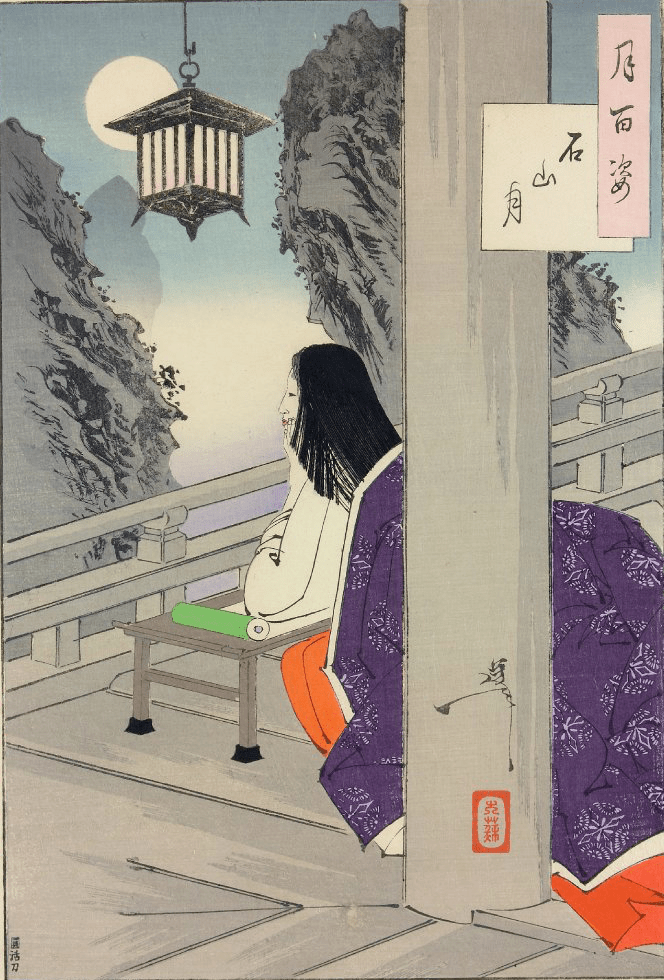
A woodblock print of Lady Murasaki from 1889 made by Yoshitoshi, Public domain, via Wikimedia Commons

By the Edo Period, 17th century, block printing and a flourishing of “book culture” greatly expanded the audience of the Tales of Genji, and Lady Murasaki enjoyed a surge in popularity, rescued from obscurity, and even today is high revered. Lady Murasaki is to Japanese culture what Shakespeare is to the English-speaking world. The historical drama that concluded is arguably an extension of this revival.

Finally, I wanted to explore the relationship between Lady Murasaki and her patron, Fujiwara no Michinaga. In the historical drama, they shared a relationship since childhood (historically improbable), and even had a love child together even though they never married. Political marriages were common among the nobilty at the time, as was infidelity, and so Fujiwara no Michinaga having an official marriage yet carrying a number of romantic trysts would not be surprising. The Hyakunin Isshu poetry is rife with such romances.

And the real, historical relationship between Lady Murasaki and Michinaga is unclear. It’s widely believed that the main character of the Tales of Genji was patterned from Michinaga. Her diary also shows her flirting with Michinaga somewhat. And yet, it’s also implied that she fended off his romantic advances too. The fact that she worked under him, the most powerful political figure in Japan at the time, made their relationship even more complicated. If her daughter, Daini no Sanmi (poem 58 of the Hyakunin Isshu, ありま) was indeed Michinaga’s, as the drama depicts, it may help explain how she was brought into the court inner circle too, alongside her mother. And yet, evidence one way or another is pretty limited, so one can only speculate.

Lady Murasaki herself was woman perpetually out of place in the courtly life of the late Heian Period. Her diary shows her frequently introverted, melancholy, out of place, and exhausted by the back-biting of other women, or the rowdiness of drunk men. Her father had lamented that in spite of her literary talents, her being born a woman in that era meant her talents would go to waste. Such was the period of the time.

One can easily imagine a brilliant woman like Lady Murasaki in modern times sitting in cafe, writing a romance novel, feeling alone, yet observing the world around her in a way that is beautiful and poetic, pouring her heart into her work. What Lady Murasaki conveyed through her writing was something can we can appreciate even today, eleven centuries later.

Out of all the literature of the time, nothing quite epitomizes the sentiments and milieu of the Heian Period, an era now lost to time, yet strangely familiar, quite like Lady Murasaki did.

P.S. The drama definitely took some historical liberties for the sake of drama, but I have to admit that it did a nice job of showing Lady Murasaki as a complex person, and all the different challenges she had to deal with. The last several episodes were really touching and brought tied up things nicely. I might try to purchase the drama next year if I can, but it’s quite expensive ($300-$500 USD), so time will tell.

1 As someone who also spent some time in the ER earlier this year with emergency surgery, I can imagine that I too would have likely died in my 40’s without modern medical care. Modern people often forget how brutal and short life was for the average person before medical science, and how many people never lived past 50, or did so with crippling conditions.

Where It All Began: Mount Ogura

Hello everyone,

I just returned from another trip to Japan,1 and we got to spend a bit of time in Kyoto. By accident, I also found Mount Ogura, and the place where Hyakunin Isshu was compiled! But first, let’s backup and explain a bit of history first.

Kyoto was the capital of Japan from the 8th century to the 19th century, and so many well-to-do families lived here. This aristocracy wrote countless waka poems that were compiled into official poetry anthologies from time to time,2 but the Hyakunin Isshu was not one of them. It was compiled by Fujiwara no Teika (poem 97) as a favor to his in-laws. Teika had been a compiler of one of the major anthologies, the Shin-Kokin-Wakashu, but was now in retirement after his liege lords (poem 100 and poem 99) were exiled in the upheaval of the Jokyu Rebellion. He resided in a small villa on the west side of Kyoto on the hillside of Mount Ogura, and was tasked with selecting the very best 100 waka poems that his in-laws could decorate their home with. Teika’s excellent poetic taste led to the Hyakunin Isshu we celebrate today.

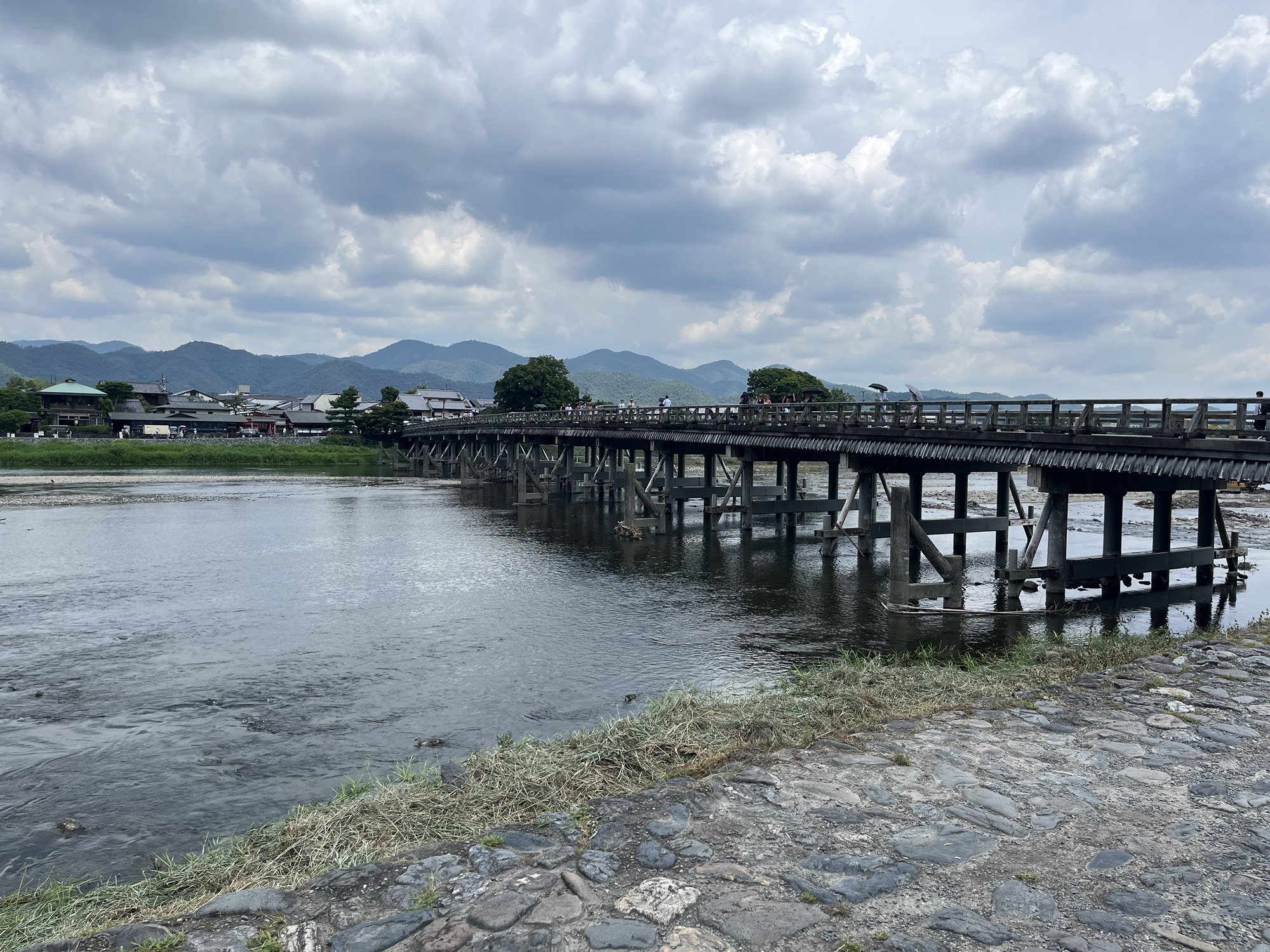
Anyhow, back to present day. I was with the family, and we visited a part of western Kyoto called Arashiyama (嵐山). It’s a very scenic place, with famous bamboo forests, and an iconic bridge named Togetsu-kyō (渡月橋):

Since we visited in the summer, it was extremely hot and muggy, so by lunch time we were exhausted and tired. We went to a local cafe and had lunch. Since we were in Kyoto, I assumed there would be many famous historical places related to the Hyakunin Isshu,3 but I was having trouble finding them on GPS, so I was disappointed.

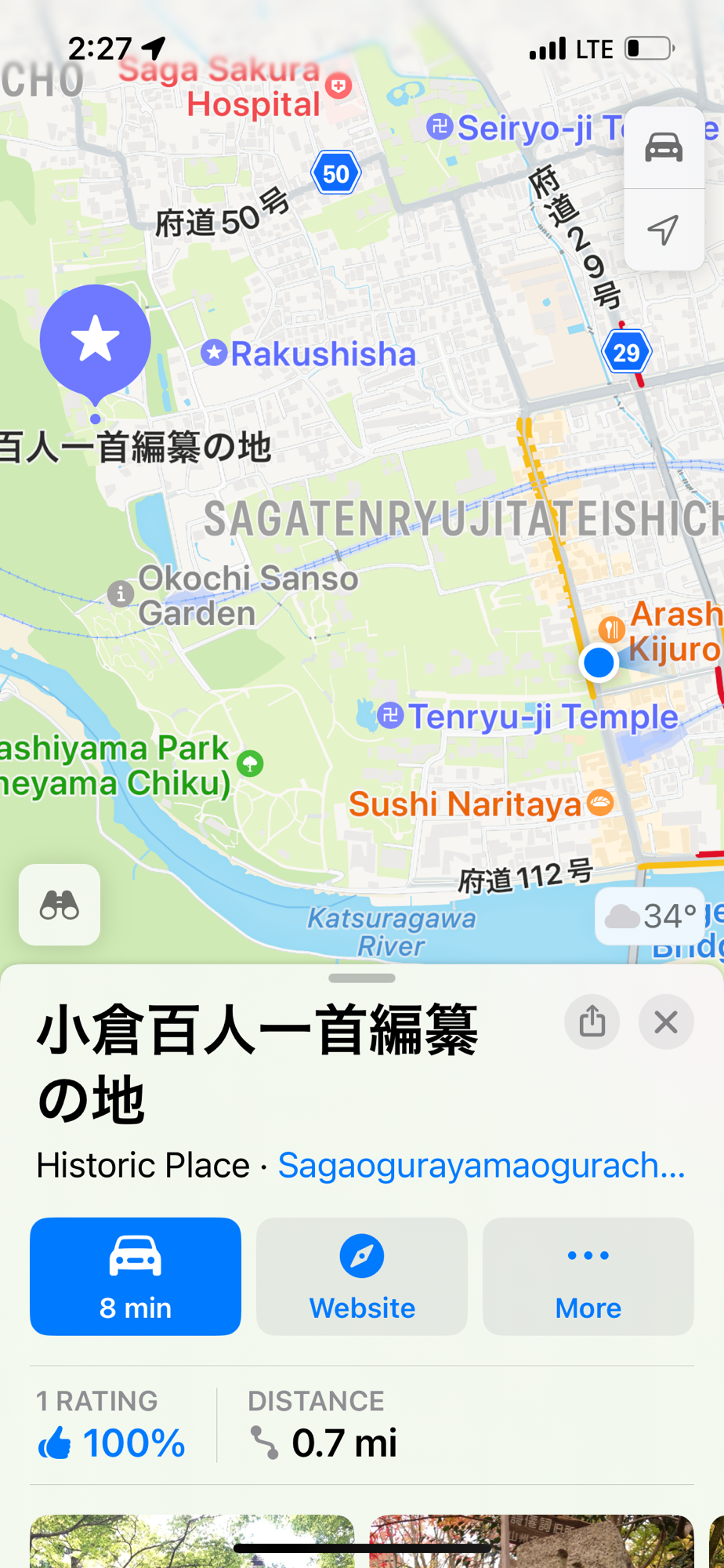
Then I noticed the following spot on my map app:

小倉百人一首編纂の地 (ogura hyakunin isshu hensan no chi) … the place where the Hyakunin Isshu was compiled…? Wow, that’s only 15 minutes by foot from where I was at!

The family was exhausted and sweaty, and were planning to return to our hotel, so I didn’t want to drag them uphill in the heat. I told them I’d be back, and I took off for the place on the map. It turns out that the properly had been converted to a Buddhist temple named Jojakkō-ji (常寂光寺) in the 17th century (a common practice in Kyoto). You can find the official website here.

This is Mount Ogura today.

I followed the map directions and made it safely to Jojakko-ji Temple:

There is a small entry fee, but once I paid that, I got to the second gate here:

The site of the Ogura Hyakunin Isshu is just down the path to the right, before the gate. I made the mistake of going up the stairs instead:

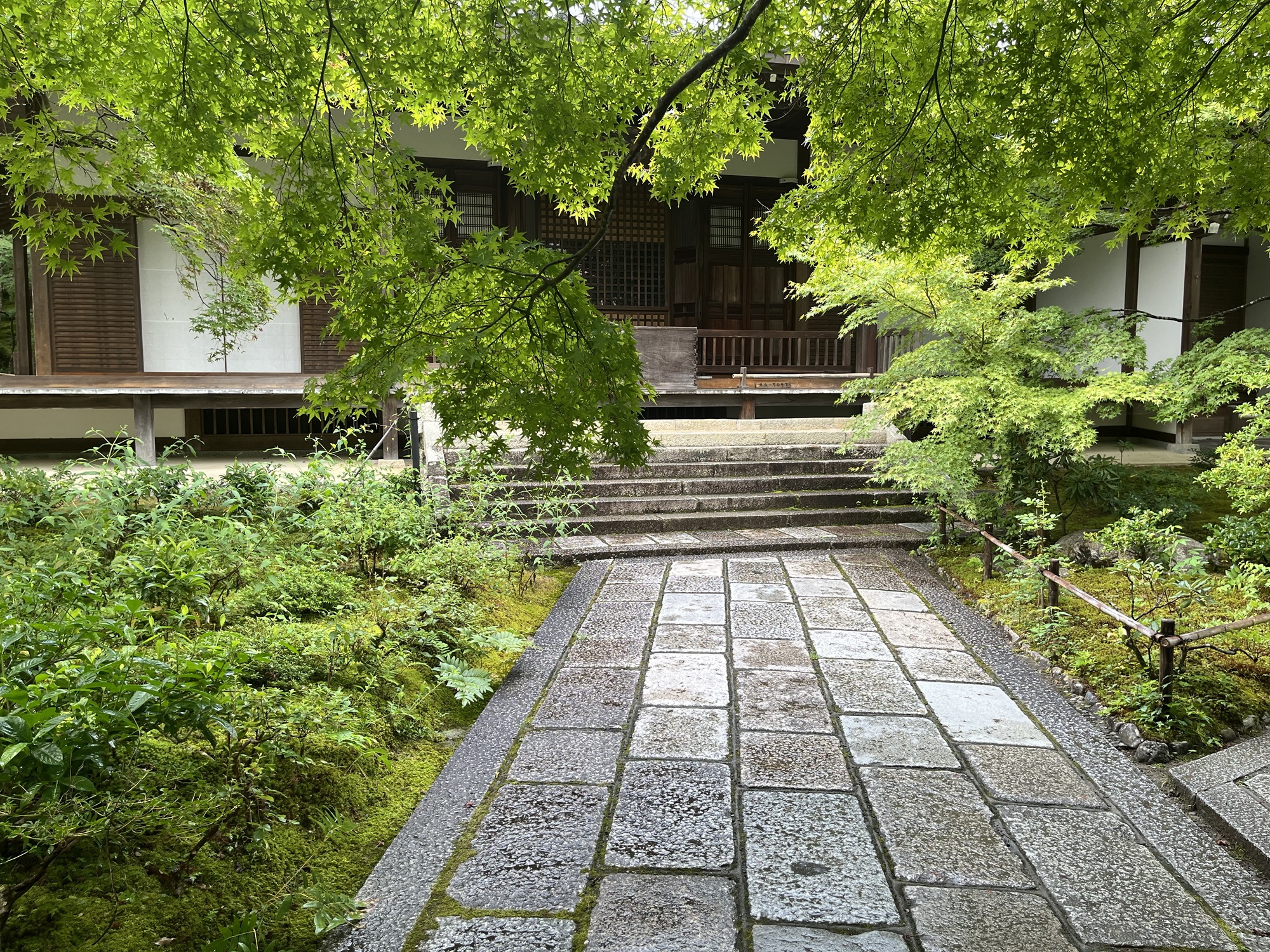
Jojakko-ji Temple is quite scenic actually:

… but it was very late in the day, my family was waiting back at Arashiyama, and I had to hurry. This was my one shot, probably in my lifetime, to find this place, but the temple maps, nor the website show precisely where it was.

Finally, I found it:

The photos from the prefectural website look a lot better than mine (good lighting helps). But there it was, the actual site where the Ogura Hyakunin Isshu was compiled!

The stone marker is pretty small and somewhat eroded, but there was no mistaking it.

Since I was short on time, I paused and said a quick “thank you” to Fujiwara no Teika and then headed back.

If you are fan of the Hyakunin Isshu, and you are in the Arashiyama area of Kyoto don’t miss this small but significant site.

P.S. while at Jojakko-ji, I met a nice Australian couple who had just finished their visit. They told me that at the top of the temple you can see a really view of Kyoto. I didn’t have the time to see it for myself, but if you go, don’t pass up the chance.

P.P.S. I forgot that, ten years ago, I had made a post about Mount Ogura. You can see the Togetsu-Kyo bridge here too.

1 We return every year when possible to visit my wife’s in-laws, and let the kids spend time with their relatives, learn more Japanese, etc.

2 Many earlier poems were also composed at a time when Japan’s capital moved around (Nara, Fujiwara-kyo, Asuka, etc) before settling down in Kyoto. See the Manyoshu for further details.

3 I did actually find one other place we visited earlier in the day, but more on that in an upcoming post.

Teika’s Handwriting!

In other recent, exciting news, I found this article on the Asahi Shimbun newspaper: the discovery of some of Fujiwara no Teika’s personal notes. This is called the kenchū mikkan (顕注密勘).

Long before Fujiwara no Teika (poem 97) compiled the Hyakunin Isshu, he served as a minister under Emperor Gotoba (poem 99). Among his duties, Teika was commissioned in 1201 to compile a new Imperial poetry anthology, which later became the Shin Kokin Wakashu (新古今和歌集).

Here you can see some of his notes and thought process as he’s compiling the poems together. It’s a fascinating discovery.

You can click here to see more detailed photos of his notes. They are read from right to left, vertically not horizontally.

You can also see another example of his handwriting here, courtesy of Wikipedia, from diary:

Teika himself had a pretty rocky career and after his liege lord was exiled, Teika spent the rest of his days living as a Buddhist monk. Nonetheless, his legacy lives on.

New Book in Japan!

Hello from Japan! The family and I are here visiting family, but we are also using the time to visit some sites my youngest son hasn’t seen before (Pandemic ruined past travel plans).

Anyhow, yesterday my wife and I stumbled upon a fascinating book at the local bookstore titled Nemurenai Hodo Omoshiroi Hyakunin Isshu (眠れないおもしろい百人一首), meaning “[Facts about the] Hyakunin Isshu that are so interesting, you can’t sleep”. The publisher’s product link is here.

The book groups the 100 poems in a different order and seeks to get inside the mind of Fujiwara no Teika (poem 97), the compiler of the anthology, in order to determine why he selected these poems above thousands of others. The book tends to favor more salacious aspects of the authors and theories about why they composed the poems they did, but much of it lines up with Professor Mostow’s book too.

For example, I am currently memorizing poem 61, and the book explains some of the backstory of why the Ise no Tayu, and not someone more senior like Lady Murasaki (poem 57) got the privilege of reciting the poem for that occasion.

The illustrations in the book are amazing. The fantastic artwork really brings the stories of the authors to life.

Anyhow, as I read more, and as I come across more stuff related to the Hyakunin Isshu, I’ll be sure to post here, and update existing poem entries with more backstory details.

Talk to all soon!