Ancient Japanese Dad Joke: Manyoshu Poem Number 27

The poem from the Manyoshu feels like an ancient Japanese dad-joke. Read it out loud and you’ll see what I mean:

ManyoganaModern JapaneseRomanizationRough Translation
淑人乃よき人のYoki hito noMen of old
良跡吉見而よしとよく見てYoshito yoku mitecame to Yoshino
好常言師よしと言ひしYoshito ii shiand declared it a good place,
芳野吉見与吉野よく見よYoshino yoku miyoSo, good sons, go
良人四来三よき人よく見Yoki hito yoku miand take in the view!

The author of the poem is Emperor Tenmu whom we saw here and here. He is the younger brother of Emperor Tenji of Hyakunin Isshu fame (poem 1, あきの), and husband/uncle to Empress Jito (poem 2, はるす).

Yo, yo, yo, this poem has lots of “yo” words.

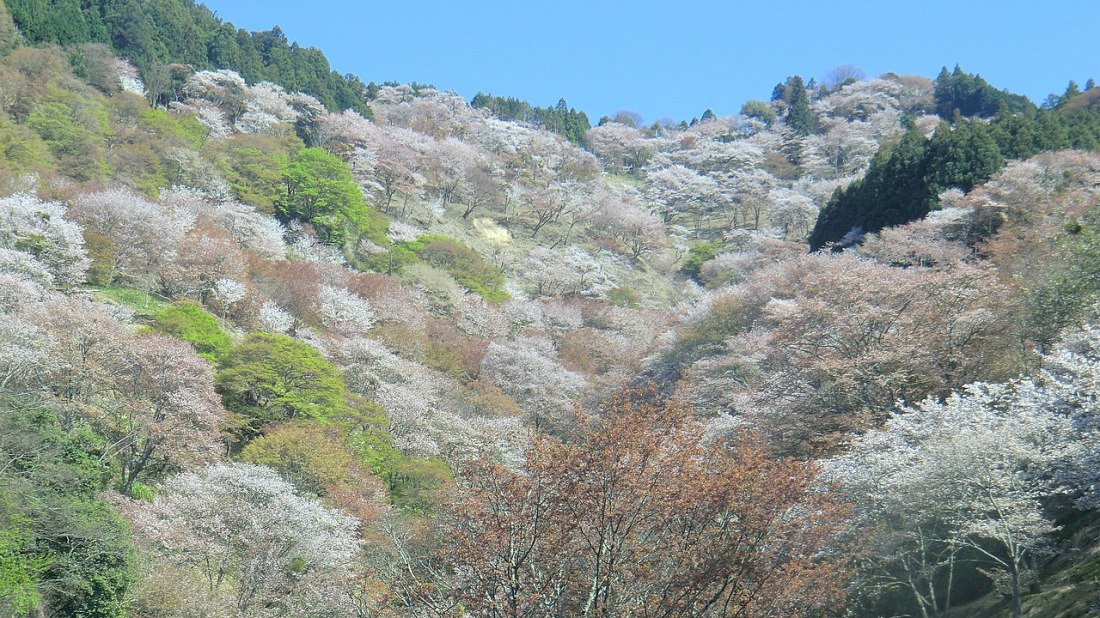
The poem was, evidentially, a suggestion by Emperor Tenmu to his sons to visit the beautiful village of Yoshino, near the old capital of Nara, famed for its otherworldly beauty in Spring. The featured image shows Yoshino and its famous cherry trees.

It was also an attempt to foster good relations between Tenmu and his sons through a combination of humor and providing some fatherly advice. Given how complicated family relations were at the time (see links above), and since Tenmu had defeated his own nephew in combat to assume the throne, he had reason to worry.

Sadly, it didn’t work.

After Tenmu’s passing, one son, Prince Ōtsu (ōtsu no miko, 大津皇子), started a rebellion and was later given the death penalty at the age of 24. Wikipedia implies that the rebellion may be a false charge though brought by Empress Jito so that her own son could ascend the throne. My book on the Manyoshu delves into this at length and comes to the same conclusion.

Still, you can’t blame Emperor Tenmu for trying to heal family divisions, yo.

Come See the Fall Leaves: Poem Number 26

Now that fall is full swing this poem seemed fitting:

JapaneseRomanizationTranslation
倉山OgurayamaO autumn leaves
みねのもみMine no mojijibaon the peak of Ogura Hill,
心あらばKokoro arabaif you have a heart,
今ひとたびのIma hitotabi noI would that you would wait
みゆき待たなMiyuki matananfor one more royal progress.
Translation by Dr Joshua Mostow

The author of this poem is Teishinkō (貞信公, 880-949), also known as Fujiwara no Tadahira, a scion of the increasingly powerful Fujiwara clan. The name “Teishinkō” is his posthumous name. The Fujiwara clan’s descendants grew increasingly powerful and ultimately monopolized the government during the Heian Period through intermarriage with the Imperial Family. By this point, you also may have noticed the increasing number of poets in the Hyakunin Isshu with the surname Fujiwara, gradually crowding out other noble families within the Imperial Court.

As Mostow notes, this poem seems to describe an excursion to the Ōi River by retired emperor (上皇, jōkō), Emperor Uda, who comments that his son the reigning emperor (天皇, tennō), Emperor Daigo, should visit too. Hence the author is beseeching the fall leaves to wait for Daigo’s arrival. This visit seems to have led to a seasonal tradition of visiting the Ōi River yearly by the Imperial Family. Further, compare this poem to a similar fall (poem 24), when Uda was still the reigning emperor.

Also, it should be noted that Ogura Mountain is none other than the place where the Hyakunin Isshu itself was compiled.

Side note: there are in fact two Oi Rivers in Japan, one near Kyoto the old capitol, and another in modern Shizuoka Prefecture. Due to location of the Imperial Court, the Emperor and his retinue almost certain visited the near Kyoto. It is, as the photo above helps illustrate, a very scenic and venerable of Japan. It is also mentioned in the Pillow Book by Sei Shonagon (poem 62) in note 59 under “Rivers”.

One other note: the term miyuki in the poem refers to an imperial outing. Such an outing was, naturally, an important occasion and so it has its own term in Japanese. According to the Hyakunin Isshu Daijiten, the “kanji” Chinese characters for miyuki differ if a retired emperor has an outing (御幸), or the current reigning emperor has an outing (行幸).

P.S. Featured photo is the Togetsukyo Bridge near the Ōi River which passes through the Arashiyama district of Kyoto. Photo taken by me in August of 2024.