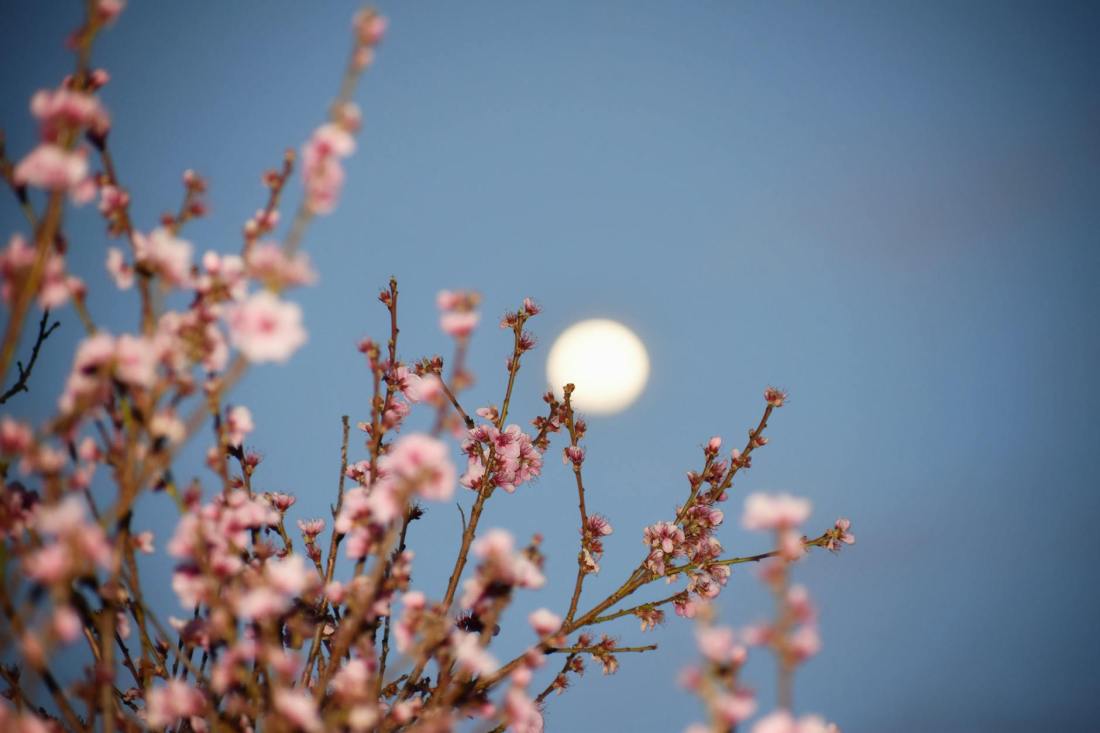
Poet Ariwara no Narihira, who wrote poem 17 (ちは) in the Hyakunin Isshu, and quite possibly the best poem on cherry blossoms ever, is also the model for the protagonist of the Ise Stories. In it, he delivers yet another banger of a cherry blossom poem. This is episode 29 of the Ise Stories:
Back then, when called to attend the cherry-blossom jubilee held at the reside of the Heir Apparent‘s mother [he recited the following]:
This is a really good cherry blossom poem, but Professors Mostow and Tyler explain that there is more to the story too. The heir apparent, later the ill-fated Emperor Yozei (poem 13, つく) in the Hyakunin Isshu, had a mother named Fujiwara no Takaiko. And within the Ise Stories, episode 6, there is a famous anecdote where:
Back then there was this man. Year after year he courted a lady he was unlikely ever to win, until at last he managed to abduct her under cover of darkness.
Translation by Mostow and Tyler
Later, the pair take cover in a storehouse during a bad rainstorm, but while he stood guard outside, a demon came and swallowed her, losing her forever. The episode then explains that the demon was in fact Takaiko’s brothers who brought her back to the capitol. Thus, it’s strongly implied in the story that Narihira and Takaiko briefly eloped before she was found by her family and brought home.
The poem above was composed after Takaiko was already wed to Emperor Seiwa and had given birth to a son, Yozei. It’s not hard to imagine that Narihira maybe still had feelings for Takaiko, though modern scholarship seems to reject this, and suggest it is simply polite felicitations.
Was this a hidden love poem, or a really colorful description of cherry blossoms? Who knows?
Poetry in Japan covers the subject of romance a lot. Like, A LOT. But while I was reading the Ise Stories recently, I stumbled upon this commentary by Dr Joshua Mostow that made me curious:
Modern commentators have felt the need to explain the erotic tone of this poem sent by one man to another. For Takeoka, such phraseology is no more than an affectation (kyoshoku) derived ultimately from Chinese poetry. Tsukahara Tetsuo and, following him, Paul Schalow, see this episode as one of five (16, 38, 46, 82, and 83) that portray deep, perhaps even homosexual, relationships between men.
page 107
This comment is in reference to poem 46 in the Ise Stories:
The story behind this poem is that our anonymous gentleman protagonist had a good friend, but they were later separated when the friend went to another province. The friend sent a letter saying that “it’s been too long”, and worried our protagonist had forgotten him. The man sent back the above poem as a reply.
Another example is poem 38, where our protagonist visits the residence of one Ki no Aritsune who was out and took too long to come home, leaving the protagonist waiting. Our protagonist sends this poem.
This brings up a subject that we don’t normally cover here on the blog, and one that admittedly I am not an expert on: is this poem, and others like it in the Ise Stories, simple affection (a.k.a. a “bromance”), or did these two men also have a romantic relationship?
The love poetry that we normally cover is heterosexual. The nobility of the Heian-Period court were constantly sleeping around, as marriages were primarily political. Attitudes about marriage were influenced by Confucian thought, so establishing a family and raising the next generation were filial duties one should fulfill. So, heterosexual relationships were expected. And yet, perhaps men also had romantic (or quasi-romantic) relationships with close male friends too.
It’s somewhat difficult to grasp this, because the way Japanese aristocracy at the time viewed romance and marriage differs from 21st century Western attitudes. So, interpreting such poems isn’t always easy, as Mostow alludes to. Different scholars will have different interpretations.
I should also add that this kind bromance/homoerotic poetry isn’t limited to the Ise Stories. Dr Mostow cites poems in the official Imperial Anthology, the Kokinshu, as well. This is one example, poem 978:
Original Japanese
Romanization
Translation
君が思ひ
Kimi ga omoi
If your thoughts of me
雪とつもらば
Yuki to tsumoraba
“gather thick as snow” I should
たのまれず
Tanomarezu
not rely on them
春よりのちは
Haru yori nochi wa
for once spring has come I know
あらしとおもへば
Araji to omoeba
the drifts will vanish from sight.
Translation by Laurel Rasplica Rodd and Mary Catherine Henkenius from Kokinshū: A Collection of Poems Ancient and Modern
This poem was composed by Ōshikōchi no Mitsune (poem 29 in the Hyakunin Isshu, こころあ) in response to a friend, Muneoka no Ōyori who had arrived at the capital and saw snow falling.
Again, it’s hard to be sure exactly how Mitsune and Oyori relate to one another, and if this is indeed romantic or just affectionate, but it’s a fascinating look at cultural norms at the time among the aristocrats of Japan.
P.S. It’s even harder to know what the attitudes of commoners, since we have so little historical information. The aristocrats of the Court may have had more liberal attitudes about love than commoners, or maybe commoners imitated the trends of the aristocracy. It’s hard to be certain.
Fall is approaching, and it reminds us of fall leaves, and famous poems of the Hyakunin Isshu such as the chihaya poem (poem 17) among others….
Throughout the blog, I’ve tended to focus on the lady authors and poets because it’s so rare to see women get credit for writing in the pre-modern era. There was an explosion of feminine talent in the Heian Period (8th – 12th century) that was not repeated until modern era in Japan, and it’s been fascinating.
However today, I wanted to highlight one particular text called the Ise Monogatari (伊勢物語). Our illustrious Dr. Joshua Mostow who has contributed much to this blog translates the title as the “Ise Stories” in his translation, but other translations call it the Tales of Ise. You can decide which one you prefer. Since Dr Mostow is a cool guy, and done much for the field, I will use his translated title. For this post, I am using the translation by Dr Mostow and Dr Royall Tyler.
Unfortunately, we still don’t know who the actual author of the Ise Stories was. In fact, Professor Mostow explains that the prevailing theory is that the Tales was composed over decades, in stages, possibly by different authors. Unlike the later Tales of Genji, or the Gossamer Years, or the Pillow Book, which were all clearly composed by one author, the Tales of Ise has a murkier development.
Anyhow, the Ise Stories is not a modern story, with narrative arc, nor does it have an ending. Instead, the Ise Stories are a series of short anecdotes about an anonymous prince who leaves the capitol of Heian (modern day Kyoto), and journeys east to the hinterlands for a time. In fact, you could probably call the Ise Stories the “Anecdotes of Ise With Lots of Poetry Thrown In”. The later work, the Tales of Genji, has a similar format.
The hero of the story, a young, charming prince who travels east with his entourage and has a few love trysts along the way, is a kind of idealized Heian-period aristocrat: a gentleman with an excellent pedigree, and talent for poetry to boot. Each story includes at least one waka poem, the same kind used in the Hyakunin Isshu, often more. Why so much poetry? Many times these were used as a back-and-forth way of greeting someone from afar, or saying “hello” to a promising lady, so a chapter might have multiple poems in the form of dialogue.
For example, section 14 deals with a tryst between our protagonist and a provincial lady in remote Michinoku province (a place also mentioned in poem 14 of the Hyakunin Isshu). She writes to him the following poem:1
Original text
Japanese romanization
Translation
なかなかに
Naka-naka ni
So if, after all,
恋に死なずは
Koi ni shizanu wa
I am not to die of love,
桑子にぞ
Kuhako ni zo
I know just the thing;
なるべかりける
Narubekarikeru
I should have been a silkworm,
玉の緒ばかり
Tama no wo bakari
for that little life’s short span.
Our protagonist was not impressed by her, as her poem “reeked of the country[side]”, but slept with her anyway. Classy guy.
Then, he left before dawn and she lamented:
Original text
Japanese romanization
Translation
夜も明けば
Yo mo akeba
Come dawn’s early light
きつにはめなで
Kitsu ni hamenade
oh yes, in the tank you go,
くたかけの
Kutakake no
you obnoxious bird,
まだきに鳴きて
Madaki ni nakite
to learn to cock-a-doodle
せなをやりつる
Sena wo yaritsuru
my darling away too soon.
The protagonist then remarked he was going to the capitol, but left behind a “charming” poem:
Original text
Japanese romanization
Translation
栗原の
Kurihara no
If the Aneha
あねはの松の
Aneha no matsu no
Pine here at Kurihara
人ならば
Hito naraba
only were human
都のつとに
Miyako no tsuto ni
“Come along with me,” I’d say,
いざといはましを
Iza to iwamashi wo
“you’re my gift to the City.”
According to the Ise Stories, she was much impressed and thought he was in love with her, but the commentaries suggest he was being condescending by implying that “if only she were worthy of Courtly life at the capitol”. Damn.
But what’s the source for all this poetry and narrative?
The origins of the Ise Stories is somewhat of a mystery, but there is strong evidence that the central character was heavily based upon a real aristocrat named Ariwara no Narihira (825 – 880), the same man who composed the aforementioned poem 17 (ちはやふる), and also composed what’s considered the greatest poem about cherry blossoms ever composed. Some of his poems in the old Kokin Wakashu imperial anthology were re-used in the Ise Stories as well.
In addition to his poetic genius, the real life Narihira was a playboy and had many relationships, even by the standards of Heian-period aristocracy. Sometimes this got him into trouble. The Ise Stories begins with an explanation that the anonymous prince left the capitol after having an affair with Emperor Seiwa’s consort. Coincidence? I think not. 🤔
Nonetheless, the Ise Stories is a whimsical and irreverent look at Heian Period culture and how the aristocracy interacted with people in the provinces, even when it was somewhat condescending. Court culture was unlike anything else in Japan at the time, and this reveals some interesting things that are not always conveyed in other works of the time.
1 Mostow and Tyler explain that the young woman’s poem was a re-working of an older poem from the Manyoshu, poem 3086:



 The Hyakunin Isshu