This is Mount Ogura (小倉山) also called Arashiyama (嵐山) near the city of Kyoto. The place name “Ogura” is where the Hyakunin Isshu gets its full-name: Ogura Hyakunin Isshu.
At that time, it was trendy for aristocrats to compile their own “hundred poems by a hundred poets” anthologies, all named “hyakunin isshu”, but the one that is by far the most famous is the Ogura Hyakunin Isshu, which of course is the source and inspiration of this blog. 🙂
Thanks to KyotoDailyPhoto on Twitter for taking this photo. It’s nice to see the place that inspired the anthology.
Edit: the pictures in his post are now lost unfortunately. There is a more up to date post here though if you would still like to read.
My wife often gets sembei crackers from her family in Japan in the mail, and especially a package of these crackers in particular:
These are Hyakunin Isshu themed crackers! In each container is 6 different sembei crackers: salty, sweet, sesame flavored, seaweed-wrapped, shrimp flavored and one with nuts. They’re all quite good.
But the clever part is what’s under the crackers:
Each package contains a different poem from the Hyakunin Isshu! The one on the left is poem 36, written in cursive, poetic script, while the one on the right is poem 26, also in cursive style.
A very nice snack, I think. 🙂 You can check out the company’s website too if you would like to learn more.
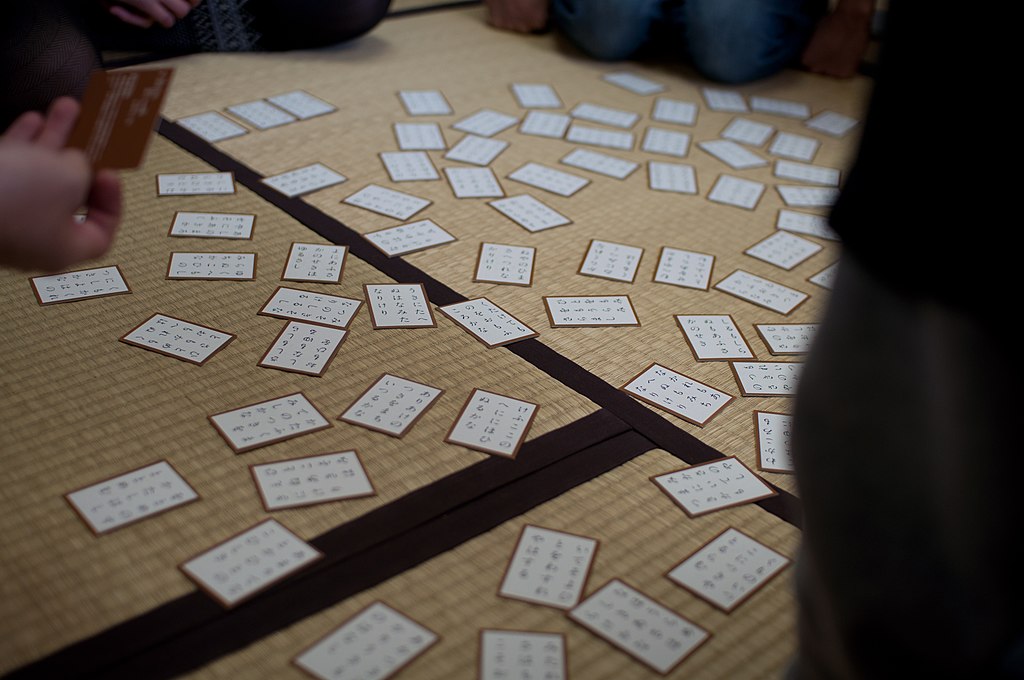
One subject I haven’t covered here much is the subject of the Hyakunin Isshu is the karuta card-game. I’ve talked about it on my other blog, but I saw this recent article on the Asahi Shinbun newspaper and wanted to talk this one in particular.
As the article explains, the Hyakunin Isshu card-game is one of many extra-curricular activities in Japan for kids, though usually not as popular as sports or other activities. Still it has a small, venerable tradition, and like many school activities, it can be pretty competitive, but a great team-building activity.
I was surprised to hear about the new comic about this sport though, titled “Chihayafuru“, which is related to poem 17 in the Hyakunin Isshu (the opening line), which also happens to be a famous pillow word too. I was thinking it might be interesting to read, except the cover implies that it’s a young ladies novel, and I am too old, and too much of a male neanderthal for that kind of thing. 😉
Well, the book was actually published in 1996, but I came across this book only recently: Joshua S. Mostow’s Pictures of the Heart: The Hyakunin Isshu in Word and Image. The book is a serious effort to study the Hyakunin Isshu, and not for a casual reader, but also the history and culture around it, while offering fresh, new translations.
The first chapter alone, dealing with issues of historiography and deconstruction, makes my head hurt, but it makes an important argument: that only studying the poems themselves, and ignoring their role in Japanese culture leads readers to a one-sided view. Mastov demonstrates how some poems have even changed and evolved over time, depending on which book published the poem over the centuries. Sometimes, even in antiquity, poems were radically different depending on which book, so Mastov explores the various debates surrounding each poem. Who knew a few lines of verse could cause so much scholarly debate?
The book is a great read because for each poem, it carefully analyzes it, provides historical context, artwork and shows how the poem has been interpreted over the generations. It often debunks certain assumptions too. For example, Poem Number 6 is traditionally thought to allude to the story of Tanabata, but in fact Mastov demonstrates how this is a later interpretation.
The translations for the poems as well are quite good, readable, and well thought out in my opinion. The book is a weighty tome, but for any serious students of Japanese poetry, and in particular the Hyakunin Isshu, I highly recommend it.
Reading classical Japanese is hard enough as it is, what with its unusual spellings and archaic vocabulary, but what makes the Hyakunin Isshu interesting, among other things, is the colorful, poetic phrases sometimes used. These phrases are strictly literary, and tend to have a dramatic sound to them, but when translating to English sometimes the meaning is lost. These words are called makura kotoba (枕詞) or “pillow words”. The term “pillow” here has no romantic connotations whatsoever, but is simply a reference to poetry. Presumably, people in the old days sat in their rooms, leaning on a pillow, composing poetry in their idle time, I guess.
Anyway, pillow words can be thought of as “filler” phrases, because they don’t have much meaning themselves, but they dress up the poems a lot more. For example in this poem, number 17:
千早ぶる Chihayaburu 神代もきかず kamiyo mo kikazu 龍田川 Tatsutagawa からくれないに karakurenai ni 水くくるとは mizu kukuru to wa
The pillow words “Chihayaburu” (千早ぶる) can mean something like “1,000 swift [swords]” or something, but really just dresses up the next word, 神 (kami, “a god”). So in modern English, it’s not just a god, but an awesome, awe-inspiring god. Likewise, in poem 2 we see another shining example.
春過ぎて Haru sugite 夏来にけらし natsu ki ni kerashi 白妙の shirotae no 衣ほすてふ koromo hosu chō 天の香具山 Ama no Kaguyama
Here again the pillow word shirotae no (白妙の) means something like gleaming white. The sheets being dried on Kaguyama mountain are not just white, but gleaming white, and a lovely contrast to the sunny, summer day in which they are being dried.
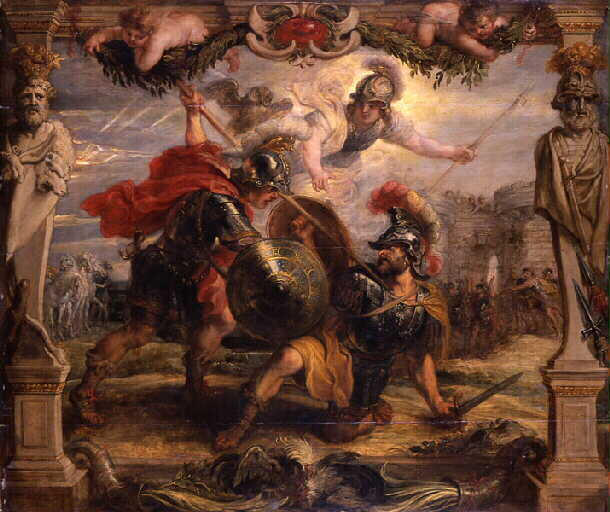
Such pillow-words don’t really exist in English, but they are very easy to find in classical Greek literature, especially the writings of Homer. Consider these epithets frequently used in the Iliad:
Goddess of the white arms, Hera: θεὰ λευκώλενος Ἥρη (thea leukōlenos Hērē)
Whenever I read the Iliad, I always find that these epithets really bring out the drama in the text.
Peter Paul Rubens – Achilles slays Hector
In the same way, the pillow-words in the Hyakunin Isshu are frequently used in certain common combinations:
chihayaburu (千早ぶる) – used to describe the Shinto divinities or Kami (神). See iconic poem 17.
shirotae no (白妙の) – used to describe something white, in particular snow, clouds or cloth. Its literal meaning is taken from the color of fresh mulberry paper. See poem 2 and poem 4.
ashibiki no (あしびきの) – used sometimes to describe mountains (山, “yama”) and peaks. Its meaning is something like “foot-drawn”. See poem 3.
hisakata no (ひさかたの) – used to describe things like the sky (空, “sora”), moon (月, “tsuki”), rain (雨, “amé”), clouds (雲, “kumo”), light (光, “hikari”), night (夜, “yoru”), and even the capitol (都, “miyako”). Its meaning is something like peaceful, shining, and especially everlasting. See poem 33 and poem 76.
Some examples of pillow words used in Japanese waka poetry, but not found in the Hyakunin Isshu are:
ubatama no (烏羽玉の) – describes the color “jet-black” and often used to describe hair or night. An example is found in the Kokinshuanthology, poem 647.
aoniyoshi (あをによし) – used to describe the old capital of Nara itself. Poem 328 in the Manyoshu is one such example. The word aoni (青丹) refers to a high-quality bluish-black pigment that was derived from soil around the Nara area.
umasaké (味酒) – used to describe the sacred mountains around Nara (see poem 2 in the Hyakunin Isshu) implying the essence of delicious rice wine. Think Dionysus from Greek mythology. You can an example in the Manyoshu, poem 17.
yasumishishi (八隅知し, or 安見知し) – refers to the august reign of an Emperor, spanning the eight cardinal directions.Manyoshu poems 50 and 923 both contain this phrase.
isanatori (いさなとり), originally from an archaic word for “whale” (いさな) is used with words such as the ocean, beach, etc. Poem 3852 in the Manyoshu is an example.
Many of these phrases are 5-syllable phrases (sometimes 4), so they “slot” in seamlessly in a typical waka poem (5-7-5-7-7 syllables). In later ages, the number of pillow words increased to about 1,200 phrases, though many of them remain pretty obscure. Even in modern poetry, these stock phrases are still very much in use.
Interestingly, my book on the Manyoshu explains that some of these phrases do not appear until they are used in poetry by Kakinomoto Hitomaro (poem 3, あし), implying that he coined some of these phrases himself. Of the hundreds of documented pillow words, at least 50 are attributed to Hitomaro including some listed above.
Pillow words are hard to translate, but they are a fascinating window into Japanese culture in antiquity.



 The Hyakunin Isshu
