While re-reading the Pillow Book lately, one of the people in Sei Shonagon’s anecdotes recites a poem from an Imperial anthology: the Kokin Wakashu (Kokinshu for short).1 When I looked up the poem, it really struck me when I read it. Since I have an English translation of the Kokin Wakashu, and since many of the poems from the Hyakunin Isshu were originally published in the Kokin Wakashu, I figured it would be fun to post other poems from the same anthology.
This poem, poem number 52 of the Kokin Wakashu, reads as follows:
Japanese
Romanization
Translation
年ふれば
Toshi fureba
As the years stream by
よはひは老いぬ
Yowai wa oinu
my own life passes from me
しかはあれど
Shika wa aredo
still I am renewed
花をし見れば
Hana oshi mireba
when I but see the blossoms
物思もなし
Mono omoi mo nashi
my heart’s sorrows disappear
Translation by Laurel Rasplica Rodd and Mary Catherine Henkenius
The headline of this poem reads “seeing cherry blossoms in a vase before the Somedono Consort [Empress]“.2
The author of the poem, Fujiwara no Yoshifusa (藤原良房, 804 – 872), was the first member of the Fujiwara clan to assume the post of Regent to the emperor. This was at a time when the Fujiwara were a rising star in the Imperial court, had married into the Imperial family, and Yoshifusa was the grandfather of the young Emperor Seiwa. So, he had much to celebrate. However, even the powerful grow old and die, and Yoshifusa was no exception.
What I really like about this poem is that in spite of his own fears of growing old, he still can enjoy life here and now and feel young again.
I am at the age where I can definitely start to feel my age, and the years ahead of me are likely fewer than the years behind me, and yet I am rarely bothered by it. I often find moments of joy in life, playing with my kids, enjoying nerdy fandom, and savoring poetry like this, so I know how Yoshifusa feels.
1 Nowadays, people quote movies, TV shows and such. I can quote more gags from The Simpsons than I care to admit. Back then, people quoted poetry from earlier generations.
2 Many poems in the Kokin Wakashu included a headline to explain the scene of the poem, or provide some background. These were not carried over when the poems were collected in the Hyakunin Isshu since they were already well-known poems, or possibly just for the sake of brevity.
One of most iconic places in the world of Karuta is a placed called Omi Shrine, also called Omi Jingu (近江神宮, おうみじんぐう) in Japanese. It is here that the big championship events are often held, and it is a big part of season one of the anime series Chihayafuru. Not to sound like a cliché, but it is a kind of mecca for the Karuta world and the Hyakunin Isshu.
A scene from Chihayafuru as Chihaya approaches the Rōmon gate.
What is Omi Shrine though?
You see, Japan has essentially two religions that co-exist: the native Shinto religion and imported Buddhist one. We don’t need to go into detail about how they differ; I have an entire blog on the subject. Suffice to say, they differ. Even the place names are different. Buddhist temples are called otera or end with -ji. Shinto shrines are called jinja, jingu or taisha.
Anyhow, Omi is a Shinto shrine located in the city of Ōtsu, in Shiga Prefecture. This area was once the province of Omi, hence the name. The shrine’s constructed began in 1937 and finished by 1940. It is a young shrine, but has a deep connection to the past.
Like all Shinto shrines, Omi Shrine venerates a kami, a divine figure. A kami can be a god (think ancient Greek gods) from Japanese mythology, a local spirit, or even a historical figure. Some shrines venerate more than one kami.
Omi Shrine venerates none other than Emperor Tenji, who wrote poem one of the Hyakunin Isshu (あきの). During his reign, the capitol of Japan was moved to Otsu city and there he reigned until his death. Here, he carried out many essential reforms that provided the foundation for Japanese society for centuries. Because Tenji also wrote the opening poem of the Hyakunin Isshu, the shrine became quickly associated with the anthology and with Karuta.
The shrine website even has a handy catalog of the Hyakunin Isshu poems, not unlike mine. 😉
The English website is pretty limited, but the Japanese site has a lot of great information about the shrine, Karuta and so on.
The shrine is a bit removed from the usual touristy areas, so you might not be able to get there. However if you do go, it’s good etiquette to pay respects to the kami there. Per Shinto tradition (explained here) the process is:
Bow deeply at the waist twice.
In reverence, clap twice.
Bow once more.
You can also use the water font nearby to wash your hands a bit (just watch how other Japanese do it) and your face a bit before facing the kami.
Since I spent so much time gushing over First Summer Uika and her portrayal of Sei Shonagon in the Japanese drama Hikaru Kimi É (“Addressed To You, My Radiant One”), this seemed like a good time to talk about the Pillow Book, or Makura no Sōshi (枕草子).
Despite the name “Pillow Book”, the book has no erotic content. Instead, it is a collection of witty musings about life in the Heian Period aristocracy, early 11th century. The image is of a person lying on their pillow, composing thoughts in a diary.
The author, Sei Shonagan (poem 62), was one of the pre-eminent writers of her generation, in a field of many excellenttalentedwomen.
I had read the book many years ago, and I felt it was a bit dry at times since it has no narrative. But back then, I also had a much more limited understanding of Heian Period culture, and many of the things mentioned in the Pillow Book are also alluded to in the Hyakunin Isshu, as well as the Diary of Lady Murasaki. So, even if the format is different, all three collections draw from the same “cultural well”.
I thought I had lost my copy of the Pillow Book (the Penguin Classics version, translated by Dr Meredith McKinney) a long time ago, but was amazed to discover that it was just buried behind other books. So, I dusted off the book and have been reading through it again.
Sei Shonagon is a keen observer of life in the Heian Period, and makes lists for all kinds of obscure things:
[23] Occasions that induce half-heartedness — The religious services on days of Buddhist fasting. Preparations for something still far in the future. Long periods of seclusion at a temple.
Or she adds things to lists that were probably drawn from personal experience:
[132] Occasions when time drags by — An abstinence that you must observe away from home. A game of sugoroku when you can’t manage to get your pieces off the board. The house of someone who’s failed to get a promotion in the Appointments List. And of course the worst of all is simply a day of heavy rain.
It’s also clear that Sei Shonagon had a pretty haughty attitude, especially when compared to Lady Murasaki’s (poem 57) withdrawn, melancholy tone or Lady Izumi’s (poem 56) whimsical passion. As they say in modern Japanese: seikaku ga deru (性格が出る, “people’s personalities come out”). In one anecdote, section 94, she grumbles about encountering “worthless peasants”. I wouldn’t be surprised if she was the only one among the nobility at the time who held such views, but it is nonetheless painful to read.
One thing I do particularly enjoy about the Pillow Book though are the anecdotes. While many of the entries are just lists and her opinions, she often reminisces about funny, sad or strange occurrences she witnessed during her 10-year tenure serving the ill-fated Empress Teishi. Some of these anecdotes and observations are quite long, while others are brief. Some happened long ago, and Sei Shonagon’s memory is a bit fuzzy, others are more recent.
For example in one anecdote, number 79, she talks about how her relationship with one Officer of the Left Gate Watch named Norimitsu had soured after an incident where he covered for her. She had gone somewhere and only Norimitsu knew her whereabouts, but the Captain Consultant demanded to know where she had gone and Norimitsu tried to keep his mouth shut. Later when Norimitsu complained, she sent a piece of dried seaweed in reply, and Norimitsu got annoyed. She criticized his lack of sense, and he was frustrated at her for putting him in such a difficult position. Later she muses that they grew more and more distant after that incident until “later, Norimitsu was promoted to Deputy Governor of Tōtōmi Province, and the relationship ended in hostility.”
Sei Shonagon discusses many people of the Court, including other ladies in waiting, but does not mention Lady Murasaki and other famous women of the Hyakunin Isshu. Such women served under the second empress, Shoshi, and thus came a bit later anyway. By the time Emperor Ichijo married a second time, Teishi’s status had greatly declined and her retinue (including Sei Shonagon) were on their way out the door. Teishi herself soon died in childbirth.
The Pillow Book is a really nice “slice of life” look at the court culture of the time: sometimes amusing, sometimes exquisite, and sometimes depressing. Her wit really shows through the ages and even today kids in Japan (and people outside Japan) still read her book.
P.S. Featured photo is a drawing of Sei Shonagon from a 13th-century illustrated copy of the Pillow Book. Courtesy of Wikimedia Commons.
In other recent, exciting news, I found this article on the Asahi Shimbun newspaper: the discovery of some of Fujiwara no Teika’s personal notes. This is called the kenchū mikkan (顕注密勘).
Long before Fujiwara no Teika (poem 97) compiled the Hyakunin Isshu, he served as a minister under Emperor Gotoba (poem 99). Among his duties, Teika was commissioned in 1201 to compile a new Imperial poetry anthology, which later became the Shin Kokin Wakashu (新古今和歌集).
Here you can see some of his notes and thought process as he’s compiling the poems together. It’s a fascinating discovery.
You can click here to see more detailed photos of his notes. They are read from right to left, vertically not horizontally.
You can also see another example of his handwriting here, courtesy of Wikipedia, from diary:
Teika himself had a pretty rocky career and after his liege lord was exiled, Teika spent the rest of his days living as a Buddhist monk. Nonetheless, his legacy lives on.
I have been away for a while due to variouslifecircumstances, but I’ve been wanting to share this news with readers.
The Japanese public TV station, NHK, broadcasts a new Taiga Drama (大河ドラマ) every year. These are big productions featuring some aspect of Japanese history, with big name actors and so on. I was very fond of the last one. Usually these cover periods of warfare or conflict, and male historical figures from Japan’s long history, but this year’s drama, titled Hikaru Kimi E (ひかる君へ, “Addressed to You [my dear Radiant One]”), features Lady Murasaki as the main character!
(Image by NHK, all rights reserved)
Lady Murasaki, poem 57 of the Hyakunin Isshu, needs little introduction. She composed the Tales of Genji, as well as her eponymous diary. She was the first female novelist in Japanese history, and has been a subject of interest ever since. The biographical details of her life are somewhat scant, unfortunately, and the drama does embellish quite a bit, including hinting strongly at a romance that probably didn’t happen in real life. My impression is that they are using romantic themes from her novel, the Tales of Genji, as the backdrop for the drama.
Nonetheless, I have been watching this series on Japanese TV1 and I enjoy it. It is somewhat different than past Taiga Drama, since it features a female main character, and this period of history (the late Heian Period), had little warfare, but it does have tons of scandal and intrigue as the Fujiwara clan tighten their grip on the reins of government. This drama is surprisingly risqué in parts, something you usually don’t see in a conservative Japanese drama. However, such scenes remind me more a more subdued Victorian romance than something in modern, American television.
That said, it’s a darn good drama thus far.
The drama frequently shows other people of the Heian period aristrocracy, many of whom were poets of the Hyakunin Isshu. To name a few who have been featured in the drama:
I admit I am particularly fond of the character Sei Shonagon. In historical pop culture, Sei Shonagon and Lady Murasaki are treated as rivals as they were both famous writers of the same generation who belong to rival cliques in the aristocracy, but in reality they probably didn’t interact much. Nonetheless, they frequently talk in the drama, and the actress who plays Sei Shonagon, stage name is “First Summer Uika” (ファーストサマーウイカ), is a talented actress and total babe:
First Summer Uika also recently visited a Shinto shrine devoted to Sei Shonagon in Kyoto called Kurumazaki Jinja (車折神社), which even sells Sei Shonagon charms (omamori):2
Because the drama features so many people related to the Hyakunin Isshu, the drama subtly works in many poems from the anthology. It’s been great to suddenly recognize a poem being recited, even if I am a bit slow to recall. The settings, costumes, and cast are all amazing, and even though the historicity is questionable, it’s been a great watch.
I really hope they eventually make an English subtitle version so people outside Japan can watch. The quality of Taiga Dramas are terrific, and they are well worth watching if you can.
Update: while visitingKyoto in 2024, we found a local NHK display of the drama:
The second photo above is First Summer Uika as Sei Shonagon.
1 Sadly there are not foreign translations, and no subtitles, and it is not always modern Japanese, so I admit I struggle at times to follow the story. At other times, I can follow easily enough.
2 We are going to visit Japan again this year (the last for our teenage daughter), including Kyoto. Visiting this shrine is definitely on the itinerary, even thought it’s pretty small.
If you’ve been following this blog for a while, and gotten to know some of the authors of the Hyakunin Isshu, then you may have noticed some patterns with the names of the authors. The authors are rarely listed by their birth name, and instead are listed under a sobriquet, or just their official title in the Imperial Court.
Why was this done?
My book, the Hyakunin Isshu Daijiten, explains that this was because in this period of Japanese history, names were thought to be tied to one’s life. People at this time, both the Nara (8th c.) and increasingly in the Heian (9th – 12th c) periods, were often worried about curses, evil spirits, and such, and went to elaborate lengths to avoid spiritual calamities (see background for poem 24 for example). So, to avoid risk of one’s name (and thus one’s life) being subject to evil magic, people often hesitated to share their personal names with others.
It’s unclear how commoners in the Nara/Heian Period named themselves; there is just not enough information, but for the nobility who all belong to the hierarchical Imperial Court, certain naming conventions developed.
Men
Men with important titles, or positions in the court often used their titles as their sobriquet. Lower-ranking men in the Hyakunin Isshu did not have this privilege.
Titles for members of the Imperial Family – Emperor Tenji, (poem 1), Retired Emperor Go-toba (poem 99), and Prince Motoyoshi (poem 20).
Positions in the Imperial Court – Sanjō Minister of the Right (poem 25), Major Counselor Fujiwara no Kintō (poem 55), and Master of the Grand Empress’s Palace (poem 83)
Clerical names – Dharma Master Jakuren (poem 87) and Former Major Archbishop Gyōson (poem 66)
Due to the Confucian, paternalistic culture of the Japan in antiquity, women were not given titles wihtin the Imperial Court (though they did earn rank just as men did), and seldom used their real name. Instead, they used a different naming convention.
Male relatives or spouses – Lady Ise (poem 19), whose husband served as governor of Ise Province, Lady Izumi (poem 56) whose tenure as governor of Izumi Province, “The Mother of Michitsuna, Major Captain of the Right” (poem 53), Taiyu of the Household of Princess Ryōshi (poem 90), and Ukon (poem 38) named after her father’s position as Captain of the Guards.
Poetic sobriquets – Lady Murasaki (poem 57) named after a character from her own novel the Tales of Genji, Akazome Emon (poem 58).
Because women were more often kept out of sight than men in the Imperial Court, biographical information about women authors of the Hyakunin Isshu is often much thinner than the men (except lower-ranking men). This makes learning about women like Lady Murasaki or Lady Izumi difficult.
In any case, the idea that names are tied to one’s lifespan is a fascinating cultural belief, and it’s likely you would find this in other pre-modern cultures as well.
Recently I mentioned an upcoming interview with the Karuta Peru Club via Steph, a fellow karuta player.
I am happy to report that we finished our interview and it is available on YouTube!
Also available on Spotify in podcast form:
In this episode, Steph and I mostly discuss the history of the blog, but then talk about some of my favorite historical figures in the Hyakunin Isshu, such as Sugawara no Michigan’s (poem 24) and Lady Izumi (poem 56), among other things. It was a fun conversation and Steph was a terrific host.
I do sometimes use the word “um” a lot, especially when I am a bit nervous (this was my first interview), but I hope viewers and listeners learn something new, and enjoy the conversation too!
In the next episode, we plan to focus more on our experiences playing kyōgi Karuta (competitive karuta). Stay tuned!
Big thanks to Steph for making all this happen. 🎉
P.S. books cited in the interview (non-Amazon links below):
Due to length and complexity of poem, plus it’s very old Japanese, I can only offer a rough translation (based on modern Japanese ones) like so:
A basket. The beauty holding the basket. A digging tool (lit. a spatula-like tool). The beauty holding the digging tool. You who are on the hill gathering vegetables, tell me, what family do you come from? Do you not know? I am the sovereign of this land (lit. Yamato, old name for Japan), and that every corner is under my dominion? So, tell me, what is your family’s name and origin?
This poem was composed by Emperor Yūryaku, who reigned in the 5th century, before recorded history. Technically, the title of “Emperor” was not used by ancestors of the Japanese imperial family at this time, and was later implemented by the time of Emperor Tenmu, brother of Tenji (poem 1), but this is a retroactive title. At this time, Yūryaku and others of the lineage were more like great kings (daiō 大王). Interestingly, although this point in Japanese history is pretty murky, Yūryaku is mentioned on a dedication inscribed on an ancient sword, providing historical evidence that he did in fact exist.
Yūryaku was described in early historical documents as a strong ruler, who slew his brothers following the death of the last king/emperor to get to his position. In later years, he helped consolidate power, but also was described as tyrannical as well.
The poor girl whom the poem was addressed to probably wasn’t in any position to say “no”, in any case.
The reason why I posted this poem is two-fold.
First, this poem is noticeably different than the tanka (短歌, “short poem”) style poems of the Hyakunin Isshu. This is a chōka (長歌, “long poem”) style poem. Tanka poems, including all poems of the Hyakunin Isshu, follow the style of 5-7-5-7-7 syllables. Chōka poems were 5-7-5-7-5-7…..5-7-7 syllables, with as many 5-7 syllable verses as needed. The Manyoshu has both formats, but by the time of the Hyakunin Isshu, the chōka format had fallen out of favor, probably because it was simply too long and difficult to fire off verses quickly.
Yūryaku’s poem doesn’t fit the chōka format very closely though, so it’s hard to say how strict poetry was back then. Over the centuries, and by the time we get towards the end of the Hyakunin Isshu, the style poetry had definitely solidified into a very rigid format with many specific rules, customs, and phrases. Yūryaku’s poem reflects an earlier, looser style of poetry. Or, as a powerful sovereign, maybe he just didn’t care. Who’s to say?
Second, the tone of the poem (ignoring the power-imbalance between him and the girl1) is a very lighthearted and romantic tone. Early poems in the Hyakunin Isshu tended to have a similar tone, but gradually the tone tended to get more somber centuries later as the aristocratic culture came to an end. Compare poems 95-100 to poem 1-5 in the Hyakunin Ishsu, and you’ll see what I mean. Yūryaku’s poem definitely belongs to this earlier, more bucolic time.
Anyhow, it’s interesting how poetry reflects history as well.
1 When you look at Lady Murasaki’s diary as well, when Michinaga makes a pass at one of the servant girls, it’s strongly implied a visit later will certainly follow. Again, women back then had less agency, and would have been hard-put to say no to powerful, ambitious men like that.
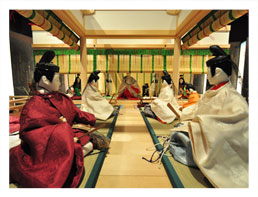
Throughout this blog, I’ve alluded many times to poetry contests, called uta-awase (歌合), as the origin of many of the poems of the Hyakunin Isshu. These contests were a popular past-time among the nobility of Nara and Heian periods of Japanese history, and onward. The first such contest was recorded as far back as 885, and became a staple of nobility since.
The poetry contest was a ritualized affair, and worth exploring here.
An excerpt from an illustrated copy of the Tales of Ise showing two contestants in a poetry contest, with an incense brazier on between. The lady here serves as the judge of their poetry.
This image comes from an illustrated copy of the classic Japanese text, the Ise Monogatari (Tales of Ise)1 and shows an example of a typical poetry contest. The contestants sit facing one another as a pair, while some contests had multiple pairs facing off.
Presiding over the contest was a judge or hanja (判者) who would provide a topic for the contest. A small incense brazier would burn between the two contestants (方人, kata-udo), who would each come up with one poem to fit the given theme. Each participant would also trash-talk the opponent’s poem while praising their own, or their Allie’s (if multiple sets of participants). Basically, an ancient Japanese rap-battle. Once the winner was declared, the contest could go another round, and each contestant would come up with another poem.
According to the Hyakunin Isshu Daijiten, the longest recorded poetry contest during the classic Heian Period was said to have continued for 500 rounds!
In more formal settings, usually held at the Imperial palace,2 with a director overseeing the contest (a tokushi, 読師), with the poems and their theme recorded by a scribe (kazusashi, 籌刺) who sat off to the side. Musical accompaniments were often added to formal poetry contests, too. Finally, the particularly good poems often ended up later in Imperial Anthologies.
You can see an example of an Imperial uta-awase from a popular manga here:
This poem was composed by Supernumerary Middle Counselor Sada’ie (権中納言定家, 1162-1241), better known as Fujiwara no Teika, or alternatively Fujiwara no Sadaie.1 He is considered one of the greatest poets in all of Japanese history. Teika was the compiler of this Hyakunin Isshu anthology and was also one of the major compilers of the officialShin Kokin Wakashū anthology. He was also the tutor for Shokushi Naishinno (poem 89), and it is thought that they had a romantic relationship too, though eventually they would be separated for good. In any case, his talent and his family’s influence were so great that the family virtually monopolized the Court poetry for centuries to come. But we’ll talk more about that shortly.
Fujiwara no Teika composed many of his own poems in his lifetime, and yet in compiling the Hyakunin Isshu, why did he select this particular poem for inclusion?
Like many of the later poems in the anthology (poem 90, 91 and 94), this poem alludes to a much older one. In Teika’s case, his poem alludes all the way back to the original anthology in Japan, the Manyoshu. Unlike later anthologies, the Manyoshu was a loose connection of poems, compiled 400+ years before Teika, and the particular poem he alludes to was written from the perspective of a man whose love was burning for a woman like the boiling of seaweed at Matsuo Bay. As you can see, Teika reversed the perspective to be that of a woman, while still alluding to the original. Additionally, Teika gives his poem a sadder tone than the poem from the Manyoshu, which came to be a hallmark of Teika’s style.
Incidentally, Matsuo Bay (written as Matsuho 松帆 here) is on the very northern tip of the famous Awaji Island in the Inland Sea. It is a scenic part of Awaji Island, and even has its own homepage. Awaji Island is also the scene for poem 78. The technique of extracting salt by boiling seaweed, or moshio (藻塩) is a time-honored tradition in Japan, and the seaweed gives the salt a special flavor. There’s a really good article about it here.
Fujiwara no Teika was a master of expressing yūgen (幽玄) or subtle, profound beauty in his poetry. This kind of subtle beauty centuries later came to influence other arts in time in Japan including Noh theater, tea-ceremony, etc.
But who was Fujiwara no Teika?
Teika, alternatively read as Sada’ie, was born from an illustrious family of poets though a minor branch of the powerful Fujiwara clan. His grandfather was Fujiwara no Toshitada and his father was Shunzei (poem 83). As a youth, Teika was a sickly boy but as the eldest son, he was obligated to carry on the family legacy. Unfortunately due to complex court politics, Teika was overlooked for much of his early life. However after a fortunate turn of events, he was noticed by Emperor Go-Toba (poem 99) who eventually commissioned him to compile two new anthologies, including the Shin Kokin Wakashū.
Over time though, Teika and Emperor Gotoba disagreed over poetry and compiling the anthology, leading to an increasingly distant and cold relationship. Teika found Gotoba overbearing, while Gotoba didn’t care for Teika’s free-wheeling style. At times, Teika and Gotoba openly criticized one another through poetry, or in their diary entries, and Gotoba even banished Teika for a year from the capitol. Teika meanwhile grew closer to Gotoba’s son who later became Emperor Juntoku (poem 100), while Gotoba became increasingly occupied with the martial arts, and with wresting power back from the samurai rulers in Kamakura (cf. poem 93)
Unfortunately for Emperor Gotoba, his meager forces were utterly routed by the Kamakura army in the short-lived Jōkyū War, and Gotoba was sent into exile (since it was sacrilege to kill the Emperor). Teika was not involved in the war, so he remained in Kyoto, and even reached the Imperial post of Middle Counselor. During this time, he also completed another Imperial anthology, the Shin Chokusen Wakashū, which shows more of his down-to-earth later style.
Finally though, his health declined from old age and from the famine at the time, so he retired and took Buddhist tonsure. It was during his final years in a Buddhist monastery that he was invited by his son’s father-in-law, Lord Utsunomiya no Yoritsuna, to his villa at Mount Ogura near Kyoto.
This stone marker at Jojakko-ji Temple in west Kyoto, near Arashiyama, marks where Teika had compiled the Hyakunin Isshu. More on that in this post. Photo taken in August 2024.
Lord Utsunomiya asked Teika to compile 100 poems in his own hand, so that they could be adorned on the silk screens of his villa, and these 100 eventually became the collection that we know today.
After Teika died at the age of 80, he was interred at Shokoku-ji Temple in Kyoto. The featured photo above shows his grave marker (Photo courtesy of Wikimedia Commons.). His grandchildren formed into three rival schools of Waka poetry that dominated the poetry scene for centuries:
Nijō School (nijō-ha 二条派) – the conservative and dominant school at first. Over time, a series of misfortunes eventually caused the school to decline and fade by the medieval period in Japanese history.
Reizei School (reizei-ke 冷泉家) – the more liberal branch, but a few generations later became the dominant branch. By the middle of the Muromachi Period, two branches had formed: the upper Reizei school (kamireizei 上冷泉家) and the lower Reizei school (shimoreizei 下冷泉家), which the upper school prevailing in the long-run. This school still maintains a large compound in Kyoto to this day.
Kyōgoku School (kyōgoku-ha 京極派) – this school died out in only a couple generations.
But more importantly, the legacy of Fujiwara no Teika is in his celebrated poetry anthologies, particularly this one. Even today, many kids in Japan enjoy playinguta-garuta in school competitions, and there are even Japanese anime about the Hyakunin Isshu. All of this is due to Teika’s talent and taste for selecting good poetry.
And now, this anthology is enjoyed by international readers like yourself. This blog was a originally a little experiment of mine, but I have enjoyed your readership, your comments, and of course your support. Thank you everyone from the bottom of my heart.
As this is the 100th and final poem of the Hyakunin Isshu, that is all I have to offer on this blog. I may take it up again sometime in the future and cover other anthologies like the Kokinshu and the Shinkokinshu, but for now, I decided that I prefer to leave it as it is.
1 The Chinese characters (kanji) for his given name (定家) have multiple readings possible, and both are seemingly correct. However, based on a cursory glance in Japanese, it seems that “Teika” is the more common reading.


 The Hyakunin Isshu


.jpg)
_(CBL_J_1050.2,_ff.11b-12a).jpg)
