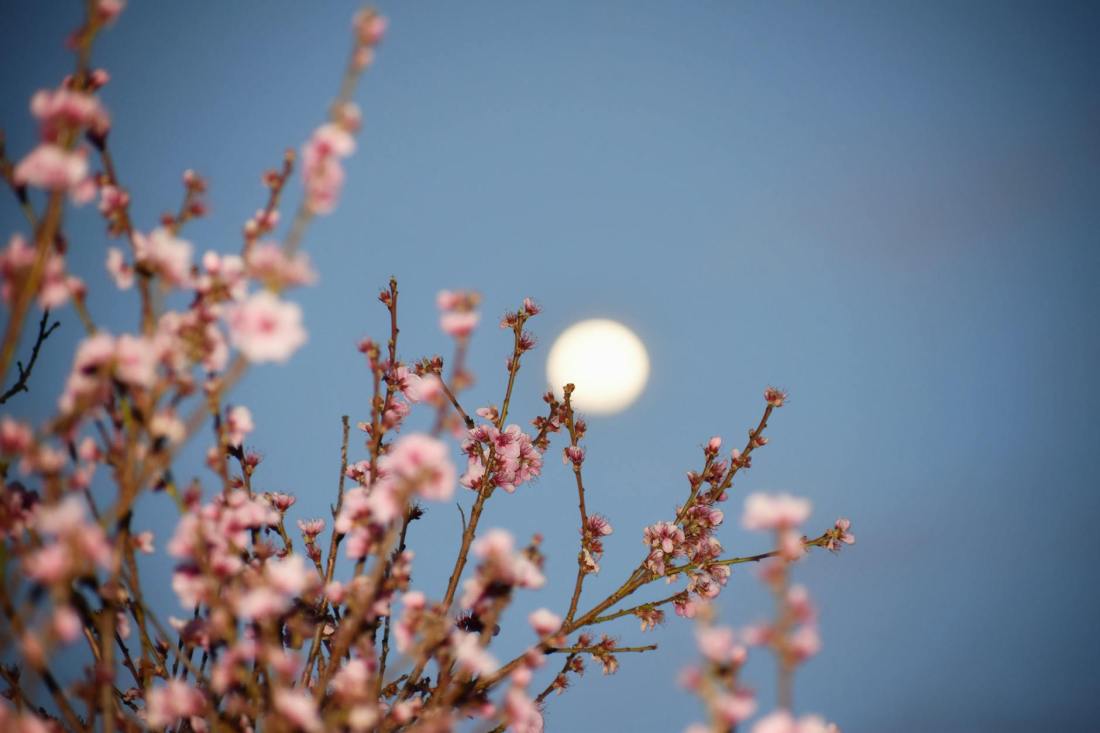
Poet Ariwara no Narihira, who wrote poem 17 (ちは) in the Hyakunin Isshu, and quite possibly the best poem on cherry blossoms ever, is also the model for the protagonist of the Ise Stories. In it, he delivers yet another banger of a cherry blossom poem. This is episode 29 of the Ise Stories:
Back then, when called to attend the cherry-blossom jubilee held at the reside of the Heir Apparent‘s mother [he recited the following]:
This is a really good cherry blossom poem, but Professors Mostow and Tyler explain that there is more to the story too. The heir apparent, later the ill-fated Emperor Yozei (poem 13, つく) in the Hyakunin Isshu, had a mother named Fujiwara no Takaiko. And within the Ise Stories, episode 6, there is a famous anecdote where:
Back then there was this man. Year after year he courted a lady he was unlikely ever to win, until at last he managed to abduct her under cover of darkness.
Translation by Mostow and Tyler
Later, the pair take cover in a storehouse during a bad rainstorm, but while he stood guard outside, a demon came and swallowed her, losing her forever. The episode then explains that the demon was in fact Takaiko’s brothers who brought her back to the capitol. Thus, it’s strongly implied in the story that Narihira and Takaiko briefly eloped before she was found by her family and brought home.
The poem above was composed after Takaiko was already wed to Emperor Seiwa and had given birth to a son, Yozei. It’s not hard to imagine that Narihira maybe still had feelings for Takaiko, though modern scholarship seems to reject this, and suggest it is simply polite felicitations.
Was this a hidden love poem, or a really colorful description of cherry blossoms? Who knows?
The compiler of the Manyoshu poetry anthology, Ōtomo no Yakamochi (大伴家持, 718 – 785), who also composed poem 6(かさ) in the Hyakunin Isshu, had a girlfriend named Kasa no Iratsumé (笠女郎, sometimes called “Lady Kasa” in English ) who was very devoted to him. She was second only to Yakamochi’s stepmother1 in her poetic contributions to the Manyoshu, and wrote many lovely poems to Yakamochi, including this one:
Rough translation by me, apologies for any mistakes
This is a nice, touching poem about someone who misses her far away lover. Not unusual in the Manyoshu, because even a journey to a neighboring province was a lengthy affair, let alone a remote one.
So, why do I highlight this poem when Kasa no Iratsume contributed many others?
In the late 19th and early 20th centuries was a Japanese author named Mori Ōgai (森 鷗外, 1862 – 1922), who during Japan’s rapid modernization period, spent some time in Germany learning Western medicine. Ogai was also an excellent writer, and wrote several stories, including a famous short story Maihime (舞姫, “The Dancing Girl”) about a young German woman who fell in love with a Japanese man studying there. After the man returns to Japan, the German woman (now pregnant) pines for him, and eventually meets a tragic end even as he prepares to return to Japan. The story is, according to Ogai, not autobiographical, but taken from anecdotes of other Japanese students studying abroad.
What’s interesting is that Ogai was definitely fascinated by Iratsume’s poem and even borrowed the obscure term 面影 (omokagé) in the title of the work Omokagé (於母影): a collection of Western poems translated into Japanese by Ogai and other members of the Shinseisha Society (新声社) in 1889. The related story of a young woman pining for the one she loves in a remote place is not hard to miss either in Dancing Girl, so perhaps that was a source of inspiration.
Nonetheless, it’s amazing how one writer or poet can inspire another 1,000+ years later.
… then again, I suppose that’s how this blog got started. 😏
1 Yakamochi’s birth mother died when Yakamochi was very young, and so he was raised by his stepmother, Ōtomo no Saka no Ue no Iratsume (大伴坂上郎女). She herself was on her third marriage after her previous two husbands both died. This underscores how short the average lifespan was in those days, even for the wealthy, as a woman in her 20’s or 30’s might be on her third marriage by then. Something almost unthinkable in the 21st century. Lady Izumi (poem Poem 56 of the Hyakunin Isshu あらざらん) had a similar string of bad luck.
Fall is approaching, and it reminds us of fall leaves, and famous poems of the Hyakunin Isshu such as the chihaya poem (poem 17) among others….
Throughout the blog, I’ve tended to focus on the lady authors and poets because it’s so rare to see women get credit for writing in the pre-modern era. There was an explosion of feminine talent in the Heian Period (8th – 12th century) that was not repeated until modern era in Japan, and it’s been fascinating.
However today, I wanted to highlight one particular text called the Ise Monogatari (伊勢物語). Our illustrious Dr. Joshua Mostow who has contributed much to this blog translates the title as the “Ise Stories” in his translation, but other translations call it the Tales of Ise. You can decide which one you prefer. Since Dr Mostow is a cool guy, and done much for the field, I will use his translated title. For this post, I am using the translation by Dr Mostow and Dr Royall Tyler.
Unfortunately, we still don’t know who the actual author of the Ise Stories was. In fact, Professor Mostow explains that the prevailing theory is that the Tales was composed over decades, in stages, possibly by different authors. Unlike the later Tales of Genji, or the Gossamer Years, or the Pillow Book, which were all clearly composed by one author, the Tales of Ise has a murkier development.
Anyhow, the Ise Stories is not a modern story, with narrative arc, nor does it have an ending. Instead, the Ise Stories are a series of short anecdotes about an anonymous prince who leaves the capitol of Heian (modern day Kyoto), and journeys east to the hinterlands for a time. In fact, you could probably call the Ise Stories the “Anecdotes of Ise With Lots of Poetry Thrown In”. The later work, the Tales of Genji, has a similar format.
The hero of the story, a young, charming prince who travels east with his entourage and has a few love trysts along the way, is a kind of idealized Heian-period aristocrat: a gentleman with an excellent pedigree, and talent for poetry to boot. Each story includes at least one waka poem, the same kind used in the Hyakunin Isshu, often more. Why so much poetry? Many times these were used as a back-and-forth way of greeting someone from afar, or saying “hello” to a promising lady, so a chapter might have multiple poems in the form of dialogue.
For example, section 14 deals with a tryst between our protagonist and a provincial lady in remote Michinoku province (a place also mentioned in poem 14 of the Hyakunin Isshu). She writes to him the following poem:1
Original text
Japanese romanization
Translation
なかなかに
Naka-naka ni
So if, after all,
恋に死なずは
Koi ni shizanu wa
I am not to die of love,
桑子にぞ
Kuhako ni zo
I know just the thing;
なるべかりける
Narubekarikeru
I should have been a silkworm,
玉の緒ばかり
Tama no wo bakari
for that little life’s short span.
Our protagonist was not impressed by her, as her poem “reeked of the country[side]”, but slept with her anyway. Classy guy.
Then, he left before dawn and she lamented:
Original text
Japanese romanization
Translation
夜も明けば
Yo mo akeba
Come dawn’s early light
きつにはめなで
Kitsu ni hamenade
oh yes, in the tank you go,
くたかけの
Kutakake no
you obnoxious bird,
まだきに鳴きて
Madaki ni nakite
to learn to cock-a-doodle
せなをやりつる
Sena wo yaritsuru
my darling away too soon.
The protagonist then remarked he was going to the capitol, but left behind a “charming” poem:
Original text
Japanese romanization
Translation
栗原の
Kurihara no
If the Aneha
あねはの松の
Aneha no matsu no
Pine here at Kurihara
人ならば
Hito naraba
only were human
都のつとに
Miyako no tsuto ni
“Come along with me,” I’d say,
いざといはましを
Iza to iwamashi wo
“you’re my gift to the City.”
According to the Ise Stories, she was much impressed and thought he was in love with her, but the commentaries suggest he was being condescending by implying that “if only she were worthy of Courtly life at the capitol”. Damn.
But what’s the source for all this poetry and narrative?
The origins of the Ise Stories is somewhat of a mystery, but there is strong evidence that the central character was heavily based upon a real aristocrat named Ariwara no Narihira (825 – 880), the same man who composed the aforementioned poem 17 (ちはやふる), and also composed what’s considered the greatest poem about cherry blossoms ever composed. Some of his poems in the old Kokin Wakashu imperial anthology were re-used in the Ise Stories as well.
In addition to his poetic genius, the real life Narihira was a playboy and had many relationships, even by the standards of Heian-period aristocracy. Sometimes this got him into trouble. The Ise Stories begins with an explanation that the anonymous prince left the capitol after having an affair with Emperor Seiwa’s consort. Coincidence? I think not. 🤔
Nonetheless, the Ise Stories is a whimsical and irreverent look at Heian Period culture and how the aristocracy interacted with people in the provinces, even when it was somewhat condescending. Court culture was unlike anything else in Japan at the time, and this reveals some interesting things that are not always conveyed in other works of the time.
1 Mostow and Tyler explain that the young woman’s poem was a re-working of an older poem from the Manyoshu, poem 3086:
Since I spent so much time gushing over First Summer Uika and her portrayal of Sei Shonagon in the Japanese drama Hikaru Kimi É (“Addressed To You, My Radiant One”), this seemed like a good time to talk about the Pillow Book, or Makura no Sōshi (枕草子).
Despite the name “Pillow Book”, the book has no erotic content. Instead, it is a collection of witty musings about life in the Heian Period aristocracy, early 11th century. The image is of a person lying on their pillow, composing thoughts in a diary.
The author, Sei Shonagan (poem 62), was one of the pre-eminent writers of her generation, in a field of many excellenttalentedwomen.
I had read the book many years ago, and I felt it was a bit dry at times since it has no narrative. But back then, I also had a much more limited understanding of Heian Period culture, and many of the things mentioned in the Pillow Book are also alluded to in the Hyakunin Isshu, as well as the Diary of Lady Murasaki. So, even if the format is different, all three collections draw from the same “cultural well”.
I thought I had lost my copy of the Pillow Book (the Penguin Classics version, translated by Dr Meredith McKinney) a long time ago, but was amazed to discover that it was just buried behind other books. So, I dusted off the book and have been reading through it again.
Sei Shonagon is a keen observer of life in the Heian Period, and makes lists for all kinds of obscure things:
[23] Occasions that induce half-heartedness — The religious services on days of Buddhist fasting. Preparations for something still far in the future. Long periods of seclusion at a temple.
Or she adds things to lists that were probably drawn from personal experience:
[132] Occasions when time drags by — An abstinence that you must observe away from home. A game of sugoroku when you can’t manage to get your pieces off the board. The house of someone who’s failed to get a promotion in the Appointments List. And of course the worst of all is simply a day of heavy rain.
It’s also clear that Sei Shonagon had a pretty haughty attitude, especially when compared to Lady Murasaki’s (poem 57) withdrawn, melancholy tone or Lady Izumi’s (poem 56) whimsical passion. As they say in modern Japanese: seikaku ga deru (性格が出る, “people’s personalities come out”). In one anecdote, section 94, she grumbles about encountering “worthless peasants”. I wouldn’t be surprised if she was the only one among the nobility at the time who held such views, but it is nonetheless painful to read.
One thing I do particularly enjoy about the Pillow Book though are the anecdotes. While many of the entries are just lists and her opinions, she often reminisces about funny, sad or strange occurrences she witnessed during her 10-year tenure serving the ill-fated Empress Teishi. Some of these anecdotes and observations are quite long, while others are brief. Some happened long ago, and Sei Shonagon’s memory is a bit fuzzy, others are more recent.
For example in one anecdote, number 79, she talks about how her relationship with one Officer of the Left Gate Watch named Norimitsu had soured after an incident where he covered for her. She had gone somewhere and only Norimitsu knew her whereabouts, but the Captain Consultant demanded to know where she had gone and Norimitsu tried to keep his mouth shut. Later when Norimitsu complained, she sent a piece of dried seaweed in reply, and Norimitsu got annoyed. She criticized his lack of sense, and he was frustrated at her for putting him in such a difficult position. Later she muses that they grew more and more distant after that incident until “later, Norimitsu was promoted to Deputy Governor of Tōtōmi Province, and the relationship ended in hostility.”
Sei Shonagon discusses many people of the Court, including other ladies in waiting, but does not mention Lady Murasaki and other famous women of the Hyakunin Isshu. Such women served under the second empress, Shoshi, and thus came a bit later anyway. By the time Emperor Ichijo married a second time, Teishi’s status had greatly declined and her retinue (including Sei Shonagon) were on their way out the door. Teishi herself soon died in childbirth.
The Pillow Book is a really nice “slice of life” look at the court culture of the time: sometimes amusing, sometimes exquisite, and sometimes depressing. Her wit really shows through the ages and even today kids in Japan (and people outside Japan) still read her book.
P.S. Featured photo is a drawing of Sei Shonagon from a 13th-century illustrated copy of the Pillow Book. Courtesy of Wikimedia Commons.



 The Hyakunin Isshu
