The Fulling of Cloth: Poem Number 94

Although not a well-known poem in the Hyakunin Isshu, I rather like this one for some reason:

JapaneseRomanizationTranslation
みよし野のMiyoshino noFair Yoshino,
山の秋風Yama no aki-kazethe autumn wind in its mountains
さよふけてSayo fuketedeepens the night and
ふるさとさむくFurusato samukuin the former capitol, cold
衣うつなりKoromo utsu nariI hear the fulling of cloth
Translation by Dr Joshua Mostow

The author, Sangi Masatsune (参議雅経, “Counselor Masatsune”, 1170-1221), also as known as Fujiwara no Masatsune, was another editor of the Shin Kokin Wakashū like Yoshitsune (poem 91) and went on to found the poetic house of Asukai (also famous for calligraphy). He also studied under Shunzei (poem 83) earlier in his career.

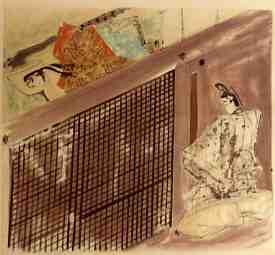
I had to look up what fulling cloth meant, but apparently it’s the process of beating cloth, especially wool, to improve the texture, or in the case of Japan, give the cloth a nice glossy sheen. You can see an example of this above, in a painting made in the 1800’s, almost 700 years later. I can’t imagine the process changed much within that time. The process was to place the cloth on a wood or stone surface and pound it with a wooden mallet. In Japanese, the process called koromo utsu (衣打つ) just as it is mentioned in this poem.

Also, this poem, like other poems we’ve looked at recently (poem 90 and poem 91), alludes to a much older poem by Korenori (poem 31), which also mentions snow in the village of Yoshino (yoshino-chō, 吉野町), near the old capitol of Nara.

Interestingly, the “former capitol” is referred to by the poetic phrase furusato, which in modern Japanese means one’s hometown. Nara was the capitol of Japan during the early Nara Period, and personally my most favorite place to visit in Japan. The culture at that time was an interesting fusion of early Japanese culture, Chinese art and culture, and Indian Buddhism (via Silk Road). Even after the capitol was moved to Kyoto (another great place), there existed many euphemisms to the “former capitol” by later poets and authors (poem 61, for example) as a kind of nostalgia or the “good ol’ days”. Hence the use of the term furusato I believe.

P.S. Featured photo is Surimono, Woman Fulling Cloth in the Moonlight, by Shigenobu, Brooklyn Museum, No restrictions, via Wikimedia Commons

Even At Low Tide: Poem 92

Another poem dedicated to those who were lonely for Valentine’s Day recently:

JapaneseRomanizationTranslation
わがそではWaga sodé waMy sleeves are like
しおに見えぬShioi ni mienuthe rock in the offing that
沖の石のOki no ishi nocan’t be seen even at low tide,
人こそしらねHito koso shiranéunknown to anyone, but
かはくまもなしKawaku mamo nashithere’s not a moment they are dry.
Translation by Dr Joshua Mostow

The author of this poem is Nijōin no Sanuki (二条院讃岐, 1141 – 1217), also known as “Lady Sanuki of Nijōin”. Her real name isn’t known. It is known that she was a daughter of famous warrior/poet Minamoto no Yorimasa and served the retired Emperor Nijō, hence her name nijōin (Imperial House of Nijō). The “Sanuki” part comes from Sanuki Province where her father was once posted on assignment.

Sanuki, like Sokushi, was a leading female poet of her day, and this poem helps illustrate why. As we discussed recently in poem 90, the image of sleeves wet with tears was a popular poetic technique used at the time for unrequited love (again, see poems 42, 65, and 72) but the idea of such sleeves being hidden like a submerged rock offshore was a novel, new way of expressing this.

Indeed, Sanuki became so famous for this verse, she herself was often referred to as oki no ishi no Sanuki (沖の石の讃岐) by later poets and authors. It was pretty rare for a poet to receive such a name for a famous verse they composed but a few other examples exist. Another female poet named kunaikyō (宮内卿) was called wakakusa no kunaikyō (若草の宮内卿) because of a famous verse she wrote regarding young grass (wakakusa, 若草) from the Shin Kokin Wakashū:

JapaneseRomanizationTranslation
薄く濃きUsuku kokiLight and dark:
野辺のみどりのNobe no midori nothe green of the field’s
若草のWakakusa noyoung herbs
あとまで見ゆるAto made miyurudistinct in
雪のむら消えYuki no muragiepatches of fading snow.
Translation source unknown

Pretty awesome when you can make a name for yourself that way.

A Cold Mat: Poem 91

A fitting poem for late fall and those who somehow missed out on Valentine’s Day recently:

JapaneseRomanizationTranslation
きりぎりすKirigirisuWhen the crickets
鳴くや霜夜のNaku ya shimoyo nocry in the frosty night,
さむしろにSa mushiro nion the cold reed-mat,
衣かたしきKoromo katashikispreading out my robe
just for one,
ひとりかも寝Hitori kamo nenmust I sleep all alone?
Translation by Dr Joshua Mostow

This sad, miserable poem was ironically composed by a famous poet of his era named Gokyōgoku Sesshō Saki no Daijōdaijin (後京極摂政前太政大臣, 1169-1206) or ”The Gokyōboku Regent and Former Chancellor”, also known as Fujiwara no Yoshitsune. He was the grandfather was Jien (poem 95). He was another member of the elite poetry family, the Mikohidari (see Jakuren poem 87) and was very well-represented in the Shin Kokin Wakashū poetry anthology which he was an editor. Elsewhere, as a scion of the Fujiwara family, he served as regent to the young Emperor Tsuchimikado, but unexpectedly died at the age of 36.

Astute readers may have noticed that this poem sounds similar, especially in Japanese, to a very early poem in the anthology by Hitomaro (poem 3). Even the last line is the same.

But part of the poem also seems similar to another poem in the Shin Kokin Wakashū anthology according to Professor Mostow, which relates to cold reed-mats and waiting alone. So, in a sense, this poem blends two famous poems and adds the novelty of crickets (kirigirisu) which symbolize autumn.

But as we’ve seen with poem 90, it was an accepted practice at the time to write poetry which allude to older poems in the poems. Indeed, as the author of the blog, I admit I kind of enjoyed this poem more when I noticed the final line and realized I had heard it before. So, I guess the amusement is not limited to 11th century Japanese aristocrats. 😉

Yoshitsune certainly never had to spend a night in the cold as a member of the elite Fujiwara family, but his ability to weave old poetry verses together and paint such a sad picture help explain why he was such a famous poet.

Fisherwomen’s Sleeves: Poem Number 90

This poem is a clever variation on the “sleeves wet with tears” poems we often see in the Hyakunin Isshu:

JapaneseRomanizationTranslation
見せばやなMisebaya naHow I’d like to show him!
島のあまのOjima no ama noThe sleeves of the fishermen
袖だにもSode dani moof Male Island
ぬれにぞぬれしNure ni zo nureshiwhen it comes to wet, are wet indeed,
色はからずIro wa kawarazubut their color doesn’t change!
Translation by Dr Joshua Mostow

The author of this poem is Inpumon-in no Taiyu (殷富門院大輔, dates unknown) or “Taiyu of the Household of Princess Ryōshi”. She served Princess Ryōshi (“Inpumon-in”), the daughter of Emperor Go-Shirakawa. Princess Ryōshi was also known as Inpumon-in (殷富門院) hence the name here. Taiyu was an accomplished poet and another member of the elite “Garden in the Poetic Forest” group (see poem 85).

The poem here, according to Mostow, is a 200-year old rebuttal of an earlier poem that celebrates the “wet sleeves” of the fisherman of Matsushima, but saying “if you think their sleeves are wet, mine are even more wet and stained with blood-red tears!” We’ve seen other “sleeves wet with tears” poems in the Hyakunin Isshu, namely poem 65, poem 72, and my favorite poem 42. But Taiyu takes this one to a new level, I think. 🙂

Regarding the location, “Male Island” (雄島, Oshima in Japanese) is one of 200+ tiny islands in a famous island chain called Matsushima (松島) in modern-day Miyagi Prefecture. The featured photo above is Matsushima (photo by Chensiyuan, CC BY-SA 4.0, via Wikimedia Commons). The islands are all pretty small, and very scenic, and each has their own unique name. However, in the 2011 Great Tohoku Earthquake, the area was badly devastated and still recovering.

In any case, poets from antiquity and centuries later used Matsushima in their poetry and it’s easy to see why.

One other point worth mentioning is that this poem, and poem 89 use a clever trick in Japanese poetry called kugire (句切れ). The idea is to add a single syllable in there, usually on the first line, in order to add impact, but also as a filler to help maintain the standard 5-7-5-7-7 lines in Waka poetry. In this poem the kugire is on the first line, at the end: 見せばや (mi-se-ba-ya-na), while in poem 89 it is 玉の緒 (ta-ma-no-o-yo).

You can see this technique centuries later in Japanese haiku, such as in the famous poem by Basho in the year 1686:

JapaneseRomanizationTranslation
古池Furu ike yaAn ancient pond!
蛙飛びこむKawazu tobikomuA frog jumps in;
水の音Mizu no otothe splash of water…
My amateur translation…

This haiku was composed 500+ years after the poems of the Hyakunin Isshu, but it’s interesting how some poetic-devices never quite get old.

Short As A Reed: Poem Number 88

If you like word-play, you’ll enjoy this poem quite a bit:

JapaneseRomanizationTranslation
江のNaniwa-e noDue to that single night
あしのかりねのAshi no karine noof fitful sleep, short as a
reed’s joint cut at the root
一よゆHitoyo yuefrom Naniwa Bay,
みをつくしてやMi wo tsukushite yaam I to exhaust myself,
like the channel markers
わたるべきKoi wataru bekipassing my days in longing?
Translation by Dr Joshua Mostow

This poem was composed by Lady Bettō (dates unknown), known in the Anthology as Kōkamon’in no Bettō (皇嘉門院別当). Lady Bettō served in the house of Empress Seishi, wife of Emperor Sutoku (poem 77). Lady Bettō was also the daughter of Minamoto no Yoshitaka.

Although the life of Lady Bettō is relatively unknown, and she doesn’t appear in many anthologies, Professor Mostow points out that her poem is quite a technical feat. There are not one, but three “pivot words”, or words that carry multiple meanings, and lend multiple interpretations to the poem:

  1. karine can mean cutting a root (刈り根) or a brief nap (仮寝) such as when traveling.
  2. hitoyo can mean either a single segment of a reed (一節) or a single night (一夜).
  3. mi wo tsukushi can mean either to exhaust one’s body (身を尽くし) or one of the famous barriers in Osaka Bay (澪標, see also poem 20)

The poem itself uses many familiar themes too. We’ve seen a lot of poems that feature Osaka Bay, called Naniwa in ancient times, including poem 20, poem 19 and poem 72 among others. Similarly, we see references to reeds, just as we do in poem 39 and poem 19 (again).

What makes this poem stand out is the excellent use of word-play throughout. On the surface, it looks like just another love poem, but Lady Bettō knew what she was doing. 😌

P.S. Featured photo is of reeds (species Phragmites) in Amsterdam, photo by PersianDutchNetwork, CC BY-SA 3.0, via Wikimedia Commons

Mists and Rain: Poem 87

It’s been a while, but I wanted to start off with a nice, descriptive poem:

JapaneseRomanizationTranslation
むら雨のMurasame noWhile the raindrops of
つゆもまだ干ぬTsuyu mo mada hinuthe passing shower have
not yet dried from
まきの葉にMaki no ha ninear the leaves of the
evergreens,
きり立ちのぼるKiri tachinoboruthe mist is already rising, on
秋のゆうぐれAki no yugurethis evening in autumn.
Translation by Dr Joshua Mostow

This poem was composed by Jakuren Hōshi (寂蓮法師, 1139 – 1202), “Dharma-master Jakuren”, whose name was originally Fujiwara no Sadanaga before he took tonsure. He is a nephew of Shunzei (poem 83) and according to Professor Mostow a leading poets in the house of Mikohidari. He helped to compile the official poetry anthologies at the time, but died before completion.

Professor Mostow points out that Fujiwara no Teika (poem 97), another member of the House of Mikohidari, didn’t praise this poem at first, and it made the “cutting floor” of the Imperial anthology that Jakuren helped compile, the Shin-Kokinshū, or in other anthologies. And yet, years later, it appears here in the Hyakunin Isshu by Fujiwara no Teika. The poem is generally viewed as a simple, straightforward descriptive poem, which is perhaps why it wasn’t as highly revered as other more subtle poems, or poems with more of a backstory.

Still, I think anyone can appreciate the scenery painted in this poem even today.

Interestingly, the poetic verse kiri tachinoboru (霧立ち上る) or “the mist is already rising”, was coined by Jakuren and was associated with him by later poets and commentators.

P.S. I’ve been away from the blog for a couple months raising our new little boy and keeping up with holidays. Now that things are finally quieting down, I hope to complete the final 7 poems (aside from this one). I’m still debating on further topics for this blog, and suggestions or requests are always appreciated.

Sleepless Nights: Poem Number 85

Whereas the last love poem expressed love and anxiety after a first-meeting, this poem is quite a different story:

JapaneseRomanizationTranslation
夜もすがらYo mo sugaraAll through the night
もの思ころはMono omou koro warecently, as I dwell on things,
明けやらでAke yaradeeven the gap between
the doors
ねやのひまさNeya no hima saeof my bedroom, which
does not lighten,
つれなかりけりTsure nakari keriseems cruel and heartless
to me.
Translation by Dr Joshua Mostow

The author is a Buddhist monk named Shun’e Hōshi (俊恵法師, 1113 – ?), or “Dharma Master Shun’e” who was the son of Minamoto no Toshiyori (poem 74) and grandson of Minamoto no Tsunenobu (poem 71). Though he had taken tonsure, Shun’e was quite a social figure and gathered many poets and writers around him and his residence called the Karin’en (歌林苑, “Garden in the Poetic Woods”). According to Professor Mostow, one of his students was a famous writer named Kamo no Chōmei who wrote the “Account of a Ten Foot Hut” or Hōjōki.

This poem is another example of when a poem expressing a woman’s anguish is written by a man, presumably on a set topic for a poetry contest. Other examples include poem 18 and poem 21. Obviously being able to express a woman’s feelings, namely that of a jilted lover, so well from a male author was not an easy task, and was a mark of excellent poetic skill, and not surprisingly Shun’e is counted among the Later Six Immortals of Poetry.

The respect that male actors in later Kabuki theater who specialize in female roles earn probably has a similar origin.

P.S. Featured photo is a scene from the illustrated Murasaki Shikibu Nikki Emaki, Public domain, via Wikimedia Commons

The Plovers’ Cry: Poem Number 78

As the weather gets colder, I’ve been saving this one for a time like this:

JapaneseRomanizationTranslation
淡路あわじAwaji shimaThe crying voices
かよ千鳥のKayou chidori noof the plovers who visit
鳴くこえNaku koe nifrom Awaji Island—
いく夜ねざめぬIkuyo nezamenuhow many nights have
they awakened him,
須磨の関守Suma no sekimorithe barrier-keepers of Suma?
Translation by Dr Joshua Mostow

The author of the poem, Minamoto no Kanemasa (源兼昌, dates unknown) was a frequent participant in poetry contests of the day, but overall very little is known about him, and it doesn’t appear he had any poetry collections of his own.

The first time I read this poem, in Japanese, I misunderstood the phrase chidori (千鳥) to literally mean 1,000 birds (in other words, a lot of birds). But in fact, chidori refers specifically to plover birds. The featured photo above shows a Western Snowy Plover bird on Morro Strand State Beach, Morro Bay, CA, “Mike” Michael L. Baird, CC BY 2.0, via Wikimedia Commons.

In Japanese poetry plover represented winter, and for other seasons, other birds typically were frequently used:

The location, Awaji Island, is a well known part of Japan’s inland sea, and is culturally significant since antiquity. Though at this time in history, it felt a bit remote from the capitol.

Professor Mostow notes that this poem uses some strange grammar though. For example nezamenu would normally mean to not wake up, but in this context means “have they awakened” instead. Also, he notes that this poem apparently alludes to the Tales of Genji, specifically the “Suma” chapter, when the prince Genji was in exile.

All told, this poem paints a sad, somber picture that fits well with wintry days.

Disheleved: Poem Number 80

A clever morning-after love poem that I felt was fun to share:

JapaneseRomanizationTranslation
長からNagakaranI do not even know
心も知らずKokoro mo shirazuhow long your feelings
will last.
黒髪のKurokami noMy long black hair
乱れてけさはMidarete kesa wais all disheveled and,
this morning,
ものをこそ思Mono wo koso omoemy thoughts too are
in a tangle!
Translation by Dr Joshua Mostow

The author of this poem is Taikenmon-in no Horikawa (待賢門院堀川, dates unknown), or “Lady Horikawa of the household of Empress Taiken”. Empress Taiken was the consort to Emperor Toba, and was the mother of Emperor Sutoku (poem 77) who was later exiled.

The use of imagery of “disheveled hair” was a common device often used by women, or writing poetry about women, to express feelings of frustration or anxiety.

As we’ve seen before, morning-after poems were very popular at this time in Japan as many of the aristocracy of the Heian Court would have love trysts between each other. Often the first meeting was the morning important, not surprisingly. It set the tone for the rest of the relationship, so a meeting like this was often celebrated in poetry.

Of course, there was another side to these trysts in the Heian Period too.

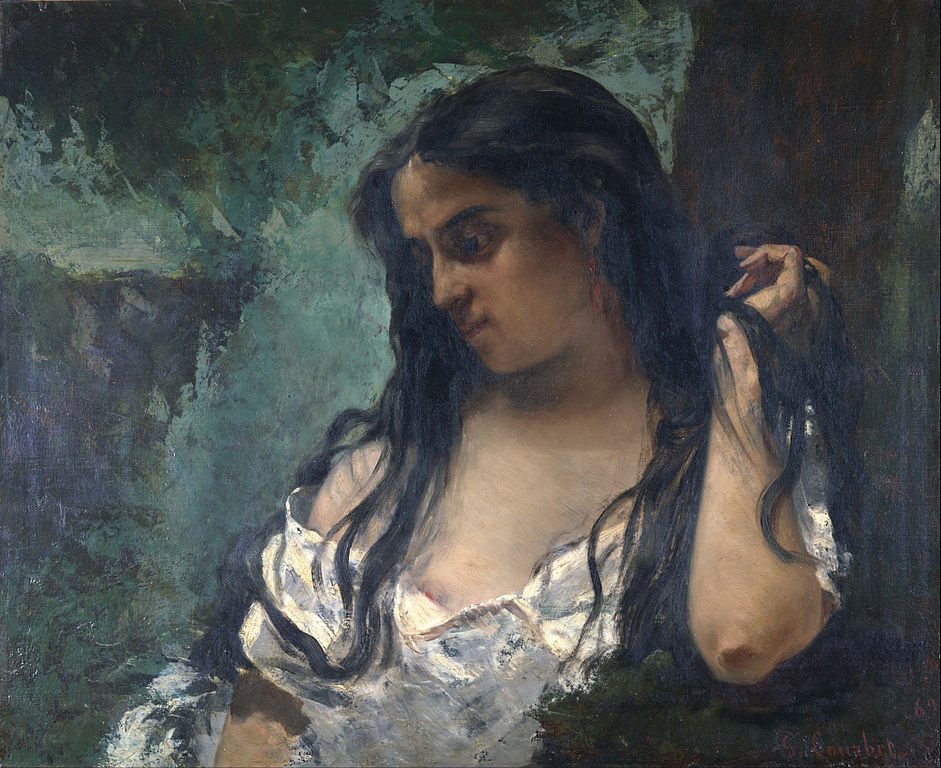
P.S. Featured photo is Gypsy in Reflection, by Gustave Courbet, Public domain, via Wikimedia Commons

Lamentations: Poem Number 86

Another Autumn moon poem, but with an interesting twist:

JapaneseRomanizationTranslation
なげけとてNageke tote“Lament!” does it say?
月やは物をTsuki ya wa mono woIs it the moon that makes me
するOmowasurudwell on things? —No,
and yet,
かこちがおなるKakochi gao narulook at the tears flowing
down
わがなみだかなWaga namida kanamy reproachful face!
Translation by Dr Joshua Mostow

This poem was composed by the Saigyō Hōshi (西行法師, 1118 – 1190), or “Dharma Master Saigyō” a famous Buddhist monk and poet from the era. Saigyo’s story is interesting in of itself, and I blogged more about it on the other blog, including additional poetry, but let me post a summary here.

In his youth, his name was Sato no Norikiyo and he was a promising young man in the Heian Court, and caught the attention of Emperor Toba, Emperor Sutoku (poem 77) and also Taira no Kiyomori, the most powerful man at the time and who later featured as a villain in the famous Tales of the Heike and a many dramas on Japanese TV.

However, Norikiyo grew disillusioned with the nasty politics and infighting in the Court, and abruptly decided to throw it all away. He left behind his career, his wife and children, and became a wandering mendicant. He took on the Buddhist name Saigyo (西行) and stayed at the famous mountain-monastery of Koyasan for monastic training. Later, he returned to the capitol to find everything had changed. The Hogen Rebellion had destroyed much of the capitol, Emperor Sutoku was exiled (having lost), and Kiyomori ruled as a warlord. A few years later, Kiyomori and the entire Heike clan were utterly destroyed in the famous Genpei War, which also spelled the end of the historical Heian Period. What might have happened had Norikiyo stayed and followed his career, rather than leave the capitol?

In any case, with the new samurai government at Kamakura (thus, the Kamakura Period of Japanese history), things settled down in Japan and Saigyo traveled around. He devoted his life to writing poetry, lamenting the loss of his former patrons, admiring the beautiful nature in Japan, and about life in general. He finally settled down in the outskirts of Osaka, and passed away at the age of 73. It was said that when he passed away, the cherry blossoms were in full bloom and that he died on the same day that Shakyamuni Buddha died (February 15th according to solar calendar).

He was also friends with Shunzei (poem 83), according to Professor Mostow.

Anyhow, this poem is, according to Professor Mostow, possibly inspired by a poem by famous Chinese poet Bo Juyi centuries earlier, and is supposed the express the feelings of a resentful lover. Is the moon making him/her tearful? Maybe, maybe not, but gazing up at the moon brings them such sadness anyway.

Saigyo’s talent with poetry and his interesting life story have certainly helped him earn a place in the Hyakunin Isshu, but also inspired many later poets such as Basho and others. Basho the Haiku master, in his travels, went to visit places frequented by Saigyo among others.