Lady Murasaki and Marital Strife

Lady Murasaki, one of the most famous women of Heian-period Japan, and the first novelist in Japan, wrote many wonderful romantic scenes through the Tales of Genji, yet her real life marriage was anything but.

The latest episode historical drama on NHK about the life and times of Lady Murasaki (poem 57, め) covers her marriage to her second-cousin Fujiwara no Nobutaka (藤原宣孝, ? – 1001), who was around 20 years her senior. Yes, this was not that unusual for the time, but still gross.

Sadly, the marriage quickly turned sour. Nobutaka slept around a lot, and had other hidden wives and children. Lady Murasaki did not take this lying down and the two of them fought frequently. Nobutaka for his part, enjoyed bragging about his trophy wife.

In the poems preserved in Lady Murasaki’s own private collection is this poem addressed to her husband:

JapaneseRomanizationRough Translation1
言ひ絶えばIi taebaIf you saw you’re going to
さこそは絶えめSa koso wa taemestop writing me, then fine!
なにかそのNanika sonoYou can’t even
らの池をMiwara no ike wostand by the bank
つつみしもせTsutsumi shimo senof Miwara pond properly.
1 Apologies for any mistakes, or for the roughness of this translation

The backstory of this poem is that Nobutaka had taken one of Lady’s Murasaki’s private letters addressed to him, and shown off that letter to friends (apparently bragging about how smart his young bride was). She was justifiably angry and told him to knock it off. Nobutaka was angry with her and threatened to stop writing. Her reply above, was a clever way of saying “fine, don’t bother writing me”. The allusion to Miwara pond was a pair of puns:

  • Miwana pond (mihara) is also a pun for anger.
  • The word tsutsumi is also pun for a bank (as in riverbank), and self-restraint.

Contrary to Lady Murasaki’s reply, Nobutaka was so impressed by the reply that he ended up bragging about it to his friends anyway. 🤦🏼‍♂️

Another letter is as follows:

JapaneseRomanizationRough Translation2
忘るるはWasururu waForgetting others is
うき世のつねとUki yo no tsune toa part of this ephemeral world,
思ふにもOmou ni moEven so,
身をやるかたのMi wo yarukata nobeing forgotten myself,
なきぞわびぬるNaki zo wabinuruI cannot help but cry.
2 Apologies for any mistakes, or for the roughness of this translation

The married nobility of the Heian Period frequently lived in separate estates, and the husband would visit his wife as needed, but not the other way around. It seems by this point, Lady Murasaki was forgotten by her philandering husband, and lamented her unhappy marriage. One can’t help but recall the Gossamer Years generations earlier.

It is sad that such a talented woman was relegated to an unhappy marriage with a faithless, not to mention narcissistic husband, especially in a society where women had little recourse. I also wonder how much this motivated her to write her novel, The Tales of Genji, as a coping mechanism.

P.S. Sources used in this post include:

P.P.S. For folks who are visiting Kyoto, there are many excellent locations associated with the life of Lady Murasaki and the Tales of Genji. The featured photo above is the “Genji Garden”, part of the Buddhist temple of Rozan-ji, courtesy of PlusMinus, CC BY-SA 3.0, via Wikimedia Commons. This blog includes an excellent photo-tour of Rozan-ji.

A Lame Excuse: Poem Number 62

As a final poem in March to honor women poets in the Hyakunin Isshu, I wanted to post a humorous, witty poem by Sei Shonagon, author of the Pillow Book:

JapaneseRomanizationTranslations
夜をこめてYo wo kometeAlthough, still wrapped in night,
鳥の空音はTori no sorane wathe cock’s false cry
はかるともHakaru tomosome may deceive,
よにおう坂のYo ni Ōsaka nonever will the Barrier
ゆるさじSeki wa yurusajiof Meeting Hill let you pass.
Translation by Dr Joshua Mostow

Sei Shonagon (清少納言, dates unknown), along with Lady Izumi (poem 56) and Lady Murasaki (poem 57), is one of the most famous female authors of her generation and Japanese history as a whole. She was the daughter of Kiyohara no Motosuke (poem 42). Her name Sei is another way to read the Chinese character “kiyo” (清), while Shonagon refers to a government post (lit. “lesser councilor of state”), but it’s unclear why it’s attached to her.

She’s best known as the author of the Pillow Book. Despite the name, it is mostly just a book of witty observations regarding court life, nature, art, etc. Whereas Lady Izumi was a hopeless romantic, and Lady Murasaki was melancholy, Sei Shonagon’s writings show she had a sharp, often haughty wit:

[151] People who seem enviable — You set about learning to recite a [Buddhist] sutra, stumbling along, going endlessly over the ame places and constantly forgetting bits. When you hear the same words tripping smoothly off the tongues of others — not only the priests, but other men and women — you wonder enviously if you’ll ever be able to perform like that.

….You have an urge to go on a pilgrimage to Inari Shrine, and as you’re laboriously gasping your way up the steep mountainside to the middle shrine, you’re filled with admiration to see others who’ve obviously started behind you go climbing straight up without the least effort; when you arrive, there they stand, already at their worship….

The Pillow Book, trans. Dr Meredith McKinney, page 152

Sei had the misfortune of serving Empress Teishi, who fell out of favor after her father died, and the Emperor’s 2nd wife, Empress Shoshi, eclipsed her. Lady Izumi and Lady Murasaki served the latter, and by that time Sei Shonagon was a bit of a has-been. This same power struggle also negatively impacted Fujiwara no Sadayori (poem 64). It is thought that Pillow Book was, among other things, a subtle middle-finger to the Court for abandoning Empress Teishi by painting such a rosy picture of her time.

In any case, this poem demonstrates Sei Shonagon’s wit at her finest though. According to the back-story of this poem, she was visited by one Yukinari, the First Controller, who left early in the night, because he had to be back to the Palace before the rooster crowed. Then Sei Shonagon receives a letter from him the next day, stating that he would have loved to stay longer, but then uses the famous example of a Chinese legend about the Lord of Meng Chang who supposedly tricked the guards at Han Ku gate to open it by imitating a rooster crow at night so that they would believe it was morning.

However, Sei is not convinced by his eloquent excuse and sends this snarky poem back that basically says that no one at Ōsaka Gate (Meeting Hill) would be fooled by it.

Dang. 👈🏼👈🏼😎

The Joys and Pains of Marriage: Poem Number 54

This is the fifth poem in our series dedicated to Valentine’s Day:

JapaneseRomanizationTranslation
忘れじのWasureji noBecause that future, until which,
行くすまではYukusue made wayou say, you will “never forget,”
難ければKatakerebais hard to rely on,
けうきょうを限りのKyo wo kagiri nooh, if only today could be
命ともがなInochi to mo ganathe last day of my life!
Translation by Dr Joshua Mostow

This poem was composed by Gidō Sanshi no Haha (儀同三司母, ? – 996), or “Kishi” or short. Her personal name was Takashina no Takako, and she was the wife of the powerful regent, Fujiwara no Michitaka. She is listed in the Hyakunin Isshu as “Mother of the Supernumerary Grand Minister” due to the tremendous power wielded by her son, Fujiwara no Korechika for a time, as well as Princess Teishi whom Sei Shonagon (poem 62) served under.

Takako herself was from an elite family, and had considerable talent in Chinese poetry, which allowed her to win competitions over many learned gentleman. No doubt this helped her catch the eye of the ambitious and rising star that was Fujiwara no Michitaka. This poem was, according to Mostow, composed shortly after their wedding, with all the joy and excitement about the future that comes with marriage.

However, as you can see, there is a bitter undertone to this poem. Noblemen at the time often married multiple wives, and such women were often living apart from their husbands. Further, Michitaka was known to carry on many side affairs, including Akazomé Emon’s sister (poem 59).

As we saw with the Gossamer Years, this can lead to many years of isolation and loneliness if the husband neglects her. So, the poem expressed a sense of unease about the future and how long this excitement might last.

Later, when Michitaka later passed away, Takako took tonsure as a Buddhist nun and left behind few other poems.

Speaking as one who’s happily married myself, I can definitely understand her excitement that day, even a thousand years later, but also the joys of staying with it for many years. One wife is enough, and I am glad to have invested the care and devotion to make it work.

The photo above was taken by me of the doll set we keep at home for Girl’s Day, a holiday celebrated in early March. It symbolizes the happy marriage of the Emperor and Empress, and the aspirations of young women everywhere for a happy life with the man of their dreams.

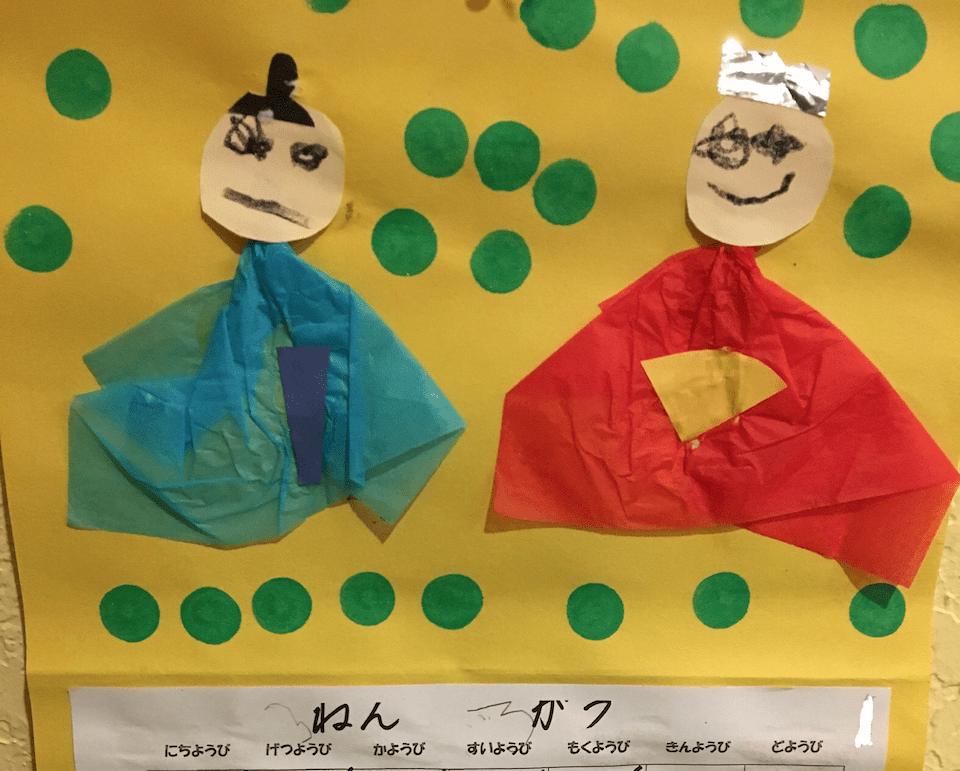
P.S. Featured image is a calendar my son made in Japanese preschool, depicting Girl’s Day.