Interesting historical fact that I learned recently.
A long, long time ago in this blog, I wrote about the Six Immortals of Poetry: a list of eminent poets devised by Ki no Tsurayiki (poem 35 in the Hyakunin Isshu, ひさ). This list was in the preface to the Kokinshu imperial anthology, wherein he raised up these six poets, as prime examples of poetry at the time ….. then promptly tore them down for one reason for another.
However, my book about the Manyoshu explains that in the same preface, Tsurayuki elevates two other poets as being above reproach:
Kakinomoto Hitomaro (poem 3 in the Hyakunin Isshu, あし) and
Together they were revered as Yamakaki no Mon (山柿の門) meaning the “Gate of Yama(be) and Kaki(nomoto)”. In modern terms, we can call them the Super Poetry Brothers…
I used to watch this show as a kid, every day after school. 😆
But I digress.
Kakinomoto and Yamabe were not exactly contemporaries. They were about a generation apart, and their poetry had different styles, but together they were seen as the epitome of poetic skill. So much so, that even Ki no Tsurayuki could find no fault in them.
Let’s look at each one.
Kakinomoto Hitomaro focused on expressing inner feelings. His poem in the Hyakunin Isshu shows his worry about sleeping alone one night, while this poem shows his passion for the one he loves. Or this one from the Manyoshu (poem 48):
Original Manyogana
Modern Japanese
Romanization
Rough Translation
東
東の
Himugashi no
To the east I
野炎
野にかぎろひの
No ni kagirohi no
see the rising sun
立所見而
立つ見えて
Tatsumiete
over the fields,
反見為者
かへり見すれば
Kaeri misureba
but if I look back [west]
月西渡
月かたぶきぬ
Tsuki katabukinu
I see the moon setting.
Translation by me, apologies for any mistakes or nuance problems.
This poem has a hidden meaning, and was both a memorial to one Prince Kusakabe who was the only child of Empress Jito (poem 2 in the Hyakunin Isshu, はるす), and praise of Prince Kusakabe’s son, who later was crowned Emperor Monmu. Thus, the poem expresses both sadness at the passing one of beloved figure, and hopes for a bright future for his son.
Meanwhile, Yamabe Akahito was more focused on the beauty of nature. His poem in the Hyakunin Isshu about the snow on Mount Fuji is a good example. He wrote many poems on various subjects, but often did so through simile with nature. Or this one from the Manyoshu (poem 1424):
Original Manyogana
Modern Japanese
Romanization
Rough Translation
春野尓
春の野に
Haru no no ni
I went to go
須美礼採尓等
すみれ摘みにと
Sumire tsumi ni to
pick some violets for
来師吾曽
来し我そ
Koshiware so
you in a spring field,
野乎奈都可之美
野を懐かしみ
No wo natsukashimi
but it was so charming
一夜宿二来
一夜寝にける
Hitoyo nenikeru
I slept there all night.
Here, Yamabe is talking about a wonderful, charming violet field and how it made him so sleepy and relaxed that he slept all night there. There’s less of the heavy, emotional pull of Hitomaro, but it paints a really lovely scene that’s timeless.
That’s a very brief look at the Super Poetry Brothers!
Waka poetry, including the Hyakunin Isshu has a lot of conventions and symbols used to express certain seasons or sentiments. This is not so unusual. For example, if someone in the US writes a poem about the smell of cinnamon, it definitely brings to mind late autumn or winter.
One common example in the Hyakunin Isshu of poetic symbolism are birds. Birds have distinctive calls, and different species tend to be prominent at different times of year, among other things. For this post, I included a lot of poetry from the Imperial anthology, the Kokin Wakashu, which is much larger than the 100 poems of the Hyakunin Isshu, and thus easier to find examples.
Spring
The most prominent bird in Spring is the uguisu, the Japanese Bush Warbler, also called the Japanese Mountain Thrush:
The uguisu’s distinctive bird call is very emblematic of the season.
The bird call of the uguisu sounds like ho-ho-ke-kyo, which to Japanese people sounds similar to a famous Buddhist text called the Lotus Sutra (hokekyo in Japanese). I’ve written much about the Lotus Sutra in my other blog, so I do not need to repeat here. Needless to say, when Spring comes, people in Japan inevitably hear this lovely sound, even in urban areas.
Oddly, there are no poems in the Hyakunin Isshu about the uguisu, however, I found many poems in the official anthology, the Kokin Wakashu. Here are a few of my favorites thus far. This first one is poem 4 by Fujiwara no Takako (藤原高子; 842–910) later Nijo-kisaki (二条后, “Nijō Consort”):
Apparently, the bird was highly praised during the aristocratic court culture of the Heian Period, and Sei Shonagon (poem 62) mentions an expedition in her Pillow Book:
[94] …it had been overcast and tending to rain since the first day of the [fifth] month. Some of us were sitting about at a loose end, when I came up with the suggestion that it would be fun to go off on an expedition to hear the hototogisu….
[ later ] … and as for the hototogisu, they were indeed calling back and forth, so loudly in fact that they made almost too much of a din for comfort.
Translation by Dr Meredith McKinney
The anecdote is quite long, but Sei Shonagon and the other ladies-in-waiting do encounter the hototogisu, and meant to write poetry about them, but then through a series of interactions forgot the poetry entirely and came back to the Empress empty handed, followed by various witty comments back and forth.
Autumn
Unlike the Spring, where the call of the bird is highly praised in poetry, in the Autumn, theHyakunin Isshu Daijiten lists a few birds that were revered in poetry. For example, migratory birds, such as the Wild Goose (kari):
I had some trouble finding poems for the fall birds listed in either the Hyakunin Isshu or the Kokin Wakashuanthology, but there seems to be a lot in the later Shin-Kokin Wakashu anthology. I don’t have a reliable translation of the Shin-Kokin Wakashu, so I may update later.
I did find this poem under the section “Miscellany 2” in the Kokin Wakashu, poem 497 by an anonymous poet:
The birds associated with winter, were birds whose cries were melancholy and said. First and foremost is the plover, which we saw in poem 78 (あわじ) of the Hyakunin Isshu:
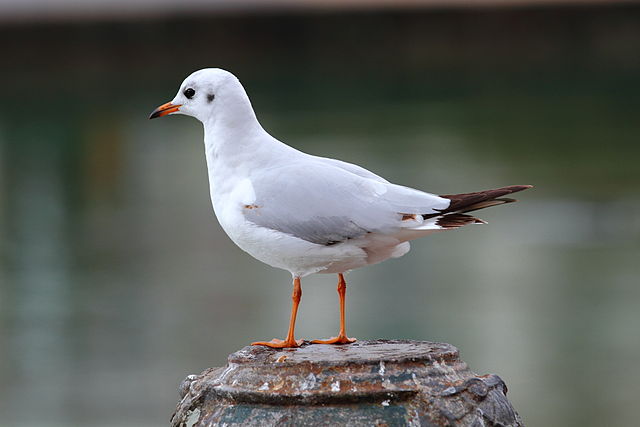
Or the Black-headed Gull (miyako-dori, meaning “bird of the capital”):
The miyakodori in particular stood out due to its unusual name. The Hyakunin Isshu Daijiten lists a poem from the official Kokin Wakashu anthology of note, poem 411 under the section “Travel Poems”:
The headline for this poem explaining the backstory is unusually long, but basically the poet, Ariwara no Narihira (who also wrote poem 17, ちはやふる, in the Hyakunin Isshu) was away in eastern Japan with some companions, and longing for home in the capital, they saw a miyako-dori bird (lit. “capital bird”) and recited this poem.
The Mallard in particular had dual-association with romance and with the melancholy of winter. This poem in the Kokin Wakashu, number 533, by an anonymous author illustrates this:
Certain birds were also used in Japanese poetry for symbolic purposes, but not necessarily for seasonal expression.
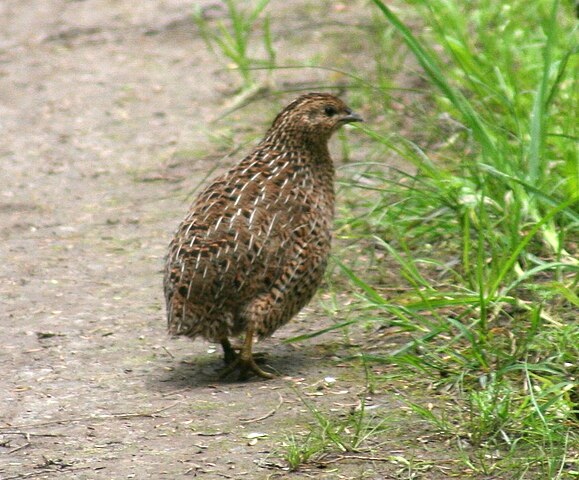
We’ve talked about birds associated with seasons thus far, but there’s a couple worth calling out that are an important part of Japanese poetry, but not related to seasons. The first is the Copper Pheasant, called yamadori, which we saw in poem 3 of the Hyakunin Isshu (あしびきの).
In antiquity, it was thought that Copper Pheasants mated for life (true), but slept in separate nests at night. Thus, the poet Kakinomoto no Hitomaro likened himself to a Copper Pheasant sleeping alone at night part from his lover.
And finally we come to the magpie. In poem 6 of the Hyakunin Isshu (かさ), the poet Chūnagon Yakamochi describes frost growing under moonlight on the so-called Magpie Bridge of the Imperial Palace. The magpie (kasasagi) was associated with a Chinese myth that evolved into the Qīxī Festival (七夕), celebrated as Tanabata in Japan.
In this tale, two star-crossed lovers, a celestial princess and a cowherd, were forcibly separated in the heavens by her father the Jade Emperor, but allowed to reunite one night a year. It was said they would reunite by crossing a bridge made of magpie birds who put their outstretched wings together. Thus, the magpie was always associated with this famous tale.






 The Hyakunin Isshu
.JPG)

.jpg)


_W_IMG_0104.jpg)

