Death and Betrayal in the Hyakunin Isshu

In the Hyakunin Isshu poetry anthology, the subject of this blog for almost 15 years (!), there are many poems about love, nature, sadness, etc. But none about death. There are poems on betrayal, but in the context of infidelity, not on stabbing others in the back.

…. and yet, beneath the surface there are other stories to be told.

In the seventh century, with the death of Emperor Kōtoku in 654 CE, another power struggle erupted. One one side was the emperor’s son, Prince Arima (有間皇子, 640-658), and on the other was the emperor’s older sister and reigning sovereign Emperess Saimei. Empress Saimei had her own son named Prince Naka-no-ōe (中大兄皇子) and was a rival to Prince Arima, Because his mother was the reigning sovereign, Naka-no-ōe would be next in line for the throne, not cousin Prince Arima who was left in the cold.

According to historical accounts, Arima was quietly approached by one Soga no Akae (蘇我赤兄), grandson of the influential Soga no Umako, who promised to help him overthrow Empress Saimei and support his ascension to the throne. Initially, Arima was interested, but later got cold feet. He swore Soga no Akae not to tell anyone, and to call the whole thing off.

But what Arima didn’t know, was that the whole thing was a setup. Prince Naka-no-ōe had planned the whole thing, and Akae told him what happened.

Prince Arima was soon arrested, and taken outside the capitol for interrogation. On his way there, at a place called Iwashiro no Hama (“Iwashiro Beach”),1 he tied a cord, or a piece of grass to a pine branch. This was evidentially a tradition at the time to pray for good luck on one’s journeys.

Once the interrogations were complete, Prince Arima was sent back toward the capital, but was executed en route by hanging at a place called Muro no Yu (牟婁の湯), which is now a seaside resort town. He was 19 at the time, the year was 658 CE.

Forty-three years later (701 CE), Kakinomoto Hitomaro (poem 3 in the Hyakunin Isshu, あし) was serving the current Emperor Monmu, grandson of Empress Jito (poem 2, はるす), and during an an imperial outing they came to Muro no Yu. By now, Prince Arima’s demise was well-known, including the story of him tying cord to a pine tree branch. Hitomaro, remembering what happened, composed the following poem (poem 146 in the Manyoshu):

Original ManyoganaModern JapaneseRomanizationRough translation
後将見跡後見むとNochi mimu toThat pine branch that
君之結有君が結べるKimi ga musuberu you were going to visit
磐代乃磐代のIwashiro noafter tying a cord:
子松之宇礼乎小松がうれをKomatsu ga ure wo I wonder if you ever did
又将見香聞またも見むかもMata mo mimu kamosee it again…
Rough translation by me, apologies for any mistakes or nuance issues

Kakinomoto Hitomaro is reminiscing whether Prince Arima got to see the pine branch again one his way back, before he was executed. It’s a sad poem on the tragically short-lived prince.

But there’s more to the story.

Soga no Akae and his clan, the Soga were frequent troublemakers at this time, and both Empress Saimei and her son Prince Naka-no-ōe executed or assassinated multiple members of the clan at the instigation of the Nakatomi. The Nakatomi were later renamed “Fujiwara”, and if you look at the list of poems in the Hyakunin Isshu, you see a lot Fujiwara poets. There’s a very good reason for this. The final straw for the Soga Clan was in 672 when yet another power struggle put the Soga on the losing side of the war. Akae was among those exiled. The Soga permanently lost power.

And finally: what happened to the powerful and conniving Prince Naka-no-ōe?

He eventually ascended the throne as Emperor Tenji, poem 1 of the Hyakunin Isshu (あきの) and instigator of conflicts of his own.

So, it’s interesting to read his poem in the Hyakunin Isshu and its rosy picture of a fall harvest, knowing that the man had some blood on his hands too…

P.S. featured photo is a 17th century depiction of the power struggle between Empress Saimei and the Soga Clan. Courtesy of Wikipedia.

P.P.S. another post on the dark political history behind some poets of the Hyakunin Isshu.

1 You can see modern photos of the place here. It is in Wakayama Prefecture.

The Dark Side of Heian Period Japan

The Hyakunin Isshu and its poets, the aristocracy of the Heian Period, represent a golden age of Japanese history, and a level of cultural refinement that was often imitated, but never surpassed in later generations. I have been celebrating that culture on this blog all the way back since 2011 (!), and it has always been a personal fascination of mine.

And yet, amidst all this culture and elegance there was very much a dark side to this culture too. This is encapsulated in works at the time, such as the melancholy and weariness of backbiting in the diary of Lady Murasaki, the isolation and frustration at her husband’s rampant infidelity in the Gossamer Years, among other sources. Further, the historical drama about Lady Murasaki highlights a particularly dark episode involving the succession to the Imperial Throne around the years 1000-1010.

The top positions at the Imperial Court were the Udaijin (右大臣, “Minister of the Right”) and Sadaijin (左大臣, “Minister of the Left”). The minister of the Left was higher rank than the minister of the Right. If you look at the authors of the Hyakunin Isshu, you’ll notice a few held such positions over the years: poems 14, 25, 81, and 93.

If you look at the list of poems, you’ll notice quite a few are composed by members of the elite Fujiwara clan (roughly 25-30%). In the 7th century or so, the Fujiwara had been instrumental in protecting the Imperial throne from a usurper, and handsomely rewarded for it. By the year 1000, the Fujiwara clan had grown so large and prosperous that it developed into multiple sub-clans, branches and rival groups.

I mention this because the episode I relate here relates to two powerful branches of the Fujiwara clan in their struggle for power. There’s an excellent article in Japanese about it, which I encourage you check out because it also includes scenes from the drama.

It all begins with one Fujiwara no Kaneie, husband of “Michitsuna no Haha” (poem 53) and the “villain” of the Gossamer Years. Kaneie was particularly ambitious, served under three emperors, and had three sons, who each held ministerial positions. The eldest son was Fujiawara no Michitaka whose wife was “Gidō Sanshi no Haha” (poem 54). He served as the regent for the young Emperor Ichijo, and later, Ichijo married his daughter, Teishi.

The third son of Kaneie was Fujiwara no Michinaga. Remember this name.

After Kaneie’s first son, Michitaka, died his son (Teishi’s brother) named Fujiwara no Korechika, took over that branch of the family. Korechika contended with his uncle, Michinaga, from the get-go, but Korechika made a fatal error. In a strange tale, Korechika believed that retired Emperor Kazan had been sleeping with Korechika’s own mistress. During one of Kazan’s nighttime travels, Korechika in a jealous fit shot an arrow at him and hit the retired Emperor’s sleeve. Michinaga capitalized on this incident to get his nephew Korechika banished from the capitol. This is probably something “Gidō Sanshi no Haha” would have never imagined happened to her son.

Korechika’s sister, Empress Teishi (also daughter of “Gidō Sanshi no Haha”), was now in a vulnerable position without her family to protect her. So, Michinaga pushed forward his own daughter, Shoshi, as a second wife for Emperor Ichijo. Later, the isolated and vulnerable Emperess Teishi died in childbirth. Teishi’s son, the Imperial prince Atsuyasu, appears later. The end result was that Ichijo’s remaining wife Shoshi (daughter of Michinaga) was the reigning empress now, and Michinaga used his influence to gain the title of Minister of the Left. The diary of Lady Murasaki covers this period when Shoshi gave birth to Emperor Ichijo’s second son, Atsuhira.

Let’s pause for a moment. Emperor Ichijo had married two women who were from rival factions of the Fujiwara clan: the exiled Korechika’s sister, and Minister of the Left Michinaga’s daughter, and each bore him a son.

Meanwhile, Korechika was later pardoned and made a junior minister in the Court. And yet Korechika was very bitter toward Michinaga, and his mental health took a downward spiral. He hired a Buddhist priest to help craft a series of curses against Michinaga. Eventually, this was discovered, and Korechika’s career was over and retired until his death in 1010.

Things took an unexpected turn when Ichijo retired early during the same year due to poor health, and his cousin ascended the throne as Emperor Sanjo (poem 68). Sanjo only reigned for a few years before a combination of ill-health and Michinaga’s machinations as the minister pushed him to abdicate too. This is why his poem in the Hyakunin Isshu is so melancholy: Sanjo finally ascended the throne, but ill health and Michinaga’s power-plays ended his reign soon after it began.

Emperor Sanjo’s retirement left Ichijo’s two sons as the next successor: one by Korechika’s sister (Teishi), and the other by Michinaga’s daughter (Shoshi). Which imperial prince do you think Michinaga, the Minister of the Left, wanted to ascend the throne? Michinaga obviously wanted his grandson to be next emperor, so Michinaga could assume the position of regent (Sessho).

Due to age, Atsuyasu, son of the first empress Teishi, should have been Emperor (Atsuhira was too young), but he was bypassed entirely and faded out of history. The child Atsuhira, grandson of Michinaga, ascended the throne as Emperor Go-Ichijo (“The latter Ichijo”).

Korechika’s own son, Michimasa (poem 63), was totally shut out of the Imperial Court as well, and mostly lived a reckless life, trolling Michinaga’s administration, and being just plain obnoxious. His life took a downward spiral much like his father had done, and that branch of the Fujiwara’s male line died out. Michimasa’s fate is particularly dark and tragic.

This multi-generational struggle between two branches of the Fujiwara clan to control the Imperial throne through marriage resulted in Michinaga being the most powerful man in Japan at the time. It also adversely affected many lives of poets in the Hyakunin Isshu. We saw the examples of Michimasa, son of Korechika, and Emperor Sanjo above.

In the case of Sei Shonagon (poem 62), who served Empress Teishi and was loyal to the losing faction, she faded away in retirement. Her Pillow Book is a last swan-song of the time spent serving Empress Teishi, and conveys a very rosy look. It’s not hard to see it was also a subtle middle-finger to Michinaga’s faction.

Many of the ladies in waiting to Michinaga’s daughter, Shoshi, were also poets of the Hyakunin Isshu:

  • Lady Izumi (poem 56),
  • Lady Murasaki (poem 57), author of the Tales of Genji
  • Akazome Emon (poem 59), her sister had an affair with Michinaga’s older brother Michitaka much to the chagrin of “Gidō Sanshi no Haha” (poem 54)
  • Ko-Shikibu no Naishi (poem 60), Lady Izumi’s daughter
  • Lady Ise (poem 61)

By association with Empress Shoshi, not Empress Teishi, they all benefitted and their daughters and family members rose to positions in the Court over time. Lady Murasaki’s daughter, Daini no Sanmi (poem 58), eventually became a wet nurse for future Emperor Reizei and attained the third rank in the Court which was quite high.

Additionally, men like Fujiwara no Kintō (poem 55) benefitted from the association with Michinaga as well.

In the end, there were obvious winners and losers in this struggle. It was not all poetry parties, moon-viewing, and romantic dalliances; people’s lives profited or were destroyed due to hair-splitting power struggles that took generations to complete.

As alluded in Lady Murasaki’s diary, the whole thing was golden sham.

Sucking Up To The New Boss: Manyoshu Poem 235

Although this blog is primarily about the Hyakunin Isshu, I enjoy when things overlap with other Japanese poetry anthologies, and history.

Let’s talk about two of the poets: Empress Jitō (poem 2, はるす) and Kakinomoto no Hitomaro (poem 3, あし). After Empress Jito ascended to the throne, she was visited by Hitomaro, the revered court poet at the time, who composed the following poem:

Original ManyoganaModern JapaneseRomanizationRough Translation1
皇者大君おおきみOkimi waAs my sovereign
神二四座者神にしませばKami ni shimasebais a living kami,
(see below)
天雲之天雲のAmakumo noshe builds a temporary
雷之上尓いかづちの上にIkazuchi no ue niresidence atop
廬為流鴨いおりせるかもIoriseru kamoIkazuchi Hill.
1 I didn’t like any of the existing translations, so I tried to translate here. Any mistakes are my own.

At first, this poem seems like a simple case of a courtier sucking up to the new boss, but as we’ll see there’s more to it. This poem is very simple in some respects, and surprisingly difficult in others.

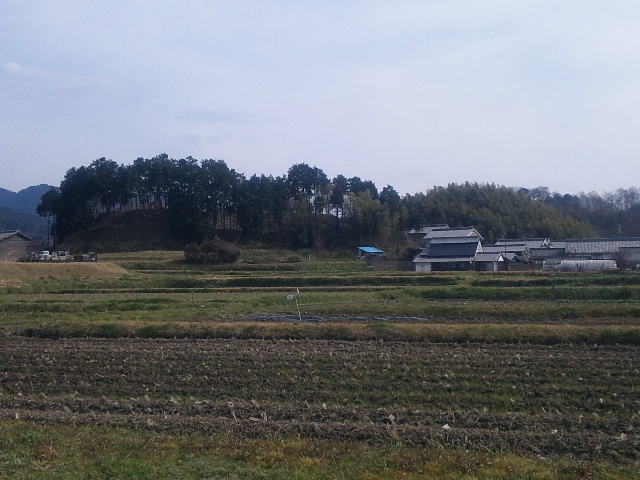
I had to check multiple sources to make sense of it, including my book on the Manyoshu, but the essence of the poem is that Kakinomoto no Hitomaro is describing Empress Jito as a living kami, and that because of her “supernatural abilities”, she can build a residence atop a small hill called Ikazuchi. Ikazuchi Hill, known as Ikazuchi no Oka (雷丘) can be seen in this photo, more information here.

But what the heck is kami? This is surprisingly tough to explain to Western audiences. It is deeply rooted in Shinto religion, and more closely matches something like ancient Greek religion where there were divine spirits both great and small. Small nature spirits would be worshiped as daimon (not to be confused with modern “demon”), and the Olympian gods were venerated too. Even the Olympian gods had “big forms” and small “household forms” worshiped at the hearth. It wasn’t unusual for Zeus, king to the gods, to also be venerated at a home shrine to protect the family assets, or a roadside marker.

In the same way, Shinto has countless kami. It’s not quite right to translate them as “gods” because the meaning is a little different, and “spirits” is not quite right either. But one could include both gods and spirits under the divine label kami. Just like in Greek religion, very talented people could also be venerated as kami after death, such as Hercules. I mention this because Sugawara no Michizane (poem 24 of the Hyakunin Isshu, この) was similarly venerated after death and became something like the Kami (god) of Learning.

This concept of great personages being kami is called arahito-gami (現人神) and that’s basically what Kakinomoto no Hitomaro is describing Empress Jito. Due to the divine ancestry of the Imperial family, this isn’t that surprising, but my book alludes to another reason for this. The turmoil caused by Emperor Tenji (poem 1 of the Hyakunin Isshu, あきの)’s family and his brother Emperor Tenmu’s family for control of the throne meant that Empress Jito (Tenmu’s wife/niece) ascended the throne on shaky ground. Female sovereigns were quite rare in Japanese history, and with the family fighting for control of the throne, Hitomaro was helping her reassert her divine status and legitimacy as the proper ruler of Japan.

The issue of arahito-gami comes up even as recently as 1946, when the reigning Emperor at the time (Emperor Showa, Hirohito), was requested to renounce his divine status after World War II. This declaration used some hair-splitting language about the Emperor’s divinity (or lack thereof), and various interpretations persist today.

…. but that’s something more knowledgeable people could explain better.

As for me, I find it fascinating (and a bit amusing) that these poets I know from the Hyakunin Isshu got embroiled in a succession dispute, but also that Hitomaro helped bolster Empress Jito’s credentials at a time when she was rebuilding the nation again while probably sucking up just a little too.

P.S. the featured photo above is Ikazuchi Hill, photo by Terumasa, CC BY-SA 3.0, via Wikimedia Commons

P.P.S. On a completely unrelated fact, while writing this post I learned that the Chinese characters for 雷丘 also mean “Raichu” as in the Pokemon.