
Hi folks, after a long break due to work obligations, I am back and happy to post this excellent poem by my favorite author in the Hyakunin Isshu:
| Japanese | Romanization | Translation |
|---|---|---|
| このたびは | Kono tabi wa | This time around |
| ぬさもとりあへず | Nusa motori aezu | I couldn’t even bring the sacred streamers |
| 手向山 | Tamuke yama | —Offering Hill— |
| もみぢのにしき | Momiji no nishiki | but if this brocade of leaves |
| 神のまにまに | Kami no mani mani | is to the gods’ liking…. |
The poem is signed as Kanké (菅家, 845 – 903), which is the Sinified (Chinese) way to read the Sugawara Family name (lit. “House of Sugawara”). You see similar names used for the Taira Clan (e.g. Heike 平家) and Minamoto Clan (e.g. Genji 源氏) in later times. Anyhow, the author is none other than the famous poet/scholar Sugawara no Michizane who in later generations was deified as a sort of god of learning named “Tenjin” after he was wrongfully exiled through political intrigue.
The term nusa (幣) means a special wand used in Shinto religious ceremonies. The photo above is an example of a nusa, more formally a gohei (御幣) “wand” used in Shinto religious ceremonies, with the paper streamers used for purification (photo by nnh, Public domain, via Wikimedia Commons). At this time in history, according to the Hyakunin Isshu Daijiten, small nusa were often made from thin strips of paper and cloth and offered to the gods for a safe journey.
The poem was composed by Michizane after going on an excursion with his patron, Emperor Uda. Compare with another outing made years later by (then retired) Emperor Uda later in poem 26. In this case, Michizane had little time to prepare, and couldn’t make a proper offering to the gods for a safe trip. However, admiring the beautiful autumn scene on Mount Tamuke, he hopes that this will make a suitable offering instead. Sadly Michizane would be disgraced and exiled only a short time later.
My interest in Sugawara no Michizane mostly comes because I admire him as a fellow scholar. I visited one of his shrines in Tokyo a couple times over the years, and usually try to pay respects. In July 2023, I visited the home shrine of Kitano Tenmangu as well.
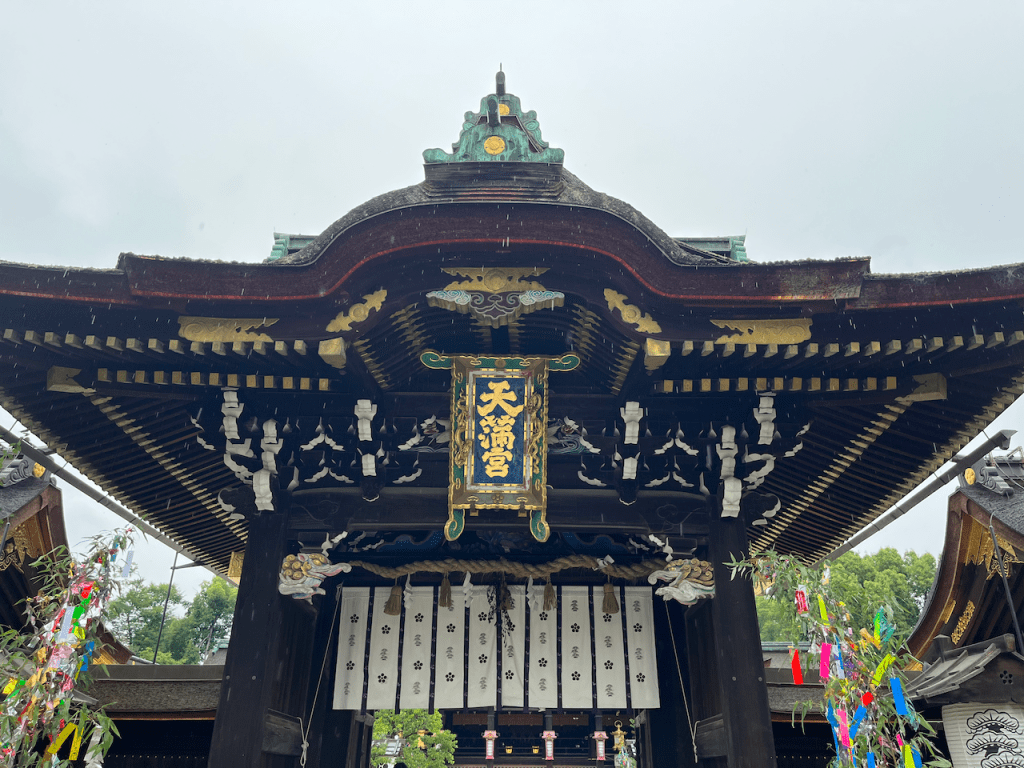
The real life Michizane was no god of learning, but his real-life contributions to poetry and Chinese literature in Japan helped the culture flourish at that time, and earned his place as a trusted adviser to the Emperor, despite his more humble background. This also helped explain his status centuries later as a god of learning. Every year in Japan in April, students pay respects hoping that they can pass entrance exams, and it’s nice to see his legacy carry on so many years later.
Discover more from The Hyakunin Isshu
Subscribe to get the latest posts sent to your email.
 The Hyakunin Isshu
