The Kōrin Karuta Collection

On a quiet Saturday afternoon, the first in a long time, I caught up on some reading and continued to read through my book about the Hyakunin Isshu (mentioned here): the Hyakunin Isshu Daijiten.

In one chapter, the book discussed a special artistic collection of the Hyakunin Isshu called the Kōrin Karuta collection (kōrin karuta, 光琳カルタ) which was painted by the famous artist Ogata Kōrin (尾形光琳, 1658-1716). The featured image above is one of his famous paintings depicting irises in a field (Public domain, via Wikimedia Commons).

I had a hard time finding available images of the Ogata Kōrin collection of cards, but you can see an example at the Tengu-do homepage. There’s a few things that make this collection noteworthy among the long history of the Hyakunin Isshu….

First, the cards use a gold background, instead of white or off-color white. If you look at Ogata’s other paintings, this is a common technique that he used, so it makes sense.

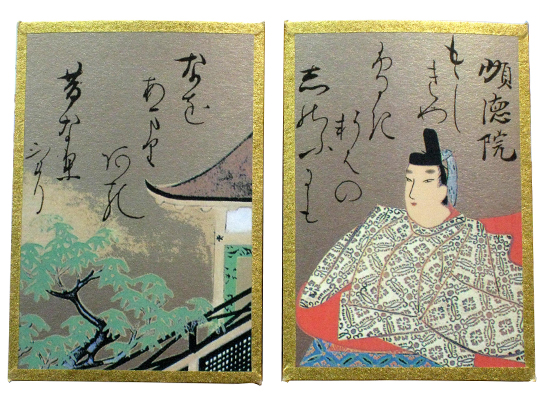
Second, and more significantly, the torifuda cards are painted as well. Whereas the yomifuda cards have portraits of the poets (with some subtle details we’ll talk about below), modern torifuda cards only have the text on them. Ogata decorated the torifuda cards using scenes that matched the poem.

For example, poem 100 (ももしきや) is shown here on the Tengu-do website. The corresponding torifuda card shows the eaves of a palace since the poem is about the declining condition of the Imperial palace amidst political strife. Poem 35 (ひとはいさ) is shown here. Since the poem is about the first cherry blossoms in spring, the torifuda card depicts cherry blossoms. And so on.

Third, the cards were larger in size than a standard karuta card used today. Perhaps the cards were not meant for playing, but as a medium of art.

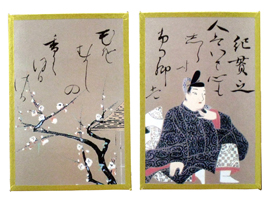
Also, I realized that the illustrations of the poets looked awfully familiar. My first karuta set uses the same Ogata illustrations, even though the torifuda are not illustrated, and the card background is plain white versus the original gold color.

Even the paintings of the authors has some pretty interesting qualities to them. Using my own set, let’s take a look at a few notable quirks.

First, the “emperor” cards (cards where the poet was a reigning or retired emperor) have them seated on a straw mat with a brocade edge, a sign of authority. None of the other poets have this, even if the poet was a high ranking officials in the court. Here are the cards for Kōkō Tennō (“Emperor Koko”, poem 15) and Juntoku-in (“Retired Emperor Juntoku”, poem 100):

Second, while most poets’ faces are visible, the card for Shokushi Naishinnyo (“Imperial Princess Shokushi”, poem 89) completely hides her face. Why is that?

Evidentially, Princess Shokushi was quite beautiful, and Ogata didn’t want to leave her open to criticism or scrutiny, so he hid her face to protect. In some versions of the Kōrin Karuta set, Ono no Komachi’s (poem 9) face is also hidden.

The Kōrin Karuta collection isn’t the only famous illustration of the Hyakunin Isshu, and in time I hope to highlight others.
Personal Growth

After playing some recent matches with the good folks at the Competitive Karuta Club (Discord invite link here), and also in person with the Seattle Karuta Club, I realized that, as of writing, I’ve been learning to play for 11 weeks. It felt longer somehow. I even double-checked the calendar and, sure enough, it has only been eleven weeks from my very first karuta experience.

In that time I have managed to memorize all 100 kimari-ji. It wasn’t always easy, and I recall some of them faster than others, but practicing fuda-nagashi does help.

Further, I haven’t won a single match yet (online or in person), but I feel like more confident than before, am more aware of my opponents card arrangement (tei’ichi 定位置), sometimes able to keep track of cards that have already been read, and even take a few cards now and then. My rate of penalties is still higher than I like, but that’s still a work in progress.

In short, I have grown as a Karuta player. Not a lot, but it’s nice to look back and actually see progress.

Using the analogy Fire Emblem: Three Houses again, if I may,* there is a part of the story where your students have the option to face the dreaded Death Knight. Unless your student’s name is Lysithea, very few characters can defeat the Death Knight without considerable luck and strategy. It’s not that the characters are weak, they’re just not ready. So the game encourages you to know your limits, and just skip if you’re not prepared. Much later in the game, when your characters are much stronger, you will encounter the Death Knight again and have a much better chance to emerge victorious.

In the same way, battling an advanced player in Karuta probably won’t result in victory, but those little incremental wins, each card taken, each penalty avoided, is still a sign of growth.

As a game, karuta is more difficult to learn upfront compared to things like Magic: the Gathering, Pokemon TCG, etc. However, once you pass that hurdle, it becomes a game you can carry with you the rest of your life. You don’t have to keep buying new sets of cards, dealing with “power creep” with new card sets, etc. The 100 poems of the Hyakunin Isshu have been around for centuries and will continue to be around for many more. The more you play, the more your skills refine. There’s no rush, come as you are, enjoy the poems, learn a little bit each time.

Finding a community of players isn’t always easy, but the budding international community continues to grow and we are always welcoming new people.

If you’re unsure, feel free to take the plunge anyway. Hopefully, you’ll be glad you did. I was.

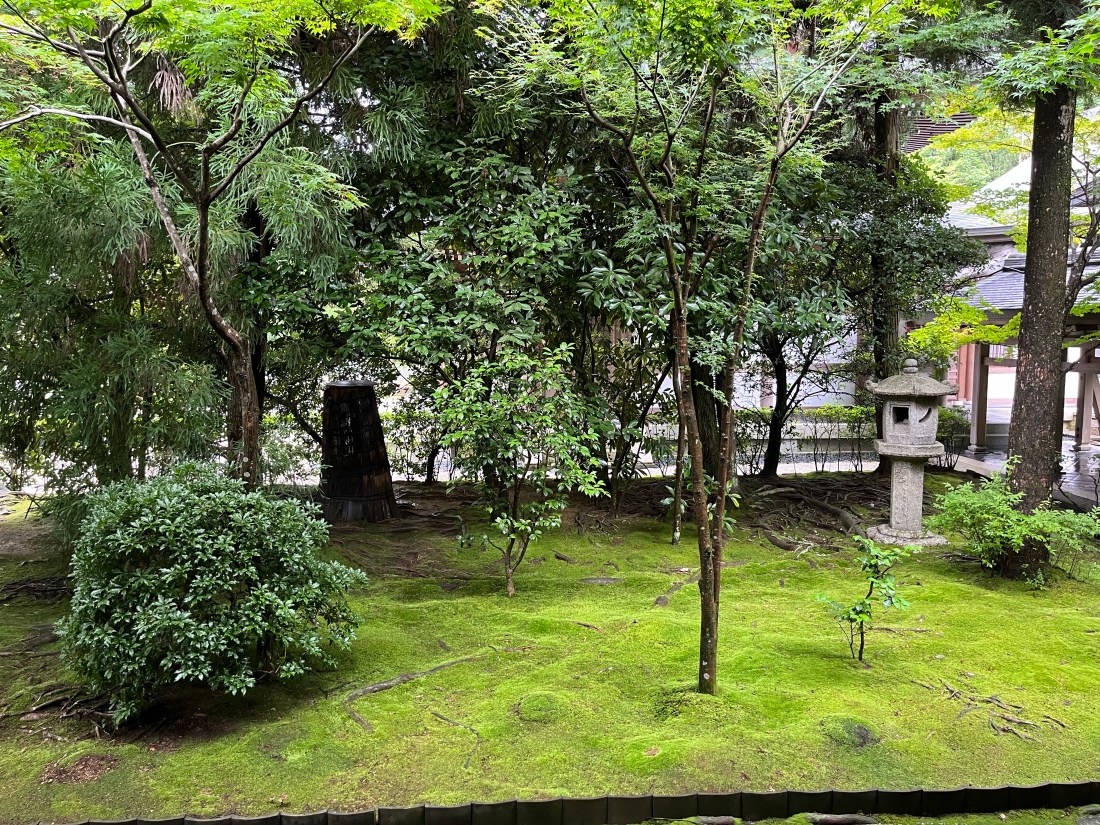
P.S. featured photo taken at Ryonaji temple in Kyoto, Japan, in summer of 2023.

* the best part of owning your own blog is that you can write whatever silly stuff you want. 😋 Also, if you own a Switch, please try FE:3H. It’s a pretty neat game.

Hello, Won’t You Tell Me Your Name? Manyoshu Poem 1

This is the opening poem of the Manyoshu, Japan’s earliest poem anthology, an anthology that a few early Hyakunin Isshu poets also contributed too.

Original
Manyogana1
Modern
Japanese
Romanization
籠毛與籠(こ)もよKo mo yo
美籠母乳み籠(こ)持ちMiko mochi
布久思毛與掘串(ふくし)もよFukushi mo yo
美夫君志持み掘串(ぶくし)持ちMibukushi mochi
此岳尓この丘にKono oka ni
菜採須兒菜摘(なつ)ます児(こ)Natsu masu ko
家吉閑名家聞かなIe kikana
告紗根名告(なの)らさねNanorasane
虚見津そらみつSoramitsu
山跡乃國者大和(やまと)の国はYamato no kuni ha
押奈戸手おしなべてOshinabete
吾許曽居われこそ居(お)れWare koso ore
師吉名倍手しきなべてShiki nabete
吾己曽座われこそ座(ま)せWare koso mase
我許背齒われにこそはWare ni koso wa
告目告(の)らめNorame
家呼毛名雄母家をも名をもIe wo mo na wo mo
1 Manyogana and pronunciation source

Due to length and complexity of poem, plus it’s very old Japanese, I can only offer a rough translation (based on modern Japanese ones) like so:

A basket. The beauty holding the basket. A digging tool (lit. a spatula-like tool). The beauty holding the digging tool. You who are on the hill gathering vegetables, tell me, what family do you come from? Do you not know? I am the sovereign of this land (lit. Yamato, old name for Japan), and that every corner is under my dominion? So, tell me, what is your family’s name and origin?

This poem was composed by Emperor Yūryaku, who reigned in the 5th century, before recorded history. Technically, the title of “Emperor” was not used by ancestors of the Japanese imperial family at this time, and was later implemented by the time of Emperor Tenmu, brother of Tenji (poem 1), but this is a retroactive title. At this time, Yūryaku and others of the lineage were more like great kings (daiō 大王). Interestingly, although this point in Japanese history is pretty murky, Yūryaku is mentioned on a dedication inscribed on an ancient sword, providing historical evidence that he did in fact exist.

Yūryaku was described in early historical documents as a strong ruler, who slew his brothers following the death of the last king/emperor to get to his position. In later years, he helped consolidate power, but also was described as tyrannical as well.

The poor girl whom the poem was addressed to probably wasn’t in any position to say “no”, in any case.

The reason why I posted this poem is two-fold.

First, this poem is noticeably different than the tanka (短歌, “short poem”) style poems of the Hyakunin Isshu. This is a chōka (長歌, “long poem”) style poem. Tanka poems, including all poems of the Hyakunin Isshu, follow the style of 5-7-5-7-7 syllables. Chōka poems were 5-7-5-7-5-7…..5-7-7 syllables, with as many 5-7 syllable verses as needed. The Manyoshu has both formats, but by the time of the Hyakunin Isshu, the chōka format had fallen out of favor, probably because it was simply too long and difficult to fire off verses quickly.

Yūryaku’s poem doesn’t fit the chōka format very closely though, so it’s hard to say how strict poetry was back then. Over the centuries, and by the time we get towards the end of the Hyakunin Isshu, the style poetry had definitely solidified into a very rigid format with many specific rules, customs, and phrases. Yūryaku’s poem reflects an earlier, looser style of poetry. Or, as a powerful sovereign, maybe he just didn’t care. Who’s to say?

Second, the tone of the poem (ignoring the power-imbalance between him and the girl1) is a very lighthearted and romantic tone. Early poems in the Hyakunin Isshu tended to have a similar tone, but gradually the tone tended to get more somber centuries later as the aristocratic culture came to an end. Compare poems 95-100 to poem 1-5 in the Hyakunin Ishsu, and you’ll see what I mean. Yūryaku’s poem definitely belongs to this earlier, more bucolic time.

Anyhow, it’s interesting how poetry reflects history as well.

1 When you look at Lady Murasaki’s diary as well, when Michinaga makes a pass at one of the servant girls, it’s strongly implied a visit later will certainly follow. Again, women back then had less agency, and would have been hard-put to say no to powerful, ambitious men like that.