
Author’s note: this draft was nearly complete before I had to go to the hospital in February. I decided to post as-is even if it is a bit late.
At a recent meeting of the Seattle Karuta Club, I tried my hand at being the yomité (読み手), the card reader.
The game of Karuta traditionally requires three people to play: two opponents and one person, the yomité, to read the full poem cards, the yomifuda.
Reading the cards is not just a matter of reading aloud, there’s a certain style and method to it. Plus you need to be able to read hiragana smoothly, including the weird spellings. Further you have to be clear enough that players know precisely which card to take.
Usually, Karuta players overseas just use one of several reader apps, but in Japan, Karuta matches usually have a yomité when possible. It’s a handy skill to learn if possible, even if you are musically tone-deaf like me.
This featured photo is me starting the match. I was quite nervous since it was my first time, and have a terrible singing voice. I don’t say that to be modest; I am genuinely a bad singer.
Right away, I found I could read the text easily enough, but I didn’t project my voice, or enunciate the kimari-ji properly. Halfway through the match I “found my groove” and my reading improved but I still needed practice.
Learning to read Karuta cards does not take long to learn, but learning to read well takes time.
This page in Japanese focuses on learning to read Karuta cards. It even includes a video (Japanese only)
The good news is that there are tools for non-Japanese as well if you know where to look.

This set above (product link here), made by Oishi Tengu-dō is designed specifically for reading:
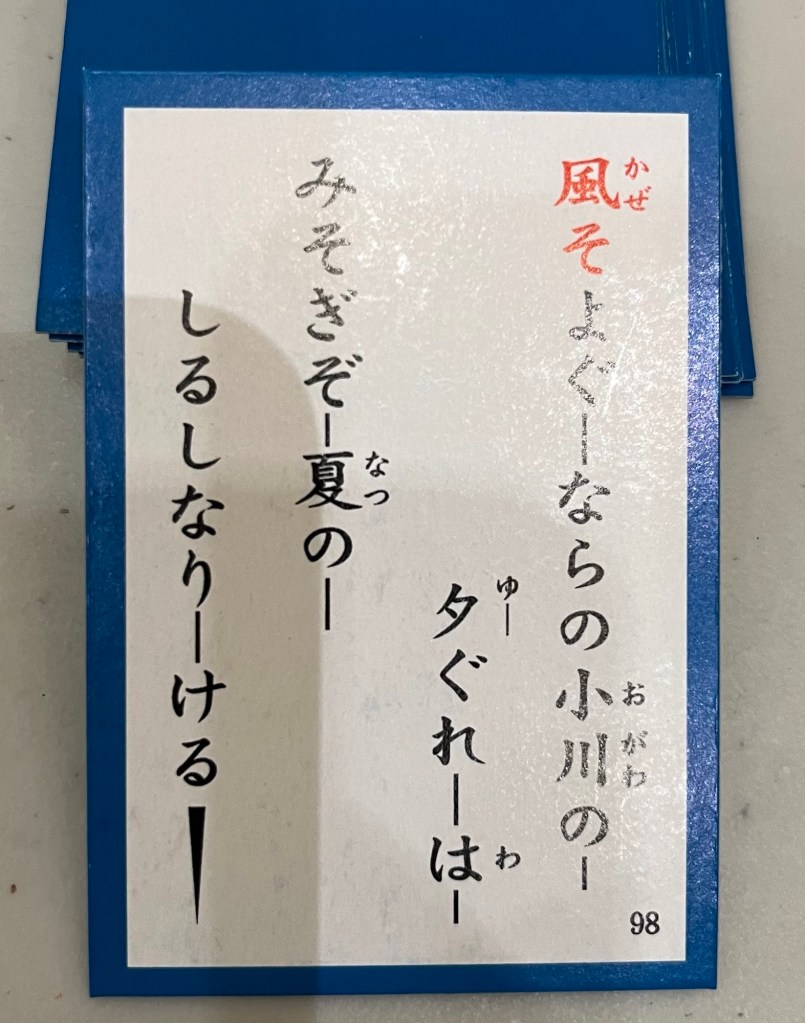
In red, the kimari-ji is shown, and the text of the poem includes rhythm clues (the lines and arrows) where you should elongate the syllable, for example. Each poem has a slightly different rhythm. It’s not the same pattern with every poem. So, you definitely have to practice each poem and how to recite them.
In the end, taking turns as the yomité is a nice way to share responsibility, and even Japanese is not your first language, you can pick it up with a bit of time and effort.
Being able to recite your favorite poem the traditional way is also a neat skill to learn anyway.
Discover more from The Hyakunin Isshu
Subscribe to get the latest posts sent to your email.
 The Hyakunin Isshu