I can’t believe this thing has kept going for so long. When I made my first post (here is the first poem I posted), I never imagined that fifteen years later I would still be fascinated by the Hyakunin Isshu, or that I would have so many wonderful readers from around the world, including some in my own backyard. ❤️
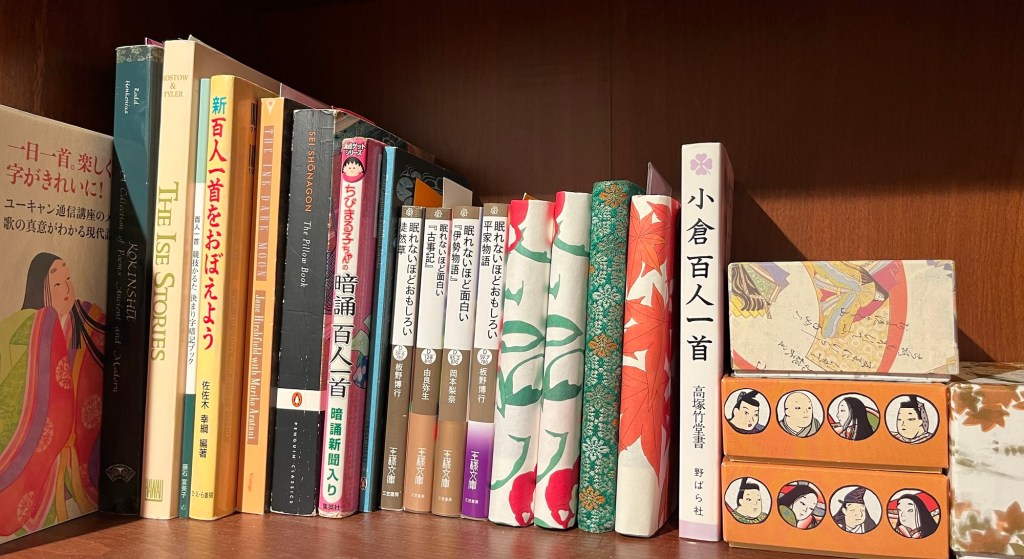
My bookshelf collection, minus a few items too large to fit. The book in yellow on the left belonged to my late mother-in-law (RIP). A few books are wrapped in book covers too.
Thank you all for your support and interest over the years. 🥰 With luck, this blog will hopefully stay around for a long time to come.
This summer my family went back to Japan to visit relatives while I stayed home, and one of the souvenirs they brought back was this wonderful book (publisher’s link here):
This book was sold at a local Kinokuniya bookstore in Japan, and each page of the book features a poem from the 100 poems of the Hyakunin Isshu, in traditional numerical order. Within that page, you can practice your own handwriting by writing out the poem, first on the right-hand side, and again on the left.
Here’s a close-up of one of the pages, depicting poem 41 (こい), one of two poems from a famous poetry contest (poem 40 is the other). You can see the poem is written out in traditional style: right to left, vertically. There is a special handwriting guide on the left-side of this page with tips to help with certain difficult Chinese characters. You can also trace the poem on the right side of the page to practice your penmanship.
On the following page, there are some historical details about the poem. In this case, it is a lineage chart of the Imperial family at the time, and focuses on the reigning Emperor Murakami who succeeded the throne after the death of Emperor Daigo. On the bottom right is a glossary of terms, since the poem is composed in old Japanese, and thus the spellings and vocabulary are not clear to modern speakers.
This is a pretty neat book, and I am hesitant to practice my handwriting on it, since it is pretty poor. But I love the idea, and it’s a lot of fun to look through. It also seems like a nice relaxing exercise if you go slow, and take in each poem one by one.
If you are ever in Japan, and happen to be browsing a local bookstore, keep an eye out for books like this. The Hyakunin Isshu continues to be a populartopic, and you’ll find many such excellent books and many ways to savor and enjoy this wonderful anthology.
I have been quietly doing a number of updates to existing blog content. This includes fixing some inconsistent formatting, and fixing broken or outdated links. Tags and categories were cleaned up and standardized as well. This was long overdue.
In addition, all references to Amazon.com have been removed.
Finally, it’s that time again: cherry blossom season. It is still a bit early where I live, but if you are planning to view cherry blossoms (ohanami, お花見), then feel free use my handy guide.
Thanks everyone and happy spring to readers in the Northern Hemisphere!
First, I appreciate the feedback recently about challenges finding a suitable poem for an occasion. I’ve experienced this problem too, so I decided to update the poem index, and sort it three ways: by traditional, numerical order, by poetry topic, and also by the kimari-ji syllables. Different readers come to this site for different reasons, and hope this will make everyone’s life easier. Some of these lists already existed, but I tried to collect them in one, convenient place.
Second, I took a few months from the blog to focus on other things, and get some much-needed rest. Now that I am picking up the blog again, I decided that I want to focus more on the Hyakunin Isshu specifically. That was the original focus of the blog, but over time I branched out to other poetry anthologies and other topics. It was fun to explore, but I’d like to get back to the blog roots and narrow the focus again. It means fewer blog posts in the short-term, but I think I will make the blog more enjoyable in the long-run.
Thanks for reading, and feel free to continue dropping feedback and such.
Welcome to the New Year and Happy 2025 to you all. The blog also celebrates its blogoversary on January 26th, 2011! The blog is 14 years old. 🥳
The first posts, posted on the same day, are here and here. At the time this blog was meant to be a side project. However it outlasted my other blogs.
The blog has had its periods of activity, and periods of quiet. Lately, the blog has been quiet as I have been preoccupied with holidays, family, and other hobbies. I haven’t played karuta in months, and haven’t been reading any pertinent books lately either.
However, I am working quietly on the back-end to make some improvements to searching the blog and making certain information more easily accessible (based on recent feedback), and shuffling a few pages around.1 What happens after that, time will tell.
But it has also been nice to just recharge and take a break.
Nonetheless, I am happy to celebrate this blog lasting as long as it has, inactivity notwithstanding. And of course, thank you readers and Hyakunin Isshu for your support and encouragement.
As for 2025, best wishes to everyone, and may the new year bring you many smiles.
1 It’s interesting to look at anonymous blog stats and see people’s viewing habits. Oftentimes, they surprise me: what I think people will want to read versus what people are actually looking for.
I wanted to share an exciting opportunity for readers. The University of Washington, my alma mater, is hosting a lecture in-person and online by none other than Professor Joshua Mostow!
Years ago, Dr Mostow graciously allowed me to use his translations of the HyakuninIsshu for this blog, and readers have hopefully enjoyed his translations over the years. We poet-enthusiasts have all benefitted from Dr Mostow’s hard work and enthusiasm for the field. Let’s show our support, and enjoy a fascinating lecture on the Hyakunin Isshu and how it impacted Japanese history in later times.
You may have noticed the blog looks a bit different now. I have been struggling since the big blog refresh I started in December 2022 to get the appearance just right. Design isn’t my forte (I am a history nerd), so I’ve struggled with finding the right design for this blog. The original blog template on WordPress was so old (this blog was started in 2011) that it was no longer supported by WordPress, so I had to find something else that works. After dabbling with a few designs this past year, I’ve settled on current blog template as of last week and I am pretty happy with it. I hope you all like the new design. I liked it so much I applied the same template to the other blog.
Next news: I will be off to Japan again this summer … though only briefly. The family and I will visit the ancient capitol of Kyoto, just like last year,1 but the visit overall is much more limited and I probably won’t get to see many things related to this blog. I won’t have time to visit Oishi Tengudo again, or Kitano Tenmangu Shrine, but I do however plan to make a stop at Kurumazaki Shrine (mentioned here) to pick up one of those Sei Shonagon (poem 62, yo wo komete) charms. I may try to work in a few other tourist spots related to the Lady Murasaki drama given that it’s popular right now. I also expect to melt under 35C(95F)-degree weather with 75% humidity again like last year.2
I have a few more posts coming up between now and the trip (late July), and I hope you will find them interesting.
Finally, just as a fun bonus, I wanted to share a one-off poem by Lady Izumi (poem 56, arazan) that I recently heard on a different Japanese historical drama. Lady Izumi is one of my personal favorite figures in the Hyakunin Isshu, and this poem was first recorded in an Imperial anthology, the Goshūi Wakashū (後拾遺和歌集), poem 755:
It’s not clear from this poem which lover she is referring to, since she had a number of relationships over the years, nonetheless it is a very sincere, romantic poem and expresses her passionate style nicely.
Happy Summer!
P.S. speaking of history nerd, I’ve debated about making a Japan / history podcast (like many other fine podcasts I follow), but have struggled to find a good theme. I might simply do the “history of the hyakunin isshu” podcast someday. It’s a bit commitment though, so we shall see.
1 While we do visit Japan yearly so my kids can spend the summer with their grandparents and extended family, visits to Kyoto are rare because of cost, time, and so on. Our last visit was almost 15 years ago. It just so happens that we could make two trips in two years. After that, who knows when we will visit next?
2 Without going into too many details, the humidity, heat and fluid loss aggravated an old medical issue I have. A reminder to stay hydrated, and avoid junk food. I like getting older in many ways, except at times like this. 😋
After a fun discussion with some fellow members of the Seattle Karuta Club, I decided it was time to go and make some much-needed updates to the Hyakunin Isshu poems in the blog. I did this for several reasons:
The blog had grown organically since 2011, so some poems used a different format than others. They were not internally consistent. Further, spellings of the same word were not consistent between poems either.
Back then, I had no access to Japanese resources (and couldn’t understand them anyway), so I used my own convention for naming the authors, based loosely on Dr. Joshua Mostow’s book. This was a problem with the Index page in particular which people use a lot.
The odd spellings in the Hyakunin Isshu were glossed over, which has become a problem for people learning karuta, who need the furigana clues on how to read them.
The poems here did not match how they’re recorded in Japanese sources. Subtle differences with using kanji (Chinese characters) vs. using hiragana. While the poem is the same, Japanese books on the Hyakunin Isshu tend to write the poems a certain way, and my blog posts didn’t match this. Back then, I didn’t know better. 😅
Some blog posts were thin on biographical information due to lack of English sources. My new book really helped fill in the blanks. I tried to add more content for some of the thinner blog posts. This is still a work in progress, as I read Japanese slow, and am a working parent.
The blog was composed starting in 2011, and the WordPress blog templates have changed over time. Differences in template code over time meant that some poems didn’t render their photos properly. Other photos just looked terrible, or didn’t match the theme of the poem upon closer inspection.
WordPress tags were applied inconsistently, making searching some poems difficult.
So, as a “type-A” nerd, I’ve spent the last two weeks going poem by poem, cleaning things up, and applying a consistent format, author names and poem texts that match Japanese sources, added furigana, and fixed the blog code for pictures, plus replacing a few pictures here and there. Consistent blog tags have been applied too.
Many of these updates and fixes are subtle, so you might not notice at first, but I hope you the reader will get a cleaner, more accurate experience as you explore the Hyakunin Isshu. Enjoy!
As for me, I am taking a break and going back to playing Fire Emblem: Three Houses.
P.S. my desk, shown above in the featured photo, has been even more messier than usual. 😅
I am happy to report that I’ll be appearing in a podcast about the Hyakunin Isshu and Karuta coming up in a few weeks! It is exciting to collaborate with a fellow karuta player, “Steph”, who hosts the Karuta Chat podcast.
(Also available on Apple Podcast and many other feeds too)
I’ll have more details soon, but it will be a chance to share my experiences with the Hyakunin Isshu, karuta and more with a wider audience. If you’d like to know, I hope you’ll consider giving the Karuta Chat podcast a listen.
Hello dear readers and karuta players! Just a few updates:
I added a new page with charts to learn the kimari-ji for playingKaruta. This is a work in progress so feel free to leave a comment or suggestion for improvement.
If you noticed the blog appearance changed you are not wrong. For many years I relied on the same old template, but when I overhauled the blog last year I tried a newer, supported template. It was difficult to manage, so I am try out other templates now. I hope you like the new look.
Finally the blog is now 13 years old, according to WordPress! When I started this as a small side project in 2011 I had no idea how things would turn out. I wasn’t even sure I could finish all 100 poems amidst parenting and work. But here we are. Thank you readers and maybe we’ll make 20 years some day! ☺️






 The Hyakunin Isshu