Death and Betrayal in the Hyakunin Isshu

In the Hyakunin Isshu poetry anthology, the subject of this blog for almost 15 years (!), there are many poems about love, nature, sadness, etc. But none about death. There are poems on betrayal, but in the context of infidelity, not on stabbing others in the back.

…. and yet, beneath the surface there are other stories to be told.

In the seventh century, with the death of Emperor Kōtoku in 654 CE, another power struggle erupted. One one side was the emperor’s son, Prince Arima (有間皇子, 640-658), and on the other was the emperor’s older sister and reigning sovereign Emperess Saimei. Empress Saimei had her own son named Prince Naka-no-ōe (中大兄皇子) and was a rival to Prince Arima, Because his mother was the reigning sovereign, Naka-no-ōe would be next in line for the throne, not cousin Prince Arima who was left in the cold.

According to historical accounts, Arima was quietly approached by one Soga no Akae (蘇我赤兄), grandson of the influential Soga no Umako, who promised to help him overthrow Empress Saimei and support his ascension to the throne. Initially, Arima was interested, but later got cold feet. He swore Soga no Akae not to tell anyone, and to call the whole thing off.

But what Arima didn’t know, was that the whole thing was a setup. Prince Naka-no-ōe had planned the whole thing, and Akae told him what happened.

Prince Arima was soon arrested, and taken outside the capitol for interrogation. On his way there, at a place called Iwashiro no Hama (“Iwashiro Beach”),1 he tied a cord, or a piece of grass to a pine branch. This was evidentially a tradition at the time to pray for good luck on one’s journeys.

Once the interrogations were complete, Prince Arima was sent back toward the capital, but was executed en route by hanging at a place called Muro no Yu (牟婁の湯), which is now a seaside resort town. He was 19 at the time, the year was 658 CE.

Forty-three years later (701 CE), Kakinomoto Hitomaro (poem 3 in the Hyakunin Isshu, あし) was serving the current Emperor Monmu, grandson of Empress Jito (poem 2, はるす), and during an an imperial outing they came to Muro no Yu. By now, Prince Arima’s demise was well-known, including the story of him tying cord to a pine tree branch. Hitomaro, remembering what happened, composed the following poem (poem 146 in the Manyoshu):

Original ManyoganaModern JapaneseRomanizationRough translation
後将見跡後見むとNochi mimu toThat pine branch that
君之結有君が結べるKimi ga musuberu you were going to visit
磐代乃磐代のIwashiro noafter tying a cord:
子松之宇礼乎小松がうれをKomatsu ga ure wo I wonder if you ever did
又将見香聞またも見むかもMata mo mimu kamosee it again…
Rough translation by me, apologies for any mistakes or nuance issues

Kakinomoto Hitomaro is reminiscing whether Prince Arima got to see the pine branch again one his way back, before he was executed. It’s a sad poem on the tragically short-lived prince.

But there’s more to the story.

Soga no Akae and his clan, the Soga were frequent troublemakers at this time, and both Empress Saimei and her son Prince Naka-no-ōe executed or assassinated multiple members of the clan at the instigation of the Nakatomi. The Nakatomi were later renamed “Fujiwara”, and if you look at the list of poems in the Hyakunin Isshu, you see a lot Fujiwara poets. There’s a very good reason for this. The final straw for the Soga Clan was in 672 when yet another power struggle put the Soga on the losing side of the war. Akae was among those exiled. The Soga permanently lost power.

And finally: what happened to the powerful and conniving Prince Naka-no-ōe?

He eventually ascended the throne as Emperor Tenji, poem 1 of the Hyakunin Isshu (あきの) and instigator of conflicts of his own.

So, it’s interesting to read his poem in the Hyakunin Isshu and its rosy picture of a fall harvest, knowing that the man had some blood on his hands too…

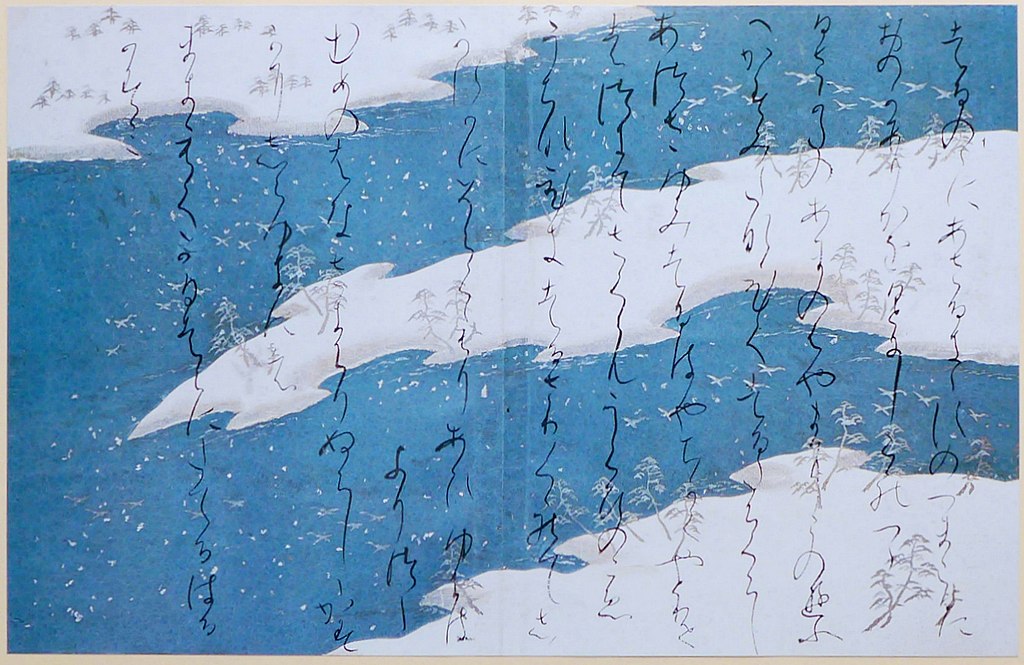
P.S. featured photo is a 17th century depiction of the power struggle between Empress Saimei and the Soga Clan. Courtesy of Wikipedia.

P.P.S. another post on the dark political history behind some poets of the Hyakunin Isshu.

1 You can see modern photos of the place here. It is in Wakayama Prefecture.

The Super Poetry Brothers

Interesting historical fact that I learned recently.

A long, long time ago in this blog, I wrote about the Six Immortals of Poetry: a list of eminent poets devised by Ki no Tsurayiki (poem 35 in the Hyakunin Isshu, ひさ). This list was in the preface to the Kokinshu imperial anthology, wherein he raised up these six poets, as prime examples of poetry at the time ….. then promptly tore them down for one reason for another.

However, my book about the Manyoshu explains that in the same preface, Tsurayuki elevates two other poets as being above reproach:

  • Kakinomoto Hitomaro (poem 3 in the Hyakunin Isshu, あし) and
  • Yamabe Akahito (poem 4, たご)

Together they were revered as Yamakaki no Mon (山柿の門) meaning the “Gate of Yama(be) and Kaki(nomoto)”. In modern terms, we can call them the Super Poetry Brothers…

I used to watch this show as a kid, every day after school. 😆

But I digress.

Kakinomoto and Yamabe were not exactly contemporaries. They were about a generation apart, and their poetry had different styles, but together they were seen as the epitome of poetic skill. So much so, that even Ki no Tsurayuki could find no fault in them.

Let’s look at each one.

Kakinomoto Hitomaro focused on expressing inner feelings. His poem in the Hyakunin Isshu shows his worry about sleeping alone one night, while this poem shows his passion for the one he loves. Or this one from the Manyoshu (poem 48):

Original ManyoganaModern JapaneseRomanizationRough Translation
東のHimugashi noTo the east I
野炎野にかぎろひのNo ni kagirohi nosee the rising sun
立所見而立つ見えてTatsumieteover the fields,
反見為者かへり見すればKaeri misurebabut if I look back [west]
月西渡月かたぶきぬTsuki katabukinuI see the moon setting.
Translation by me, apologies for any mistakes or nuance problems.

This poem has a hidden meaning, and was both a memorial to one Prince Kusakabe who was the only child of Empress Jito (poem 2 in the Hyakunin Isshu, はるす), and praise of Prince Kusakabe’s son, who later was crowned Emperor Monmu. Thus, the poem expresses both sadness at the passing one of beloved figure, and hopes for a bright future for his son.

Meanwhile, Yamabe Akahito was more focused on the beauty of nature. His poem in the Hyakunin Isshu about the snow on Mount Fuji is a good example. He wrote many poems on various subjects, but often did so through simile with nature. Or this one from the Manyoshu (poem 1424):

Original ManyoganaModern JapaneseRomanizationRough Translation
春野尓春の野に Haru no no niI went to go
須美礼採尓等すみれ摘みにとSumire tsumi ni topick some violets for
来師吾曽来し我そKoshiware soyou in a spring field,
野乎奈都可之美野を懐かしみNo wo natsukashimibut it was so charming
一夜宿二来一夜寝にけるHitoyo nenikeruI slept there all night.

Here, Yamabe is talking about a wonderful, charming violet field and how it made him so sleepy and relaxed that he slept all night there. There’s less of the heavy, emotional pull of Hitomaro, but it paints a really lovely scene that’s timeless.

That’s a very brief look at the Super Poetry Brothers!

Love Across Time and Place

The compiler of the Manyoshu poetry anthology, Ōtomo no Yakamochi (大伴家持, 718 – 785), who also composed poem 6 (かさ) in the Hyakunin Isshu, had a girlfriend named Kasa no Iratsumé (笠女郎, sometimes called “Lady Kasa” in English ) who was very devoted to him. She was second only to Yakamochi’s stepmother1 in her poetic contributions to the Manyoshu, and wrote many lovely poems to Yakamochi, including this one:

Original ManyoganaModern JapaneseRomanizationRough Translation
陸奥之陸奥のMichinoku noI can see your visage
真野乃草原真野の草原Mano no kayaharain the fields of
雖遠遠けどもTōkedomoMano no Kayahara in Michinoku,
面影為而面影にしてOmokage ni shiteyet why can I not
所見云物乎見ゆといふものをMiyu to iu no wosee you close?
Rough translation by me, apologies for any mistakes

This is a nice, touching poem about someone who misses her far away lover. Not unusual in the Manyoshu, because even a journey to a neighboring province was a lengthy affair, let alone a remote one.

So, why do I highlight this poem when Kasa no Iratsume contributed many others?

In the late 19th and early 20th centuries was a Japanese author named Mori Ōgai (森 鷗外, 1862 – 1922), who during Japan’s rapid modernization period, spent some time in Germany learning Western medicine. Ogai was also an excellent writer, and wrote several stories, including a famous short story Maihime (舞姫, “The Dancing Girl”) about a young German woman who fell in love with a Japanese man studying there. After the man returns to Japan, the German woman (now pregnant) pines for him, and eventually meets a tragic end even as he prepares to return to Japan. The story is, according to Ogai, not autobiographical, but taken from anecdotes of other Japanese students studying abroad.

What’s interesting is that Ogai was definitely fascinated by Iratsume’s poem and even borrowed the obscure term 面影 (omokagé) in the title of the work Omokagé (於母影): a collection of Western poems translated into Japanese by Ogai and other members of the Shinseisha Society (新声社) in 1889. The related story of a young woman pining for the one she loves in a remote place is not hard to miss either in Dancing Girl, so perhaps that was a source of inspiration.

Nonetheless, it’s amazing how one writer or poet can inspire another 1,000+ years later.

… then again, I suppose that’s how this blog got started. 😏

1 Yakamochi’s birth mother died when Yakamochi was very young, and so he was raised by his stepmother, Ōtomo no Saka no Ue no Iratsume (大伴坂上郎女). She herself was on her third marriage after her previous two husbands both died. This underscores how short the average lifespan was in those days, even for the wealthy, as a woman in her 20’s or 30’s might be on her third marriage by then. Something almost unthinkable in the 21st century. Lady Izumi (poem Poem 56 of the Hyakunin Isshu あらざらん) had a similar string of bad luck.

Shell Matching Game

I learned a neat little cultural facet from watching the historical drama about Lady Murasaki, but also from the anime Onmyoji.1 Since people in Heian-Period Japan did not have the technology to play Super Smash Brothers Ultimate,2 they passed the time in other ways.

One such pasttime, besides poetry contests and court music, was a neat little game originally called Kai-ōi (貝覆い, “Shell hiding”), but came to be more commonly known as Kai-awase (貝合わせ, “Shell matching”). Using shells from the common Meretrix lusoria or “Asiatic hard clam” (hamaguri in Japanese), the insides of the shells were painted so that both halves of the shell had the same picture. Then the shells would be put face down alongside many other similar shells for a matching game. In art, the game seems to be played mostly by women, and in later generations it was used as a wedding gift to upper-class brides.

The designs of shells started out fairly simple in the 11th and 12 centuries (i.e. the late Heian Period which we focus on so much here), but by the Edo Period, the designs were increasingly elaborate, and tended to hark back to the earlier period in history. Here’s a set of shells featuring scenes from Lady Murasaki’s novel The Tales of Genji:

Photo by Sailko, CC BY-SA 4.0, via Wikimedia Commons

This nice blog post below shows kids painting their own shells at the Toy Museum in Hyogo Prefecture:

The idea of a matching game is easy to find in many cultures, but the idea of painting the inside of shells, featuring scenes from a 12th century novel is awfully clever, and shows how the brilliance of the Heian Period culture still shines through even into modern times.

1 Onmyoji was pretty good, but I didn’t get very far. To be honest, I don’t watch anime very much. Even Chihayafuru; I only watched the first season.

2 Who would be the “main” for each poet in SSBU? My guess is:

  • Lady Murasaki – Sephiroth (dark and brooding)
  • Sei Shonagon – Samus
  • Lady Izumi – Bayonetta or Zero-suit Samus
  • Fujiwara no Teika – Metaknight (loyal to Gotoba-in)
  • Ono no Komachi – Peach
  • Ariwara no Narihira – Marth or Link (dashing guy)
  • Gotoba-in – King Dedede
  • Fujiwara no Mototoshi – Bowser (demanding)
  • Kakinomoto no Hitomaro – Kirby
  • Kanké – Dr Mario (scholarly guy)

As for me, I usually play “best dad” Chrom or his daughter Lucina. Byleth is fun to play sometimes, but kind of sluggish in the game.

P.S. I think I spent more time making this SSBU list than writing the rest of the post. 🤦🏼‍♂️

Gagaku Music

Courtly life in the Heian Period of Japanese history wasn’t limited to poetry and love trysts. Music was an important part of the culture too, but Japanese music at the time was considerably different than we might expect. This kind of Court music is called gagaku (雅楽).

You can see a good example of Gagaku music here:

It may not seem obvious at first, but this style preserves many cultural aspects of the Heian Period (which the Hyakunin Isshu was a part of too): the costumes, music, songs of the time, and so on. The music takes a bit of getting used to for modern audiences (it is kind of screechy at times), but it was common then for such music to accompany important dances such as the yearly Go-sechi dance (see poem 12 of the Hyakunin Isshu, あまつ). When Lady Murasaki talks about concerts and dances in her diary or Sei Shonagon in her Pillow Book, this kind of music was played.

Gagaku music still lives on in Japan in traditional theater, and some religious services. It also makes a nice cover for Led Zeppelin’s Stairway to Heaven, too:

Enjoy!

Special thanks to Mr Togi for this awesome video. 東儀さん、ありがとうございます!

P.S. Speaking of Stairway

A Look at the Ise Stories: a Gentleman’s Tales

Hello dear readers,

Fall is approaching, and it reminds us of fall leaves, and famous poems of the Hyakunin Isshu such as the chihaya poem (poem 17) among others….

Throughout the blog, I’ve tended to focus on the lady authors and poets because it’s so rare to see women get credit for writing in the pre-modern era. There was an explosion of feminine talent in the Heian Period (8th – 12th century) that was not repeated until modern era in Japan, and it’s been fascinating.

However today, I wanted to highlight one particular text called the Ise Monogatari (伊勢物語). Our illustrious Dr. Joshua Mostow who has contributed much to this blog translates the title as the “Ise Stories” in his translation, but other translations call it the Tales of Ise. You can decide which one you prefer. Since Dr Mostow is a cool guy, and done much for the field, I will use his translated title. For this post, I am using the translation by Dr Mostow and Dr Royall Tyler.

Unfortunately, we still don’t know who the actual author of the Ise Stories was. In fact, Professor Mostow explains that the prevailing theory is that the Tales was composed over decades, in stages, possibly by different authors. Unlike the later Tales of Genji, or the Gossamer Years, or the Pillow Book, which were all clearly composed by one author, the Tales of Ise has a murkier development.

Anyhow, the Ise Stories is not a modern story, with narrative arc, nor does it have an ending. Instead, the Ise Stories are a series of short anecdotes about an anonymous prince who leaves the capitol of Heian (modern day Kyoto), and journeys east to the hinterlands for a time. In fact, you could probably call the Ise Stories the “Anecdotes of Ise With Lots of Poetry Thrown In”. The later work, the Tales of Genji, has a similar format.

The hero of the story, a young, charming prince who travels east with his entourage and has a few love trysts along the way, is a kind of idealized Heian-period aristocrat: a gentleman with an excellent pedigree, and talent for poetry to boot. Each story includes at least one waka poem, the same kind used in the Hyakunin Isshu, often more. Why so much poetry? Many times these were used as a back-and-forth way of greeting someone from afar, or saying “hello” to a promising lady, so a chapter might have multiple poems in the form of dialogue.

For example, section 14 deals with a tryst between our protagonist and a provincial lady in remote Michinoku province (a place also mentioned in poem 14 of the Hyakunin Isshu). She writes to him the following poem:1

Original textJapanese romanizationTranslation
なかなかにNaka-naka niSo if, after all,
恋に死なずはKoi ni shizanu waI am not to die of love,
桑子にぞKuhako ni zoI know just the thing;
なるべかりけるNarubekarikeruI should have been a silkworm,
玉の緒ばかりTama no wo bakarifor that little life’s short span.

Our protagonist was not impressed by her, as her poem “reeked of the country[side]”, but slept with her anyway. Classy guy.

Then, he left before dawn and she lamented:

Original textJapanese romanizationTranslation
夜も明けばYo mo akebaCome dawn’s early light
きつにはめなでKitsu ni hamenadeoh yes, in the tank you go,
くたかけのKutakake noyou obnoxious bird,
まだきに鳴きてMadaki ni nakiteto learn to cock-a-doodle
せなをやりつるSena wo yaritsurumy darling away too soon.

The protagonist then remarked he was going to the capitol, but left behind a “charming” poem:

Original textJapanese romanizationTranslation
栗原のKurihara noIf the Aneha
あねはの松のAneha no matsu noPine here at Kurihara
人ならばHito narabaonly were human
都のつとにMiyako no tsuto ni“Come along with me,” I’d say,
いざといましをIza to iwamashi wo“you’re my gift to the City.”

According to the Ise Stories, she was much impressed and thought he was in love with her, but the commentaries suggest he was being condescending by implying that “if only she were worthy of Courtly life at the capitol”. Damn.

But what’s the source for all this poetry and narrative?

The origins of the Ise Stories is somewhat of a mystery, but there is strong evidence that the central character was heavily based upon a real aristocrat named Ariwara no Narihira (825 – 880), the same man who composed the aforementioned poem 17 (ちはやふる), and also composed what’s considered the greatest poem about cherry blossoms ever composed. Some of his poems in the old Kokin Wakashu imperial anthology were re-used in the Ise Stories as well.

In addition to his poetic genius, the real life Narihira was a playboy and had many relationships, even by the standards of Heian-period aristocracy. Sometimes this got him into trouble. The Ise Stories begins with an explanation that the anonymous prince left the capitol after having an affair with Emperor Seiwa’s consort. Coincidence? I think not. 🤔

Nonetheless, the Ise Stories is a whimsical and irreverent look at Heian Period culture and how the aristocracy interacted with people in the provinces, even when it was somewhat condescending. Court culture was unlike anything else in Japan at the time, and this reveals some interesting things that are not always conveyed in other works of the time.

1 Mostow and Tyler explain that the young woman’s poem was a re-working of an older poem from the Manyoshu, poem 3086:

Original ManyoganaModern JapaneseJapanese romanizationTranslation
中々二なかなかにNaka naka niNot this lukewarm
人跡不在者人とあらずはHito to arazu walife that we humans live–
桑子尓毛桑子にもKuhako ni moa silkworm
成益物乎ならましものをNaramashi mono woI would rather be,
玉之緒許玉の緒ばかりTama no wo bakarihowever short its life.

The Return of the Hyakunin Isshu Crackers!

The Hyakunin Isshu Cracker trilogy continues! Way back in 2011, when I first wrote this blog, I posted about some neat Japanese senbei (deep fried crackers made from rice dough), featuring poems of the Hyakunin Isshu. The pictures were lost however, and so I can’t really show what they looked like.

Then in 2022, I wrote another post about a different set of Hyakunin Isshu crackers we got in Japan. However, I only had a couple examples, not the complete set.

This time, I have the complete set. My father-in-law sometimes receives them as periodic gifts during the summer (a.k.a. Ochūgen, お中元) from business partners and such. The company website for these crackers is here.

There are six varieties in the set, each featuring a poem of the Hyakunin Isshu.

These first two are poems 98 (left, かぜそ) which has a spicy, wasabi (?) flavor, and 36 (right, なつ) which has baked shrimp flavor.

These two are poems 2 (left, はるす) which has leaf-shaped crackers with a salty taste, and 81 (right, ほ) is baked with nori seaweed.

The one on the left is also written with poem 98 (left, かぜそ), but has a light salty cracker flavor. This one is my favorite. The one on the right didn’t have a poem written on the front, but the back was printed with poem 97 (こぬ), and has some lightly flicked baked seaweed on it.

There might be more poems and/or flavors, but this is what I got from the boxed set we brought back to the US. Anyhow, it’s neat to see the poems written in a traditional cursive script (rather than standard printed Japanese), and I wonder if there’s some association between certain poems and certain flavors but I don’t see a connection yet.

As with the handwriting book, it’s interesting to see how the Hyakunin Isshu lives on in Japanese culture in fun, friendly ways like this.

Hyakunin Isshu Book Handwriting Book

This summer my family went back to Japan to visit relatives while I stayed home, and one of the souvenirs they brought back was this wonderful book (publisher’s link here):

This book was sold at a local Kinokuniya bookstore in Japan, and each page of the book features a poem from the 100 poems of the Hyakunin Isshu, in traditional numerical order. Within that page, you can practice your own handwriting by writing out the poem, first on the right-hand side, and again on the left.

Here’s a close-up of one of the pages, depicting poem 41 (こい), one of two poems from a famous poetry contest (poem 40 is the other). You can see the poem is written out in traditional style: right to left, vertically. There is a special handwriting guide on the left-side of this page with tips to help with certain difficult Chinese characters. You can also trace the poem on the right side of the page to practice your penmanship.

On the following page, there are some historical details about the poem. In this case, it is a lineage chart of the Imperial family at the time, and focuses on the reigning Emperor Murakami who succeeded the throne after the death of Emperor Daigo. On the bottom right is a glossary of terms, since the poem is composed in old Japanese, and thus the spellings and vocabulary are not clear to modern speakers.

This is a pretty neat book, and I am hesitant to practice my handwriting on it, since it is pretty poor. But I love the idea, and it’s a lot of fun to look through. It also seems like a nice relaxing exercise if you go slow, and take in each poem one by one.

If you are ever in Japan, and happen to be browsing a local bookstore, keep an eye out for books like this. The Hyakunin Isshu continues to be a popular topic, and you’ll find many such excellent books and many ways to savor and enjoy this wonderful anthology.

Learning Karuta For Fun

My journey with the game of Karuta began one August day in 2023 with the kind folks at a local karuta club, and right away I loved the game. However, over time, I realized that the competitive style of karuta, like you see in the anime Chihayafuru, was not for me. The constant pressure to grind out game after game to make incremental improvements, especially as a working parent with little time or energy for such endeavors, made me feel increasingly hopeless about making any real gains.1 Finally, with my children getting older, and one of them graduating, I had to take a long break from karuta. It just wasn’t fun anymore.

Recently, I’ve been playing again with a small informal group where we just mess around a bit, and play shorter Karuta games using the casual format. This is how most Japanese people play in Japan, by the way.

Thus, I wanted to share my experiences lately with readers in hopes that they may find ways to keep enjoying karuta, or help introduce it to people outside of Japan who didn’t learn it in grade school.

For starters, I ordered this 5-color Hyakunin Isshu set online from the good people at Oishi Tengudo last year,2 and after using the set a few times, I finally realized this five-color set is different than the more well-known version sold in Japan. It uses different colors, and divides the cards differently. My karuta reader apps were not set to recite poems according to Oishi Tengudo groupings, so I was really confused at first.

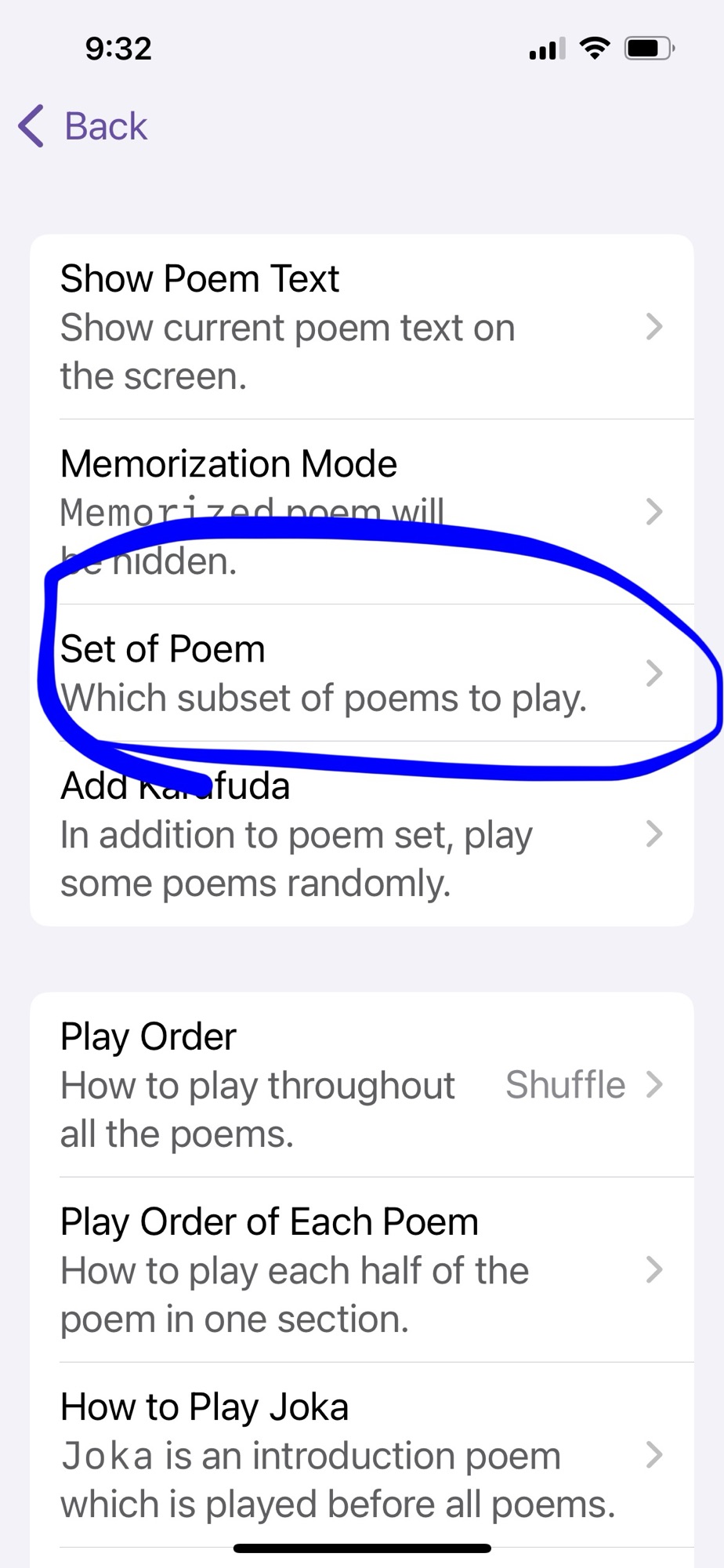
Using my favorite karuta reader app, Wasuramoti (Android and iOS), I decided to make custom lists based on the Oishi Tengudo groupings. You can do this too in Wasuramoti by selecting Advanced Config, then Set of Poem:

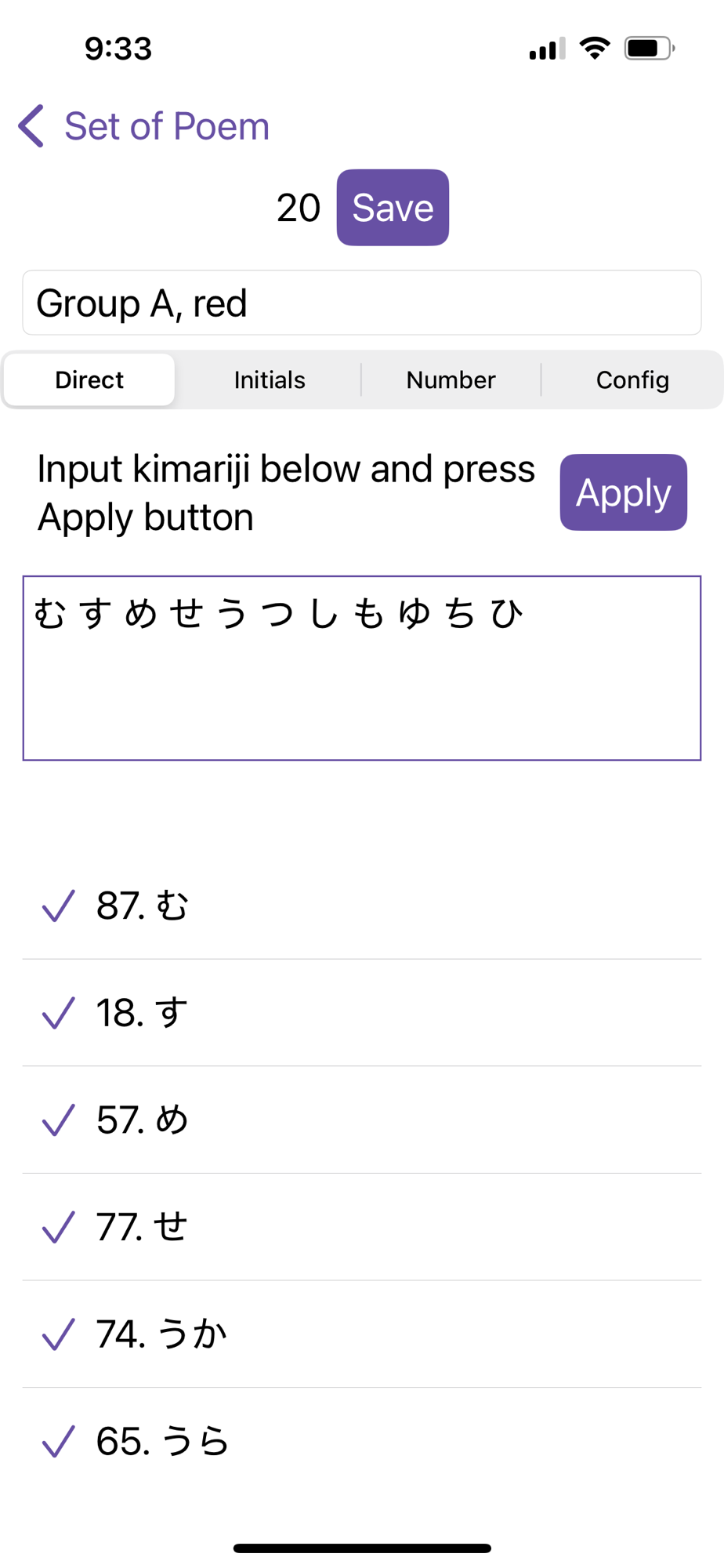
In the Oishi Tengudo set, the “red” group (also called Group A), is comprised of poems whose kimari-ji (starting syllables) start with む (mu), す (su), め (me), せ (se), う (u), つ (tsu), し (shi), も (mo), ゆ (yu), ち (chi), and ひ (hi). These cards have very few or no tomofuda (cards with similar kimari-ji), so they’re distinct and easy to learn first. I created my custom list with 20 cards, just like my physical set.

I made a similar custom list for Group B (“blue”) as well. This group is a bit harder because it includes cards whose kimari-ji have slightly more tomofuda cards (3-4): い (i), み (mi), た (ta), and こ (ko). So, there’s a bit more effort required to distinguish one card from another. Yet it’s still the second easiest group.

… and so on.

When I practice, I just grab the color I want to play (“red”, or Group A in this case) and scatter then on my desk, casual-style.

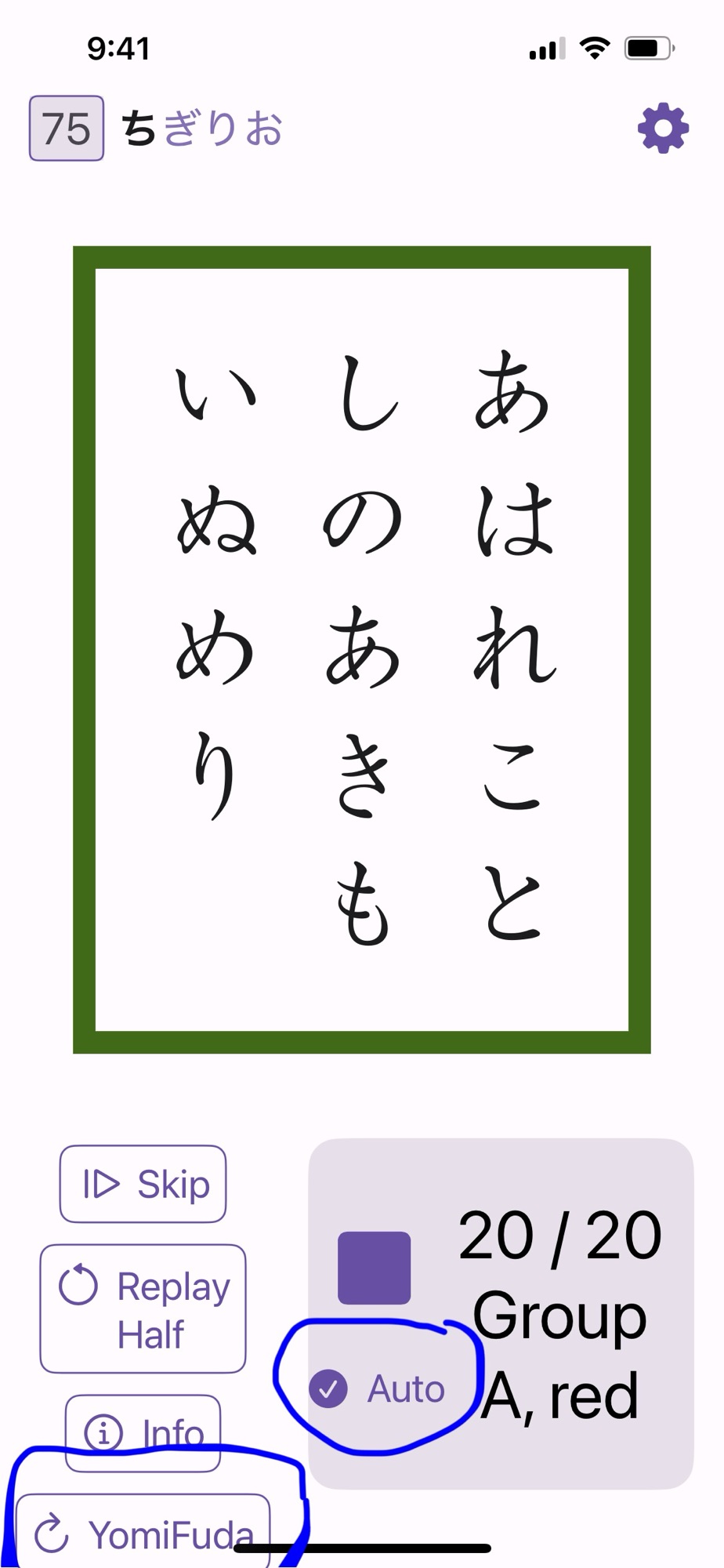
Then in the Wasuramoti app, I select the group of poems I want (see above), set the app to display the torifuda, same as cards on my desk, and set the reader to “auto” mode so it doesn’t stop with each poem. I just want to see if I can recognize the poem before too late. I don’t care very much about speed.

It is fun to play this way. I can finish a game pretty quickly (roughly ten minutes) and it is not very exhausting. Since I chose the easiest set of cards first, I remembered many of them pretty quickly despite the long hiatus, which was gratifying.

This format of playing smaller sets of cards, with optional levels of difficulty, and no threat of penalties, seems to be a great way to introduce to new players as well. I was happy to see that a new player, who had experience with Japanese language, quickly pick up the game, took a few cards of her own, and had a great time. If people aren’t having a great time, why play karuta?

Karuta is super fun, and a great game to enjoy throughout one’s life. However, if you are struggling, don’t blame yourself. Instead, find what you enjoy about karuta, pick a more gentle format, and focus on that, not what the A-rank players are doing.

Happy gaming!

1 The final nail in the coffin was when I joined some online communities which I soon realized were very focused on competition, and very little on actually enjoying the culture of the Hyakunin Isshu. It was just another sport, with physical training regimens, and techniques to edge out your opponent. That is not why I created this blog back in 2011, and not why I continue to enjoy the Hyakunin Isshu now. I had left the world of competitive card games behind when I quit playing Magic the Gathering before the Pandemic, and didn’t want to resume.

2 They only ship in Japan as far as I can tell, and with tariffs making things more expensive, it might be hard to get outside of Japan. Thus, I am adding a new index page for five-color Hyakunin Isshu to help readers make their own sets

Drinking Poems in the Manyoshu

The Hyakunin Isshu anthology, the subject of this blog, is not known for bawdy subjects as Japanese poetry by that time had become increasingly refined and codified in style. By contrast, the much older Manyoshu included a wider variety of poems and topics. This includes drinking poetry.

In fact, the compiler of the Manyoshu, Ōtomo no Yakamochi (大伴家持, 718 – 785) who also composed poem 6 in the Hyakunin Isshu (かさ), was the son of a famous literati and booze-hound: Ōtomo no Tabito (大伴旅人, 665 – 731). Tabito was a contemporary of Hyakunin Isshu poet Hitomaro (poem 3, あし), though not quite as successful.

Tabito was dispatched by the Imperial bureaucracy at the time to serve a term as governor of Daizafu in western Japan, and while there he formed a poetry circle called the Tsukushi Kadan (筑紫歌壇, “Tsukushi Poetry Circle”), where Tsukushi is the name of an old district in Dazaifu. Of Tabito’s 50+ poems in the Manyoshu, 13 of them were contributed by Tabito, known as the Sake wo Homuru Uta Ju-san-shu (酒を讃むる歌13首) or “The Thirteen Poems Praising Saké [rice wine]”.

My book lists two example poems:

Manyogana Modern JapaneseRomanizationRough Translation
験無験なきShirushi nakiI’d rather
物乎不念者ものを思はずはMono wo omowazu wadrink a cup of
一坏乃一杯のIppai no“dirty rice wine”1
濁酒乎濁れる酒をNigoreru sake wothan think about
可飲有良師飲むべくあるらしNomu beku aru rashiuseless things.
Poem 388, source: https://art-tags.net/manyo/three/m0338.html
ManyoganaModern JapaneseRomanizationRough Translation
中〻尒なかなかにNaka naka niI’d rather be
人跡不有者人とあらずはHito to arazu waa rice wine cask
酒壷二酒壷にSaka tsubo niand immerse myself
成而師鴨成りにてしかもNari te shikamoin wine, than live a
酒二染甞酒に染みなむSake ni shiminanhalf-assed life.
Poem 343, source: https://manyo-hyakka.pref.nara.jp/db/detailLink?cls=db_manyo&pkey=343

Although I joke about Tabito’s possible alcoholism, the poems are not necessarily meant to be taken as literal. My book on the Manyoshu points out that these poems may have intended to imitate a famous 3rd century literati group in China called the Seven Sages of the Bamboo Grove, sometimes known as the Seven Sages of the Western Jin [Dynasty]. In Japanese they are called the chikurin-shichiken (竹林七賢). The enduring image of these seven musicians, poets and scholars is a band of bohemian, drunken geniuses, and Tabito and his poetry circle was likely inspired by them. You can see other examples of artistic inspiration in this post from my other blog. Between this collection of poems, and the Zen artwork in my other blog, I had no idea that the Seven Sages were such a popular topic in art.

But I digress.

There is another side to this poetry as well : evidentially on the move from the capital (Kyoto) to Dazaifu to the west, Tabito’s wife apparently fell ill and died. So, my book alludes to the idea that Ōtomo no Tabito took up drinking not just as a literati trend, but also to deal with the grief of losing his wife. Marriages at this time were often political as various noble families vied for position in the tightly stratified hierarchy in the Imperial Court. However, even political marriages could be happy ones at a personal level, so Tabito may have genuinely been grieving for a wife that he loved, plus the isolation from the capital.

Tabito’s poems, celebrating the virtues of rice wine, are technically very good poems, but also cover a subject that is omitted in later anthologies where style and form were pretty much codified by then. So, by the time the Hyakunin Isshu was compiled, 4 centuries later, no one would write such crass poetry about booze and girls (at least not openly). Further, while the Manyoshu lacks the refinement of the Hyakunin Isshu, it does have a raw, visceral tone that’s often missing in later anthologies, and resonates differently with readers. Personally, I love both anthologies, but for different reasons.

P.S. I’m finally back, and have a few upcoming topics. Please enjoy.

1 This kind of rice wine seems to be a style from China, where the fluid is cloudy rather than clear.