Progress At Long Last

I started playing Karuta last August with the Seattle Karuta Club, and from time to time I play the computer on the Karuta online app. There’s been a lot of ups and downs in my life, but I’ve tried to stay focused and practice when time allows.

However until today I was never able to beat the hard mode on the Karuta app. At first, I played the easy or solo modes for a long time, afraid to get demolished. I eventually moved up to medium difficulty for a time and got used to it.

But every time I play hard mode, I get destroyed. I get nervous, get penalties, and lose track of where cards are because I am thinking too much about losing.

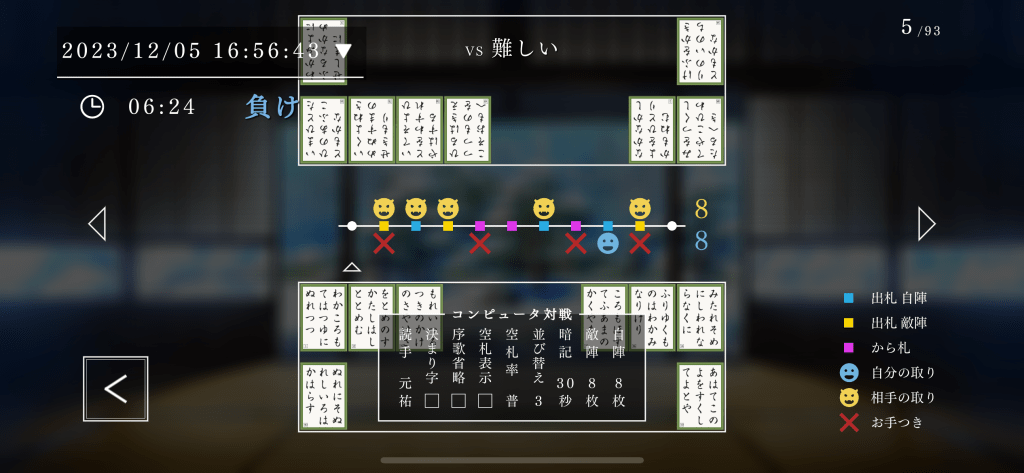
Finally, I won a match. I made a single penalty (oku vs. ogu) and yet otherwise everything else went surprisingly smooth for me. I even got three of the one-character kimarji cards (se, fu and mu) which I usually struggle with.

It was weird.

For once, I was relaxed and focused on where each card was. My mind was clear. Everything just clicked. In spite of the penalty, I played solid Karuta and won.

I guess practice really does make perfect.

Thank you, Byleth. 😋

Tips for Being the Yomite: the Karuta Reader

Author’s note: this draft was nearly complete before I had to go to the hospital in February. I decided to post as-is even if it is a bit late.

At a recent meeting of the Seattle Karuta Club, I tried my hand at being the yomité (読み手), the card reader.

The game of Karuta traditionally requires three people to play: two opponents and one person, the yomité, to read the full poem cards, the yomifuda.

Reading the cards is not just a matter of reading aloud, there’s a certain style and method to it. Plus you need to be able to read hiragana smoothly, including the weird spellings. Further you have to be clear enough that players know precisely which card to take.

Usually, Karuta players overseas just use one of several reader apps, but in Japan, Karuta matches usually have a yomité when possible. It’s a handy skill to learn if possible, even if you are musically tone-deaf like me.

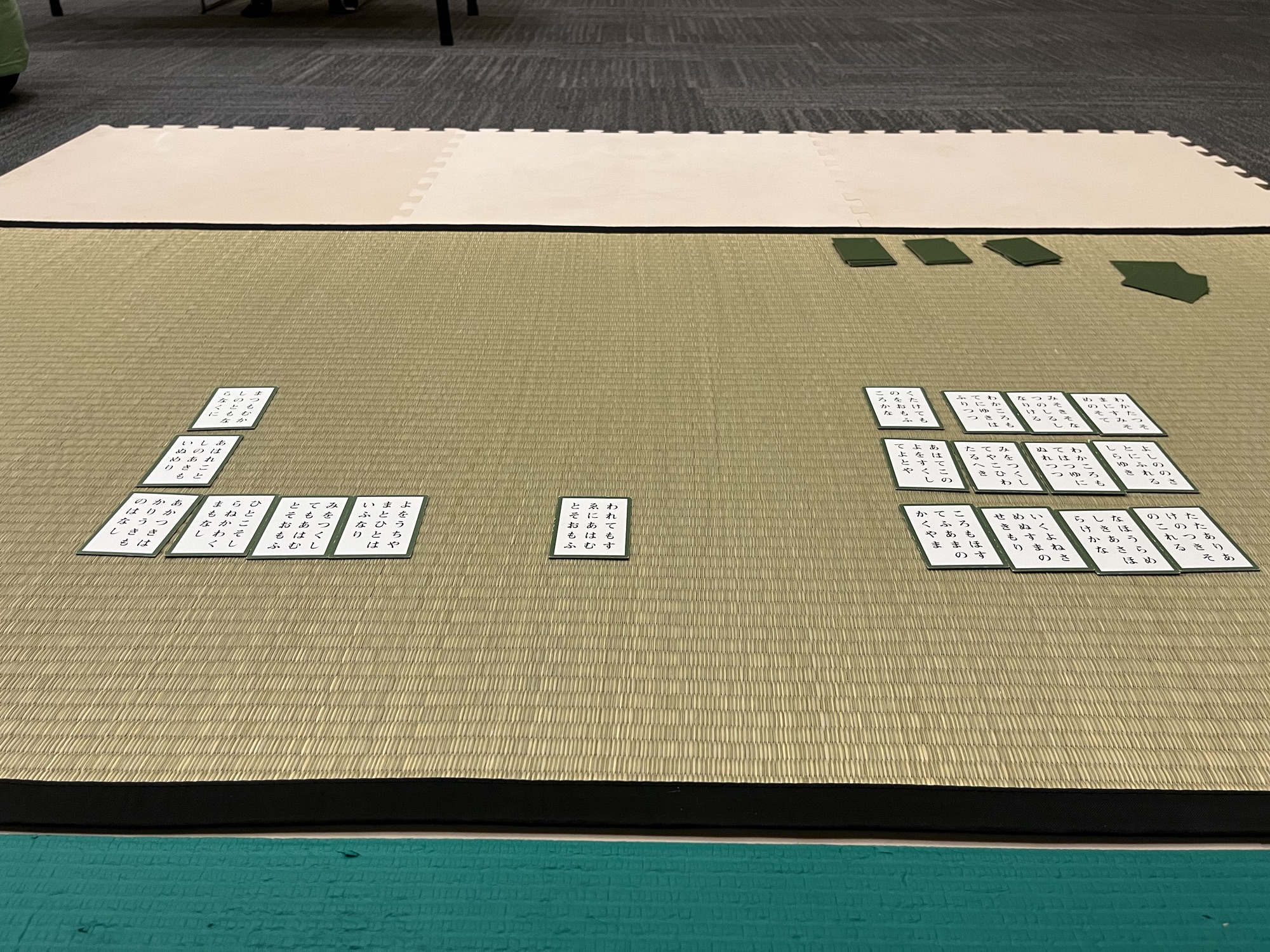
This featured photo is me starting the match. I was quite nervous since it was my first time, and have a terrible singing voice. I don’t say that to be modest; I am genuinely a bad singer.

Right away, I found I could read the text easily enough, but I didn’t project my voice, or enunciate the kimari-ji properly. Halfway through the match I “found my groove” and my reading improved but I still needed practice.

Learning to read Karuta cards does not take long to learn, but learning to read well takes time.

This page in Japanese focuses on learning to read Karuta cards. It even includes a video (Japanese only)

Source: https://www.karuta.or.jp/karuta/reading/

The good news is that there are tools for non-Japanese as well if you know where to look.

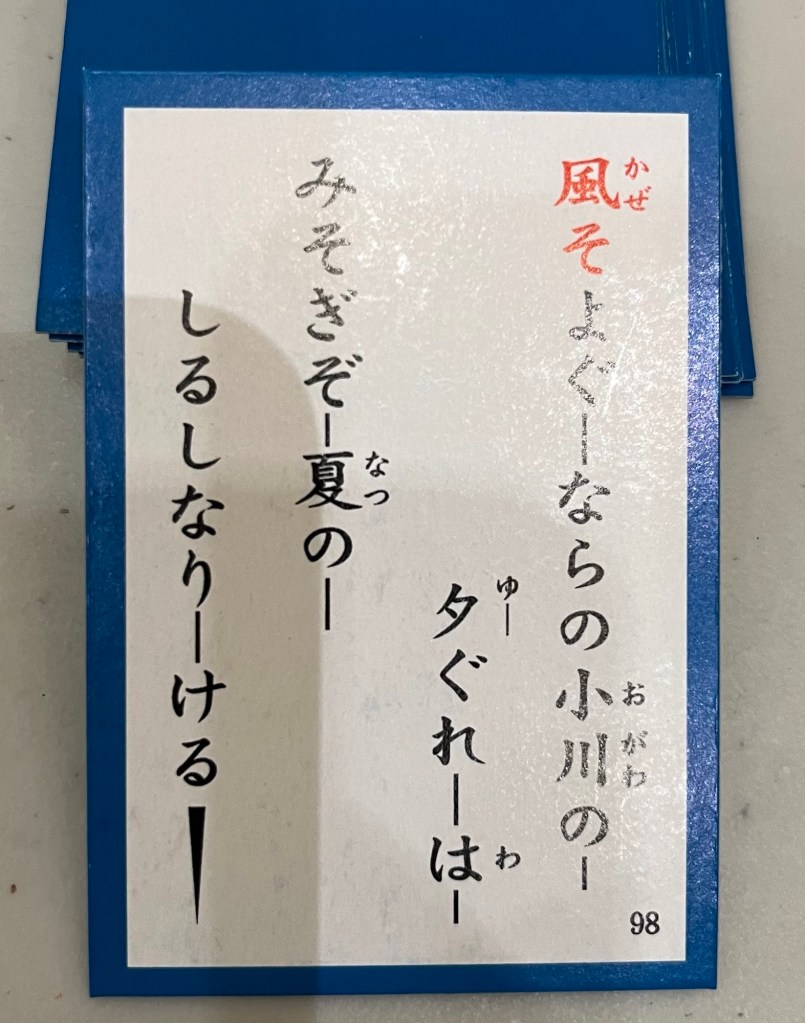
This set above (product link here), made by Oishi Tengu-dō is designed specifically for reading:

In red, the kimari-ji is shown, and the text of the poem includes rhythm clues (the lines and arrows) where you should elongate the syllable, for example. Each poem has a slightly different rhythm. It’s not the same pattern with every poem. So, you definitely have to practice each poem and how to recite them.

In the end, taking turns as the yomité is a nice way to share responsibility, and even Japanese is not your first language, you can pick it up with a bit of time and effort.

Being able to recite your favorite poem the traditional way is also a neat skill to learn anyway.

Otetsuki Penalties

One of my biggest challenges with learning to play karuta are penalties (otetsuki, お手付き). A penalty happens in one of there scenarios:

  • The correct card is on the opponents side, but you touch a card on your side for any reason.
  • The correct card is on your side, but for any reason you touch a card on the opponent’s side.
  • The card is not on the board (karafuda, から札), but for any reason you touch a card on the board.

In all three cases the result is the same: your opponent is allowed to send a card over to you. Their card count is reduced by one (advantage), and your card count also increases by one (disadvantage).

If you think about it, a penalty is more costly than simply letting your opponent take the card. In the rare case of a double penalty, it is extremely costly because your opponent will send over two cards.

However, the pressure to correctly identify and then take the correct card before your opponent makes penalties possible, even for pro players. However, the more you prevent penalties the better your gameplay overall.

In my case, I get penalties often under pressure. In some games, I get as many as 8-9 penalties which is disastrous. The featured photo is a game I lost recently where I had 6 penalties. I would have still lost but the margin was much bigger due to penalties and panic (i.e. “tilting”).

If I calm down and focus, I can reduce this far fewer. Sometimes when I panic, I have to remind myself that it is better to be slow, than to be wrong.

For the past month, I have been striving to reduce my penalty rate and found a great article in Japanese. It identifies a few different patterns of penalties people tend to do, and how to counteract each. I won’t explain the article word for word, but some of the more common patterns are:

  • Forgetting (or mis-remembering) the position of cards on the board. This requires a grasp of the kimariji for quick recognition, and focus to maintain a “mental map” in your head. Personally, I find it helpful to focus on an empty spot on the board as a meditation “focal point”, so I can visualize without looking.
  • Hitting cards on both sides of the board on accident. This requires physically practicing how you move your hand and being quick, but more precise.
  • Listening incorrectly (or jumping the gun) and taking the wrong card. This is very common and a good habit to break quickly.

One method I have used and wrote about before is playing solo and reducing the pressure while focusing on being correct, not fast.

Another, general method for reducing penalties is practicing kikiwaké (聞き分け): “separating sounds”. This is a form of teaming and a mini-game in the online karuta app called “Branching Cards” in English. The Japanese kikiwake means to listen and differentiate.

“Branching Card” in English

In each round you will be presented with 2-3 tomofuda (友札), or cards with similar kimariji. Your job is to listen and take the correct one. There are no empty cards; the correct one is always on the board somewhere.

As the article explains above, you should focus on the last syllable of each kimariji so that you can more easily differentiate which is being read.

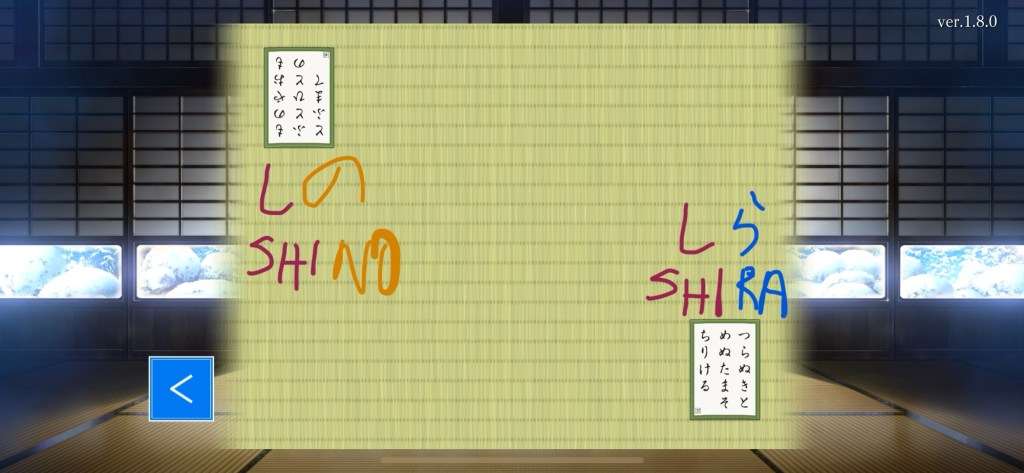
In the example below, there are two cards with kimariji of しの (shino) and しら (shira). The の and ら are what differentiate the two.

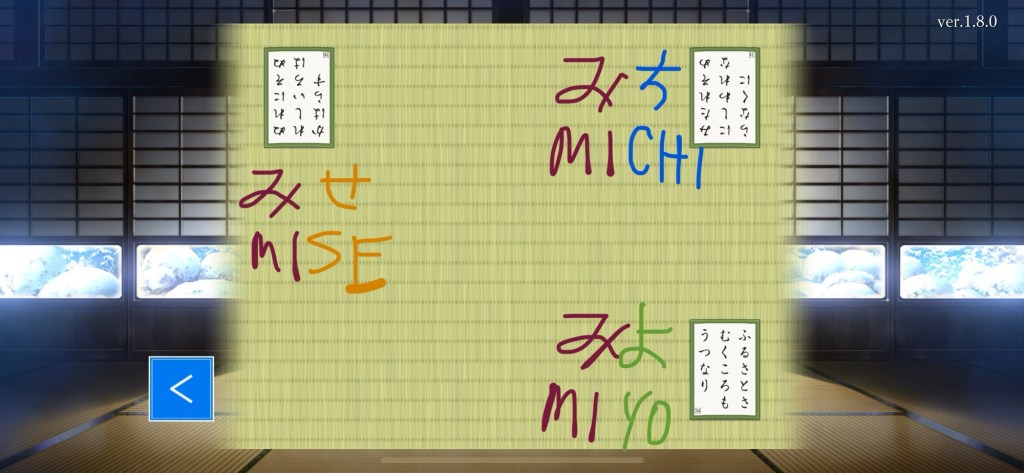
In a more challenging example, there are cards with kimariji of みせ (mise), みち (michi) and みよ (miyo). The せ, ち, and よ are what differentiate the three.

At first this is surprisingly tough to do. You have to recognize the cards quickly, and then listen for the important syllable. I made many mistakes at first, but after a couple weeks, I’ve gotten better about waiting until the correct syllable is read.

As always keep practicing fudawake, but also strive to improve your listening and self-discipline too.

Good luck!

2024 Meijin and Queen Championships

Hello,

The 2024 championships for 70th men’s Meijin (名人) and 68th women’s Queen (クイーン) titles, were streamed on YouTube this weekend!

And sub-channel here:

It seems that the Meijin-Queen championships are held every year shortly after Japanese New Year (oshōgatsu, January 1st through 3rd), and are played as “best of 3” (out of 5) battle.

The battles this year, particularly for the Queen title, were especially intense. The reigning Queen, Yamazoe (山添), ultimately lost to Inoue (井上), but each of the matches was a nail-biter. Many of them came to unmeisen (運命戦, “sudden death”), where each player is down to their last card. The Meijin battle finished in three consecutive wins for Kawase (川瀬), keeping is title.

Even if you’re not an expert player karuta player, it’s pretty fun to watch. I watched the first few matches with fellow karuta players on Discord (invite here), and we had a great time.

Also, it’s neat to see the best of the best play, learn some good techniques, and see the tradition of the Hyakunin Isshu live on for another generation.

Upcoming Podcast Interview

Dear Readers,

I am happy to report that I’ll be appearing in a podcast about the Hyakunin Isshu and Karuta coming up in a few weeks! It is exciting to collaborate with a fellow karuta player, “Steph”, who hosts the Karuta Chat podcast.

(Also available on Apple Podcast and many other feeds too)

I’ll have more details soon, but it will be a chance to share my experiences with the Hyakunin Isshu, karuta and more with a wider audience. If you’d like to know, I hope you’ll consider giving the Karuta Chat podcast a listen.

Playing Karuta Solo Has Its Benefits

Having played Karuta now for three months and against a variety of opponents, including computer opponents, I realize that I get otetsuki (お手付き, “penalties”) a lot. Like, a lot.

In one in-person game, I was nervous and got eight penalties which is simply painful. Even when playing against the computer on hard mode, I get 2-4 penalties at a time.

I had 4 this particular game (the red X’s shown). 🤦🏼‍♂️

Anyhow, after finishing some other long-term projects recently, I’ve been investing time to practice karuta, and to grow and develop my skills. One of my big goals has been to reduce penalties as much as possible, and so after some introspection, I realized that my biggest issue, besides being nervous and jumpy, is that i don’t pay attention enough to the reader.

As folks who have been following the blog know, the key to playing karuta is to know the kimari-ji syllables, those first, unique syllables each poem has to distinguish from other poems. Until you hear those syllables, you can not be 100% sure which poem is being read, and if you guess wrong, you get a penalty. Sometimes, I got lucky and guessed correctly, obviously though, sometimes I guessed wrong.

Memorizing the kimari-ji is the first step. You also have to recognize them when you hear them, and hopefully faster than your opponent.

I decided this month that I wanted to invest more time in discipline and listening skills, and less on speed, so I have switched to playing “solo mode” on the online karuta app. There are other ways to do this of course, but the point is that I am playing against a “goldfish”.

Why a goldfish?

A “goldfish” is a term in Magic: The Gathering, for when you are practicing against a completely passive opponent. They are there, but do nothing. Like a goldfish. 🐠

If you play solo mode on the online karuta app, you are not pressed for time. You can slow down, pay attention to the reader, and then take the card when you recognize it. It is also a good way to catch your bad habits, test your different card arrangements, etc. It’s a surprisingly handy tool for improving your game.

Also, it’s a great way to analyze your play style. when playing “solo mode” against the computer, I still got jumpy and took a penalty.

Further, as your listening improves, your speed will gradually improve, but it does require a touch of patience, and a willingness to sacrifice speed over accuracy. I need this. My accuracy is poor, and speed cannot fix that. If I don’t play more accurately, I will continue to suffer loss after loss.

Even when I practice fuda-nagashi drills, I realized that I had to slow down a bit, or I would mis-identify cards again. It’s important to recall cards quickly, but if you mis-identify a card, then it’s not worth it. Better to accurately recall the correct kimari-ji, even if slower.

So, if you are learning karuta, and you feel like you are struggling, stop, backtrack, slow down, and focus on playing good karuta, not fast karuta. With a bit of time and patience, it should pay for itself.

P.S. Special thanks to the crew on the Competitive Karuta Discord group (Discord invite link here) for their helpful advice, much of which was incorporated in this blog post. ☺️

The Kōrin Karuta Collection

On a quiet Saturday afternoon, the first in a long time, I caught up on some reading and continued to read through my book about the Hyakunin Isshu (mentioned here): the Hyakunin Isshu Daijiten.

In one chapter, the book discussed a special artistic collection of the Hyakunin Isshu called the Kōrin Karuta collection (kōrin karuta, 光琳カルタ) which was painted by the famous artist Ogata Kōrin (尾形光琳, 1658-1716). The featured image above is one of his famous paintings depicting irises in a field (Public domain, via Wikimedia Commons).

I had a hard time finding available images of the Ogata Kōrin collection of cards, but you can see an example at the Tengu-do homepage. There’s a few things that make this collection noteworthy among the long history of the Hyakunin Isshu….

First, the cards use a gold background, instead of white or off-color white. If you look at Ogata’s other paintings, this is a common technique that he used, so it makes sense.

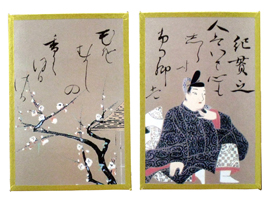
Second, and more significantly, the torifuda cards are painted as well. Whereas the yomifuda cards have portraits of the poets (with some subtle details we’ll talk about below), modern torifuda cards only have the text on them. Ogata decorated the torifuda cards using scenes that matched the poem.

For example, poem 100 (ももしきや) is shown here on the Tengu-do website. The corresponding torifuda card shows the eaves of a palace since the poem is about the declining condition of the Imperial palace amidst political strife. Poem 35 (ひとはいさ) is shown here. Since the poem is about the first cherry blossoms in spring, the torifuda card depicts cherry blossoms. And so on.

Third, the cards were larger in size than a standard karuta card used today. Perhaps the cards were not meant for playing, but as a medium of art.

Also, I realized that the illustrations of the poets looked awfully familiar. My first karuta set uses the same Ogata illustrations, even though the torifuda are not illustrated, and the card background is plain white versus the original gold color.

Even the paintings of the authors has some pretty interesting qualities to them. Using my own set, let’s take a look at a few notable quirks.

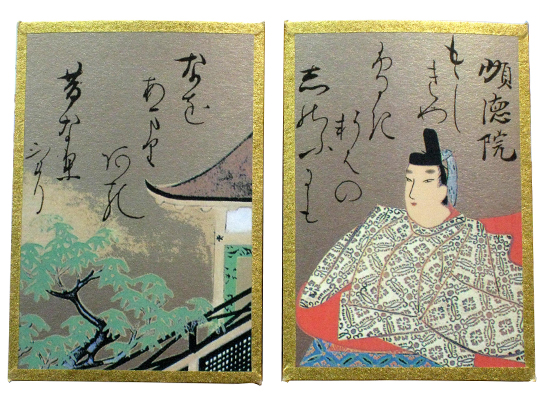
First, the “emperor” cards (cards where the poet was a reigning or retired emperor) have them seated on a straw mat with a brocade edge, a sign of authority. None of the other poets have this, even if the poet was a high ranking officials in the court. Here are the cards for Kōkō Tennō (“Emperor Koko”, poem 15) and Juntoku-in (“Retired Emperor Juntoku”, poem 100):

Second, while most poets’ faces are visible, the card for Shokushi Naishinnyo (“Imperial Princess Shokushi”, poem 89) completely hides her face. Why is that?

Evidentially, Princess Shokushi was quite beautiful, and Ogata didn’t want to leave her open to criticism or scrutiny, so he hid her face to protect. In some versions of the Kōrin Karuta set, Ono no Komachi’s (poem 9) face is also hidden.

The Kōrin Karuta collection isn’t the only famous illustration of the Hyakunin Isshu, and in time I hope to highlight others.

Personal Growth

After playing some recent matches with the good folks at the Competitive Karuta Club (Discord invite link here), and also in person with the Seattle Karuta Club, I realized that, as of writing, I’ve been learning to play for 11 weeks. It felt longer somehow. I even double-checked the calendar and, sure enough, it has only been eleven weeks from my very first karuta experience.

In that time I have managed to memorize all 100 kimari-ji. It wasn’t always easy, and I recall some of them faster than others, but practicing fuda-nagashi does help.

Further, I haven’t won a single match yet (online or in person), but I feel like more confident than before, am more aware of my opponents card arrangement (tei’ichi 定位置), sometimes able to keep track of cards that have already been read, and even take a few cards now and then. My rate of penalties is still higher than I like, but that’s still a work in progress.

In short, I have grown as a Karuta player. Not a lot, but it’s nice to look back and actually see progress.

Using the analogy Fire Emblem: Three Houses again, if I may,* there is a part of the story where your students have the option to face the dreaded Death Knight. Unless your student’s name is Lysithea, very few characters can defeat the Death Knight without considerable luck and strategy. It’s not that the characters are weak, they’re just not ready. So the game encourages you to know your limits, and just skip if you’re not prepared. Much later in the game, when your characters are much stronger, you will encounter the Death Knight again and have a much better chance to emerge victorious.

In the same way, battling an advanced player in Karuta probably won’t result in victory, but those little incremental wins, each card taken, each penalty avoided, is still a sign of growth.

As a game, karuta is more difficult to learn upfront compared to things like Magic: the Gathering, Pokemon TCG, etc. However, once you pass that hurdle, it becomes a game you can carry with you the rest of your life. You don’t have to keep buying new sets of cards, dealing with “power creep” with new card sets, etc. The 100 poems of the Hyakunin Isshu have been around for centuries and will continue to be around for many more. The more you play, the more your skills refine. There’s no rush, come as you are, enjoy the poems, learn a little bit each time.

Finding a community of players isn’t always easy, but the budding international community continues to grow and we are always welcoming new people.

If you’re unsure, feel free to take the plunge anyway. Hopefully, you’ll be glad you did. I was.

P.S. featured photo taken at Ryonaji temple in Kyoto, Japan, in summer of 2023.

* the best part of owning your own blog is that you can write whatever silly stuff you want. 😋 Also, if you own a Switch, please try FE:3H. It’s a pretty neat game.

Karuta Practice: Fuda-waké

As part of my efforts to improve my practice routine and make small, incremental gains, I got some helpful advice from the Seattle Karuta Club, and was pointed toward this website. This Karuta Club, the Akita Kohohana Karuta Club, in Akita Prefecture demonstrates how to practice Karuta using a method called fuda-waké (札分け), meaning “distributing cards” or “dividing up cards”, etc.

This technique takes a bit of setup at first but is a great way to both reinforce kimari-ji and also positioning your cards (tei’ichi 定位置).

First, you need to make a chart large enough to place your cards on a 7×4 grid, like so:


Then fill in the Japanese hiragana like so. I’ve added both romaji (Roman alphabet) and kiriji (Cyrillic alphabet) for convenience.

や ya яみ mi миは ha хаた ta таさ sa саか ka каあ a a
ゆ yu юむ mu муひ hi хиち chi тиし shi сиき ki киい i и/й
よ yo ёめ me мэふ fu фуつ tsu цуす su суう u у
わ wa ваも mo моほ ho хоな na наせ se сэこ ko коお o o

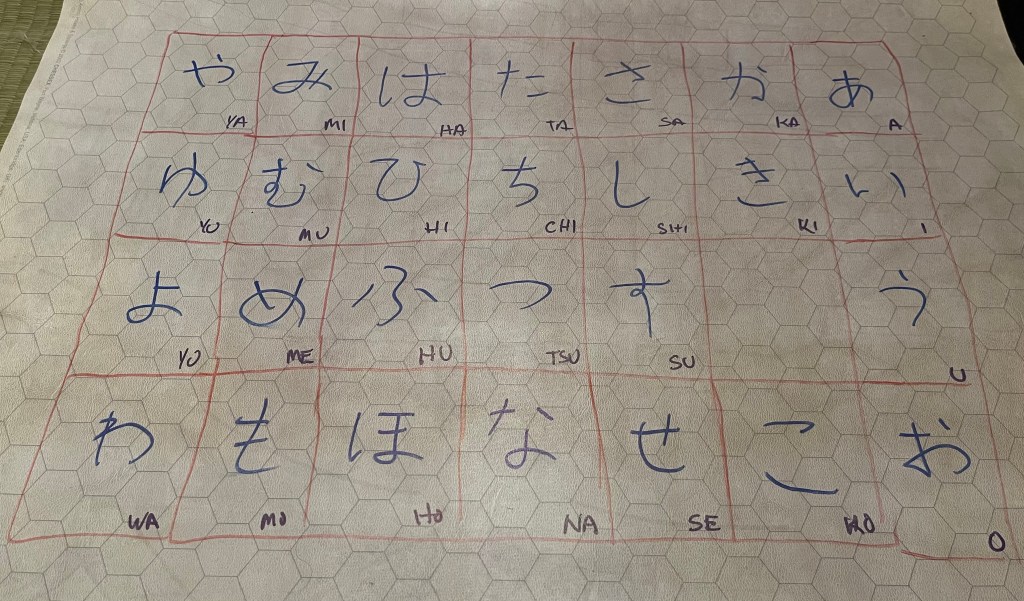
I wanted to try out this method, so I used my old battle-map from Dungeons and Dragons, and drew the same chart on there:

My handwriting is terrible, but hopefully legible. You can see a close-up here:

To be honest, I made my grid a bit too small, so as I piled cards, I couldn’t see which space was which. If you make something similar, make sure the squares are extra big.

Anyhow, the method for fudawaké is to pile up your torifuda cards to the side, then time yourself:

  • Grab a handful (doesn’t matter how many)
  • One by one, put them in the right square based on the first letter of their kimari-ji.
  • Grab more cards as needed.
  • When you place all 100 cards, stop the timer.

According to the Akita Konohana Karuta Club website, their team standard is 1:40, which is quite fast. You can see that some members finish in less than one minute!

When I tried it the first time, it took me 8:05, and then on my second try, it took 6:07. Not even close to their standard, but it was a fun exercise. It is more challenging than fuda-nagashi, but still teaches many of the same skills. It also helps with the initial board setup too, because you can correctly remember where to group your cards based on common kimari-ji.

Try it out and let me know what you think!

Five Color Hyakunin Isshu

Recently I learned about the concept of go-shoku Hyakunin Isshu (五色百人一首), or five color Hyakunin Isshu.

During my recent trips to Japan, while shopping for Karuta sets, I did see some advertised as “five color sets” but didn’t understand the significance, and there is no information in English.

According to this helpful website, it’s a kind of teaching aid for grade school kids to learn Karuta by diving the cards into 5 sets of 20, color-coded: Blue, Pink, Yellow, Green and Orange. The website above has a comprehensive chart for each color, and which poems belong to each.

The cards are grouped this way to ease the memorization of the kimari-ji for playing karuta by organizing easier versus more difficult cards into different groups. The website above suggests the following game to help (my rough translation below):

  1. This is a 1v1 game
  2. Of the five color groups, select one at random (or however you want to decide).
  3. Shuffle the 20 cards and then divide into two piles. Using rock-paper-scissors to decide, the winner can pick their preferred pile.
  4. Each player will lay out their cards in two rows of 5 cards each. Lay your cards out so that you can read them.
  5. The tops of your cards on the top row will touch the top of your opponent’s cards on their top row. Your cards do not have to be touching each other.
  6. You have one minute to memorize your cards.
  7. The reader will reader the upper verses of the poem, then the lower verses, one time each.
  8. When you are going to take the card, yell hai!
  9. If both players touch the card at the same time, you can decide the winner using rock-paper-scissors.
  10. If one player’s hand is on top of another, the player who’s hand is at the bottom is the winner.
  11. When the reader is not reading cards, you are allowed to flip the cards over to see the upper verses. (Me: I guess the official five color cards print on both sides?)
  12. When 17 cards have been read, the match is over.
  13. Whoever took the most cards wins.

There is a helpful instructional video too (sorry, no English):

It also points out some penalties: touching the wrong card (even if you touch the correct one later) and such. Most of this is geared towards grade school kids, so adults would not likely make such mistakes.

Also, some groups seem easier than others. Based on reviews in the website above, yellow and blue seemed easiest, while orange and green were the hardest.

Since I don’t own an official five-color set (yet), I decided to make my own set by using one of my non-competitive sets, and dividing it up into the five color groups. You can see my efforts above in the featured photo. Also, please buy Dr Mostow’s book on the Hyakunin Isshu. This blog is graciously his debt. 😌

Even if you don’t play the five color Hyakunin Isshu game, you can still use an online reader app like Karuta Chant (iOS and Android). The app even has options for reading only the specified color group:

This established method of dividing up the cards into five colored groups is a very handy way to divide and conquer in your efforts to learn the karuta cards.

Try it out and let me know what you think in the comments!