This poem was composed not by a woman as one would expect, but by a Buddhist priest named Sosei Hōshi (素性法師, dates unknown), or “Dharma Master Sosei”. He was the son of Henjō who wrote poem 12. Sosei was a prolific and popular poet and according to Mostow heavily represented in the more official anthology, the Kokin Wakashū. He is also one of the Thirty-Six Immortals of Poetry.
As we’ve seen with other poems from this earlier era, it was common to write about poetry themes, and to write from a role outside one’s own. So, for a monastic to be writing from the perspective of a lonely woman wasn’t unusual.
Mostow explains the contradiction in this poem between the “one long night” and “months” as being an issue of interpretation. Though most people assumed it was a long Autumn night, Fujiwara no Teika (poem 97), the compiler of the Hyakunin Isshu anthology, felt it was more like a long passage of time.
P.S. Photo above is a Japanese calendar we have a home. More on that in a related post in my other blog.
The author of the poem is by a priest of the Tendai sect of Buddhism named Saki no Daisōjō Jien (先の大僧正慈円, 1155-1225), or “Former Archbishop Jien”. He was the son of the powerful Fujiwara no Tadamichi (poem 76) and nephew of fellow poet Yoshitsune (poem 91) as well as Fujiwara no Teika (poem 97) himself. Although he was from an elite family, he was the 10th son of Tadamichi, and thus extraneous. Like many powerful medieval families in both Europe and Asia, the extraneous kid was sent to a monastery. In this case, the prestigious monastery of Mount Hiei (homepage here), one of two powerful centers of the Tendai sect.
Interestingly, Professor Mostow suspects the poem may actually be an allusion to Emperor Daigo, who was said to have taken off his robe one winter night to suffer the same cold as the people did.
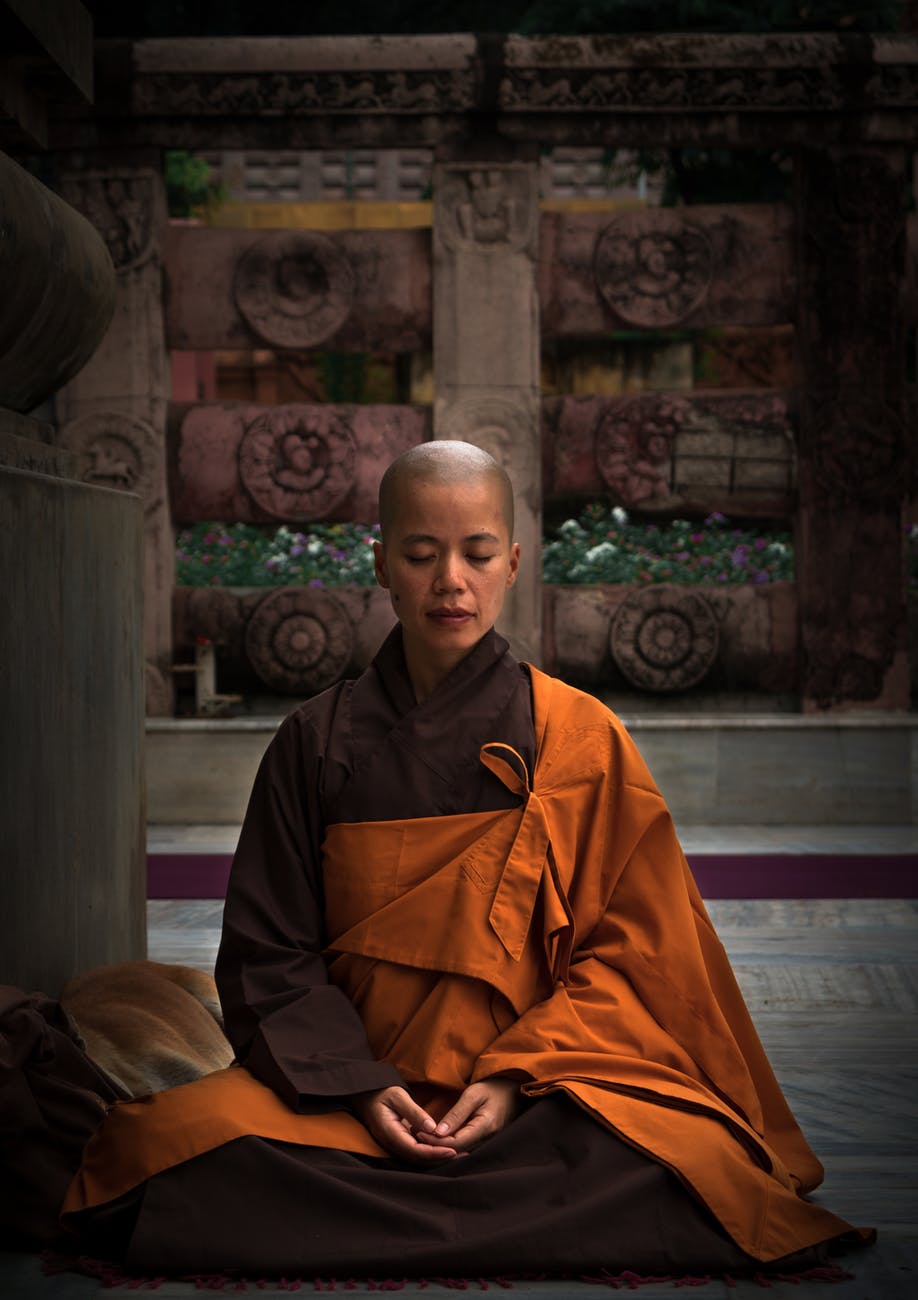
In any case, the last line of the poem is noteworthy because it is a direct quote from the founder of Tendai Buddhism in Japan, Saichō who lived centuries before. So, for many, this has been interpreted as Jien’s vow as a monk to carry on this tradition of compassion for all beings in a world that is transient and marked by suffering. Here, the “ink-black” or sumizome no sodé (墨染の袖) literally means “ink-black sleeves” (sumi is Japanese ink), and is the traditional color that Buddhist priests in East Asia wear. Compare the black sleeves with the orange-ochre robes in Southeast Asia, or red robes in Tibet.
This notion of compassion for all beings is exemplified by the Buddhist notion of a bodhisattva who is a being who is highly advanced on the Buddhist path and has turned outward to help and teach all beings before becoming a Buddha (i.e. enlightened) themselves. An example is a bodhisattva named Kannon (Avalokiteshvara), “who hears the cries of the world”.
Kannon, symbolized here with 1,000 arms, providing aid to all who seek it. Photo taken by me in 2013 at a local Vietnamese temple.
Tendai Buddhism, in particular, reveres the Bodhisattva ideal and practices, and not surprisingly the poem reflects this. In any case, the notion of goodwill and compassion for others is something I hope others find inspiring.
The poem is signed as Kanké (菅家, 845 – 903), which is the Sinified (Chinese) way to read the Sugawara Family name (lit. “House of Sugawara”). You see similar names used for the Taira Clan (e.g. Heike 平家) and Minamoto Clan (e.g. Genji 源氏) in later times. Anyhow, the author is none other than the famous poet/scholar Sugawara no Michizane who in later generations was deified as a sort of god of learning named “Tenjin” after he was wrongfully exiled through political intrigue.
The term nusa (幣) means a special wand used in Shinto religious ceremonies. The photo above is an example of a nusa, more formally a gohei (御幣) “wand” used in Shinto religious ceremonies, with the paper streamers used for purification (photo by nnh, Public domain, via Wikimedia Commons). At this time in history, according to the Hyakunin Isshu Daijiten, small nusa were often made from thin strips of paper and cloth and offered to the gods for a safe journey.
The poem was composed by Michizane after going on an excursion with his patron, Emperor Uda. Compare with another outing made years later by (then retired) Emperor Uda later in poem 26. In this case, Michizane had little time to prepare, and couldn’t make a proper offering to the gods for a safe trip. However, admiring the beautiful autumn scene on Mount Tamuke, he hopes that this will make a suitable offering instead. Sadly Michizane would be disgraced and exiled only a short time later.
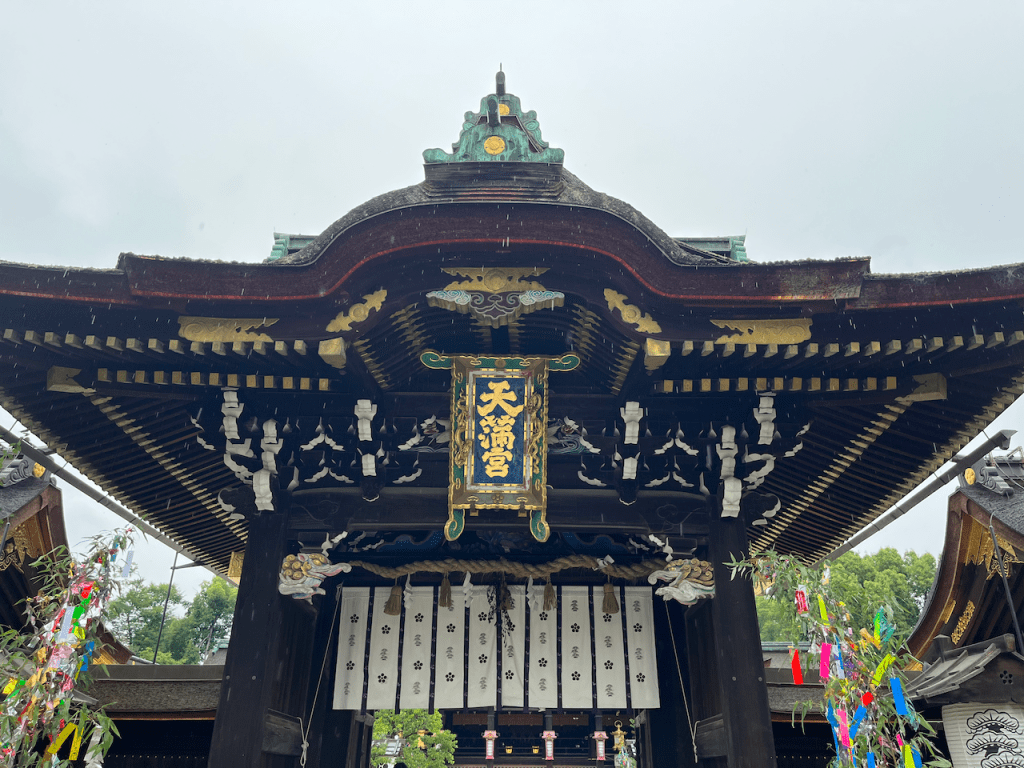
My interest in Sugawara no Michizane mostly comes because I admire him as a fellow scholar. I visited one of his shrines in Tokyo a couple times over the years, and usually try to pay respects. In July 2023, I visited the home shrine of Kitano Tenmangu as well.
Kitano Tenmangu shrine in Kyoto, Japan. Taken in July 2023.
The real life Michizane was no god of learning, but his real-life contributions to poetry and Chinese literature in Japan helped the culture flourish at that time, and earned his place as a trusted adviser to the Emperor, despite his more humble background. This also helped explain his status centuries later as a god of learning. Every year in Japan in April, students pay respects hoping that they can pass entrance exams, and it’s nice to see his legacy carry on so many years later.
The author of this poem is a monk named Ryōzen Hōshi (良暹法師, dates unknown) or “Dharma Master Ryōzen”, who supposedly composed it while doing austerities in a remote hut outside the capitol. Unfortunately, we have little about Ryōzen Hōshi’s personal history, even in my new book. He had some infamy over a poem he composed during a poetry contest, by inadvertently copying one in the Kokin Wakashu, causing him to be a laughing stock. However, other scant records show he was still respected by the nobility overall.
The notion of “Autumn sunset” appears a lot in Japanese poetry, but apparently its meaning differs depending on the time and place. Ryōzen Hoshi gives a more melancholy, almost Buddhist, tone implying that the world around him is declining into winter and possibly, metaphorically declining in a general Buddhist sense. However, Sei Shonagon (poem 62) also wrote about Autumn Sunset in her PillowBook, but used it to describe crows and wild-geese flying
An Autumn sunset means a lot of different things to a lot of different people, but it still is significant one way or another. For me, I tend to like Ryōzen’s imagery the best, and it’s the one I imagine whenever I read this poem.
The poet, Egyō Hōshi (恵慶法師, dates unknown) also known by his title “Dharma Master Egyō”, was a Buddhist monk active during the last half of the tenth century. He was the bishop (kōsō 高僧) of a major temple in old Harima Province and often gave lectures. As Professor Mostow explains, he was closely associated with other poets who frequently met at the Kawara Villa on the banks of the Kamo River. According to Mostow, these included Yoshinobu (poem 49) and Motosuke (poem 42) among others. He was also friends with Kanemori (poem 40).
The poem was given as an entry to a poetry contest about the coming of autumn to a ‘dilapidated house’ according to Mostow, but he points out that the “house” in question was probably referring to the Kawara Villa, itself previously owned generations earlier by Minamoto no Toru (poem 14). The juxtaposition between people (who don’t visit) and autumn (which does) makes this poem highly prized.
Given that Egyō is a Buddhist monk, and well-versed in the Buddhist teachings of the effervescence of life, it seems reasonable that he used the house and the seasons to give the poem a bit of a Buddhist theme. Spring gives way to Summer, Summer to Fall, Fall to Winter and so on. In the same way, things rise and fall, and Egyō perhaps wanted to remind his audience that “Autumn” comes sooner or later.
This poem was composed by one Semimaru (蝉丸, dates unknown) who is reputedly a blind man who built a hut near Osaka Barrier and was famous for playing the biwa, but the authenticity of this story is questionable, and as Mostow points out, it’s not even certain he existed at all. The story about his life has also changed throughout the generations, so in some cases he’s the servant of the son of an Emperor, and in others he’s the son of an Emperor, abandoned by his blindness.
According to one account in my new book, a high-ranking official named Minamoto no Hiromasa (源博雅) once heard a rumor of a talented blind man with a biwa lute who lived near the Osaka Barrier (see below). He wanted to hear this man’s music, and sought him out for three years until he finally found him on the evening of 15th day of the 8th month (old lunar calendar), and from this man, Hiromasa learned to play the songs that he had been squirreling away. Songs titled such as 流泉 (ryūsen, “flowing spring”) and 啄木 (takuboku, “woodpecker”).
The place in question, Osaka Barrier, is a popular subject of poetry from this era. Poems 62 and 25 also mention the same place because it was a popular meeting spot for people coming and going from the capitol (modern-day Kyoto) eastward. Note that this Osaka has no relation to the modern city of Osaka, which was called Naniwa during that era. In fact the name of Osaka Barrier is also a pun. The Chinese characters are 逢坂, which means “meeting hill”, but is also the place-name.
Anyway, these kinds of check-points, or sekisho (関所) existed in Japan across major roads going in and out of the capitol, but were also popular meeting places for friends and lovers too, as well as having inns nearby for weary travelers. The featured photo above is an example of “sekisho” checkpoint, photo by 663highland, CC BY-SA 3.0, via Wikimedia Commons
The Osaka Barrier in particular was the first check-point leaving eastward from the capitol, so many people probably parted company here, or met old friends at this particular gate more than others. It’s fun to imagine what Osaka Barrier was like in those days. As Mostow points out, this poem probably was originally just a poem about Osaka Barrier, but by the medieval era, it took on an increasingly Buddhist tone in symbolizing the coming and going of all phenomena. Even modern Japanese books on the Hyakunin Isshu tend to reflect this sentiment. Pretty interesting metaphor I think.
One other interesting thing about this poem is its rhythm. If you read this one out loud, the rhythm is very easy to follow, and this is probably one of the easier poems to memorize if you’re looking for a place to start (poem 3 is another good choice in my opinion 😉).
Finally, one random note about Semimaru himself.
His artistic depiction in karuta cards, such as the yomifuda card above based on the famous Korin Karuta collection, leads to frequent confusion by people who play bozu mekuri: is he a monk or a nobleman? Even my new book mentions this conundrum among Japanese players. His lack of verified biographical information makes this question even more mysterious. The book jokes that the author’s house-rule is that if anyone pulls the Semimaru card, then everyone loses what their stack of cards. Feel free to make your own house-rule. 😊
This poem was composed by Sōjō Henjō, (僧正遍昭, 816 – 890), “Bishop Henjo”, who served in the Heian Court until the death of Emperor Nimmyo. It was then that he took tonsure as a Buddhist priest. He is one of the original Six Immortals of Poetry as well as the Thirty-Six Immortals.
The poem was composed during the time that Henjo was in the service of the Emperor (and not yet a priest). The occasion for this was the famous Gosechi Dance or gosechi no mai (五節の舞), more formally known as the toyono akari no sechi-é (豊明の節会), a dance that took place in the Imperial Court during the middle of the eleventh month of the old Japanese calendar (roughly December in modern times) to celebrate the harvest.
During the final months of the year, the Imperial Court held several important events to celebrate the yearly harvest, starting with the niiname no matsuri (新嘗祭) when the Emperor would offer part of the harvest to the gods.1 The following day, the Court would celebrate the Gosechi dance at the Shishinden Palace, and the Emperor would partake of the new harvested rice. According to Richard Bowring, the Gosechi festivities last up to four days.
The Gosechi dance involved 4 “heavenly” maidens called otomé (をとめ) from high-ranking noble families, and is mentioned by several authors from the era, including Sei Shonagon (poem 62) in the Pillow Book:
[87] At the time of the Gosechi Festival somehow everything in the palace, even the people you see every day, becomes simply delightful. There’s the unusual sight of the bits of coloured fabric that the groundswomen wear in their ceremonial hair combs, rather like abstinence tags. When they seat themselves along the arched bridgeway from the Senyōden, the dapple-dye pattern on the ribbons that bind up their hair stands out beautifully, and the whole effect is somehow quite marvelous. It’s perfectly understandable that the serving women and those who attend the dancers should find it all a splendid honour.
The Gosechi dancers arrived on the twentieth….I knew full well how hard the young dancers had prepared this year in comparison to normal years when things were worse it must have been for them this year, I thought; I was both apprehensive and eager to see them. As they fully stepped forward together I was, for some reason, overcome with emotion and felt dreadfully sorry for them….And with all those young nobles around and the girls not allowed so much as a fan to hide behind in broad daylight, I felt somehow concerned for them, convinced that, although they may have been able to deal with the situation both in terms of rank and intelligence, they must surely have found the pressures of constant rivalry daunting; silly of me, perhaps. (pg. 39-40)
trans. Richard Bowring
Further, even artwork depicts the Gosechi as shown by the featured photo, painted by Hokusai.
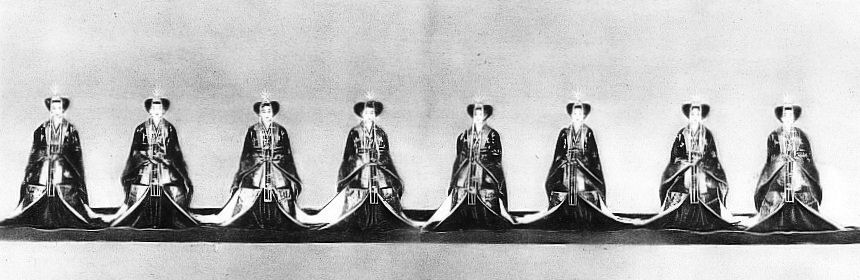
Even now, the Gosechi dance is still performed for the Emperor, at least for special occasions:
Dancers of the Gosechi dance performed in 1928, for the ascension of the Showa Emperor. See page for author, Public domain, via Wikimedia Commons
But I digress, Henjo was so mesmerized by their dance, he compared them with heavenly maidens, and hoped that the breeze would keep them on the earth a bit longer. As Professor Mostow notes, the Gosechi dance had a legendary origin involving Emperor Temmu who beheld heavenly maidens in the sky one night, so Bishop Henjo isn’t just making this up.
However, his playful simile has lasted through the ages.
1 This is still observed today in the form of Labor Day in Japan.
The poem was composed by a Buddhist monk named Kisen Hōshi (喜撰法師, dates unknown), in English lit. “Dharma master Kisen”. Kisen Hōshi lived in the mid-9th century, and this is the only poem known to be his, though others may exist. He is considered one of the original Six Immortals of Poetry and is mentioned in the preface of the official anthology, the kokin wakashū.
The location is a place called ujiyama (宇治山), located on the Tatsumi region southeast of Kyoto, which in turn is named after the twelve animals of the Chinese zodiac. In this context, tatsumi (辰巳) meaning literally “dragon-snake” refers to the direction (southeast) relative to the capitol of Kyoto, then Heian-kyō.
Due to word-play of “uji” meaning either 宇治 (“uji”) or 喜し[つらい] (“ushi[tsurai]”), this place was associated with sorry or grief, so few poeple chose to live here. Since that time, it has been renamed in honor of its resident and is now called kisenzan (喜撰山). Someone did a really nice write-up on their visit to Kisen-zan with photos and a view of what is purported to be Kisen’s original hut. Also, the famous Buddhist temple of Byōdōin also can be found there. It was located south of the capital at the time, Kyoto.
The poem is a tricky one and lends itself to two possible interpretations according to Professor Mostow. One interpretation has been that Kisen came there out of grief and weariness of the world, and made it his home. Mostow provides evidence that instead, Kisen lived there contentedly, and only heard from others that it was called brief mountain.
As there is a Buddhist tradition since the time of the Buddha to withdraw from the entanglement of the world, and find peace of mind. This tradition has led to the Buddhist monastic community that exists today in various parts of the world. Kisen is one of many who sought solace in places like Ujiyama. Question is, did he find only sorrow, or did he find contentedness?
The author of the poem, Dōin Hōshi (道因法師, 1090 – 1179?), or “Dharma Master Dōin”. He lived as Fujiwara no Atsuyori, and served under Emperor Sutoku (poem 77), but wasn’t particularly successful. Later in life, he took tonsure in 1172 and became a Buddhist priest. It’s not clear if this poem was written before or after he took up the religious life.
According to Mostow, it’s not clear if the poem is a real expression of pain or part of poetry contest. Unfortunately, none of the poetry collections of Dōin survive, though he frequented poetry contests since 1160. He became a member of a famous poetry group called the Karin-en (歌林苑), though, and spent much time around other influential poets of the day.
P.S. Featured photo is Il Triste Messaggio (“The Sad Message”), by Peter Fendi, Public domain, via Wikimedia Commons