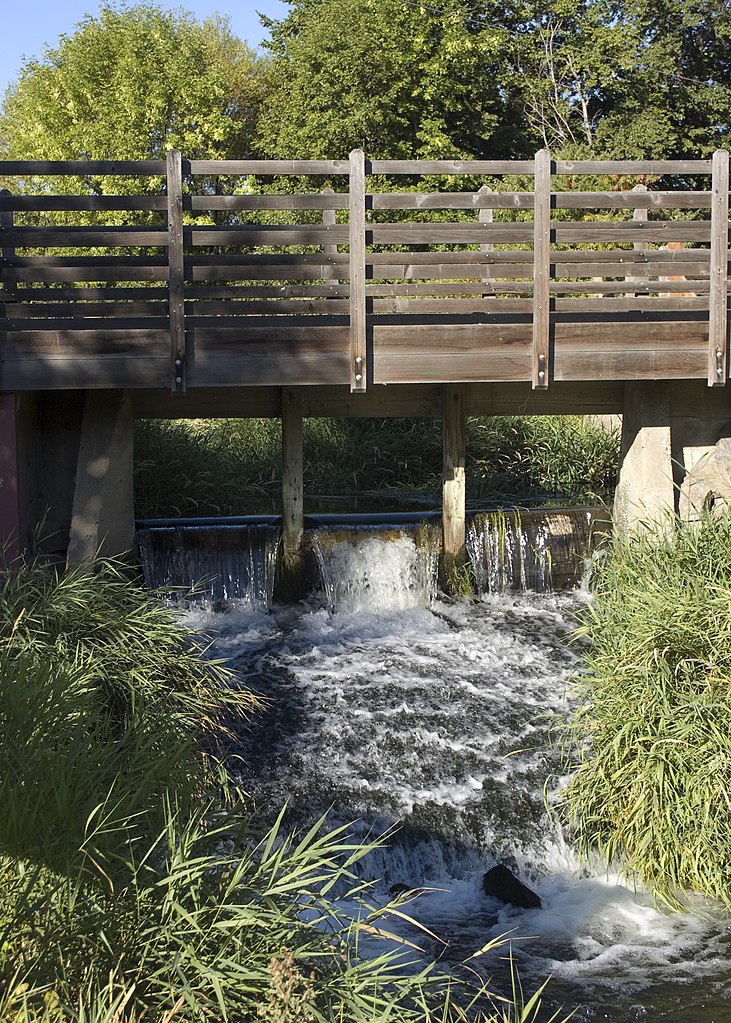
Harumichi no Tsuraki (春道列樹, ? – 920) was a relatively unknown, lower-ranking member of the Court who graduated from the Imperial university in 910 and had only a few poems published in the official anthologies. So, it’s somewhat unusual to see such a poem like this in the Hyakunin Isshu anthology, but as Mostow points out, commentators in the past heavily praised the line “the weir1 that the wind has flung” (kaze no kaketaru shigarami wa). Fujiwara no Teika, the composer of the Hyakunin Isshu, must have been similarly impressed.
Anyhow, nice to see someone get their moment in the sun (let alone poetic history).
1 A weir, by the way, is a barrier across the length river or stream designed to adjust the flow of a stream. I had to look this up. 😅 Featured photo is a weir at the Thorp Gristmill in Thorp, WA. A. Balet, CC BY 3.0, via Wikimedia Commons
This poem was composed not by a woman as one would expect, but by a Buddhist priest named Sosei Hōshi (素性法師, dates unknown), or “Dharma Master Sosei”. He was the son of Henjō (poem 12, あまつ) before Henjō took tonsure. In fact, when Henjō did become a monk, Sosei was obligated to do the same.
Nonetheless, Sosei kept busy. He worked in the Imperial Court and was a priest, and a prolific and popular poet. He kept a salon of fellow poets including Ki no Tsurayuki (poem 35, ひさ) and Oshikochi no Mitsune (poem 29, こころあ). Both men were tasked with compiling the imperial anthology, the Kokin Wakashū, and Mostow points out Sosei is heavily represented in there. Coincidence? My new book suggests not. To his credit, Sosei is also one of the Thirty-Six Immortals of Poetry.
As we’ve seen with other poems from this earlier era, it was common to write about poetry themes, and to write from a role outside one’s own. So, for a monastic to be writing from the perspective of a lonely woman wasn’t unusual.
This poem is interesting because it seems to happen in one night, or a long period of time. It is a mystery. Mostow explains the contradiction in this poem between the “one long night” and “months” as being an issue of interpretation. Though most people assumed it was a long Autumn night, Fujiwara no Teika (poem 97, こぬ), the compiler of the Hyakunin Isshu anthology, felt it was more like a long passage of time.
P.S. Photo above is a Japanese calendar we have a home. More on that in a related post in my other blog.
The poem is signed as Kanké (菅家, 845 – 903), which is the Sinified (Chinese) way to read the Sugawara Family name (lit. “House of Sugawara”). You see similar names used for the Taira Clan (e.g. Heike 平家) and Minamoto Clan (e.g. Genji 源氏) in later times. Anyhow, the author is none other than the famous poet/scholar Sugawara no Michizane who in later generations was deified as a sort of god of learning named “Tenjin” after he was wrongfully exiled through political intrigue.
The term nusa (幣) means a special wand used in Shinto religious ceremonies. The photo above is an example of a nusa, more formally a gohei (御幣) “wand” used in Shinto religious ceremonies, with the paper streamers used for purification (photo by nnh, Public domain, via Wikimedia Commons). At this time in history, according to the Hyakunin Isshu Daijiten, small nusa were often made from thin strips of paper and cloth and offered to the gods for a safe journey.
The poem was composed by Michizane after going on an excursion with his patron, Emperor Uda. Compare with another outing made years later by (then retired) Emperor Uda later in poem 26. In this case, Michizane had little time to prepare, and couldn’t make a proper offering to the gods for a safe trip. However, admiring the beautiful autumn scene on Mount Tamuke, he hopes that this will make a suitable offering instead. Sadly Michizane would be disgraced and exiled only a short time later.
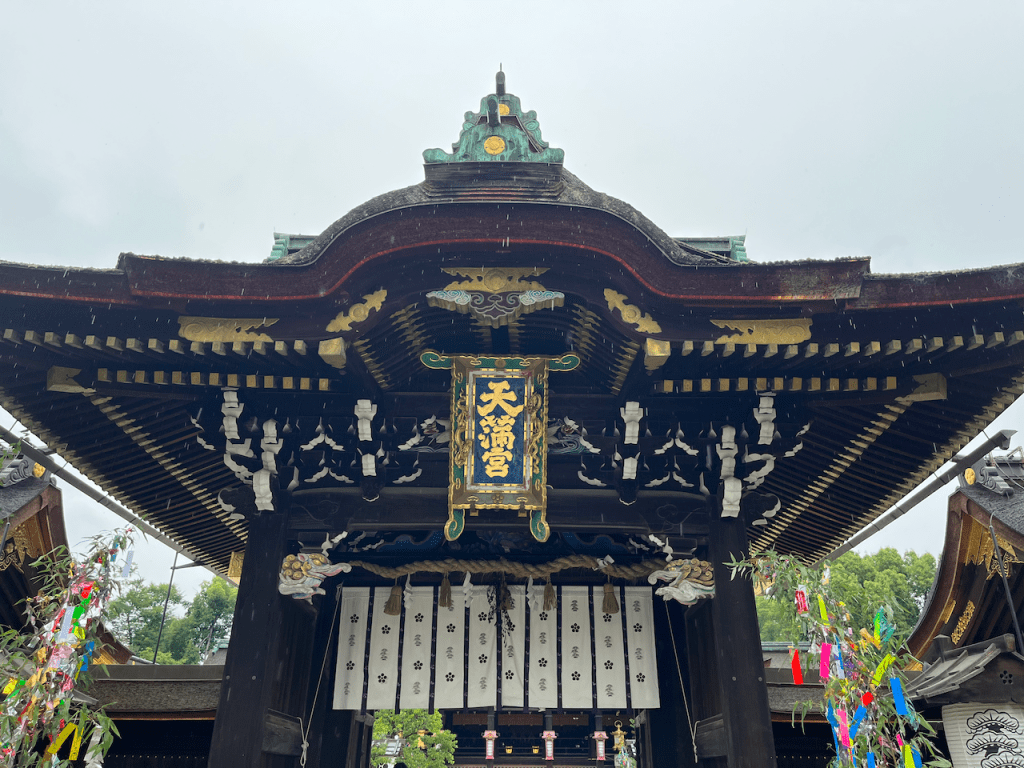
My interest in Sugawara no Michizane mostly comes because I admire him as a fellow scholar. I visited one of his shrines in Tokyo a couple times over the years, and usually try to pay respects. In July 2023, I visited the home shrine of Kitano Tenmangu as well.
Kitano Tenmangu shrine in Kyoto, Japan. Taken in July 2023.
The real life Michizane was no god of learning, but his real-life contributions to poetry and Chinese literature in Japan helped the culture flourish at that time, and earned his place as a trusted adviser to the Emperor, despite his more humble background. This also helped explain his status centuries later as a god of learning. Every year in Japan in April, students pay respects hoping that they can pass entrance exams, and it’s nice to see his legacy carry on so many years later.
The author of this poem is a monk named Ryōzen Hōshi (良暹法師, dates unknown) or “Dharma Master Ryōzen”, who supposedly composed it while doing austerities in a remote hut outside the capitol. Unfortunately, we have little about Ryōzen Hōshi’s personal history, even in my new book. He had some infamy over a poem he composed during a poetry contest, by inadvertently copying one in the Kokin Wakashu, causing him to be a laughing stock. However, other scant records show he was still respected by the nobility overall.
The notion of “Autumn sunset” appears a lot in Japanese poetry, but apparently its meaning differs depending on the time and place. Ryōzen Hoshi gives a more melancholy, almost Buddhist, tone implying that the world around him is declining into winter and possibly, metaphorically declining in a general Buddhist sense. However, Sei Shonagon (poem 62) also wrote about Autumn Sunset in her PillowBook, but used it to describe crows and wild-geese flying
An Autumn sunset means a lot of different things to a lot of different people, but it still is significant one way or another. For me, I tend to like Ryōzen’s imagery the best, and it’s the one I imagine whenever I read this poem.
The author, Fun’ya no Asayasu (文屋朝康, dates unknown), is the son of Fun’ya no Yasuhidé (poem 22), but is otherwise unknown. My new book states that, like his father, he achieved only middling rank (junior sixth rank) in the Imperial bureaucracy, but unlike his father, he did not achieve much fame through poetry either. There have been persistent rumors, though, across the ages that some of Yasuhidé’s poems were in fact composed by his son, Asayasu. However, evidence is sketchy.
The poem is something of an oddity in the Hyakunin Isshu because, as Mostow explains, it seems to be a relatively common poem. It uses a popular motif of dew as gems, comparing them to pearls or jewels, and you can find similar imagery in other poems of the time. So, why did the compiler of the Hyakunin Isshu, Fujiwara no Teika (poem 97), select this poem for this anthology?
Mostow points out that this poem is featured in other anthologies as well, so for some unknown reason, it was highly prized, even though the significance is lost now.
Still, there is something beautiful about the idea of gems scattering in the Autumn wind in particular and perhaps that is what sets this poem apart from others from the same era.
The poet, Egyō Hōshi (恵慶法師, dates unknown) also known by his title “Dharma Master Egyō”, was a Buddhist monk active during the last half of the tenth century. He was the bishop (kōsō 高僧) of a major temple in old Harima Province and often gave lectures. As Professor Mostow explains, he was closely associated with other poets who frequently met at the Kawara Villa on the banks of the Kamo River. According to Mostow, these included Yoshinobu (poem 49) and Motosuke (poem 42) among others. He was also friends with Kanemori (poem 40).
The poem was given as an entry to a poetry contest about the coming of autumn to a ‘dilapidated house’ according to Mostow, but he points out that the “house” in question was probably referring to the Kawara Villa, itself previously owned generations earlier by Minamoto no Toru (poem 14). The juxtaposition between people (who don’t visit) and autumn (which does) makes this poem highly prized.
Given that Egyō is a Buddhist monk, and well-versed in the Buddhist teachings of the effervescence of life, it seems reasonable that he used the house and the seasons to give the poem a bit of a Buddhist theme. Spring gives way to Summer, Summer to Fall, Fall to Winter and so on. In the same way, things rise and fall, and Egyō perhaps wanted to remind his audience that “Autumn” comes sooner or later.
The author, Ōe no Chisato (大江の千里, dates unknown), is the nephew of Yukihira (poem 16) and Narihira (poem 17) and boasted a famous collection of his own called the Kudai Waka. Ōe no Chisato was also the son of a famous Chinese-studies scholar, who taught Confucianism and composed Chinese-style poetry (not Japanese-style waka poetry like above). Ōe no Chisato was thus part of the Imperial Court culture of the time, but not necessarily high-ranking. More of a middling family.
Similar to poem 22, this poem has influence from Chinese Six Dynasties style, but as Mostow explains, the poem reflects a change where Chinese poetic style is adapted into more native Japanese style. Mostow explains that the poem may allude to a famous poetic line by Bo Juyi.
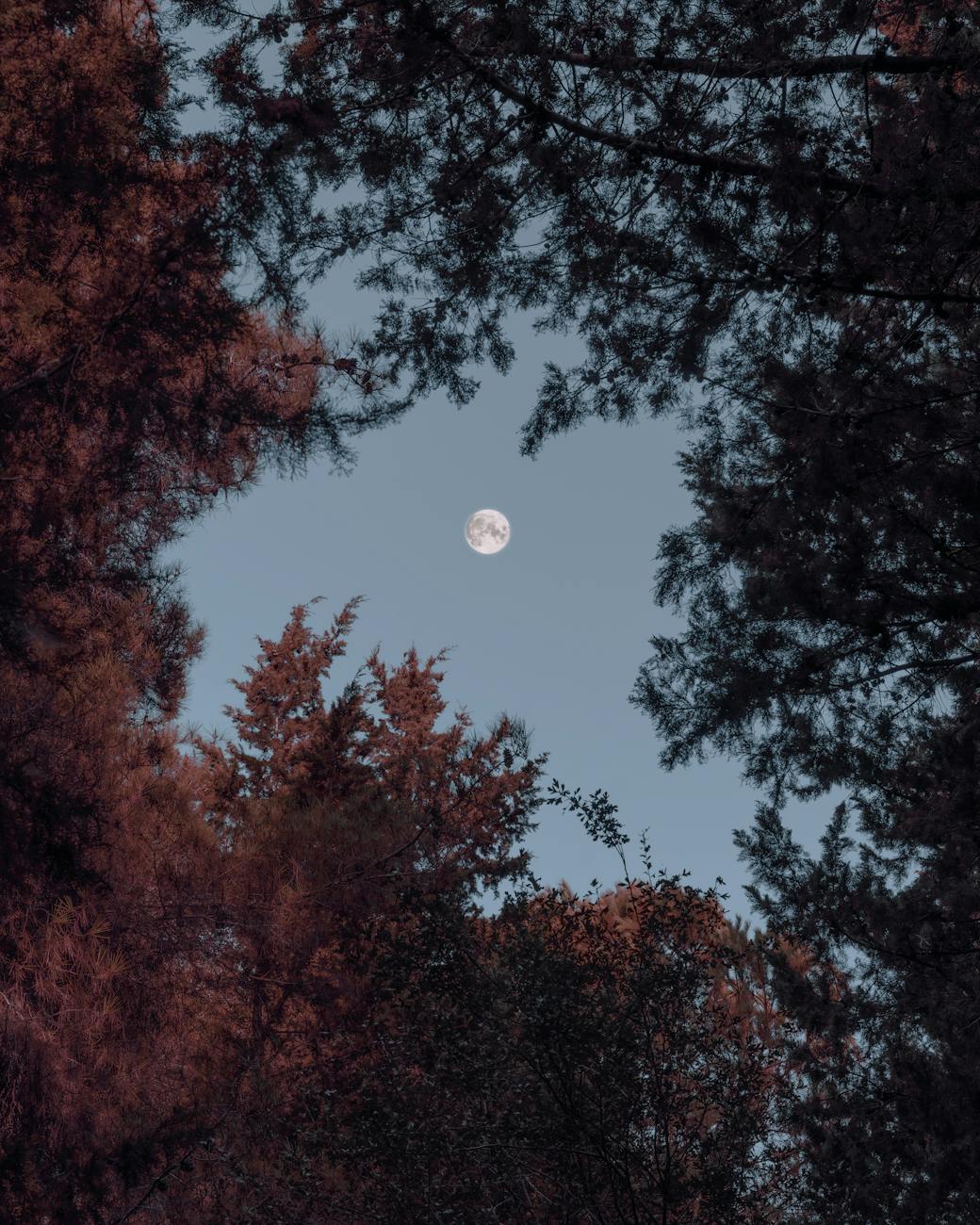
As mentioned before, the moon plays a really important role in the Hyakunin Isshu, and poetry in general. But also, it’s a source of festivities too. In Japan, the 15th lunar day of the 8th month (harvest moon in the West), marks a fun time called o-tsukimi or “moon-viewing”. More on that in the other blog.
As for the poem, it kind of expresses a quiet humility too, I think, which is why I always find it one of the most memorable. The Moon inspires a lot of deep feelings, but this poem reminds us that it does not shine just for us.
Speaking of the moon, Ōe no Chisato is also famous for another moon poem, which is in the imperial anthology Shin-Kokin-Wakashu and considered one of the finest in the entire collection:
Japanese
Romanization
Rough Translation1
照りもせず
Teri mo sezu
Neither the shining moon,
曇りもはてぬ
Kumori mo hatenu
nor the cloudy night
春の夜の
Haru no yo no
can win against
朧月夜に
Oborozukuyo ni
a hazy moonlit
しくものぞなき
Shiku mono zo naki
night in Spring.
1 Amateur translation
This poem in turn was used in the iconic Tales of Genji by Lady Murasaki (poem 57 in the Hyakunin Isshu, め).
So, we can see that Ōe no Chisato was no stranger to poetry, especially Chinese-style poetry, and was capable of describing the moon in many contexts.
This, the opening poem of the Hyakunin Isshu, was composed by Tenji Tennō (天智天皇, 626 – 671), known in English as Emperor Tenji. Emperor Tenji helped oversee Taika Reforms as Crown Prince from the new capitol in Otsu, home of Omi Shrine, and was responsible for promulgating important historical texts in early Japanese history such as the Nihon Shoki and Kojiki. Further, he was a pretty ambitious guy and needed to strengthen his family lineage, so he compelled his younger brother to marry his own daughter, after marrying his younger brother’s former wife, Princess Nukata.
Complicated.
This poem is unique in the anthology because it deals with subjects that related to peasant life, rather than life in the Court, and later commentators explain that this was because of Emperor Tenji’s image as a benevolent ruler. It’s also possibly because of this image, that Fujiwara Teika chose this as the first poem.
In any case, the poem gives a window into the life of the peasants in Japan during this era. Like elsewhere in the world, the harvest was a very important time of the year, and in each village, someone had to guard the grain overnight from theft or from animals. They would often stay in small thatched huts, and stay awake overnight. As night fell, the temperatures would get cold and their sleeves wet with dew, while the smell of dried grains permeated the air.
Outside the aristocratic court, this was the life that many led to feed their family and it was this labor that Emperor Tenji sought to praise.
The poem was composed by one mysterious figure named Sarumaru Dayū (猿丸大夫, dates unknown), whom we know nothing about.
My new book offers a couple theories as to Sarumaru’s identity. One theory is that he could be the son of Emperor Tenmu (mentioned here among others places) named Prince Yuge (弓削皇子, Yuge no Miko). Another theory suggests that he could be the infamous Buddhist monk Dokyo, Japan’s version of Rasputin, who served Empress Shotoku. However, these theories are, as of writing, entirely speculative. We simply don’t have enough information.
Even in the Kokinshū where this poem is first found, it is listed as anonymous, according to Professor Mostow, but seems to have been composed for a poetry contest in 893 hosted by Prince Koresada. Mostow further explains that this poem is surprisingly tricky to interpret: who is walking through the leaves, the deer or the author?
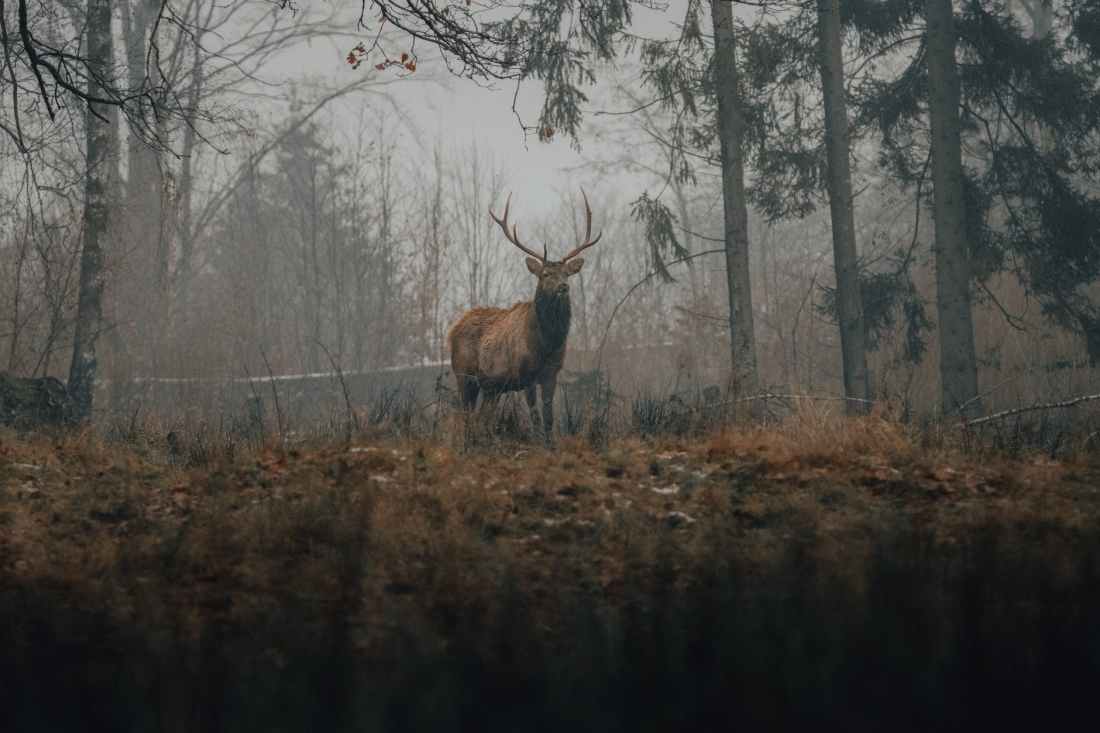
Speaking of deer, deer have been an integral part of Japanese poetry since early times. This and poem 83 show how the deer’s cry is a popular poetic symbol of sadness or melancholy.
The author, Kōtai Gōgū no Daibu Toshinari (皇太后宮大夫俊成, 1114 – 1204), or “Master of the Grand Empress’s Palace, Shunzei”. He is also known as Fujiwara no Shunzei, or Fujiwara no Toshinari (俊成 can be read either way), the father of Fujiwara no Teika . Additionally, a surprising number of other poets in the Hyakunin Isshu were associated with (poem 81, 86 and 87), studied under Shunzei (poem 89 and 98), or were directly in opposition to him (poem 79). Shunzei is probably the second most important person in the Hyakunin Isshu after his son of course. 😏
This poem is both moving and technically strong. For example, according to Mostow, the phrase omoi iru is a “pivot word”, meaning that both the words before and after hinge on its double meanings: omoi-iru “to set one’s heart on” and iru “to enter”.
Again, as Mostow explains, the poem generates quite a bit of debate because it’s not clear what concerned him so much. Was it melancholy, a sense of his mortality, or was the state of society at the time (i.e. the decline of the Heian Period)?
Speaking of a deer’s cry, I found this video one of the famous “Nara deer”:
The Nara deer are more domesticated versions of the wild deer in Japan, but it gives you an idea what Shunzei must have heard deep in the woods 900 years ago.








 The Hyakunin Isshu

