
The Hyakunin Isshu poetry anthology has been celebrated for centuries, and gradually evolved into a card game in late-medieval Japan (e.g. the Edo Period) and early modern (e.g. Meiji Period) called karuta. The term karuta is a generic term borrowed from Portuguese traders from the word carta.
The game of karuta is something that’s played often during New Year’s celebrations in Japan, and a popular high school after-school activity. The famous manga and anime series Chihayafuru helped bring awareness of the game not just to Japan, but also to audiences overseas. In a competitive context, the game is also called kyōgi karuta (競技かるた). You can learn more about competitive karuta from this article that I previously wrote. If you’re looking for a more low-stress, easy introduction to karuta try bozu-mekuri instead, or try one of a handful of casual karuta games.
This page is a brief introduction to the game, and how to get started. I experienced it for the first time recently with a karuta club in my area, and I really enjoyed it. I was also surprised to learn that there are small karuta clubs in many places in the world, and new ones are being formed all the time. But you don’t have to be competitive to enjoy karuta: many families in Japan play it occasionally like a playing board games, so learn at your own pace, and have fun.
How Do You Play Karuta?

The game of karuta involves special cards with the 100 poems of the Hyakunin Isshu written on them. There are two sets of cards:
- Yomifuda – these cards have pictures on them of the poem authors, and contain the full poem: all 5 verses.
- Torifuda – these cards have no pictures on them, and only contain the last 2 verses.
There are usually 2 players. Each player gets 25 random torifuda cards, and lays them across the board on their side in three rows. You can arrange them in any way you like, but the three rows have to be spaced properly. This site in Japanese has some excellent visuals on how the rows work.
I also put together a crude diagram here:

In addition to each player, a third person (or a recording) reads a randomly-select yomifuda card, and the two players have to find the matching torifuda card on the board. The player who takes it first wins that round.
Note that since only 50 cards are on the board maximum, out of 100 total, half of the poems read are karafuda, meaning “empty cards”. It’s important not to accidentally jump the gun and take the wrong card, especially if the poem being read is a karafuda. On the other hand, if the card is on the board you have to take it before your opponent does. This tension is what makes karuta so compelling.
The goal of the game is to get rid of all the cards on your side. If you take a card on your side, that’s simple. If you take a card on your opponent’s side, you then “send over” one of your cards to compensate. In either case, you are one step closer to victory.
Taking Cards
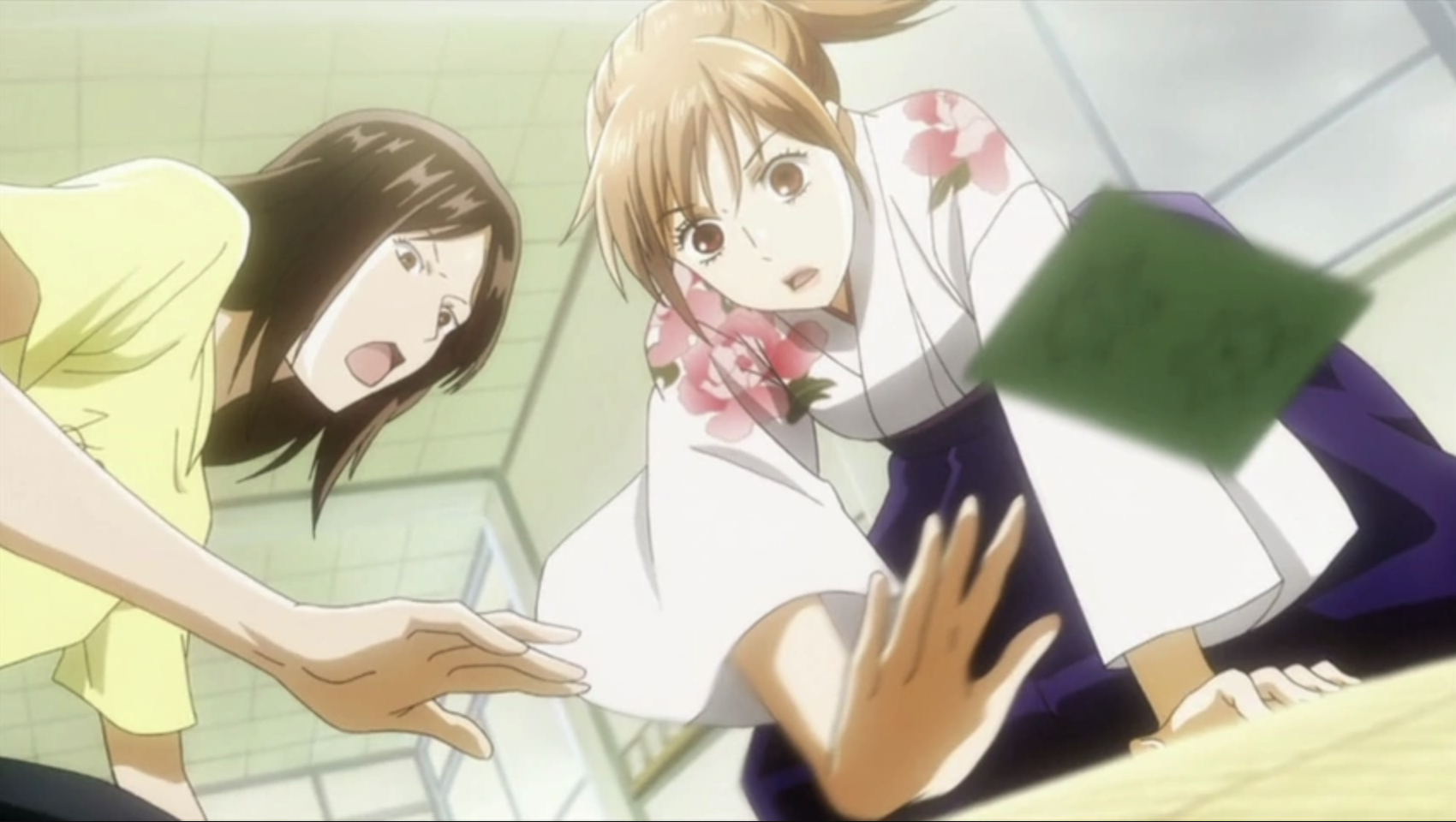
One of the things that makes karuta fun is that explosive moment when the players take the card from board. In the anime Chihayafuru, or if you watch competitive karuta on Youtube, you can see people are really fast.
In real life, most people aren’t quite that fast, but still it’s fun when you recognize the poem being read, and move to take the card before your opponent does, especially if it happens to be on the opponent’s side.
There’s a few ways to do it:
- Touch the card – obviously.
- You can also swat it off the board. As long as it is off the board, and you were the one to take it off, it counts as your win.
- The rules state that you can touch any card (or cards) on the same side as the correct card without taking a penalty. So, oftentimes, it’s just easier to sweep a bunch of cards off the board at once, knowing that one of the cards is correct.
- You will only earn a penalty if you take/swat a card on the wrong side of the board.
- Sometimes, poeple use more advanced, sneaky techniques to either block the other person with their hand, or use misdirection to confuse their opponent.
- No matter how you take the card, you can only use one hand. If you use the other hand, you will take a penalty.
Penalties
There are generally four ways people get otetsuki (“penalties”):
- Touching a card on the opponent’s side when the correct card is on your side.
- Touching a card on your side, when the correct card is on the opponent’s side.
- Touching a card when the poem is a karafuda (i.e. not on the board anyway).
- Using your other hand, or two hands, in any way to take cards.
In each case, if you get a penalty, the opponent will send over a card to you. Since you are trying to reduce your side of the board, this is not good. Even worse, if they got the correct card, and it was on your side, and you got a penalty, then they will send two cards over. Obviously this is pretty painful.
Once again, the key is to be faster than your opponent, but not also jump the gun.
More Rules Resources
This page does not cover all the details of playing karuta, and there are some very good links out there:
- The Boston Nakamaro Karuta Club has an excellent rules introduction, including diagrams and how to get started.
- This site also provides a nice overview with cute illustrations.
- Learnkaruta.com is another, great resource for getting started.
Sadly, there isn’t much in English. Japanese websites are easy to find. If you are not comfortable with Japanese, you can try using Google Translate, but you might get mixed results:
- The All-Japan Karuta Association has an excellent introduction (I referred to it often when I first learned about this sport)
- This site provides a great introduction and excellent visuals.
- Another great site with excellent visuals.
I will try to add more sites as they come up.
Getting Started
Great! You’ve maybe watched (or read) Chihayafuru, or maybe you’d like to just start playing. Where do you begin?
There are three basic criteria you need:
- You need a set of cards.
- You need to be able to read Japanese hiragana script.
- You need a third person who can read the poems, a recording, or an app that can simulate this.
Getting Karuta Cards
Purchasing a set of karuta cards is easier than it used to be … if you know where to look. For a full set (torifuda + yomifuda), average cost in USD is $45 to $60, but you often get a CD for listening and other helpful tools. If you want a more minimal set, you can also just purchase a tournament-legal set of torifuda cards.
Learning Hiragana Script
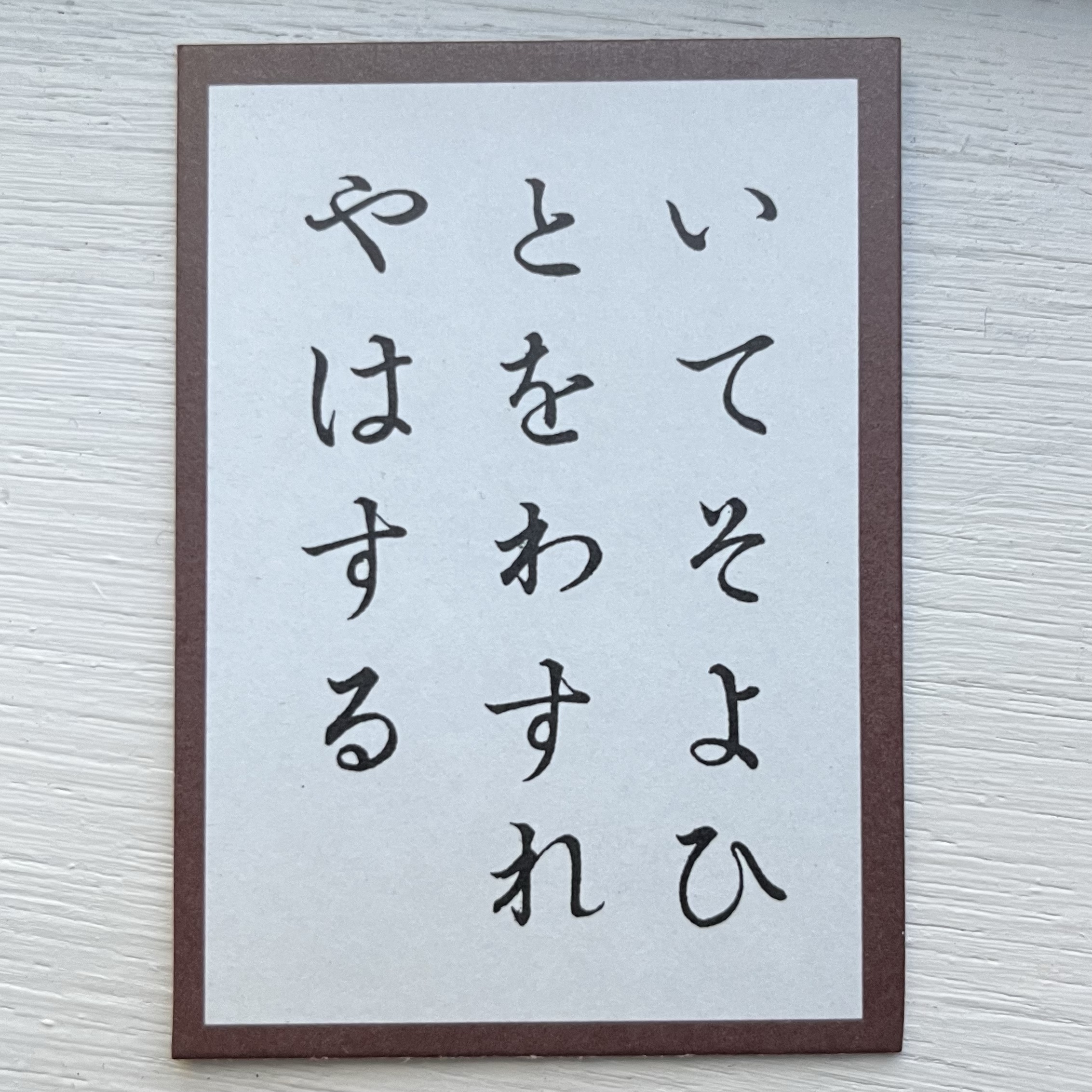
Probably the hardest part of getting started is learning hiragana. Hiragana is the basic script used in Japanese language. You do not need to learn Chinese characters, and you don’t need to master the Japanese language, just reading the hiragana script.
Hiragana is a bit unusual because it is a syllabary, not an alphabet: each character is a full syllable / sound. There are quite a few resources online for learning hiragana, and I may have written a few. In either case, you can’t really play karuta without knowing hiragana.
Note: I have seen examples of English-only karuta, but I don’t think these are widely used, and I believe something gets lost in the translation (plus you can’t play with the wider Japanese community anyway). It’s better to just take the hit and learn hiragana.
Finding a Reader
Normally, a third person acts as the reader (yomité) who randomly selects poem cards and reads them, while the other two players find the matching verses. If you don’t have 3 people, you may need use pre-recorded readings of the poems. These are available via CD or through smartphone apps.
Some karuta sets include a CD. I imported my CD into my smartphone music app and shuffle the album every time in order to randomize things.
The Seattle Karuta Club has some excellent suggested links for smartphone apps that simulate a karuta reader very nicely:
- Wasuramoti – Android Only
- Karuta Chant – iOS/Android
- 百首読み上げ – iOS Only
Of these, “Karuta Chant” is my personal favorite and is available in English.
Practice
Practicing with friends and family is the best approach, even if you are lacking 3 people or more. Simply having hands-on experience is what matters most. Also, as soon as you reasonably can, start memorizing the kimari-ji for each card. You can use the chart here for reference.
If you are by yourself, the good news is that there is an excellent app (Japanese language only) that lets you play online or against a computer: Kyōgi Karuta Online (homepage), available for both IOS and Google Android. I provided some translations here.
Also, try practicing methods such as fuda-nagashi, fuda-waké, or five-color Hyakunin Isshu.
Karuta International Community
If you have Discord, why not join the international Karuta community server? Invite link here.
Conclusion
I have played a number of card games over the years, including Magic the Gathering and Pokemon TCG, and personally I like Karuta the best. It takes more effort upfront due to cards and learning hiragana, but it’s a subtly fun game that lets you tap into Japanese culture, but also requires intense speed, skill and strategy.
Also, a good set of cards, and knowledge of the poems, is something you can enjoy your whole life.
Good luck!
1 These Amazon links are “associate” links, so any purchases made through them give me a small amount of credit in the future.
 The Hyakunin Isshu