Courtly life in the Heian Period of Japanese history wasn’t limited to poetry and love trysts. Music was an important part of the culture too, but Japanese music at the time was considerably different than we might expect. This kind of Court music is called gagaku (雅楽).
You can see a good example of Gagaku music here:
It may not seem obvious at first, but this style preserves many cultural aspects of the Heian Period (which the Hyakunin Isshu was a part of too): the costumes, music, songs of the time, and so on. The music takes a bit of getting used to for modern audiences (it is kind of screechy at times), but it was common then for such music to accompany important dances such as the yearly Go-sechi dance (see poem 12 of the Hyakunin Isshu, あまつ). When Lady Murasaki talks about concerts and dances in her diary or Sei Shonagon in her Pillow Book, this kind of music was played.
Gagaku music still lives on in Japan in traditional theater, and some religious services. It also makes a nice cover for Led Zeppelin’s Stairway to Heaven, too:
Enjoy!
Special thanks to Mr Togi for this awesome video. 東儀さん、ありがとうございます!
Fall is approaching, and it reminds us of fall leaves, and famous poems of the Hyakunin Isshu such as the chihaya poem (poem 17) among others….
Throughout the blog, I’ve tended to focus on the lady authors and poets because it’s so rare to see women get credit for writing in the pre-modern era. There was an explosion of feminine talent in the Heian Period (8th – 12th century) that was not repeated until modern era in Japan, and it’s been fascinating.
However today, I wanted to highlight one particular text called the Ise Monogatari (伊勢物語). Our illustrious Dr. Joshua Mostow who has contributed much to this blog translates the title as the “Ise Stories” in his translation, but other translations call it the Tales of Ise. You can decide which one you prefer. Since Dr Mostow is a cool guy, and done much for the field, I will use his translated title. For this post, I am using the translation by Dr Mostow and Dr Royall Tyler.
Unfortunately, we still don’t know who the actual author of the Ise Stories was. In fact, Professor Mostow explains that the prevailing theory is that the Tales was composed over decades, in stages, possibly by different authors. Unlike the later Tales of Genji, or the Gossamer Years, or the Pillow Book, which were all clearly composed by one author, the Tales of Ise has a murkier development.
Anyhow, the Ise Stories is not a modern story, with narrative arc, nor does it have an ending. Instead, the Ise Stories are a series of short anecdotes about an anonymous prince who leaves the capitol of Heian (modern day Kyoto), and journeys east to the hinterlands for a time. In fact, you could probably call the Ise Stories the “Anecdotes of Ise With Lots of Poetry Thrown In”. The later work, the Tales of Genji, has a similar format.
The hero of the story, a young, charming prince who travels east with his entourage and has a few love trysts along the way, is a kind of idealized Heian-period aristocrat: a gentleman with an excellent pedigree, and talent for poetry to boot. Each story includes at least one waka poem, the same kind used in the Hyakunin Isshu, often more. Why so much poetry? Many times these were used as a back-and-forth way of greeting someone from afar, or saying “hello” to a promising lady, so a chapter might have multiple poems in the form of dialogue.
For example, section 14 deals with a tryst between our protagonist and a provincial lady in remote Michinoku province (a place also mentioned in poem 14 of the Hyakunin Isshu). She writes to him the following poem:1
Original text
Japanese romanization
Translation
なかなかに
Naka-naka ni
So if, after all,
恋に死なずは
Koi ni shizanu wa
I am not to die of love,
桑子にぞ
Kuhako ni zo
I know just the thing;
なるべかりける
Narubekarikeru
I should have been a silkworm,
玉の緒ばかり
Tama no wo bakari
for that little life’s short span.
Our protagonist was not impressed by her, as her poem “reeked of the country[side]”, but slept with her anyway. Classy guy.
Then, he left before dawn and she lamented:
Original text
Japanese romanization
Translation
夜も明けば
Yo mo akeba
Come dawn’s early light
きつにはめなで
Kitsu ni hamenade
oh yes, in the tank you go,
くたかけの
Kutakake no
you obnoxious bird,
まだきに鳴きて
Madaki ni nakite
to learn to cock-a-doodle
せなをやりつる
Sena wo yaritsuru
my darling away too soon.
The protagonist then remarked he was going to the capitol, but left behind a “charming” poem:
Original text
Japanese romanization
Translation
栗原の
Kurihara no
If the Aneha
あねはの松の
Aneha no matsu no
Pine here at Kurihara
人ならば
Hito naraba
only were human
都のつとに
Miyako no tsuto ni
“Come along with me,” I’d say,
いざといはましを
Iza to iwamashi wo
“you’re my gift to the City.”
According to the Ise Stories, she was much impressed and thought he was in love with her, but the commentaries suggest he was being condescending by implying that “if only she were worthy of Courtly life at the capitol”. Damn.
But what’s the source for all this poetry and narrative?
The origins of the Ise Stories is somewhat of a mystery, but there is strong evidence that the central character was heavily based upon a real aristocrat named Ariwara no Narihira (825 – 880), the same man who composed the aforementioned poem 17 (ちはやふる), and also composed what’s considered the greatest poem about cherry blossoms ever composed. Some of his poems in the old Kokin Wakashu imperial anthology were re-used in the Ise Stories as well.
In addition to his poetic genius, the real life Narihira was a playboy and had many relationships, even by the standards of Heian-period aristocracy. Sometimes this got him into trouble. The Ise Stories begins with an explanation that the anonymous prince left the capitol after having an affair with Emperor Seiwa’s consort. Coincidence? I think not. 🤔
Nonetheless, the Ise Stories is a whimsical and irreverent look at Heian Period culture and how the aristocracy interacted with people in the provinces, even when it was somewhat condescending. Court culture was unlike anything else in Japan at the time, and this reveals some interesting things that are not always conveyed in other works of the time.
1 Mostow and Tyler explain that the young woman’s poem was a re-working of an older poem from the Manyoshu, poem 3086:
The Hyakunin Isshu Cracker trilogy continues! Way back in 2011, when I first wrote this blog, I posted about some neat Japanese senbei (deep fried crackers made from rice dough), featuring poems of the Hyakunin Isshu. The pictures were lost however, and so I can’t really show what they looked like.
Then in 2022, I wrote another post about a different set of Hyakunin Isshu crackers we got in Japan. However, I only had a couple examples, not the complete set.
This time, I have the complete set. My father-in-law sometimes receives them as periodic gifts during the summer (a.k.a. Ochūgen, お中元) from business partners and such. The company website for these crackers is here.
There are six varieties in the set, each featuring a poem of the Hyakunin Isshu.
These first two are poems 98 (left, かぜそ) which has a spicy, wasabi (?) flavor, and 36 (right, なつ) which has baked shrimp flavor.
These two are poems 2 (left, はるす) which has leaf-shaped crackers with a salty taste, and 81 (right, ほ) is baked with nori seaweed.
The one on the left is also written with poem 98 (left, かぜそ), but has a light salty cracker flavor. This one is my favorite. The one on the right didn’t have a poem written on the front, but the back was printed with poem 97 (こぬ), and has some lightly flicked baked seaweed on it.
There might be more poems and/or flavors, but this is what I got from the boxed set we brought back to the US. Anyhow, it’s neat to see the poems written in a traditional cursive script (rather than standard printed Japanese), and I wonder if there’s some association between certain poems and certain flavors but I don’t see a connection yet.
As with the handwriting book, it’s interesting to see how the Hyakunin Isshu lives on in Japanese culture in fun, friendly ways like this.
This summer my family went back to Japan to visit relatives while I stayed home, and one of the souvenirs they brought back was this wonderful book (publisher’s link here):
This book was sold at a local Kinokuniya bookstore in Japan, and each page of the book features a poem from the 100 poems of the Hyakunin Isshu, in traditional numerical order. Within that page, you can practice your own handwriting by writing out the poem, first on the right-hand side, and again on the left.
Here’s a close-up of one of the pages, depicting poem 41 (こい), one of two poems from a famous poetry contest (poem 40 is the other). You can see the poem is written out in traditional style: right to left, vertically. There is a special handwriting guide on the left-side of this page with tips to help with certain difficult Chinese characters. You can also trace the poem on the right side of the page to practice your penmanship.
On the following page, there are some historical details about the poem. In this case, it is a lineage chart of the Imperial family at the time, and focuses on the reigning Emperor Murakami who succeeded the throne after the death of Emperor Daigo. On the bottom right is a glossary of terms, since the poem is composed in old Japanese, and thus the spellings and vocabulary are not clear to modern speakers.
This is a pretty neat book, and I am hesitant to practice my handwriting on it, since it is pretty poor. But I love the idea, and it’s a lot of fun to look through. It also seems like a nice relaxing exercise if you go slow, and take in each poem one by one.
If you are ever in Japan, and happen to be browsing a local bookstore, keep an eye out for books like this. The Hyakunin Isshu continues to be a populartopic, and you’ll find many such excellent books and many ways to savor and enjoy this wonderful anthology.
My journey with the game of Karuta began one August day in 2023 with the kind folks at a local karuta club, and right away I loved the game. However, over time, I realized that the competitive style of karuta, like you see in the anime Chihayafuru, was not for me. The constant pressure to grind out game after game to make incremental improvements, especially as a working parent with little time or energy for such endeavors, made me feel increasingly hopeless about making any real gains.1 Finally, with my children getting older, and one of them graduating, I had to take a long break from karuta. It just wasn’t fun anymore.
Recently, I’ve been playing again with a small informal group where we just mess around a bit, and play shorter Karuta games using the casual format. This is how most Japanese people play in Japan, by the way.
Thus, I wanted to share my experiences lately with readers in hopes that they may find ways to keep enjoying karuta, or help introduce it to people outside of Japan who didn’t learn it in grade school.
For starters, I ordered this 5-color Hyakunin Isshu set online from the good people at Oishi Tengudo last year,2 and after using the set a few times, I finally realized this five-color set is different than the more well-known version sold in Japan. It uses different colors, and divides the cards differently. My karuta reader apps were not set to recite poems according to Oishi Tengudo groupings, so I was really confused at first.
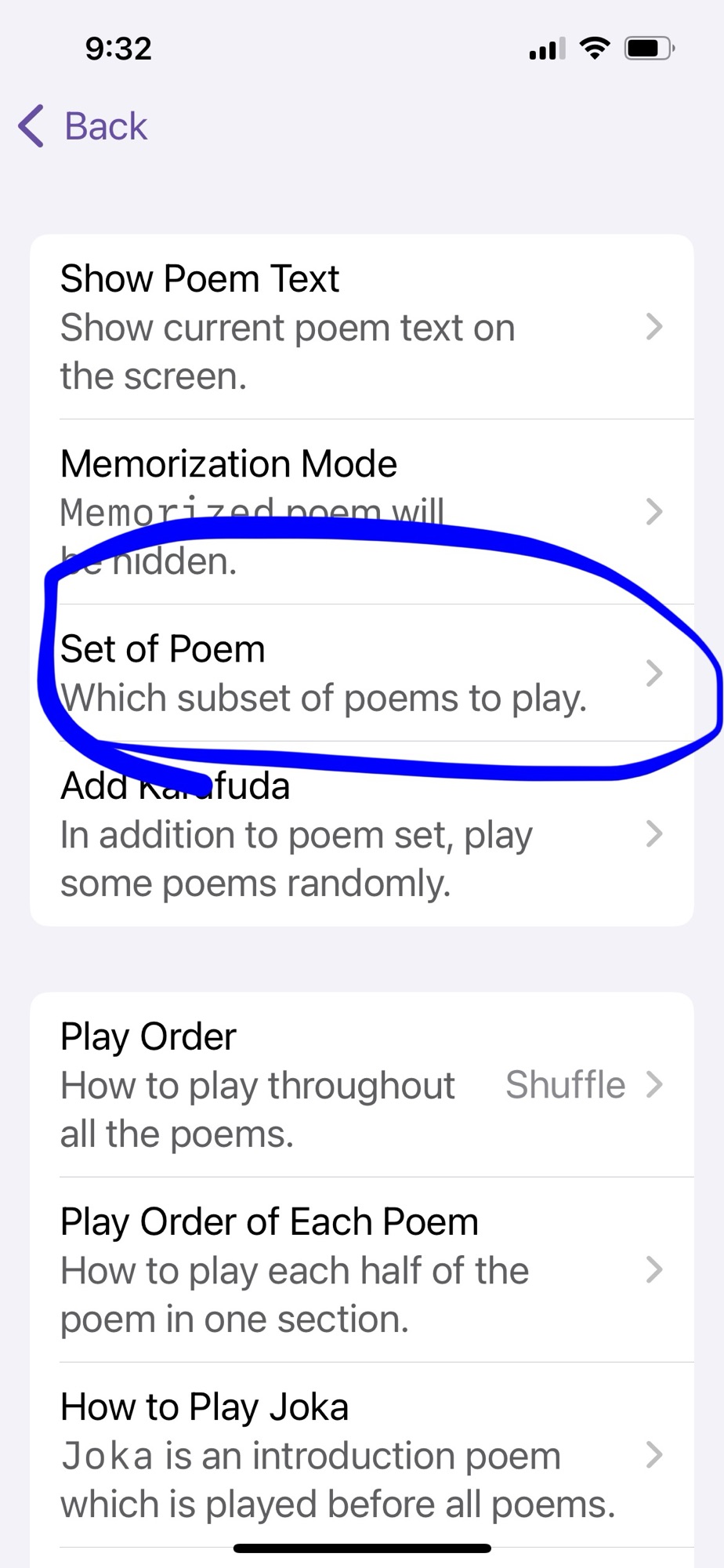
Using my favorite karuta reader app, Wasuramoti (Android and iOS), I decided to make custom lists based on the Oishi Tengudo groupings. You can do this too in Wasuramoti by selecting Advanced Config, then Set of Poem:
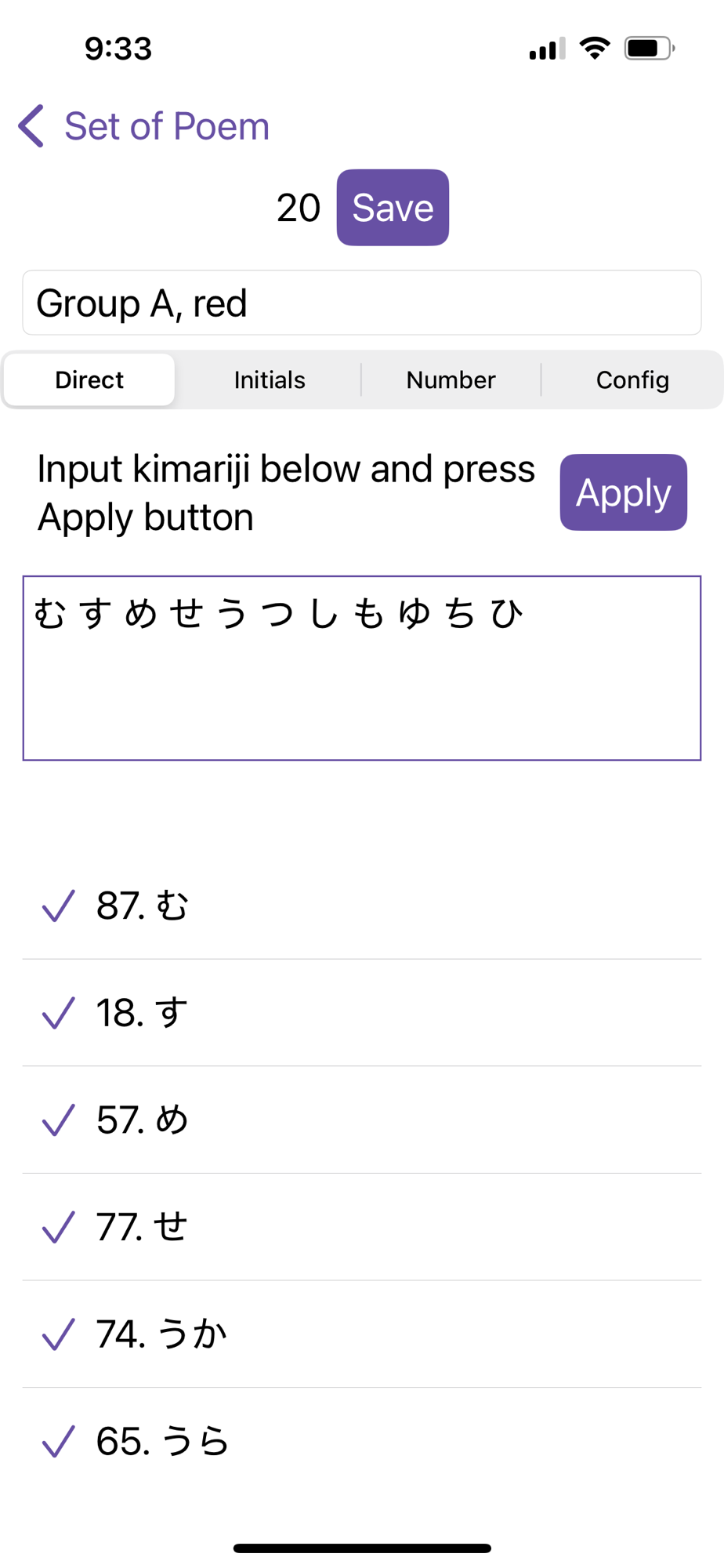
In the Oishi Tengudo set, the “red” group (also called Group A), is comprised of poems whose kimari-ji (starting syllables) start with む (mu), す (su), め (me), せ (se), う (u), つ (tsu), し (shi), も (mo), ゆ (yu), ち (chi), and ひ (hi). These cards have very few or no tomofuda (cards with similar kimari-ji), so they’re distinct and easy to learn first. I created my custom list with 20 cards, just like my physical set.
I made a similar custom list for Group B (“blue”) as well. This group is a bit harder because it includes cards whose kimari-ji have slightly more tomofuda cards (3-4): い (i), み (mi), た (ta), and こ (ko). So, there’s a bit more effort required to distinguish one card from another. Yet it’s still the second easiest group.
… and so on.
When I practice, I just grab the color I want to play (“red”, or Group A in this case) and scatter then on my desk, casual-style.
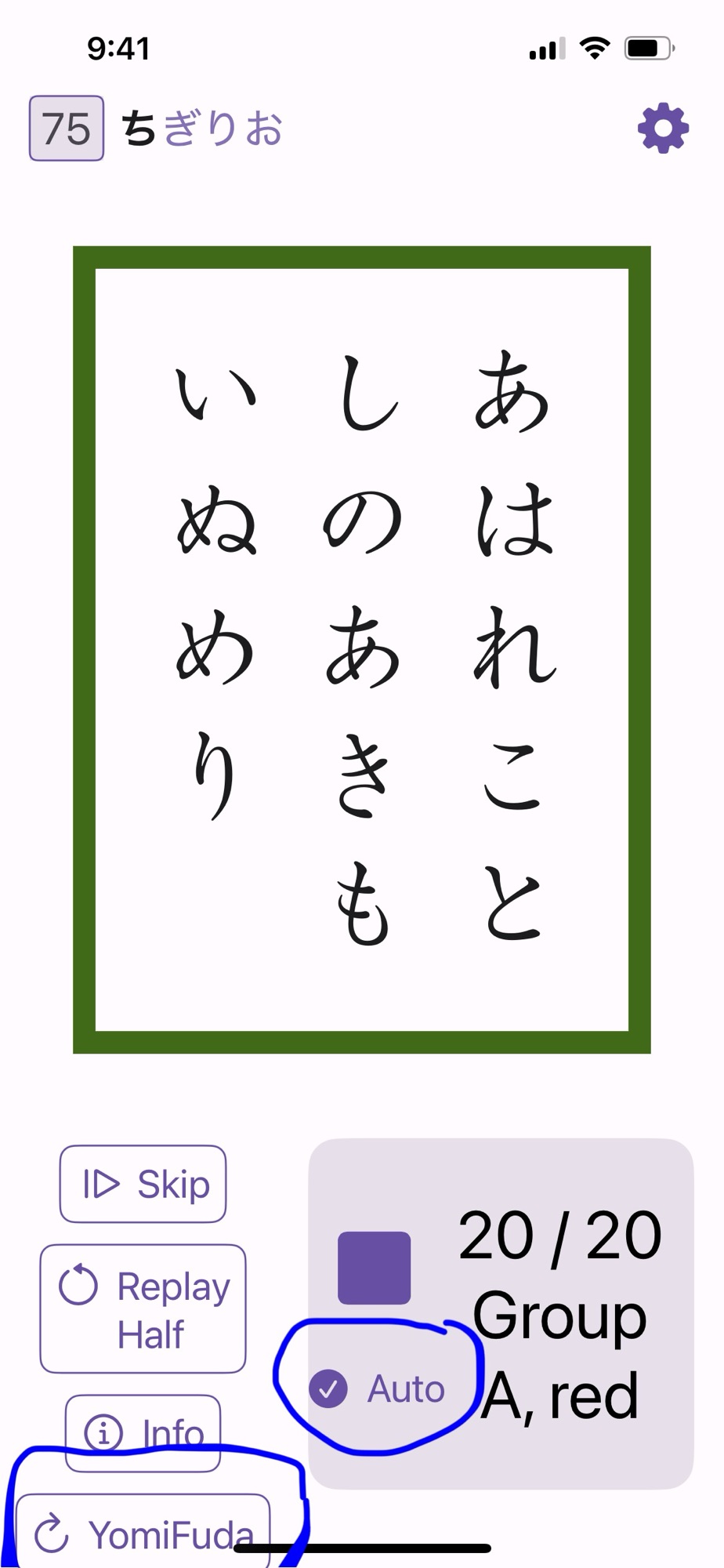
Then in the Wasuramoti app, I select the group of poems I want (see above), set the app to display the torifuda, same as cards on my desk, and set the reader to “auto” mode so it doesn’t stop with each poem. I just want to see if I can recognize the poem before too late. I don’t care very much about speed.
It is fun to play this way. I can finish a game pretty quickly (roughly ten minutes) and it is not very exhausting. Since I chose the easiest set of cards first, I remembered many of them pretty quickly despite the long hiatus, which was gratifying.
This format of playing smaller sets of cards, with optional levels of difficulty, and no threat of penalties, seems to be a great way to introduce to new players as well. I was happy to see that a new player, who had experience with Japanese language, quickly pick up the game, took a few cards of her own, and had a great time. If people aren’t having a great time, why play karuta?
Karuta is super fun, and a great game to enjoy throughout one’s life. However, if you are struggling, don’t blame yourself. Instead, find what you enjoy about karuta, pick a more gentle format, and focus on that, not what the A-rank players are doing.
Happy gaming!
1 The final nail in the coffin was when I joined some online communities which I soon realized were very focused on competition, and very little on actually enjoying the culture of the Hyakunin Isshu. It was just another sport, with physical training regimens, and techniques to edge out your opponent. That is not why I created this blog back in 2011, and not why I continue to enjoy the Hyakunin Isshu now. I had left the world of competitive card games behind when I quit playing Magic the Gathering before the Pandemic, and didn’t want to resume.
2 They only ship in Japan as far as I can tell, and with tariffs making things more expensive, it might be hard to get outside of Japan. Thus, I am adding a new index page for five-color Hyakunin Isshu to help readers make their own sets
The Hyakunin Isshu anthology, the subject of this blog, is not known for bawdy subjects as Japanese poetry by that time had become increasingly refined and codified in style. By contrast, the much older Manyoshu included a wider variety of poems and topics. This includes drinking poetry.
In fact, the compiler of the Manyoshu, Ōtomo no Yakamochi (大伴家持, 718 – 785) who also composed poem 6 in the Hyakunin Isshu (かさ), was the son of a famous literati and booze-hound: Ōtomo no Tabito (大伴旅人, 665 – 731). Tabito was a contemporary of Hyakunin Isshu poet Hitomaro (poem 3, あし), though not quite as successful.
Tabito was dispatched by the Imperial bureaucracy at the time to serve a term as governor of Daizafu in western Japan, and while there he formed a poetry circle called the Tsukushi Kadan (筑紫歌壇, “Tsukushi Poetry Circle”), where Tsukushi is the name of an old district in Dazaifu. Of Tabito’s 50+ poems in the Manyoshu, 13 of them were contributed by Tabito, known as the Sake wo Homuru Uta Ju-san-shu (酒を讃むる歌13首) or “The Thirteen Poems Praising Saké [rice wine]”.
Although I joke about Tabito’s possible alcoholism, the poems are not necessarily meant to be taken as literal. My book on the Manyoshu points out that these poems may have intended to imitate a famous 3rd century literati group in China called the Seven Sages of the Bamboo Grove, sometimes known as the Seven Sages of the Western Jin [Dynasty]. In Japanese they are called the chikurin-shichiken (竹林七賢). The enduring image of these seven musicians, poets and scholars is a band of bohemian, drunken geniuses, and Tabito and his poetry circle was likely inspired by them. You can see other examples of artistic inspiration in this post from my other blog. Between this collection of poems, and the Zen artwork in my other blog, I had no idea that the Seven Sages were such a popular topic in art.
But I digress.
There is another side to this poetry as well : evidentially on the move from the capital (Kyoto) to Dazaifu to the west, Tabito’s wife apparently fell ill and died. So, my book alludes to the idea that Ōtomo no Tabito took up drinking not just as a literati trend, but also to deal with the grief of losing his wife. Marriages at this time were often political as various noble families vied for position in the tightly stratified hierarchy in the Imperial Court. However, even political marriages could be happy ones at a personal level, so Tabito may have genuinely been grieving for a wife that he loved, plus the isolation from the capital.
Tabito’s poems, celebrating the virtues of rice wine, are technically very good poems, but also cover a subject that is omitted in later anthologies where style and form were pretty much codified by then. So, by the time the Hyakunin Isshu was compiled, 4 centuries later, no one would write such crass poetry about booze and girls (atleastnotopenly). Further, while the Manyoshu lacks the refinement of the Hyakunin Isshu, it does have a raw, visceral tone that’s often missing in later anthologies, and resonates differently with readers. Personally, I love both anthologies, but for different reasons.
P.S. I’m finally back, and have a few upcoming topics. Please enjoy.
1 This kind of rice wine seems to be a style from China, where the fluid is cloudy rather than clear.
Lately, I’ve been having some fun conversations with coworkers introducing them to the Hyakunin Isshu, and while describing the poems, I realized that learning the kimari-ji of each poem is a handy way to keep track of which poem is which. When I first learned the Hyakunin Isshu way back in the early days of this blog, I tried to learn the poems by number. They are listed in numerical order in many publications, so this made sense.
However, many publications in Japan also list the poems by their kimari-ji too.
But if you’re not playing karuta (casual or competitive) why bother? Think Michael Jackson.
The album cover for Michael’s Jacksons Thriller, courtesy of Wikipedia.
Michael Jackson’s songs are tremendously famous. As soon as I say out loud, “Eddie are you OK?”, or “Billie Jean”, anyone listening beyond a certain age range will know how to finish the next lyric. It’s not necessary to know the whole song, simply knowing a key lyric triggers the rest of the song, or at least recognition of the song.
Think of kimari-ji the same way. Since the Hyakunin Isshu was meant to be a compilation of the very 100 best waka poems in Japanese antiquity (as chosen by Fujiwara no Teika), you can think of them as a “Best of Michael Jackson” album collection.
Thus, rather than remembering poem 29 it may be easier to remember it as the ko-ko-ro-a poem since the first line starts with that verse (kokoro até ni), and that’s enough to distinguish itself from other poems.
I have been quietly doing a number of updates to existing blog content. This includes fixing some inconsistent formatting, and fixing broken or outdated links. Tags and categories were cleaned up and standardized as well. This was long overdue.
In addition, all references to Amazon.com have been removed.
Finally, it’s that time again: cherry blossom season. It is still a bit early where I live, but if you are planning to view cherry blossoms (ohanami, お花見), then feel free use my handy guide.
Thanks everyone and happy spring to readers in the Northern Hemisphere!
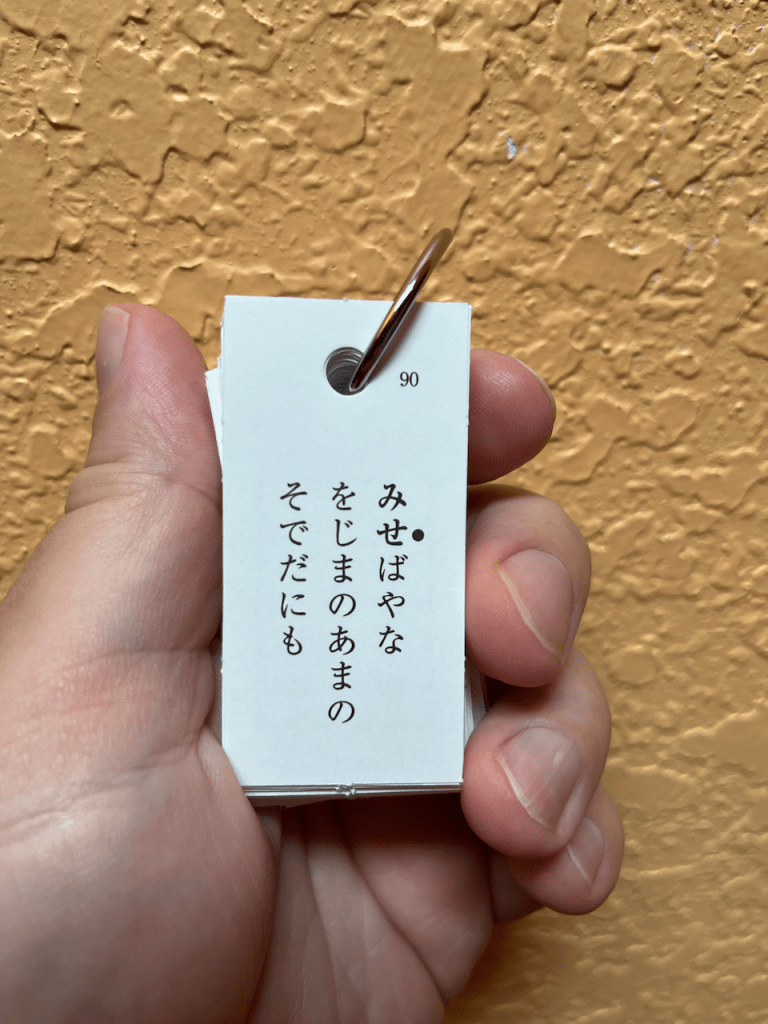
In 2023, during a visit to Kyoto, I picked up some flashcards for memorizing the kimari-ji syllables of the Hyakunin Isshu poems (product link here). These flashcards were really helpful in those first few months of learning to play karuta, and although I don’t really use them anymore, I kept them around for nostalgia…
But… after I took my flashcards to the office one day recently to show some curious co-workers about the Hyakunin Isshu and Karuta, I forgot to take them out of my pants pocket. This is what happened after they got washed…
Initially, I tried to just let the ring dry out, but it’s pretty water-logged. Plus, I found that if was careful, I could peel the cards apart one by one, so they could dry much faster….
Sadly, a few cards ripped in the process, but I think I have salvaged about 80% of the cards. In reality, I will likely purchase it again anyway (preferably with extras to give out to others) since it is very cheap. However, shipping overseas is pretty expensive, so I have to wait until I am in Japan again.
And so, like cherry blossoms and moonlit nights, all things fade. Unlike cherry blossoms and moonlit nights, my flashcards faded in my pants pocket in the washing machine.
This fun website will let you pick a Hyakunin Isshu poem at random, and that will be your fortune for the day. After your poem is selected it is shown in the upper right corner:
On the left hand side is your “lucky color” for the day, and in middle is a fortune for you. You can see the matching karuta card on the bottom. The site is entirely in Japanese, so you will have to use an online translator. It reminds me of those page-a-day calendars I used to buy for work.
In any case, this is a terrific site and worth visiting. Enjoy!








 The Hyakunin Isshu
