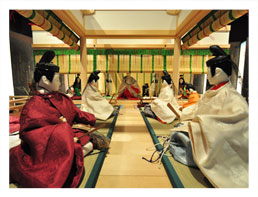
Poetry Contests in the Heian Period

Throughout this blog, I’ve alluded many times to poetry contests, called uta-awase (歌合), as the origin of many of the poems of the Hyakunin Isshu. These contests were a popular past-time among the nobility of Nara and Heian periods of Japanese history, and onward. The first such contest was recorded as far back as 885, and became a staple of nobility since.

The poetry contest was a ritualized affair, and worth exploring here.

An excerpt from an illustrated copy of the Tales of Ise showing two contestants in a poetry contest, with an incense brazier on between. The lady here serves as the judge of their poetry.

This image comes from an illustrated copy of the classic Japanese text, the Ise Monogatari (Tales of Ise)1 and shows an example of a typical poetry contest. The contestants sit facing one another as a pair, while some contests had multiple pairs facing off.

Presiding over the contest was a judge or hanja (判者) who would provide a topic for the contest. A small incense brazier would burn between the two contestants (方人, kata-udo), who would each come up with one poem to fit the given theme. Each participant would also trash-talk the opponent’s poem while praising their own, or their Allie’s (if multiple sets of participants). Basically, an ancient Japanese rap-battle. Once the winner was declared, the contest could go another round, and each contestant would come up with another poem.

According to the Hyakunin Isshu Daijiten, the longest recorded poetry contest during the classic Heian Period was said to have continued for 500 rounds!

In more formal settings, usually held at the Imperial palace,2 with a director overseeing the contest (a tokushi, 読師), with the poems and their theme recorded by a scribe (kazusashi, 籌刺) who sat off to the side. Musical accompaniments were often added to formal poetry contests, too. Finally, the particularly good poems often ended up later in Imperial Anthologies.

You can see an example of an Imperial uta-awase from a popular manga here:

You can also see examples of re-creations of an uta-awase in this Kyoto museum here, specifically here. This blog also has a nice example photo here.

1 Image and main image courtesy of Wikimedia Commons and Chester Beatty Library, Public domain.

2 These are specifically called dairi-uta-awase (内裏歌合)

Burning with Longing: Poem Number 97

At last, faithful readers, we come to the final poem of the Hyakunin Isshu, composed by the anthology’s compiler himself!

JapaneseRomanizationTranslation
こぬ人をKonu hito woFor the man who doesn’t
come
まつの浦のMatsuo no ura noI wait at the Bay of Matsuo—
ゆうなぎにYunagi niin the evening calm
やくやもしYaku ya moshio nowhere they boil seaweed
for salt,
身もこがれつつMi mo kogaretsutsuI, too, burn with longing!
Translation by Dr Joshua Mostow

This poem was composed by Supernumerary Middle Counselor Sada’ie (権中納言定家, 1162-1241), better known as Fujiwara no Teika, or alternatively Fujiwara no Sadaie.1 He is considered one of the greatest poets in all of Japanese history. Teika was the compiler of this Hyakunin Isshu anthology and was also one of the major compilers of the official Shin Kokin Wakashū anthology. He was also the tutor for Shokushi Naishinno (poem 89), and it is thought that they had a romantic relationship too, though eventually they would be separated for good. In any case, his talent and his family’s influence were so great that the family virtually monopolized the Court poetry for centuries to come. But we’ll talk more about that shortly.

Fujiwara no Teika composed many of his own poems in his lifetime, and yet in compiling the Hyakunin Isshu, why did he select this particular poem for inclusion?

Like many of the later poems in the anthology (poem 90, 91 and 94), this poem alludes to a much older one. In Teika’s case, his poem alludes all the way back to the original anthology in Japan, the Manyoshu. Unlike later anthologies, the Manyoshu was a loose connection of poems, compiled 400+ years before Teika, and the particular poem he alludes to was written from the perspective of a man whose love was burning for a woman like the boiling of seaweed at Matsuo Bay. As you can see, Teika reversed the perspective to be that of a woman, while still alluding to the original. Additionally, Teika gives his poem a sadder tone than the poem from the Manyoshu, which came to be a hallmark of Teika’s style.

Incidentally, Matsuo Bay (written as Matsuho 松帆 here) is on the very northern tip of the famous Awaji Island in the Inland Sea. It is a scenic part of Awaji Island, and even has its own homepage. Awaji Island is also the scene for poem 78. The technique of extracting salt by boiling seaweed, or moshio (藻塩) is a time-honored tradition in Japan, and the seaweed gives the salt a special flavor. There’s a really good article about it here.

Fujiwara no Teika was a master of expressing yūgen (幽玄) or subtle, profound beauty in his poetry. This kind of subtle beauty centuries later came to influence other arts in time in Japan including Noh theater, tea-ceremony, etc.

But who was Fujiwara no Teika?

Teika, alternatively read as Sada’ie, was born from an illustrious family of poets though a minor branch of the powerful Fujiwara clan. His grandfather was Fujiwara no Toshitada and his father was Shunzei (poem 83). As a youth, Teika was a sickly boy but as the eldest son, he was obligated to carry on the family legacy. Unfortunately due to complex court politics, Teika was overlooked for much of his early life. However after a fortunate turn of events, he was noticed by Emperor Go-Toba (poem 99) who eventually commissioned him to compile two new anthologies, including the Shin Kokin Wakashū.

Over time though, Teika and Emperor Gotoba disagreed over poetry and compiling the anthology, leading to an increasingly distant and cold relationship. Teika found Gotoba overbearing, while Gotoba didn’t care for Teika’s free-wheeling style. At times, Teika and Gotoba openly criticized one another through poetry, or in their diary entries, and Gotoba even banished Teika for a year from the capitol. Teika meanwhile grew closer to Gotoba’s son who later became Emperor Juntoku (poem 100), while Gotoba became increasingly occupied with the martial arts, and with wresting power back from the samurai rulers in Kamakura (cf. poem 93)

Unfortunately for Emperor Gotoba, his meager forces were utterly routed by the Kamakura army in the short-lived Jōkyū War, and Gotoba was sent into exile (since it was sacrilege to kill the Emperor). Teika was not involved in the war, so he remained in Kyoto, and even reached the Imperial post of Middle Counselor. During this time, he also completed another Imperial anthology, the Shin Chokusen Wakashū, which shows more of his down-to-earth later style.

Finally though, his health declined from old age and from the famine at the time, so he retired and took Buddhist tonsure. It was during his final years in a Buddhist monastery that he was invited by his son’s father-in-law, Lord Utsunomiya no Yoritsuna, to his villa at Mount Ogura near Kyoto.

This stone marker at Jojakko-ji Temple in west Kyoto, near Arashiyama, marks where Teika had compiled the Hyakunin Isshu. More on that in this post. Photo taken in August 2024.

Lord Utsunomiya asked Teika to compile 100 poems in his own hand, so that they could be adorned on the silk screens of his villa, and these 100 eventually became the collection that we know today.

After Teika died at the age of 80, he was interred at Shokoku-ji Temple in Kyoto. The featured photo above shows his grave marker (Photo courtesy of Wikimedia Commons.). His grandchildren formed into three rival schools of Waka poetry that dominated the poetry scene for centuries:

  • Nijō School (nijō-ha 二条派) – the conservative and dominant school at first. Over time, a series of misfortunes eventually caused the school to decline and fade by the medieval period in Japanese history.
  • Reizei School (reizei-ke 冷泉家) – the more liberal branch, but a few generations later became the dominant branch. By the middle of the Muromachi Period, two branches had formed: the upper Reizei school (kamireizei 上冷泉家) and the lower Reizei school (shimoreizei 下冷泉家), which the upper school prevailing in the long-run. This school still maintains a large compound in Kyoto to this day.
  • Kyōgoku School (kyōgoku-ha 京極派) – this school died out in only a couple generations.

But more importantly, the legacy of Fujiwara no Teika is in his celebrated poetry anthologies, particularly this one. Even today, many kids in Japan enjoy playing uta-garuta in school competitions, and there are even Japanese anime about the Hyakunin Isshu. All of this is due to Teika’s talent and taste for selecting good poetry.

And now, this anthology is enjoyed by international readers like yourself. This blog was a originally a little experiment of mine, but I have enjoyed your readership, your comments, and of course your support. Thank you everyone from the bottom of my heart.

As this is the 100th and final poem of the Hyakunin Isshu, that is all I have to offer on this blog. I may take it up again sometime in the future and cover other anthologies like the Kokinshu and the Shinkokinshu, but for now, I decided that I prefer to leave it as it is.

All good things must come to an end, after all.

1 The Chinese characters (kanji) for his given name (定家) have multiple readings possible, and both are seemingly correct. However, based on a cursory glance in Japanese, it seems that “Teika” is the more common reading.

Not Quite Done Yet: Poem Number 68

This poem is something that touches on an important theme here on the blog, but first, let’s take a look:

JapaneseRomanizationTranslation
心にもKokoro ni moThough it is not what’s
in my heart,
あらで浮世にArade ukiyo niif in this world of pain
ながらNagaraebaI should linger, then
こいしかるべきKoishikaru bekino doubt I shall remember
fondly
の月かなYowa no tsuki kanathe bright moon of
this dark night!
Translation by Dr Joshua Mostow

This poem was composed by Sanjō-in (三条院, 976 – 1017), known in English as the “retired Emperor Sanjo“. He only reigned briefly for 5 years until his regent, Fujiwara no Michinaga, forced him to abdicate so that his own grandson could become Emperor (Emperor Go-ichijo). Fujiwara no Michinaga will be remembered as the main character of Lady Murasaki’s Diary, plus he employed a number of the female authors in the Hyakunin Isshu to be ladies in waiting for his daughter. Fujiwara no Sadayori (poem 64)’s family also lost in the same struggle.

To make matters worse, Emperor Sanjo was frequently ill, and this added further pressure for him to abdicate.

The poem above, according to Mostow, is thought to have been composed toward the end of his reign when he was ill and considering abdication. Was he concerned that night about his illness, or about the prospect of losing the throne? What made him savor that moon so?

As mentioned in this post, the later poems of the Hyakunin Isshu reflect a more somber era when political scheming and conflict replaced the earlier enthusiasm of previous generations. By this time, the Emperors had lost much of their power to ministers (mainly from the Fujiwara family) and were increasingly isolated, or even battling one another.

The 400-year Heian Period, the height of aristocratic culture in Japanese history, which the Hyakunin Isshu covers, would come crashing down about 100 years later.

The World Moves On: Poem 93

I was reminded of this poem recently and felt like sharing it with readers. It is one of the most poignant in the anthology, I think:

JapaneseRomanizationTranslation
世の中はYo no naka waIf only this world
つねにもがもなTsune ni mo ga mo nacould always remain the same!
なぎさこぐNagisa koguThe sight of them towing
あまのぶねのAma no obune nothe small boats of the fishermen who row in the tide
綱手かなしもTsuna de kanashi mois touching indeed!
Translation by Dr Joshua Mostow

This poem was composed by the Kamakura no Udaijin (鎌倉右大臣, 1192-1219), or “Kamakura Minister of the Right”. He is also known as Minamoto no Sanetomo. Sanetomo was the third shogun of the new Kamamura Shogunate, the same military government opposed by Emperor Gotoba (poem 99) and Emperor Juntoku (poem 100).

Sanetomo was a more gentler ruler than some of his predecessors, and even studied poetry under Fujiwara no Teika (poem 97), the compiler of the Hyakunin Isshu anthology and contributed to other Imperial anthologies as well.

However, he lived at a time when the old Heian court (which included most of the authors in this anthology) had been reduced to a shadow of its former self (see poem 100 above). The power had shifted away from the Imperial Court to the eastern city of Kamakura, and the country was still rebuilding itself after war. Sadly, this new center of power was unstable, and as the third Shogun, he was surrounded by ambitious family members and retainers who either plotted to replace him with their chosen candidate, or ruled “on his behalf”. Sanetomo was a tragic, powerless figure who was given to drink and poetry because he had little else to look forward to.

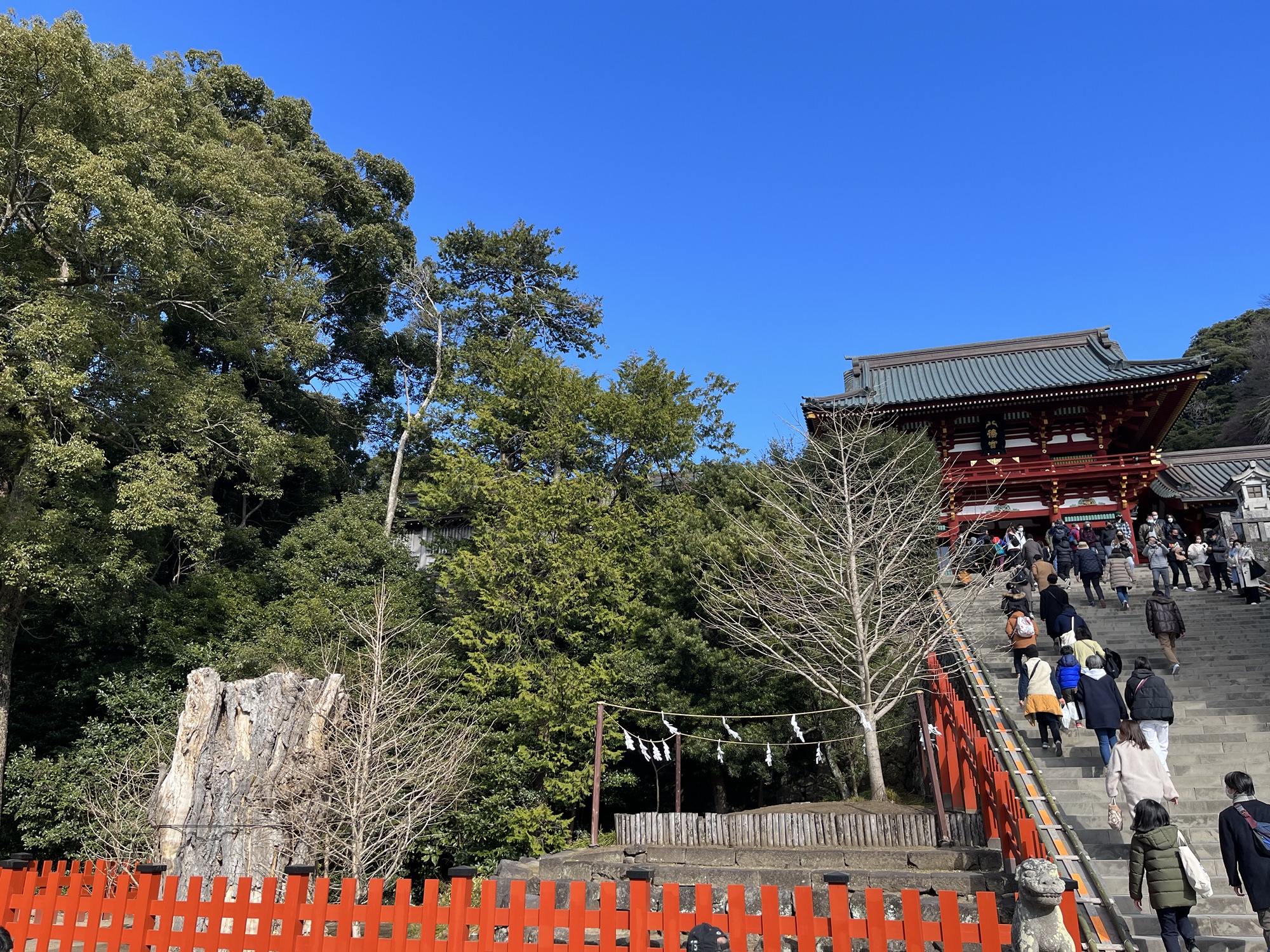
After escaping other assassination attempts, Sanetomo was killed at age 28 at Tsurugaoka Hachimangu shrine (English site here). His nephew, Kugyo, was hiding behind a ginkgo tree which can be seen to the left of the stairs in the photo above. As Sanetomo descended the stairs, Kugyo leapt out and cut him down with a sword. The ginkgo tree still stood for another 800+ years, but finally fell over in March of 2010 due to age and disease. Efforts to resuscitate the tree are underway. The photos in this post were both taken by me in the winter of 2023: the stump of the dead tree is on the left, while the restored sapling is fenced off in the middle. The grand stairs leading up to the shrine is where Sanetomo was assassinated.

This poem reflects his melancholy as he views the shores of Kamakura, and wishing this peaceful scene would always remain, in contrast to the turbulent life he lived.

Politics and power are a dangerous thing.

The Gossamer Years

Hi all,

This somewhat different than my usual posts, but I after posting by poem by the Mother of Michitsuna (poem 53), I decided to read her diary, titled the Gossamer Years, or kagerō nikki (蜻蛉日記) in Japanese.

The “Mother of Michitsuna” is never named as per the culture of the Heian Period of Japan. She lived a generation or two before other famous female authors such as Sei Shonagon (poem 62), Lady Murasaki (poem 57), Lady Izumi (poem 56), etc. The translator, Professor Seidensticker, did a masterful job translating this difficult text. In reading the footnotes, you can see he struggled a lot with the vagaries of the text, and with the language, where it’s not always clear from the context who’s talking about whom.

At the time, she was from a lesser branch of the powerful Fujiwara Family, but she married Fujiwara no Kane’ie, who was gradually moving up the ranks of the Heian Court. Fujiwara clan, Kane’ie had to contend with various other members of the court, and even his own clan, to gain the prestigious position of Regent, which he finally accomplished in 986 as regent for Emperor Ichijō. His sons, Michinaga and Michitaka both became regents and the most powerful men in the Heian Court. Lady Murasaki (poem 57) served under Michinaga, by the way, and they are the subject of a Japanese historical drama in 2024.

Suffice to say, Kane’ie was a very ambitious and influential man. As such, he married a few women, as per Heian Period custom, and also carried on various affairs, having yet more children on top of this. One of these children is the author of poem 52.

The Mother of Michitsuna began her diary when Kane’ie first met her, and courted her. Her own father was the governor of a remote province, a mediocre position in the Court, but he gave his blessing and they were married. In the early part of the Diary, she writes about all the passionate love poems they exchanged and such. It seemed like a good relationship early on, but the Mother of Michitsuna wasn’t Kane’ie’s first wife. She was probably his second or third wife (the diary isn’t clear on this), and his time was divided between his wives. When he was not around, she stayed in one of the outer rooms of his mansion and just passed the time with her hand-maidens.

But as the diary shows, Kane’ie’s visits came less and less often. In time she tracked him down to an alleyway where he’d spend the night with some girl, presumably a bastard child of one of the emperors, and rumor has it that she had a son by him as well. The author was not surprisingly furious and jealous, but completely powerless to stop him. She writes about the sound of his carriage driving by the residence, but not even stopping by to say hello, while she spent night after night alone.

Later, in Book 3, she finds about more of his affairs and children, and adopts the daughter of another of his lovers so that she doesn’t have to spend her young life in a monastery. Strangely, Kane’ie’s brother takes an interest in the child (his own niece) and gets very pushy about marrying her which again was not unusual at the time among the nobility. The Mother of Michitsuna expends a lot of effort to delay and make excuses for the girl, and pleads with her husband to help her, with only modest success.

This agonizing loneliness and sense of abandonment is the primary theme of the Gossamer Years. There are times when Kane’ie and the Mother of Michitsuna grow closer briefly, such as when Kane’ie falls gravely ill or when the Mother of Michitsuna loses her own mother to old age, but after a while he forgets her again. Their relationship is quite strained in the diary though, because she is frequently enraged by his insensitivity, but Kane’ie gets frustrated by her “moods” and can’t seem to understand why she is mad at him. Worse, he blames her regularly as to why he doesn’t come anymore.

At one point, the Mother of Michitsuna, now old and a has-been, has had it with Kane’ie and abruptly moves out of the mansion and retreats to a monastery which causes quite a stir at the Court and humiliates Kane’ie. Furious he tries to send messenger after messenger to bring her back, but she refuses for a long time. Finally, after a combination of threats and pleading, she agrees to return home, but they soon fall into the old routine again.

The Mother of Michitsuna only had one child with Kane’ie, Michitsuna of course (who rose to be a minister of the Court, though not as powerful as his half-brothers), and Kane’ie seems to take much pride in his son, but also periodically uses him as a weapon for getting back at his mother.

Thus, the Gossamer Years is a long, and often very depressing diary of a noblewoman in a very unsatisfying marriage who spent many dreary days alone. The diary ends abruptly one day when there’s a knock at her residence, and it appears that she never took up the brush again. Nobody knows why. As for the diary itself, it is full of poems exchanged back and forth. Most of these are mediocre poems, though as you can see, Fujiwara no Teika did include one of them in his famous Hyakunin Isshu anthology. However, these other poems are also waka poems, just like the ones you read here on this blog, and it’s amazing how many poems people exchanged in those days just to express things like “how are you?” or “can you come over?”.

In today’s modern age where text-messages replace letters or poems, we can send messages much quicker now, but it’s amazing how much skill and subtlety it took to get a simple point across to someone back then. Not surprisingly, the kinds of feelings of frustration a broken-hearted woman might have were probably much worse then because they were traditionally very isolated in their homes. It was uncommon for women, especially powerful noblewomen, to go out on their own without permission from their husbands, and their lifestyle and huge robes made it difficult to travel far anyway. Customs and such would also get in the way too. In short, women spent most of their time indoors in their home with nothing to do.

As for the Mother of Michitsuna herself, it’s tempting to make her a tragic, almost saintly figure, but in reality she was prone to faults of her own. When the “woman in the alley” had the misfortune of losing her home to a fire, the author felt a moment of triumph and petty revenge without any remorse. In another, more troubling scene late in book one, she encounters a defeated rival (it’s not clear who) and gloats over her:

At the Hollyhock Festival in the Fourth Month I recognized the carriage of a lady who had once been my rival, and I deliberately had my own carriage stopped beside it. While we were waiting, rather bored, for the procession to go by, I sent over the first line of a poem, attached to an orange and a hollyhock: “The hollyhock should promise a meeting, but the orange tells us we have yet to wait.” After a time she sent back a line to complete the couplet: “Today for the first time I know the perverseness of her who sends this bitter yellow fruit.” “Why just today—she must have had similar feelings for years,” said one of my women. When I told the Prince [Kane’ie] of the incident, he remarked, to our considerable amusement, that the closing line the lady really had in mind was probably more like this: “This fruit you send me, I would like to grind it to bits with my teeth.”

pg. 59, trans. Seidensticker.

Clearly the Mother of Michitsuna was not above petty rivalries or revenge when it suited her.

Anyhow, what makes the Gossamer Years such a significant work of literature is that it was the first and only real diary of the Heian Period to really express how a woman felt in that small, cloistered world. The Heian Period had many great works of literature, both by men and women, but these works were either fiction (e.g. Tales of Genji), poetry (e.g. Tales of Ise) or just dry, stodgy journals about oval events. The Gossamer Years is much more “raw” and unfiltered than other works at the time. The Mother of Michitsuna is not a strong or witty writer like Sei Shonagon or Lady Murasaki, but you can really feel her pain at times, and wonder why she puts up with him. Then again, the customs of the time gave her few options.

But as you see later in Book 3, it was the culture of the time, not unlike the cloistered French Aristocracy centuries later. The marriage laws from the Taika Reform were vague and full of loopholes, so men could marry as often as they could afford, and affairs were pretty rampant as other poetry in the Hyakunin Isshu regularly show. So while I do enjoy the Hyakunin Isshu and the culture of the Heian Period very much, the Gossamer Years was a sobering reminder that there was a serious side to it as well.

P.S. Featured photo is a scene from the Genji Monogatari (“The Tales of Genji)”, Chapter “YADORI GI”( mistletoe ), by Lady Murasaki (poem 57).  Imperial court in Kyoto, Public domain, via Wikimedia Commons

The Hyakunin Isshu as a Rough Historical Tour

As you may have started to notice, the Hyakunin Isshu anthology provides a subtle historical overview of the classical period in Japanese history. This may have been intention on the part of Fujiwara no Teika, or just reflects the sentiment of his time. Either way, it’s an interesting tour of Japan from the 8th to 12th centuries.

The anthology begins with poems in the Nara Period, when Japanese culture, flush with cultural imports from China (e.g. Confucian ethics, Buddhism, technology, administration, poetry, etc). It was an exciting time in Japanese history. And if you look at the poems from this era, you can see that they tend to feature benevolent rulers (poem 1), bright and happy natural scenes (poems 2 and poem 4), or just often dealt with frivolous issues of love (poem 3 and poem 12) or just life in general around the capitol (poem 10).

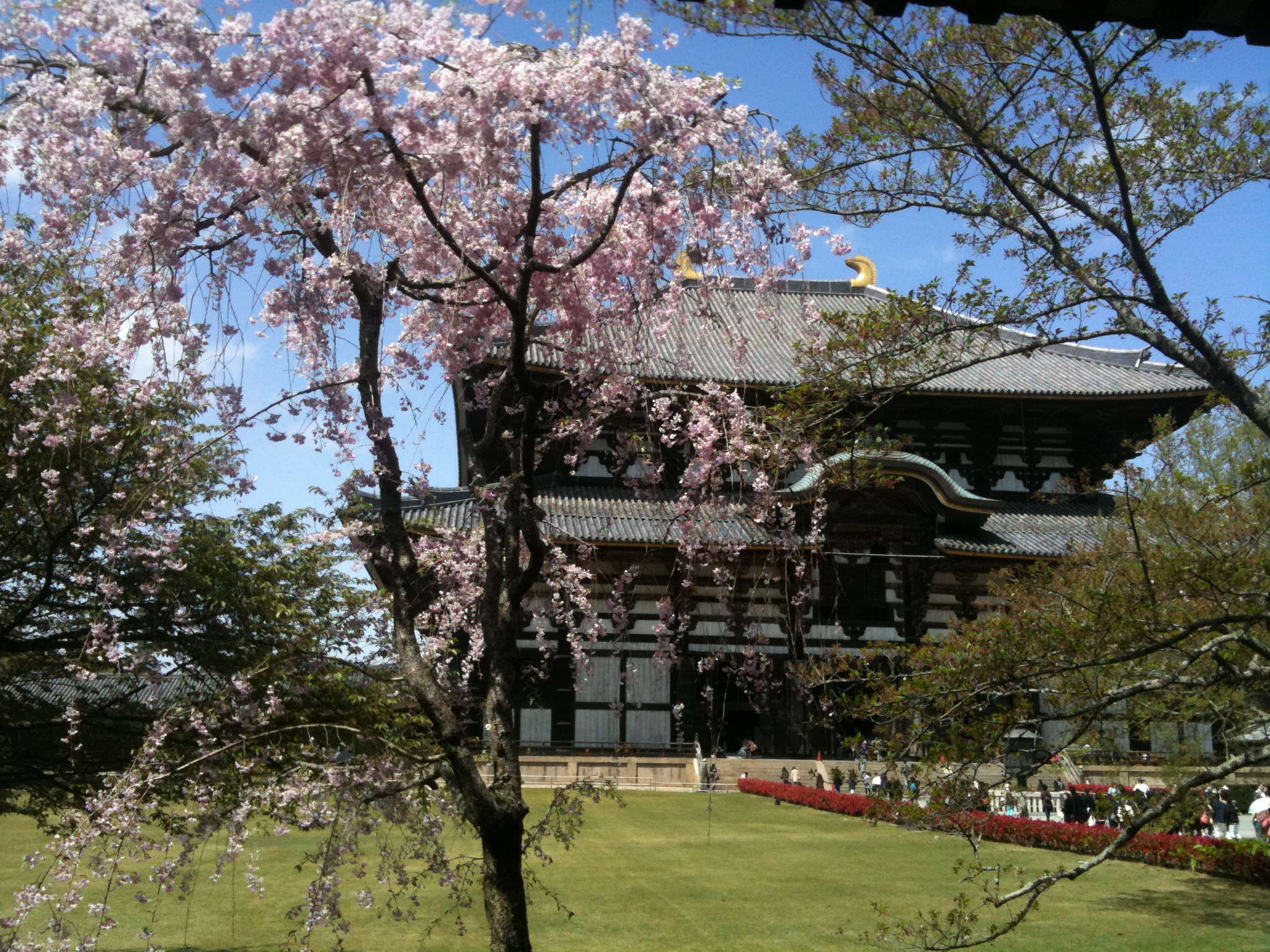
Todaiji Temple in Nara on a warm April day in 2010. Taken by author.

Even when the poems were more melancholy (poem 9, poem 11) they still reflected a more genteel time, and were probably included by Fujiwara no Teika to demonstrate the range of poetic skills of the nobility during that bygone time.

However, the Nara Period eventually gave way to the Heian Period, which was a 400-year flowering of Japanese culture that is still revered today. The transition was slow, and much remained the same generations later, but eventually things started to change:

  • Japan’s contact with China and the Asian mainland eventually stopped, and Japanese culture turned more and more inward for several centuries. Poetry and culture at this time reflected more “native” styles by and by.
  • Politically, the northern-branch of the Fujiwara clan gradually monopolized power around the Emperor through political marriages. In the early period, the nobility included several families who supported the family, but by the 11th century, the Fujiwara controlled every major position in government and most emperors were related to them in one way or another. This is what led in part to Sugawara no Michizan’e exile for example. You’ll notice too how many of the poets have the surname “Fujiwara” in the anthology as well, including Fujiwara no Teika the compiler himself.
  • Toward the end, conflict began to arise again and again, culminating in the famous Genpei War and the fall of the Heike clan. The new samurai class (originally bodyguards to the noble families) clashed with one another for control of Japan and ultimately swept aside the nobility, while still trying to imitate the courtly culture.

As such, if you look at poems toward the very end of the Hyakunin Isshu, they tend to be more dismal in tone. Starting with poem 77 onward, you get an increasing melancholy tone to many poems, culminating at the end when poets often speak of longing for the past (poem 100), complaints about life (poem 83, poem 99) or just expressions of people suffering (poem 95).

Indeed, by this time the flowering culture that started in the Nara Period and flourished in the Heian Period had declined, and war and politics had taken their toll on society. The final few poems begin in the militaristic Kamakura Period, and reflect both nostalgia and unease by people of that era. Small wonder that Fujiwara no Teika, who took tonsure after Emperor Go-Daigo was exiled, decided to compile the Hyakunin Isshu the way he did.

The End of an Era: Poem 100

The very last poem in the anthology goes along with the previous one in our theme on the end of the Heian Court era:

JapaneseRomanizationTranslation
百敷やMomoshiki yaThe hundredfold palace!
古き軒端のFuruki nokiba noeven in the shinobu grass
しのぶにもShinobu ni moon its old eaves
あまりあるNao amari aruI find a past for which
むかしなりけりMukashi narikeriI long yet ever more.
Translation by Dr Joshua Mostow

This poem was composed by Juntoku-in (順徳院. 1197 – 1242), or “Retired Emperor Juntoku”. Emperor Juntoku‘s father, Emperor Go-toba (poem 99), led the disastrous Jōkyū Disturbance in a last-ditch effort to wrest back power from the new samurai military government in 1221. Like his father, Juntoku was exiled after the rebellion was crushed, but he was sent to Sado Island instead, and lived there for 20 years before his death.

This poem, though, was composed in 1216, five years before the war, and recalls the glory days of the Imperial Court before the downfall in the late 12th century. When we look at the lengthy history of the poetry included in the Hyakunin Isshu anthology, spanning 400+ years, you can see how much poems like this one contrast with the upbeat, optimistic ones from earlier generations. By the time that Emperor Juntoku had assumed the throne, the capitol of Kyoto was already a shadow of its former self, and his reign a greatly diminished one.

In fact, in the Hyakunin Isshu Daijiten, the book points out that the Hyakunin Isshu begins with a poem by an Emperor (poem 1) writing on the harvest, a prosperous subject, and ends with another Emperor longing for bygone times. Fujiwara no Teika (poem 97), the compiler of the anthology obviously knew what he was implying.

Also, the phrase momoshiki is an interesting one. According to Professor Mostow, the phrase is borrowed from a much earlier poem in the Manyoshu:

JapaneseRomanizationRough translation
ももしきのMomoshiki noAre the people of the
大宮人はŌmiyabito waHundred Fold Palace
暇あれやItoma areyaso carefree that they
梅をかざしてUme wo kazashitegather plum blossoms
ここにつどへるKoko ni tsudoeruto decorate their hair?
Book 10, poem 1883

This poem colorfully describes how people in the palace are decorating their hair with plum blossoms they’ve collected, and playfully suggests that life at the palace is well and carefree.

So, it’s really interesting to see how Emperor Juntoku revives this ancient phrase in a poem that conveys the opposite meaning. The sun has set on the Imperial Court, and the palace looks tired and worn now. 

Further, Professor Mostow translates momoshiki as the Hundred-fold Palace which is as good a translation as any in English. But the Chinese characters (kanji) are 百敷 or “hundred seats laid out”, but alternatively, momoshiki can be written as 百石城 meaning “100-stones castle”. Both meanings refer to the Imperial Palace or kyūchū (宮中) in Japanese. The first word implies a hundred mats laid out for sitting (i.e. many people attending the court), while the latter means 100 stones, implying a palace with firm foundations.

But it’s a poignant reminder that all things decline some day.

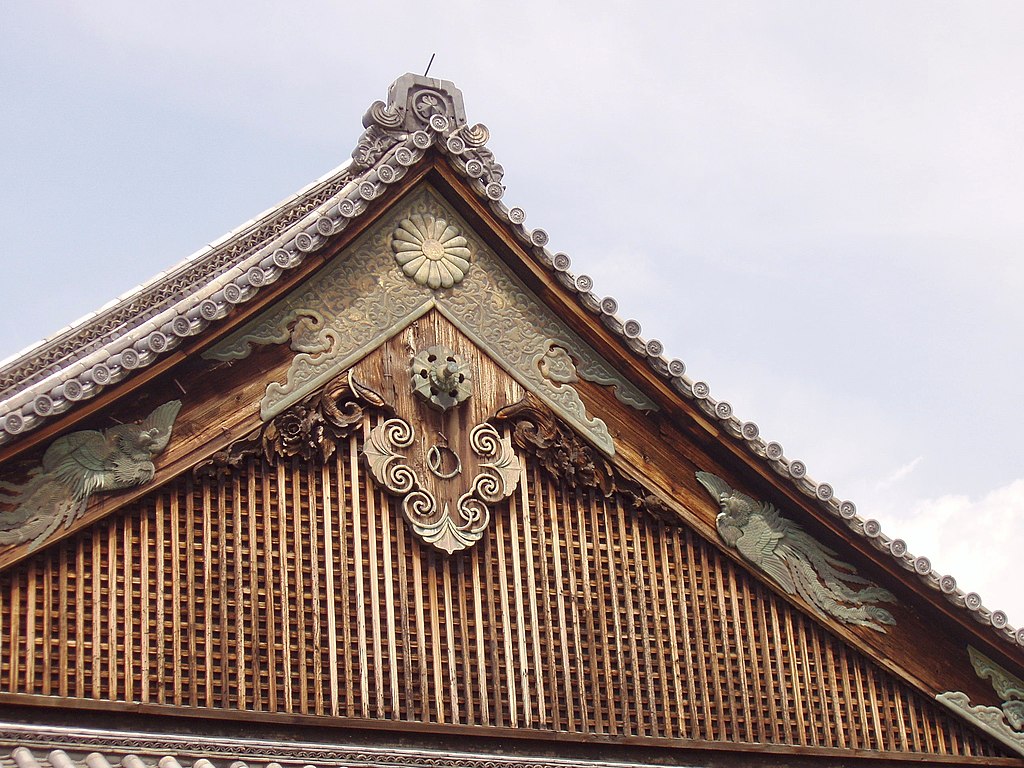
P.S. The featured photo above is the Ninomaru Palace, Kyoto, Japan (photo by Daderot, CC BY-SA 3.0, via Wikimedia Commons).

Brooding: Poem Number 99

Since I touched upon the end of the Court-era in Japanese history, I thought it would be fitting to post this poem:

JapaneseRomanizationTranslation
人もHito mo oshiPeople seem dear and
人もうらめしHito mo urameshipeople also seem hateful
きなくAjiki nakuwhen vainly
世を思Yo wo omou yue niI brood about the world—
もの思身はMono omou mi wathis self who broods about things.
Translation by Dr Joshua Mostow

The author of this poem was Gotoba-in (後鳥羽院, 1180 – 1239), or “Retired Emperor Gotoba”. Emperor Gotoba was one of the most noteworthy Emperors in Japanese antiquity. Gotoba was responsible for a revival in Waka poetry. He commissioned Fujiwara Teika (poem 97), who compiled the Hyakunin Isshu, among others to make a new official anthology after the Kokin Wakashū centuries before, and this new edition became the Shin Kokinshū which is still an important part of Japanese literature.

Gotoba was a bold character, and sought to restore power which had recently been wrested from the Imperial family by the new samurai class based in Kamakura, Japan (cf. poem 93). So, he and his son Emperor Juntoku, poem 100, organized a last-stand rebellion in 1221 called the Jōkyū Disturbance (or Jōkyū War) where he rallied the samurai back to his banner. Unfortunately, most didn’t want to lose their recent gains, and sided with the Kamakura government under the persuasion of Hojo Masako, the famous “Nun Warlord”.

Thus, the Jokyu Disturbance was a disaster and the Emperor’s forces were quickly destroyed. The young firebrand of an Emperor was then exiled to the Oki Islands and lived their for another 18 years.

This poem though, predates the rebellion and exile. According to Professor Mostow, it was composed as part of a series in 1212, which included Fujiwara no Teika, with the topic of “personal grievance”.

As to “who” he was referring to in the poem, that’s tricky. The word hito means “person or persons”, so it’s pretty generic. Mostow suggestions some traditional interpretations, such as those who oppose the Kamakura government, and those who uphold it (whom he detests), or another traditional interpretation was the common folk vs. those who opposed the rebellion (whom he obviously didn’t like).

We will never really know. But certainly after his exile, we can be sure he spent many days brooding.

P.S. Featured photo is another patron of the arts, Victor Hugo, brooding in this photograph from 1853. Photo by Charles Hugo, Public domain, via Wikimedia Commons