Nonomiya Shrine, Charms and Thank You

Happy Holidays, Dear Readers!

As I noted in my other blog, I am taking time off the rest of the year to rest, and catch up on nerd projects.

One last post before end of the year: I forgot to share this previously, but during the trip to Japan this summer, and on the same day we both visited the shrine to Sei Shonagon, and the site where the Hyakunin Isshu was compiled, I made one more stop: Nonomiya Shrine. The official website is here (English).

Nonomiya Shrine (nonomiya-jinja, 野宮神社) is a Shinto shrine that has been around since antiquity in west Kyoto within the bamboo forests. You can see it here on Google Maps:

While it is not related to the Hyakunin Isshu, it is related to Lady Murasaki (poem 57, め), whom I wrote about here. You see, one of the most iconic chapters of the Tales of Genji, Lady Murasaki’s famous novel, the “Heartvine” (Aoi, 葵) takes place at Nonomiya Shrine. Here, Genji the protagonist meets Lady Aoi his future wife. So, Nonomiya Shrine is associated with romance and falling in love, or meeting one’s soulmate, and since it was already a fixture in Kyoto culture at the time, Lady Murasaki used it as the backdrop for this romantic encounter.

Even now, many people (both Japanese and tourists) come here to pray for love, and many of the omamori charms are focused on romance too. It’s nestled within the famous bamboo forests in the area:

I stumbled upon it by accident after leaving the aforementioned site where the Hyakunin Isshu site was compiled. My family was waiting for me, it was late in the day, and it was very hot and humid, so I didn’t stay very long, but I wanted to at least grab a few photos, and get an omamori charm.1

Anyhow, that’s it for the blog for 2024.

I wanted to end this post by saying thank you to readers. The blog has been been around since 2011 (with some major gaps in content), and with plenty of twists and turns, but I am happy to see that people are still actively reading it, and discovering the Hyakunin Isshu, Heian-period culture, and Japanese poetry overall.

See you all next year!

P.S. Not far away was an exhibit for the historical drama about Lady Murasaki as well.

1 Most of the charms are for en-musubi (縁結び), meaning finding a partner in life, but since I am already happily married, I looked for something general. I picked up a omamori for kai-un (開運), meaning “good luck”, but it showed the famous scene from the Tales of Genji where Genji and Lady Aoi meet at Nonomiya Shrine. I wish I remembered to take a photo sooner, but I already gave it to someone, and have no photos to show. 🤦🏼‍♂️

You can see it on the website here, the charm on the upper-right corner.
The Final Days and Legacy of Lady Murasaki

At last, the historical drama about Lady Murasaki has come to an end this week, and sadly I watched the last episode. The drama was slower than other past Taiga Drama on NHK, but it was a lovely tribute to an amazing woman. Lady Murasaki, author of the Tales of Genji, her eponymous diary, and a famous poem in the Hyakunin Isshu left a lasting mark on Japanese culture and world literature.

The final title card for the Japanese historical drama “Hikaru Kimi E”.
The concluding title card for the historical drama: hikaru kimi é (光る君へ, “to you, my radiant one”).

Details of Lady Murasaki’s final years are pretty sketchy, but it seems that she eventually retired from service in Fujiwara no Michinaga’s household, and gradually took up travel. She was born in the year 973, but some scholars believe she may have passed away in 1014 at the age of 41. Others believe she may have lived to the year 1025 (age 52). For the premodern era, this is a pretty typical lifespan for many people, including nobility. Still, as someone who’s older than her, it’s hard to imagine her dying so young.1

Her grave is located in Kita-ku ward of Kyoto:

With her passing, a couple attempts were made to preserve and edit her magnum opus. Fujiwara no Teika (poem 97, こぬ) who compiled the Hyakunin Isshu itself undertook one of these efforts, creating the Aobyōshibon (青表紙本) edition. At this time in Japan, manuscripts had to be hand-copied, and so across several centuries, limited efforts were made to hand-copy works from Lady Murasaki’s time, which helped preserve them across the medieval period, but were inaccessible to general audiences.

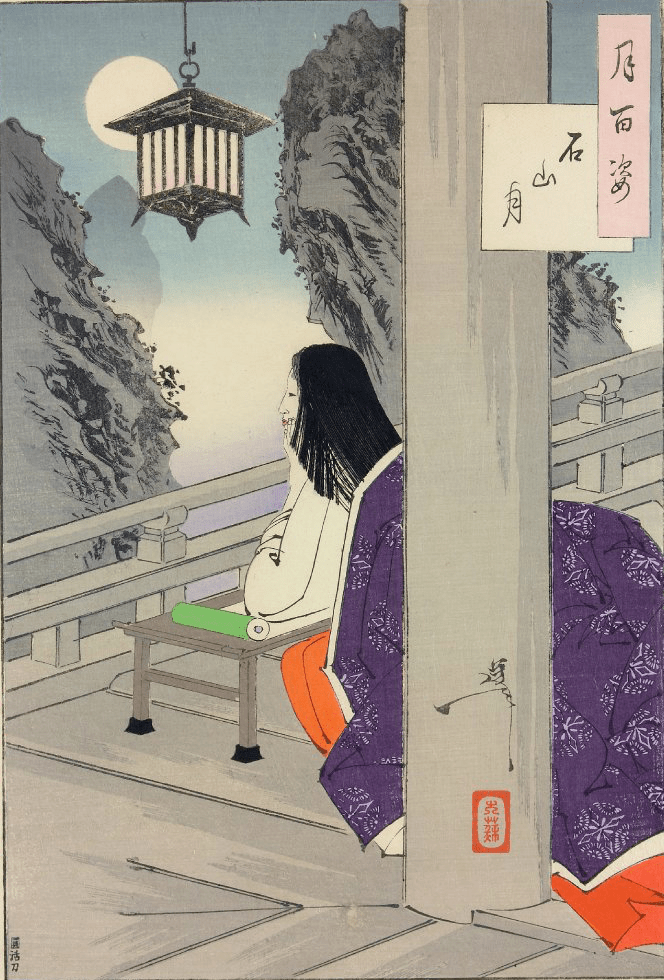
A woodblock print of Lady Murasaki from 1889 made by Yoshitoshi, Public domain, via Wikimedia Commons

By the Edo Period, 17th century, block printing and a flourishing of “book culture” greatly expanded the audience of the Tales of Genji, and Lady Murasaki enjoyed a surge in popularity, rescued from obscurity, and even today is high revered. Lady Murasaki is to Japanese culture what Shakespeare is to the English-speaking world. The historical drama that concluded is arguably an extension of this revival.

Finally, I wanted to explore the relationship between Lady Murasaki and her patron, Fujiwara no Michinaga. In the historical drama, they shared a relationship since childhood (historically improbable), and even had a love child together even though they never married. Political marriages were common among the nobilty at the time, as was infidelity, and so Fujiwara no Michinaga having an official marriage yet carrying a number of romantic trysts would not be surprising. The Hyakunin Isshu poetry is rife with such romances.

And the real, historical relationship between Lady Murasaki and Michinaga is unclear. It’s widely believed that the main character of the Tales of Genji was patterned from Michinaga. Her diary also shows her flirting with Michinaga somewhat. And yet, it’s also implied that she fended off his romantic advances too. The fact that she worked under him, the most powerful political figure in Japan at the time, made their relationship even more complicated. If her daughter, Daini no Sanmi (poem 58 of the Hyakunin Isshu, ありま) was indeed Michinaga’s, as the drama depicts, it may help explain how she was brought into the court inner circle too, alongside her mother. And yet, evidence one way or another is pretty limited, so one can only speculate.

Lady Murasaki herself was woman perpetually out of place in the courtly life of the late Heian Period. Her diary shows her frequently introverted, melancholy, out of place, and exhausted by the back-biting of other women, or the rowdiness of drunk men. Her father had lamented that in spite of her literary talents, her being born a woman in that era meant her talents would go to waste. Such was the period of the time.

One can easily imagine a brilliant woman like Lady Murasaki in modern times sitting in cafe, writing a romance novel, feeling alone, yet observing the world around her in a way that is beautiful and poetic, pouring her heart into her work. What Lady Murasaki conveyed through her writing was something can we can appreciate even today, eleven centuries later.

Out of all the literature of the time, nothing quite epitomizes the sentiments and milieu of the Heian Period, an era now lost to time, yet strangely familiar, quite like Lady Murasaki did.

P.S. The drama definitely took some historical liberties for the sake of drama, but I have to admit that it did a nice job of showing Lady Murasaki as a complex person, and all the different challenges she had to deal with. The last several episodes were really touching and brought tied up things nicely. I might try to purchase the drama next year if I can, but it’s quite expensive ($300-$500 USD), so time will tell.

1 As someone who also spent some time in the ER earlier this year with emergency surgery, I can imagine that I too would have likely died in my 40’s without modern medical care. Modern people often forget how brutal and short life was for the average person before medical science, and how many people never lived past 50, or did so with crippling conditions.

Spring or Fall: Which is Better?

As fall is approaching, I wanted to share an interesting anecdote provided by my book on the Manyoshu. It seems that throughout Japanese antiquity, poets frequently debated which is better: spring or fall.

The first example comes from Princess Nukata in the 7th century, whom we discussed here and here, she wrote a lengthy poem (a chōka poem, not the usual tanka poem) in the Manyoshu (poem 16). She discusses the pros and cons of spring and of fall:

Original Manyogana1JapaneseRomanizationRough Translation2
冬木成 春去來者 冬ごもり 春さり來れば Fuyu gomori haru sari kurebaWhen winter passes and spring comes
不喧有之 鳥毛来鳴奴鳴かざりし鳥も來鳴きぬNakazarishi tori mo nakinuBirds that didn’t sing before, now come and sing
不開有之 花毛佐家礼抒 山乎茂咲かざりし 花も咲けれど 山を茂みSakazarishi hana mo sakeredo yama wo shigemiFlowers that didn’t bloom before now bloom, but because the mountains grass is so thick
入而毛不取 草深 執手母不見入りても取らず 草深み 取り手も見ずIrite mo torazu kusabukami torite me mizuOne cannot go and pick flowers, let alone see them.
秋山乃 木葉乎見而者 秋山の 木の葉を見ては Aki yama no ko no ba wo mite waWhen you look at the leaves in the mountains during fall,
黄葉乎婆 取而曾思努布黄葉をば 取りてそしのふMomiji wo ba torite soshi no fucollecting the yellow leaves is especially prized.
青乎者 置而曾歎久青きをば 置きてそ歎くAoki wo ba okite so nagekuLeaving the green leaves as they are is regrettable.
曾許之恨之 秋山吾者そこし恨めし 秋山われはSokoshi urameshi akiyama ware waIn spite of that, autumn in the mountains is spectacular…
a – I am heavily indebted to this site for both the original text. Translation is based in part on that site, but also my Manyoshu book, but probably lots of mistakes. Translating a five-line poem in archaic Japanese is hard enough… 😅

Speaking of the Manyoshu, its compiler Otomo no Yakamochi (poem 6 of the Hyakunin Isshu, かさ) left us some very nice poetry about spring:

Original Manyogana1JapaneseRomanizationRough Translation2
春苑春の苑Haru no sonoBeneath
紅尓保布紅にほふKurenai ni hofuthe shining crimson
桃花桃の花Momo no hanaorchard of
下照道尓下照る道にShita deru michi nipeach blossoms
出立オ嬬出で立つ少女Idetatsu otomea young maiden lingers.
Poem 4139, book 19

and about fall:

Original Manyogana1JapaneseRomanizationRough Translation2
秋去者秋さらばAki sarabaWhen fall comes
見乍思跡見つつ思Mitsutsu shinoe tothink fondly of those
妹之殖之妹が植Imo ga ue shipink blossoms
屋前乃石竹やどのなでしこYado no nadeshikoof days gone by
開家流香聞咲きにけるかもSaki ni keru kamoand remember me.
Poem 464, book 3

Otomo no Yakamochi wrote both of these poems about his beloved wife, but the second was composed shortly after her parting. The word nadeshiko has special meaning in Japan and has a very feminine, demure3 meaning.

Returning to the debate between spring and fall, Ki no Tsurayuki (poem 35 of the Hyakunin Isshu, ひとは) took up the same topic centuries later. This is poem 509 from an imperial anthology, the Shuishu :

JapaneseRomanizationRough Translation2
春秋にHaru aki niSpring or Fall?
おもみたれてOmoi mitareteMy thoughts are a mess,
わきかねつWaki kanetsuand I cannot decide.
時につけつつToki ni tsuketsutsuThe more time passes,
うつるこころUtsuru kokoro wathe more my heart shifts back and forth.
1 This is a rough translation, all mistakes are my own.

The debate was even cited in the famous 12th century novel Tales of Genji written by Lady Murasaki (poem 57 of the Hyakunin Isshu, め):

春秋の争ひに、昔より秋に心寄する人は数まさりけるを、名立たる春の御前の花園に心寄せし人びと、また引きかへし移ろふけしき、世のありさまに似たり。

“Since antiquity, in the debate about spring versus fall, many people lean toward fall, and yet some very noteworthy people who view the Imperial gardens in spring may yet change their mind, as is the way of the world.”

Princess Nukata all the way back in the Manyoshu seemed to imply that autumn was preferable, and it seems that most of the aristocracy shared this view. In fact if we divide up the poems of the Hyakunin Isshu by season, there are more fall poems than spring:

Spring Poems, first verse listedFall Poems, first verse listed
Hana no iro (poem 9)
Kimi ga tame haru (poem 15)
Hito wa isa (poem 35)
Inishie no (poem 61)
Morotomo ni (poem 66)
Haru no yo no (poem 67)
Takasago no (poem 73)
Hana sasou (poem 96)
Aki no ta no (poem 1)
Ashibiki no (poem 3)
Okuyama ni (poem 5)
Waga io wa (poem 8)
Chihayaburu (poem 17)
Ima kon to (poem 21)
Fuku kara ni (poem 22)
Tsuki mireba (poem 23)
Kono tabi wa (poem 24)
Ogurayama (poem 26)
Kokoroate ni (poem 29)
Yamagawa ni (poem 32)
Shiratsuyu wo (poem 37)
Yaemugura (poem 47)
Arashi fuku (poem 69)
Sabishisa ni (poem 70)
Yū sareba (poem 71)
Akikaze ni (poem 79)
Yo no naka yo (poem 83)
Nageke tote (poem 86)
Murasame no (poem 87)
Kirigirisu (poem 91)
Miyoshino no (poem 94)
Note: summer only has 4 poems, winter has 9 (same as spring).

But what do you think? Are you Team Spring, or Team Fall?

Edit: added Hyakunin Isshu poetry chart.

1 If you’re wondering why I post Manyogana for some poems, but not others, it depends on the era. The Manyoshu is the oldest anthology by far, and at that time, there was a brief writing system that took Chinese characters, but used them in a phonetic way for Japanese language (a.k.a. Manyogana). By the time of Ki no Tsurayuki and Lady Murasaki, centuries later, this had been replaced with hiragana script. This blog strives to both be accurate and accessible, so I try to balance both needs.

2 These are all rough translations on my part, and likely have mistakes. Any such mistakes are entirely my own.

3 Not to be confused with the “very demure, very mindful” meme. 😛

Hello from Japan, new items

Hello readers,

I am writing this post while staying with my in-laws house in Japan. We will be doing a bit of traveling later, but are mostly fighting jet lag and record heat + humidity for now.

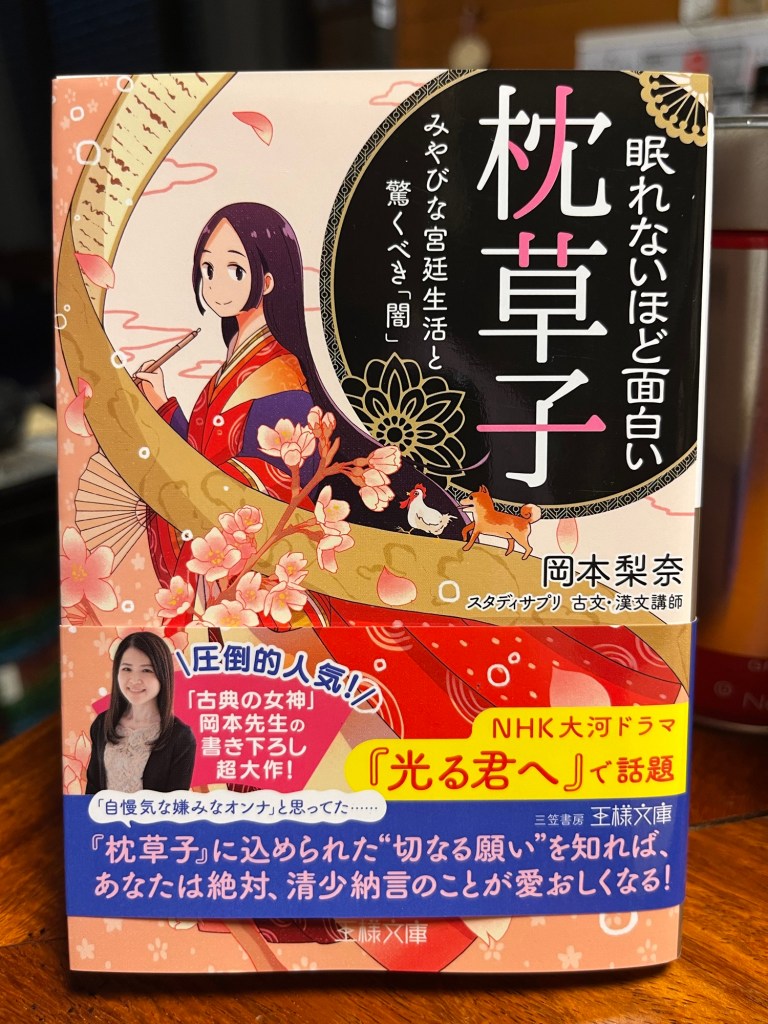
In the meantime I am excited to share some items I picked up, including these new books:

The first book explores the Pillow Book by Sei Shonagon, the second Lady Murasaki’s diary. These texts are both pivotal to appreciating the life and culture of people back then, the same people who composed the poetry of the Hyakunin Isshu. It’s a window to a world that simply doesn’t exist anymore.

Further, this book series, 眠れないほど面白い (nemurenai hodo omoshiroi, “so interesting you can’t sleep!”) has been a huge boon for the blog. It’s provided a lot of fun, historical information about the Heian Period, the Hyakunin Isshu, the Manyoshu, etc., that is simply not available in English. The Japanese is sometimes difficult to read at my level, but it’s been a labor of love, so I enjoy the challenge and have been learning a lot. So I am excited to delve into these two books as well.

Also, it’s noteworthy that both books above mention the current drama series 「光る君へ」as a tie-in.

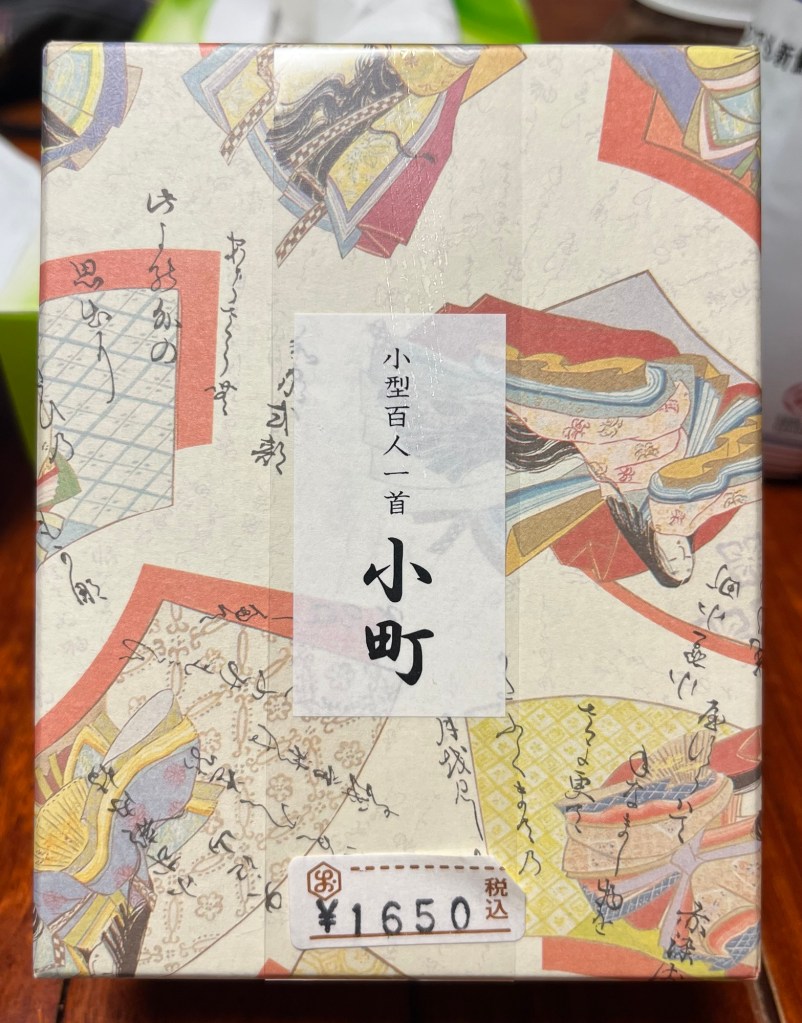
Yesterday, on a day trip to Tokyo I visited the Karuta shop Okuno Karuta (奥野かるた店). It was very easy to find from the Jinbocho train station (just head left and walk down a few blocks). The store was larger than the Tengu-do and includes lots of neat card sets not related to Karuta. I was on a budget so I tried not to spend too much. I did pick up a mini Karuta set though:

This set looks just like the first set I got, both Tengu-dō brand, but roughly half the size. It’s not suitable for competitive karuta but it’s cute and fun to own.

Anyhow, the staff at Okuno Karuta were very nice and helpful. While I was perusing, a tour group of elderly Japanese came through for a while, and the staff had to handle the rush of customers, before things quieted down again.

Hopefully I can post more updates soon.

P.S. also picked up an obscure Fire Emblem game too:

Lady Murasaki and Marital Strife

Lady Murasaki, one of the most famous women of Heian-period Japan, and the first novelist in Japan, wrote many wonderful romantic scenes through the Tales of Genji, yet her real life marriage was anything but.

The latest episode historical drama on NHK about the life and times of Lady Murasaki (poem 57, め) covers her marriage to her second-cousin Fujiwara no Nobutaka (藤原宣孝, ? – 1001), who was around 20 years her senior. Yes, this was not that unusual for the time, but still gross.

Sadly, the marriage quickly turned sour. Nobutaka slept around a lot, and had other hidden wives and children. Lady Murasaki did not take this lying down and the two of them fought frequently. Nobutaka for his part, enjoyed bragging about his trophy wife.

In the poems preserved in Lady Murasaki’s own private collection is this poem addressed to her husband:

JapaneseRomanizationRough Translation1
言ひ絶えばIi taebaIf you saw you’re going to
さこそは絶えめSa koso wa taemestop writing me, then fine!
なにかそのNanika sonoYou can’t even
らの池をMiwara no ike wostand by the bank
つつみしもせTsutsumi shimo senof Miwara pond properly.
1 Apologies for any mistakes, or for the roughness of this translation

The backstory of this poem is that Nobutaka had taken one of Lady’s Murasaki’s private letters addressed to him, and shown off that letter to friends (apparently bragging about how smart his young bride was). She was justifiably angry and told him to knock it off. Nobutaka was angry with her and threatened to stop writing. Her reply above, was a clever way of saying “fine, don’t bother writing me”. The allusion to Miwara pond was a pair of puns:

  • Miwana pond (mihara) is also a pun for anger.
  • The word tsutsumi is also pun for a bank (as in riverbank), and self-restraint.

Contrary to Lady Murasaki’s reply, Nobutaka was so impressed by the reply that he ended up bragging about it to his friends anyway. 🤦🏼‍♂️

Another letter is as follows:

JapaneseRomanizationRough Translation2
忘るるはWasururu waForgetting others is
うき世のつねとUki yo no tsune toa part of this ephemeral world,
思ふにもOmou ni moEven so,
身をやるかたのMi wo yarukata nobeing forgotten myself,
なきぞわびぬるNaki zo wabinuruI cannot help but cry.
2 Apologies for any mistakes, or for the roughness of this translation

The married nobility of the Heian Period frequently lived in separate estates, and the husband would visit his wife as needed, but not the other way around. It seems by this point, Lady Murasaki was forgotten by her philandering husband, and lamented her unhappy marriage. One can’t help but recall the Gossamer Years generations earlier.

It is sad that such a talented woman was relegated to an unhappy marriage with a faithless, not to mention narcissistic husband, especially in a society where women had little recourse. I also wonder how much this motivated her to write her novel, The Tales of Genji, as a coping mechanism.

P.S. Sources used in this post include:

P.P.S. For folks who are visiting Kyoto, there are many excellent locations associated with the life of Lady Murasaki and the Tales of Genji. The featured photo above is the “Genji Garden”, part of the Buddhist temple of Rozan-ji, courtesy of PlusMinus, CC BY-SA 3.0, via Wikimedia Commons. This blog includes an excellent photo-tour of Rozan-ji.

Lady Murasaki Drama

Hi folks!

I have been away for a while due to various life circumstances, but I’ve been wanting to share this news with readers.

The Japanese public TV station, NHK, broadcasts a new Taiga Drama (大河ドラマ) every year. These are big productions featuring some aspect of Japanese history, with big name actors and so on. I was very fond of the last one. Usually these cover periods of warfare or conflict, and male historical figures from Japan’s long history, but this year’s drama, titled Hikaru Kimi E (ひかる君へ, “Addressed to You [my dear Radiant One]”), features Lady Murasaki as the main character!

(Image by NHK, all rights reserved)

Lady Murasaki, poem 57 of the Hyakunin Isshu, needs little introduction. She composed the Tales of Genji, as well as her eponymous diary. She was the first female novelist in Japanese history, and has been a subject of interest ever since. The biographical details of her life are somewhat scant, unfortunately, and the drama does embellish quite a bit, including hinting strongly at a romance that probably didn’t happen in real life. My impression is that they are using romantic themes from her novel, the Tales of Genji, as the backdrop for the drama.

Nonetheless, I have been watching this series on Japanese TV1 and I enjoy it. It is somewhat different than past Taiga Drama, since it features a female main character, and this period of history (the late Heian Period), had little warfare, but it does have tons of scandal and intrigue as the Fujiwara clan tighten their grip on the reins of government. This drama is surprisingly risqué in parts, something you usually don’t see in a conservative Japanese drama. However, such scenes remind me more a more subdued Victorian romance than something in modern, American television.

That said, it’s a darn good drama thus far.

The drama frequently shows other people of the Heian period aristrocracy, many of whom were poets of the Hyakunin Isshu. To name a few who have been featured in the drama:

I admit I am particularly fond of the character Sei Shonagon. In historical pop culture, Sei Shonagon and Lady Murasaki are treated as rivals as they were both famous writers of the same generation who belong to rival cliques in the aristocracy, but in reality they probably didn’t interact much. Nonetheless, they frequently talk in the drama, and the actress who plays Sei Shonagon, stage name is “First Summer Uika” (ファーストサマーウイカ), is a talented actress and total babe:

She is on Instragram, too:

First Summer Uika also recently visited a Shinto shrine devoted to Sei Shonagon in Kyoto called Kurumazaki Jinja (車折神社), which even sells Sei Shonagon charms (omamori):2

But I digress.

Because the drama features so many people related to the Hyakunin Isshu, the drama subtly works in many poems from the anthology. It’s been great to suddenly recognize a poem being recited, even if I am a bit slow to recall. The settings, costumes, and cast are all amazing, and even though the historicity is questionable, it’s been a great watch.

I really hope they eventually make an English subtitle version so people outside Japan can watch. The quality of Taiga Dramas are terrific, and they are well worth watching if you can.

Update: while visiting Kyoto in 2024, we found a local NHK display of the drama:

The second photo above is First Summer Uika as Sei Shonagon.

1 Sadly there are not foreign translations, and no subtitles, and it is not always modern Japanese, so I admit I struggle at times to follow the story. At other times, I can follow easily enough.

2 We are going to visit Japan again this year (the last for our teenage daughter), including Kyoto. Visiting this shrine is definitely on the itinerary, even thought it’s pretty small.

New Book in Japan!

Hello from Japan! The family and I are here visiting family, but we are also using the time to visit some sites my youngest son hasn’t seen before (Pandemic ruined past travel plans).

Anyhow, yesterday my wife and I stumbled upon a fascinating book at the local bookstore titled Nemurenai Hodo Omoshiroi Hyakunin Isshu (眠れないおもしろい百人一首), meaning “[Facts about the] Hyakunin Isshu that are so interesting, you can’t sleep”. The publisher’s product link is here.

The book groups the 100 poems in a different order and seeks to get inside the mind of Fujiwara no Teika (poem 97), the compiler of the anthology, in order to determine why he selected these poems above thousands of others. The book tends to favor more salacious aspects of the authors and theories about why they composed the poems they did, but much of it lines up with Professor Mostow’s book too.

For example, I am currently memorizing poem 61, and the book explains some of the backstory of why the Ise no Tayu, and not someone more senior like Lady Murasaki (poem 57) got the privilege of reciting the poem for that occasion.

The illustrations in the book are amazing. The fantastic artwork really brings the stories of the authors to life.

Anyhow, as I read more, and as I come across more stuff related to the Hyakunin Isshu, I’ll be sure to post here, and update existing poem entries with more backstory details.

Talk to all soon!

An Awesome Poetic Comeback: Poem Number 60

This is one of my most favorite poems in the Hyakunin Isshu due to its backstory and its clever delivery and was composed by the daughter of Lady Izumi:

JapaneseRomanizationTranslation
おお江山ŌeyamaŌe Mountain and
いく野の道のIkuno no michi nothe road that goes to Ikumo
とおければTō kerebaare far away, and so
まだふみも見ずMada fumi mo mizunot yet have I trod there,
nor letter seen,
天の橋立Ama no Hashidatefrom Ama-no-Hashidate
Translation by Dr Joshua Mostow

This poem was composed by Ko-Shikibu no Naishi (小式部内侍, 1000? – 1025), daughter of Lady Izumi (poem 56). She too was a handmaiden of Empress Shoshi like her mother. The “ko” in her name implies a “junior” lady-in-waiting (shikibu) compared to her mother.

Sadly, she died in her 20’s, leaving her mother behind with a granddaughter to care for, and for such a talented poet, she has only a handful of poems in official anthologies.

According to the backstory of this poem, Lady Izumi was away in the province of Tango with her (current) husband, and there was a poetry contest in the capital. Ko-Shikubu, age 15, was selected to represent her mother. Middle Counselor Sadayori (poem 64) teases her saying:

What will you do about the poems? Have you sent someone off to Tango [to ask your mother for help]? Hasn’t the messenger come back? My, you must be worried.

trans. Joshua Mostow

To which the young and bold Ko-Shikibu pulled at Sadayori’s sleeve and composed this poetic reply off-the-cuff. While less obvious in English, the poem is a master piece because it recites three places in Tango in geographic order, has two puns (iku in Ikuno also means to go 行く, and fumi means both a letter 文 and to step 踏み) and the bridge mentioned, Ama-no-Hashidate, is associated with “stepping” too.

As the story goes, Sadayori was totally speechless and couldn’t come back with a good reply, so he ran off. My new book implies that they evidentially fell in love later like a modern romcom.

Think of this exchange as an 11th century Japanese rap-battle, and Ko-Shikibu trashed her opponent. Well done! 👏🏼👏🏼

P.S. Featured photo is “Travelers on a mountain path along the coast”, by Utagawa Hiroshige, Public domain, via Wikimedia Commons

Rustling of the Grass: Poem 58

The next poem in our series devoted to women was composed by the daughter of Lady Murasaki, Daini no Sanmi:

JapaneseRomanizationTranslation
ありま山ArimayamaWhen the wind blows
名の笹原Ina no sasawarathrough the bamboo-
grass field of Ina
風吹けばKaze fukebanear Arima Mountain
いでそよ人をIde soyo hito wosoyo—so it is:
忘れやするWasure ya wa suruhow could I forget you?
Translation by Dr Joshua Mostow

Daini no Sanmi (大弐三位, dates unknown), was the daughter of Lady Murasaki (poem 57) and was an accomplished poet as well. Her name in the Hyakunin Isshu is a sobriquet and comes from her husband’s position as Assistant Governor-general of Dazaifu province (daini). She served as the wet-nurse for Emperor Go-Reizei, she achieved the prestigious Third Rank in the Court hence “sanmi”.

This poem seems simple at first, which Professor Mostow explains as a poem composed about a man who had grown distant toward Daini no Sanmi, and that he was uneasy because he believed her feelings for him had changed. However, the poem contains some clever word-play too. The first three lines lead up to the word soyo which is an otomatopeoia for the sound of rustling grass, but also means “so it is!”. Professor Mostow explains that this is meant to convey to the man that she was the one was uneasy (because he was uneasy?). In other words, she was worried about his feelings because she cared about him. It’s amazing how one word can make all the difference like that when the context is just right.

Also, as a bit of reference, Arima Mountain, or arimayama (有馬山) is in the northern part of the city of Kobe, and boasts one of the most famous and oldest hot-spring resorts in all of Japan called Arima Onsen (有馬温泉). The Hyakunin Isshu Daijiten states that the combination of bamboo grasses at Ina (猪名) and Mount Arima was a popular setting used by many poets in antiquity.

One interesting aspect about the Hyakunin Isshu as a collection of poems is its tendency to have poets related to other poets in the anthology. The poems are not necessarily close to one another numerically, but quite a few poets in the anthology are related to another poet either as the child, parent, siblings, etc. You can see it through the women poets, but also through many of the male poets as well: Kiyohara no Motosuke (poem 42) is the father of Sei Shonagon (poem 62) and grandson of Kiyohara no Fukayabu (poem 36).

An Old Acquaintance: Poem Number 57

This next poem in our series devoted to women of the Hyakunin Isshu anthology is by one of the most famous women authors in Japanese history, Lady Murasaki:

JapaneseRomanizationTranslation
めぐりあMeguri aiteAs I was wondering
見しやそれともMishi ya sore tomowhether or not I had seen it
わかぬ間にWakanu ma niby chance,
雲がくれにしKumo-gakure ni shiit became cloud-hidden,
の月かなYowa no tsukikanathe face of the midnight moon!
Translation by Dr Joshua Mostow

Professor Mostow explains that the headnote for this poem describes an experience one night when Lady Murasaki had seen someone she had known long ago as a child, but she only saw them briefly in passing as they raced by. But there are many interpretations as to who that person had been. Many propose it was a fellow female acquaintance while others wonder if it was a male lover. Unfortunately we can’t be sure.

Lady Murasaki, known as murasaki shikibu (紫式部) in Japanese, was a somewhat unusual figure in the 11th century Heian Court, both for her talents and her personality. Compared to other women of that era, like Lady Izumi (poem 56) who was very passionate, and Sei Shonagon (poem 62) who was very bold and witty, Lady Murasaki was more introverted and sullen and prone to be alone, or exchange letters with other women who shared her frequent melancholy.

Lady Murasaki was among those rare women at the time who learned to read Classical Chinese, which normally was used by men of the Heian Court for official purposes, Buddhist liturgy, and of course Chinese-style poetry and literature. Women generally did not learn it, though the women listed above were exceptions. Indeed, Lady Murasaki’s father, Fujiwara no Tametoki, was said to have lamented that Lady Murasaki was born a woman, because her talents for literature was outstanding. In any case, it was Lady Murasaki’s talents that led her to being recruited as a lady-in-waiting (shikibu) to Empress Shoshi along with other dynamic women of her generation. She is often depicted in Japanese art like the painting below (she is at the bottom-right):

Empress Shoshi and son
Tokyo National Museum, Public domain, via Wikimedia Commons

Unfortunately, we know very little about Lady Murasaki today, apart from her writings: the Tales of Genji, her poetry, and of course her eponymous diary which covers a year or two of her life while serving the powerful Fujiwara no Michinaga. We don’t even know her real name. The term murasaki (紫, “purple”) refers to one of her characters in the Tales of Genji, of which several drafts circulated the Heian Court and people started to call her by that name. Her diary implies that the eminent poet of the time, Fujiwara no Kintō (poem 55), gave her this nickname as a nod to her skills. Later, her daughter Daini no Sanmi (poem 58) went on to become a talented woman herself.

Nevertheless, Lady Murasaki’s reputation has always endured throughout Japanese history as an author and poet of the highest caliber, and has a following even among Western audiences as well. She is celebrated and revered throughout the generations, and like Lady Izumi, enjoys a following in Japan among younger generations of women today. This page is a tribute to her as well.

P.S. Featured photo is of Lady Murasaki, as depicted by Tosa Mitsuoki (1617 – 1691), Public domain, via Wikimedia Commons