Disheleved: Poem Number 80

A clever morning-after love poem that I felt was fun to share:

JapaneseRomanizationTranslation
長からNagakaranI do not even know
心も知らずKokoro mo shirazuhow long your feelings
will last.
黒髪のKurokami noMy long black hair
乱れてけさはMidarete kesa wais all disheveled and,
this morning,
ものをこそ思Mono wo koso omoemy thoughts too are
in a tangle!
Translation by Dr Joshua Mostow

The author of this poem is Taikenmon-in no Horikawa (待賢門院堀川, dates unknown), or “Lady Horikawa of the household of Empress Taiken”. Empress Taiken was the consort to Emperor Toba, and was the mother of Emperor Sutoku (poem 77) who was later exiled.

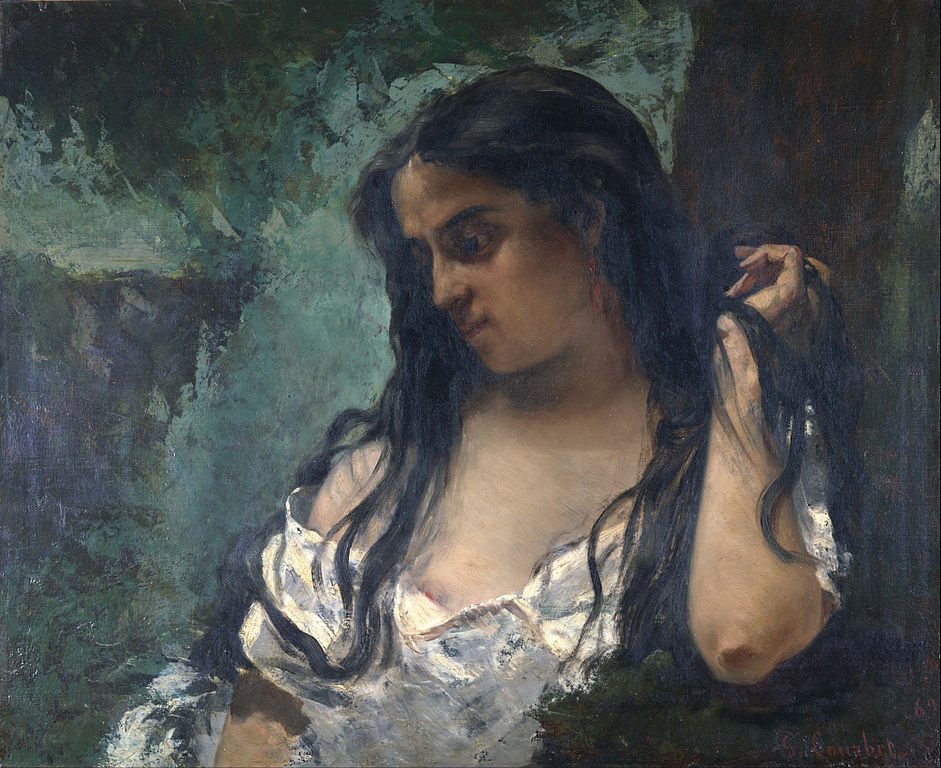
The use of imagery of “disheveled hair” was a common device often used by women, or writing poetry about women, to express feelings of frustration or anxiety.

As we’ve seen before, morning-after poems were very popular at this time in Japan as many of the aristocracy of the Heian Court would have love trysts between each other. Often the first meeting was the morning important, not surprisingly. It set the tone for the rest of the relationship, so a meeting like this was often celebrated in poetry.

Of course, there was another side to these trysts in the Heian Period too.

P.S. Featured photo is Gypsy in Reflection, by Gustave Courbet, Public domain, via Wikimedia Commons

Lamentations: Poem Number 86

Another Autumn moon poem, but with an interesting twist:

JapaneseRomanizationTranslation
なげけとてNageke tote“Lament!” does it say?
月やは物をTsuki ya wa mono woIs it the moon that makes me
するOmowasurudwell on things? —No,
and yet,
かこちがおなるKakochi gao narulook at the tears flowing
down
わがなみだかなWaga namida kanamy reproachful face!
Translation by Dr Joshua Mostow

This poem was composed by the Saigyō Hōshi (西行法師, 1118 – 1190), or “Dharma Master Saigyō” a famous Buddhist monk and poet from the era. Saigyo’s story is interesting in of itself, and I blogged more about it on the other blog, including additional poetry, but let me post a summary here.

In his youth, his name was Sato no Norikiyo and he was a promising young man in the Heian Court, and caught the attention of Emperor Toba, Emperor Sutoku (poem 77) and also Taira no Kiyomori, the most powerful man at the time and who later featured as a villain in the famous Tales of the Heike and a many dramas on Japanese TV.

However, Norikiyo grew disillusioned with the nasty politics and infighting in the Court, and abruptly decided to throw it all away. He left behind his career, his wife and children, and became a wandering mendicant. He took on the Buddhist name Saigyo (西行) and stayed at the famous mountain-monastery of Koyasan for monastic training. Later, he returned to the capitol to find everything had changed. The Hogen Rebellion had destroyed much of the capitol, Emperor Sutoku was exiled (having lost), and Kiyomori ruled as a warlord. A few years later, Kiyomori and the entire Heike clan were utterly destroyed in the famous Genpei War, which also spelled the end of the historical Heian Period. What might have happened had Norikiyo stayed and followed his career, rather than leave the capitol?

In any case, with the new samurai government at Kamakura (thus, the Kamakura Period of Japanese history), things settled down in Japan and Saigyo traveled around. He devoted his life to writing poetry, lamenting the loss of his former patrons, admiring the beautiful nature in Japan, and about life in general. He finally settled down in the outskirts of Osaka, and passed away at the age of 73. It was said that when he passed away, the cherry blossoms were in full bloom and that he died on the same day that Shakyamuni Buddha died (February 15th according to solar calendar).

He was also friends with Shunzei (poem 83), according to Professor Mostow.

Anyhow, this poem is, according to Professor Mostow, possibly inspired by a poem by famous Chinese poet Bo Juyi centuries earlier, and is supposed the express the feelings of a resentful lover. Is the moon making him/her tearful? Maybe, maybe not, but gazing up at the moon brings them such sadness anyway.

Saigyo’s talent with poetry and his interesting life story have certainly helped him earn a place in the Hyakunin Isshu, but also inspired many later poets such as Basho and others. Basho the Haiku master, in his travels, went to visit places frequented by Saigyo among others.

Thanks for Nothing: Poem Number 75

This is another autumn-themed poem, but with an interesting story behind it:

JapaneseRomanizationTranslation
ちぎりをきしChigiri okishiDepending with my life
させもがつゆをSasemo ga tsuyu woon promises that fell thick
命にてInochi ni teas dew on sasemo plants—
れことしのAware kotoshi noalas! the autumn of
this year too
秋もいぬめりAki mo inumeriseems to be passing.
Translation by Dr Joshua Mostow

The author of the poem, Fujiwara no Mototoshi (藤原基俊, 1060 – 1142), was a leading poet of the famous Insei Period of Japanese history, along with his contemporary Toshiyori (poem 74), but according to my new book, was never particularly successful as a bureaucrat.

According to both Professor Mostow and my new book, this poem was written as a complaint to the former Chancellor and Buddhist lay-novice (upasaka) named Tadamichi, the same man who composed poem 76.

Mototoshi’s complaint is that his son, better known as Bishop Kōkaku of Kofukuji Temple, wanted to preside over the annual lecture on the Vimalakirti Sutra, an important Buddhist text. This occasion was known as the yuima-e (維摩会) and was rather prestigious within the bureaucratic monastic system of the time. Being the chosen lecturer would have fast-tracked Mototoshi’s son to other opportunities. In spite of Tadamichi’s promises to help, year after year Mototoshi’s son was passed up, and so Mototoshi sent this poem as a complaint.

The term sasemo is another way of saying sashimo, which in modern Japanese is the yomogi (ヨモギ) plant. In English, this is better known as the Japanese mugwort, pictured above. We saw the use of mugwort as well back in poem 51, though for a very different reason. The featured photo above shows Japanese Mugwort (yomogi, ヨモギ) leaves, photo by Sphl, CC BY-SA 3.0, via Wikimedia Commons.

Sasemo plants inspired an earlier, more Buddhist poem, which Mototoshi alludes to:

JapaneseRomanizationTranslation
なお頼めNao tanomeStill rely on me!
しめぢが原のShimeji ga hara nofor I will help those of
させも草Sasemo-gusathis world for as long
わが世の中にWa ga yo no naka nias there are sasemo-plants
あらむ限りはAramu kagiri wain the fields of Shimeji
Translation by Dr Joshua Mostow

This was attributed to Kannon, the Buddhist deity (bodhisattva) of compassion who promised to rescue all beings in the world. This poem was in the Shinkokin wakashū, number 1917.

Thanks to Professor Mostow for the double-translation this week. If you haven’t already, definitely show him some love and check out his excellent translations. 🙂

Backfired: Poem Number 74

Even the Hyakunin Isshu has its comedic moments:

JapaneseRomanizationTranslation
うかりけるUkarikeru“Make that heartless
人をはつせのHito wo hatsuse nowoman, O mountain storm
山おろしよYama oroshiyoof Hatsuse Temple—
はげしかれとはHageshikareto wacrueller still!”—this is not
祈らぬものをInoranu mono wowhat I prayed for, and yet…
Translation by Dr Joshua Mostow

The author is Minamoto no Toshiyori Ason (源俊頼朝臣, 1055 – 1129), “Sir Minamoto no Toshiyori”, who is the son of Tsunenobu (poem 71) and father of Shun’e (poem 85) and was also a leading poet of his era, along with Mototoshi (poem 75). Toshiyori’s talents were not limited to poetry. According to my new book, he excelled at playing an instrument called the hichiriki, enough that he was invited to serve in the Imperial court under Emperor Horikawa. We went on to serve three Emperors in this capacity, and helped compile the unusually eclectic Imperial Anthology the Kinyō Wakashū, as well as many poems of his own in various anthologies.

The poem above was actually composed during a poetry contest held at the residence of Fujiwara no Toshitada, grandfather of Fujiwara no Teika (poem 97) who compiled the Hyakunin Isshu. The topic of the contest was “unfulfilled love so strong that one even prays to the gods”. The poem expresses frustration after having prayed to be able to meet a certain woman, and somehow she became even more resistant. As Professor Mostow explains, Teika valued this poem very highly because of its depth of feeling, excellent word choices, and clever story-telling (see below).

The name “Hatsuse Temple” is another name for a famous Buddhist temple in Nara, Japan called Hasedera. Hasedera is very well-known in Japan, and apparently was a frequent pilgrimage site for lovers and those with romantic interests. If you ever do happen to be in Japan, especially in the Nara area, I’d highly recommend visiting Hasedera temple.

This poem is listed as a “winter” poem, but I was really confused why this is since the topic sounds more like unrequited love. I checked my source, which explains that Toshiyori went up to Hatsuse Temple to pray, and then came back down (yama-oroshi, 山おろし) in the third verse. This symbolism of coming back down the mountain is evidentially considered a powerful symbol of winter. Perhaps this relates to New Year’s prayers and such. This third verse is also a neat dividing technique between the first half, praying at the temple, and the second half, the girl he was fond of despising him even more.

Catch Me If You Can: Poem Number 72

This is a more light-hearted poem in contrast to the previous one:

JapaneseRomanizationTranslation
音にきくOto ni kikuKnown far and wide,
高師の浜のTakashi no hama nothe unpredictable waves
あだ浪はAdanami waof Takashi’s beach—
かけじや袖のKakeji ya sode noI will not let them catch me—
ぬれもこそすれNure mo koso sureFor I’d be sorry should
my sleeves get wet!
Translation by Dr Joshua Mostow

The author of this poem was known only as Yūshi Naishinnō Ke no Kii (祐子内親王家紀伊, dates unknown) or “Kii of Princess Yūshi’s Household”. She served in the household of Imperial Princess Yūshi, and was the daughter of Taira no Tsunekata and one Lady Koben. The salon of Princess Yūshi included a number of poets and writers and it seems Kii was no exception. She participated in a number of poetry contests and her poems appear in various anthologies.

Speaking of contests, Professor Mostow explains that this poem actually was intended as a response to another poem in a competition held by Retired Emperor Horikawa. Kii was 70 years old at the time according to another source, which is impressive given that she expresses young love so easily after all these years.

The word adanami in the third verse is a particularly interesting phrase. It implies flowers that failed to bear fruit, and thus infidelity. Apparently the women in the poem is not a fool and won’t fall for a dishonest man.

But where is Takashi beach? I checked and it seems to be a famous beach in Osaka Bay, near modern-day Takaishi City in the Osaka Metropolitan Area.

Thanks, But No Thanks: Poem Number 67

This clever little poem shows the battle of the sexes as it existed 1,000 years ago:

JapaneseRomanizationTranslation
春の夜のHaru no yo noWith your arm as my pillow
夢ばかりなるYume bakari narufor no more than a brief
たまくらにTamakura nispring night’s dream,
なく立たKainaku tatanhow I would regret my name
名こそしけれNa koso oshikerecoming, pointlessly, to ‘arm!
Translation by Dr Joshua Mostow

The author, known as Suō no Naishi (周防内侍, dates unknown), the “Suō Handmaid”, was so named because her father was governor Suō Province. As mentioned before, this was a common method used by female authors (cf. poem 65), so unfortunately, their real names are rarely known. This is another poem that speaks to the importance of a woman’s reputation in the ancient Court of Japan, just like poem 65. However, this one is much more playful and shows a lot of wit.

According to the back-story, there was a social gathering at the Nijō-In (二条院), the woman’s quarters at the palace. The woman there were relaxing, and the author of this poem said, “I wish I had a pillow”. At that moment, one Fujiwara no Tada’ie happen to walk by, and hearing this stuck his arm through the bamboo screen (御簾, misu) and said, “Here, takes this as your pillow!”.

In reply, the author composed this poem. As Professor Mostow points out, the word for arm here (kaina) is a pun for pointless (kainaku).

People flirted pretty clever back in those days. 😏

P.S. Featured photo by Christian Kadluba, CC BY-SA 2.0, via Wikimedia Commons

A Matter of Personal Honor: Poem Number 65

A poignant poem that also provides insight into culture at the time:

JapaneseRomanizationTranslation
うらみわびUramiwabiAlthough there are
ほさぬそでだにHosanu sodé da nimy sleeves that never dry,
あるものをAru mono wobitter and sad,
恋にくちなKoi ni kuchinanwhat I really regret is
名こそしけれNa koso oshikerémy name, made rotten by love!
Translation by Dr Joshua Mostow

The author is Sagami (相模, 998? – 1068?) also known as “Lady Sagami”. Her name is taken from her father who served the governor of Sagami Province at one point, hence this became her sobriquet.

The poem is somewhat typical of the era, a woman is jilted and because of the public scrutiny her reputation is ruined. Because the Court society was so closed and small, rumors and reputation were a big part of the social life there. This is expressed in other poems in the Hyakunin Isshu, such as poem 18 or in the Gossamer Years. A woman who’s reputation was marred by an embarrassing incident, bad fashion choice or an unfaithful spouse would lose her standing in the court, and may not recover. She couldn’t really go pick up and start a new life either.

The motif tear-soaked sleeves was a popular poetic device, and you can find it in other poems in the Hyakunin Isshu, poem 42 for example. Sleeves (袖, sodé) in general are featured in a surprising number of poems from the Hyakunin Isshu:

  • Sleeves covered in dew from the overnight watch (poem 1)
  • Sleeves of a Buddhist monk, shielding the world (poem 95)
  • Pollen covered sleeves (poem 15)

Further, fashion in this time was somewhat different than the kimono we are familiar with from the medieval Japanese era. The photo above, taken by ロリ (CC BY-SA 3.0, via Wikimedia Commons) is an example of the jū-ni-hitoé (十二単) robes worn by ladies of the court during formal occasions. This multi-layered garment was difficult to put on as it comprised of up to 12 layers of garments. It was also difficult to walk in. And yet the junihitoé is an iconic fashion for the time, and as we can see in the Diary of Lady Murasaki, women of the Court would be heavily scrutinized for their sense of taste during such occasions.

It’s not hard to imagine a broken-hearted woman with tear-soaked sleeves nevertheless, and how it became an important expression of Japanese sentiment at the time.

End Of An Affair: Poem 63

This is one of the sadder poems to share, but does have an interesting historical point to share as well:

JapaneseRomanizationTranslation
今はただIma wa tadaNow, the only thing
たえなOmoi taenanI wish for is a way to say
とばかりをTo bakari woto you directly
人づてならでHitozute nara de—not through another—
よしもがなIu yoshi mo ga na“I will think of you no longer!”
Translation by Dr Joshua Mostow

The poem was composed by Sakyō Daibu Michimasa (左京大夫道雅, 993 – 1054) who title means “Master of the Western Capital Michimasa”. He also known by his personal name as Fujiwara no Michimasa. 

Michimasa was the son of Fujiwara no Korechika, and Michimasa’s grandmother wrote poem 54. Despite their power and influence, Michimasa’s family was on the losing side of a struggle with a rival clan faction, led by his great-uncle Fujiwara no Michinaga. Michimasa. According to Mostow, Michimasa spent the remainder of his life in “elegant retirement” after their family lost the power struggle.

According to Mostow, the story behind this poem was a famous affair involving Michimasa and the former High Priestess of the Ise Shrine, Masako Naishinnō (当子内親王, “Princess Masako”). My new book explains that Michimasa was 24 at the time and she was 15, and had just returned to the capitol after fulfilling her duties as the high priestess. More on that below.

This affair is described in the Eiga Monogatari, an important historical source at the time, possibly composed by Akazome Emon (poem 55).

In any case, news of the affair angered her father, the Retired Emperor Sanjo (poem 68) and the retired emperor subsequently assigned bodyguards to her to prevent Michimasa from seeing her again. As you can see, Michimasa is lamenting that he can’t even say a proper goodbye to her in person anymore. Princess Masako eventually took tonsure as a Buddhist nun, and soon after died due to illness. They never met again.

But there is a bit more to the story. Michimasa, like his father Korechika, had a bad reputation that dogged him throughout his life, and kept him shut of out any official posts in the government. With the loss of Masako, and no hope of success in society, Michimasa took a dramatic turn for the worse. My new book explains that Michimasa fell headlong into gambling, and violence, so much so that he earned the nicknames such as Arasanmi (荒三位, “Wild third rank”) and Akusanmi (悪三位, “evil third rank”). The “third rank” was his aristocratic rank in the Imperial court.

Worse still, Michimasa was implicated in the murder of Emperor Kazan’s daughter in 1024 in the dread Jotomon-in Incident (上東門院女房殺害事件, jōtōmon-in nyōbō satsugai jiken). The murderer confessed to killing her on Michimasa’s orders. Yikes.

Michimasa was finally demoted and in his final years took tonsure as a Buddhist monk, and faded from history.

Let’s talk about Princess Masako’s role of High Priestess, though.

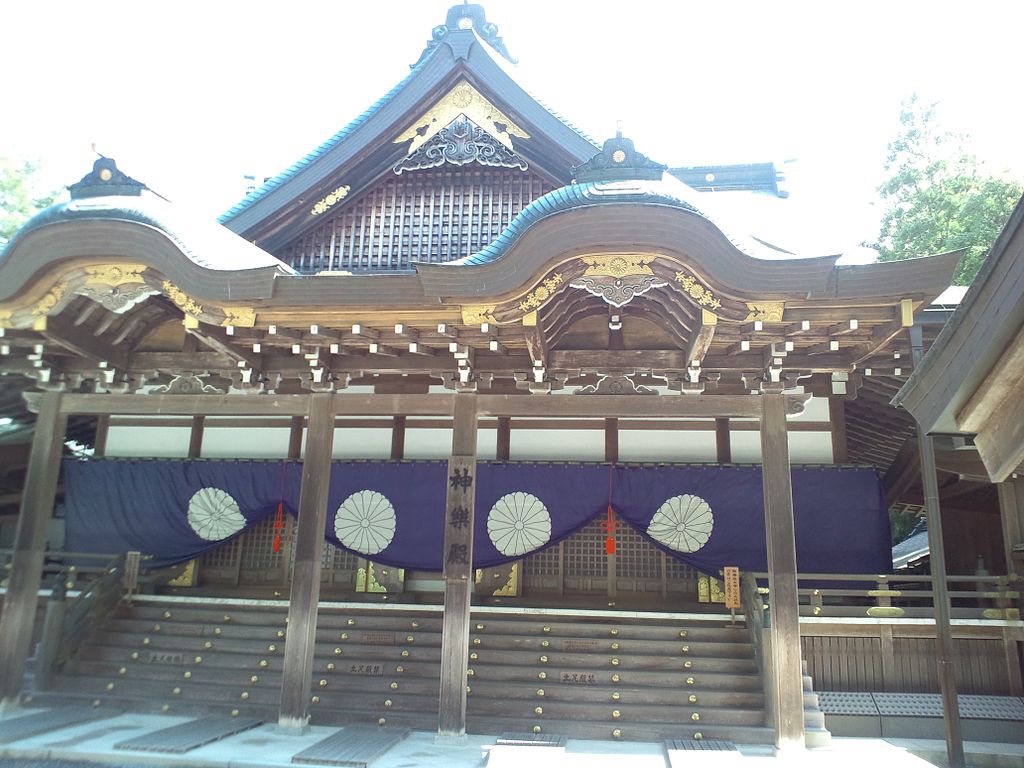
The Ise Grand Shrine is probably one of the most sacred, if not the most sacred, in all of Japanese Shinto religion. The featured photo above shows the inner sanctum (photo by Yanajin33, CC BY-SA 3.0, via Wikimedia Commons).

Due to shrine’s connection with the Imperial Family, who were said to be descended from its primary deity, Amaterasu Omi-no-Kami, the Imperial Family always had one member serving as the High Priestess or saiin (斎院). Usually this was the reigning Emperor’s daughter, and when that Emperor stepped down, she would return to the capitol. This tradition still continues to this day, even with the modern Imperial family. Another example within the Hyakunin Isshu is Shokushi Naishinnō (poem 89).

In those days, the High Priestess was a vestal virgin, similar to the ancient priestesses of Rome, and was supposed to remain so during her tenure. However, as other writings of the time showed, such women still corresponded with men from time to time and kept a social circle of women around them. Lady Murasaki (poem 57) lamented in her diary about the rival social circle around the High Priestess at the time outshining the Court itself.

Nevertheless, the life of High Priestess was very demanding and required strict ritual purity, part of Shinto religion. One could not come into the presence of the gods, particularly at more sacred sites, without it. Thus, Princess Masako’s affair with the dubious Michimasa apparently went too far and Emperor Sanjo’s reaction was quite harsh.

The tragic story of Fujiwara no Michimasa and Princess Masako, encapsulated in this short poem, is a complex and dark tale. Michimasa was in a sense doomed from the start due to his family’s loss of grace and dubious reputation. Princess Masako, being a teen and cloistered in the Imperial family duties probably didn’t know better. Their romance was doomed from the start, but the evil turn by Michimasa only makes the story sadder. What if Michimasa had been able to continue his romance with Masako, or maybe wasn’t shunned by society in his youth? What might the two have become? What if they had simply never met?

We will sadly never know.

The Gossamer Years

Hi all,

This somewhat different than my usual posts, but I after posting by poem by the Mother of Michitsuna (poem 53), I decided to read her diary, titled the Gossamer Years, or kagerō nikki (蜻蛉日記) in Japanese.

The “Mother of Michitsuna” is never named as per the culture of the Heian Period of Japan. She lived a generation or two before other famous female authors such as Sei Shonagon (poem 62), Lady Murasaki (poem 57), Lady Izumi (poem 56), etc. The translator, Professor Seidensticker, did a masterful job translating this difficult text. In reading the footnotes, you can see he struggled a lot with the vagaries of the text, and with the language, where it’s not always clear from the context who’s talking about whom.

At the time, she was from a lesser branch of the powerful Fujiwara Family, but she married Fujiwara no Kane’ie, who was gradually moving up the ranks of the Heian Court. Fujiwara clan, Kane’ie had to contend with various other members of the court, and even his own clan, to gain the prestigious position of Regent, which he finally accomplished in 986 as regent for Emperor Ichijō. His sons, Michinaga and Michitaka both became regents and the most powerful men in the Heian Court. Lady Murasaki (poem 57) served under Michinaga, by the way, and they are the subject of a Japanese historical drama in 2024.

Suffice to say, Kane’ie was a very ambitious and influential man. As such, he married a few women, as per Heian Period custom, and also carried on various affairs, having yet more children on top of this. One of these children is the author of poem 52.

The Mother of Michitsuna began her diary when Kane’ie first met her, and courted her. Her own father was the governor of a remote province, a mediocre position in the Court, but he gave his blessing and they were married. In the early part of the Diary, she writes about all the passionate love poems they exchanged and such. It seemed like a good relationship early on, but the Mother of Michitsuna wasn’t Kane’ie’s first wife. She was probably his second or third wife (the diary isn’t clear on this), and his time was divided between his wives. When he was not around, she stayed in one of the outer rooms of his mansion and just passed the time with her hand-maidens.

But as the diary shows, Kane’ie’s visits came less and less often. In time she tracked him down to an alleyway where he’d spend the night with some girl, presumably a bastard child of one of the emperors, and rumor has it that she had a son by him as well. The author was not surprisingly furious and jealous, but completely powerless to stop him. She writes about the sound of his carriage driving by the residence, but not even stopping by to say hello, while she spent night after night alone.

Later, in Book 3, she finds about more of his affairs and children, and adopts the daughter of another of his lovers so that she doesn’t have to spend her young life in a monastery. Strangely, Kane’ie’s brother takes an interest in the child (his own niece) and gets very pushy about marrying her which again was not unusual at the time among the nobility. The Mother of Michitsuna expends a lot of effort to delay and make excuses for the girl, and pleads with her husband to help her, with only modest success.

This agonizing loneliness and sense of abandonment is the primary theme of the Gossamer Years. There are times when Kane’ie and the Mother of Michitsuna grow closer briefly, such as when Kane’ie falls gravely ill or when the Mother of Michitsuna loses her own mother to old age, but after a while he forgets her again. Their relationship is quite strained in the diary though, because she is frequently enraged by his insensitivity, but Kane’ie gets frustrated by her “moods” and can’t seem to understand why she is mad at him. Worse, he blames her regularly as to why he doesn’t come anymore.

At one point, the Mother of Michitsuna, now old and a has-been, has had it with Kane’ie and abruptly moves out of the mansion and retreats to a monastery which causes quite a stir at the Court and humiliates Kane’ie. Furious he tries to send messenger after messenger to bring her back, but she refuses for a long time. Finally, after a combination of threats and pleading, she agrees to return home, but they soon fall into the old routine again.

The Mother of Michitsuna only had one child with Kane’ie, Michitsuna of course (who rose to be a minister of the Court, though not as powerful as his half-brothers), and Kane’ie seems to take much pride in his son, but also periodically uses him as a weapon for getting back at his mother.

Thus, the Gossamer Years is a long, and often very depressing diary of a noblewoman in a very unsatisfying marriage who spent many dreary days alone. The diary ends abruptly one day when there’s a knock at her residence, and it appears that she never took up the brush again. Nobody knows why. As for the diary itself, it is full of poems exchanged back and forth. Most of these are mediocre poems, though as you can see, Fujiwara no Teika did include one of them in his famous Hyakunin Isshu anthology. However, these other poems are also waka poems, just like the ones you read here on this blog, and it’s amazing how many poems people exchanged in those days just to express things like “how are you?” or “can you come over?”.

In today’s modern age where text-messages replace letters or poems, we can send messages much quicker now, but it’s amazing how much skill and subtlety it took to get a simple point across to someone back then. Not surprisingly, the kinds of feelings of frustration a broken-hearted woman might have were probably much worse then because they were traditionally very isolated in their homes. It was uncommon for women, especially powerful noblewomen, to go out on their own without permission from their husbands, and their lifestyle and huge robes made it difficult to travel far anyway. Customs and such would also get in the way too. In short, women spent most of their time indoors in their home with nothing to do.

As for the Mother of Michitsuna herself, it’s tempting to make her a tragic, almost saintly figure, but in reality she was prone to faults of her own. When the “woman in the alley” had the misfortune of losing her home to a fire, the author felt a moment of triumph and petty revenge without any remorse. In another, more troubling scene late in book one, she encounters a defeated rival (it’s not clear who) and gloats over her:

At the Hollyhock Festival in the Fourth Month I recognized the carriage of a lady who had once been my rival, and I deliberately had my own carriage stopped beside it. While we were waiting, rather bored, for the procession to go by, I sent over the first line of a poem, attached to an orange and a hollyhock: “The hollyhock should promise a meeting, but the orange tells us we have yet to wait.” After a time she sent back a line to complete the couplet: “Today for the first time I know the perverseness of her who sends this bitter yellow fruit.” “Why just today—she must have had similar feelings for years,” said one of my women. When I told the Prince [Kane’ie] of the incident, he remarked, to our considerable amusement, that the closing line the lady really had in mind was probably more like this: “This fruit you send me, I would like to grind it to bits with my teeth.”

pg. 59, trans. Seidensticker.

Clearly the Mother of Michitsuna was not above petty rivalries or revenge when it suited her.

Anyhow, what makes the Gossamer Years such a significant work of literature is that it was the first and only real diary of the Heian Period to really express how a woman felt in that small, cloistered world. The Heian Period had many great works of literature, both by men and women, but these works were either fiction (e.g. Tales of Genji), poetry (e.g. Tales of Ise) or just dry, stodgy journals about oval events. The Gossamer Years is much more “raw” and unfiltered than other works at the time. The Mother of Michitsuna is not a strong or witty writer like Sei Shonagon or Lady Murasaki, but you can really feel her pain at times, and wonder why she puts up with him. Then again, the customs of the time gave her few options.

But as you see later in Book 3, it was the culture of the time, not unlike the cloistered French Aristocracy centuries later. The marriage laws from the Taika Reform were vague and full of loopholes, so men could marry as often as they could afford, and affairs were pretty rampant as other poetry in the Hyakunin Isshu regularly show. So while I do enjoy the Hyakunin Isshu and the culture of the Heian Period very much, the Gossamer Years was a sobering reminder that there was a serious side to it as well.

P.S. Featured photo is a scene from the Genji Monogatari (“The Tales of Genji)”, Chapter “YADORI GI”( mistletoe ), by Lady Murasaki (poem 57).  Imperial court in Kyoto, Public domain, via Wikimedia Commons

Waves Beating Against The Shore: Poem Number 48

I decided to post this one after Valentine’s Day for all those whose plans didn’t go well. You’re not alone, as we shall see.

JapaneseRomanizationTranslation
風をいたみKaze wo itamiWaves that beat against the rocks,
うつ波のIwa utsu nami nofanned by a fierce wind—
おのれのみOnore nomiit is I alone
くだけて物をKudakete mono wowho breaks, those times
おも頃かなOmou koro kanawhen I think of her!
Translation by Dr Joshua Mostow

The author, Minamoto no Shigeyuki (源重之, ? – 1001) was a well-associated poet who knew Kanemori (poem 40) and Sanekata (poem 51) according to Mostow. He is the last of the Thirty Six Immortals of Poetry featured in the blog (not all 36 are in the Hyakunin Isshu).

The poem, like poem 45 and poem 19, features the popular theme of a cold lover. For some reason, I had a difficult time understanding the analogy of this poem the first time, but Shigeyuki is comparing himself to the waves that crash on the shore. His lover is like the rocks that are unmoved by the waves.

It turns out though that this poem was actually composed for a poetry game involving a hundred-poem sequence “when Retired Emperor Reizei was still called the crown prince” according to Mostow. Such poetry games were popular in the late Heian Period, and influenced people like Fujiwara no Teika and the Hyakunin Isshu anthology.