For the end of the year, I wanted to share a poem compsed by Otomo no Yakamochi, the compiler of the Manyoshu:
Original Manyogana
Modern Japanese
Romanization
Rough Translation
新
新しき
Aratashiki
Just as the
年乃始乃
年の初めの
Toshi no hajime no
new-fallen snow
波都波流能
初春の
Hatsu haru no
of this New Year’s day
家布敷流由伎能
今日降る雪の
Kyo furu yuki no
piles up, so too do
伊夜之家餘其騰
いやしけ吉事
Iyashike yogoto
auspicious tidings.
Poem 4516, chapter 20, rough translation by me.
The headline of the poem explains that that particular New Year’s day experienced record snowfall, and so Yakamochi recited this poem for the occasion.
Also, a note on translation: the poem as written in Japanese doesn’t say “new year”, but actually says “first spring”. This is because in the traditional Chinese calendar (which Japan used for many centuries) the New Year began early Spring, not mid-winter as we do in the West (i.e. January 1st). This is true even now in Chinese culture: Lunar New Year usually begins in late January or February depending on lunar cycles. Thus, many traditional phrases related to New Year in Japan literally say “Spring”, for example shinshun (新春, “new spring”) or geishun (迎春, “welcoming spring / new year”). This poem is no exception.
So with that, I wish you all a wonderful 2026, and a happy, joyous new year. May your good fortune pile up like snow!
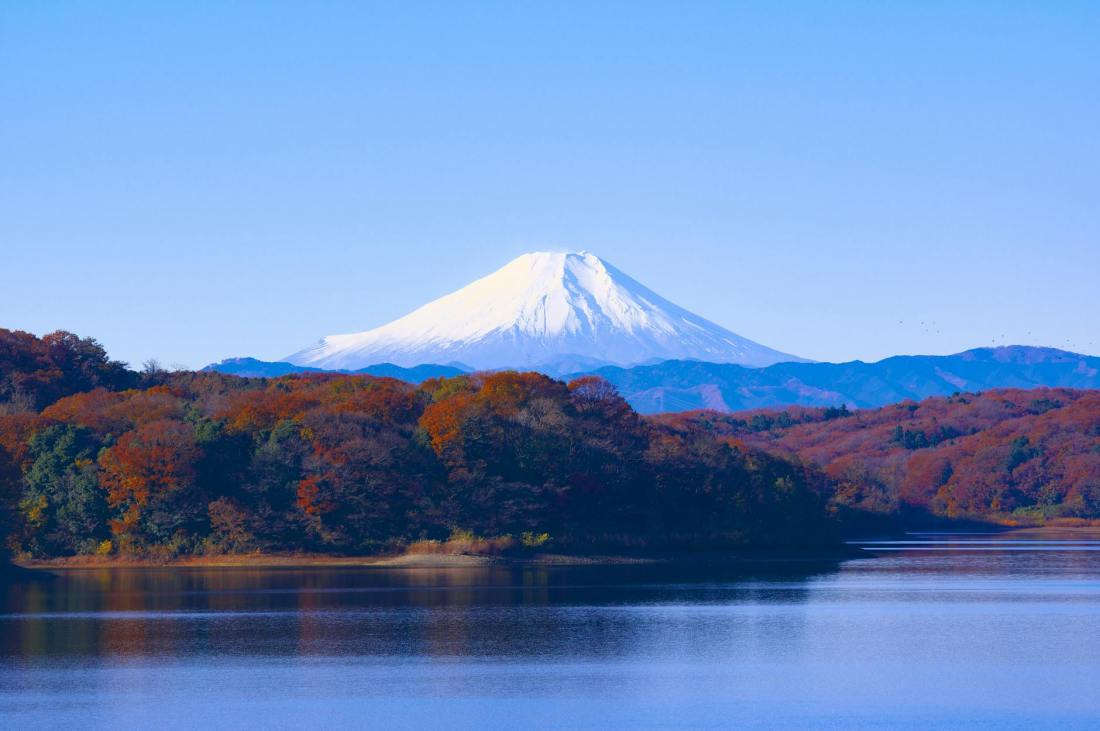
P.S. According to Japanese tradition, if you dream about Mount Fuji, an eagle, or eggplant during the first sleep after New Year, you will have an extra good year.
Recently, I finally finished my book on the Manyoshu. I can’t read Japanese fast, so it took me a year to finish, but it was satisfying to finish an adult-level book in another language, even if I relied heavily on dictionaries. I learned a lot! I hope you enjoyed some of the related posts here too.
Anyhow, the end of the book explored some miscellaneous poems, and this one really stood out to me for its Buddhist theme, and the unusual format. This is poem 3852:
Original Manyogana
Modern Japanese
Romanization
Rough Translation
鯨魚取
鯨魚取り
Isanatori
While fishing, I wonder
海哉死為流
海や死にする
Umi ya shinisuru
if the seas will die,
山哉死為流
山や死にする
Yama ya shinisuru
and the mountains die
死許曽
死ぬれこそ
Shinure koso
They will surely die
海者潮干而
海は潮干て
Umi wa shiohite
for the tides recede,
山者枯為礼
山は枯れすれ
Yama wa karesure
and the mountains wither.
This poem is a rare example of a Japanese sedōka-style ( 旋頭歌 ) poem, which has 5-7-7-5-7-7 syllables. Compare this to the later waka style poem of the Hyakunin Isshu (and the vast majority of the poems in this blog) which are 5-7-5-7-7, and haiku which are 5-7-5. Sedoka poems are an early stage of Japanese poetry that wasn’t used much beyond that as Waka (then later Haiku) became more popular.
Still, this poem is quite interesting. In fact, it was used in a famous Japanese pop song a few generations ago.
Nonetheless, the Buddhist themes of impermanence are hard to miss here, even with my amateur translating skills. The poet asks if even the seas and mountains will wither and die, and indeed, since the tides come in and out, and the mountains dry up (during the summer?), this can only mean “yes”, they won’t last forever.
Similarly, there is another Buddhist poem in the Manyoshu worth looking at:
The two oceans maybe an allusion that mirrors Shandao’s Parable of the Two Rivers (in my other blog), or the general Japanese-Buddhist concept of Ohigan. We also see the theme of mountains drying up, and seas receding again.
But if you thought this was vague, poem 3850 is even more straightforward in its meaning:
This poem alludes to another place, which again can mean the world of peace or enlightenment, or allude to the notion of a Buddha’s Pure Land. It doesn’t specify which Buddha (Amida, Shakyamuni, etc), but I am inclined toward this latter interpretation. I suppose it doesn’t really matter. The sentiment is the same: this world is impermanent and troublesome, and the author longs for something better, but is unsure of the path to follow.
I think we can all empathize with this at some point in our lives…
In the Hyakunin Isshu poetry anthology, the subject of this blog for almost 15 years (!), there are many poems about love, nature, sadness, etc. But none about death. There are poems on betrayal, but in the context of infidelity, not on stabbing others in the back.
…. and yet, beneath the surface there are other stories to be told.
In the seventh century, with the death of Emperor Kōtoku in 654 CE, another power struggle erupted. One one side was the emperor’s son, Prince Arima (有間皇子, 640-658), and on the other was the emperor’s older sister and reigning sovereign Emperess Saimei. Empress Saimei had her own son named Prince Naka-no-ōe (中大兄皇子) and was a rival to Prince Arima, Because his mother was the reigning sovereign, Naka-no-ōe would be next in line for the throne, not cousin Prince Arima who was left in the cold.
According to historical accounts, Arima was quietly approached by one Soga no Akae (蘇我赤兄), grandson of the influential Soga no Umako, who promised to help him overthrow Empress Saimei and support his ascension to the throne. Initially, Arima was interested, but later got cold feet. He swore Soga no Akae not to tell anyone, and to call the whole thing off.
But what Arima didn’t know, was that the whole thing was a setup. Prince Naka-no-ōe had planned the whole thing, and Akae told him what happened.
Prince Arima was soon arrested, and taken outside the capitol for interrogation. On his way there, at a place called Iwashiro no Hama (“Iwashiro Beach”),1 he tied a cord, or a piece of grass to a pine branch. This was evidentially a tradition at the time to pray for good luck on one’s journeys.
Once the interrogations were complete, Prince Arima was sent back toward the capital, but was executed en route by hanging at a place called Muro no Yu (牟婁の湯), which is now a seaside resort town. He was 19 at the time, the year was 658 CE.
Forty-three years later (701 CE), Kakinomoto Hitomaro (poem 3 in the Hyakunin Isshu, あし) was serving the current Emperor Monmu, grandson of Empress Jito (poem 2, はるす), and during an an imperial outing they came to Muro no Yu. By now, Prince Arima’s demise was well-known, including the story of him tying cord to a pine tree branch. Hitomaro, remembering what happened, composed the following poem (poem 146 in the Manyoshu):
Original Manyogana
Modern Japanese
Romanization
Rough translation
後将見跡
後見むと
Nochi mimu to
That pine branch that
君之結有
君が結べる
Kimi ga musuberu
you were going to visit
磐代乃
磐代の
Iwashiro no
after tying a cord:
子松之宇礼乎
小松がうれを
Komatsu ga ure wo
I wonder if you ever did
又将見香聞
またも見むかも
Mata mo mimu kamo
see it again…
Rough translation by me, apologies for any mistakes or nuance issues
Kakinomoto Hitomaro is reminiscing whether Prince Arima got to see the pine branch again one his way back, before he was executed. It’s a sad poem on the tragically short-lived prince.
But there’s more to the story.
Soga no Akae and his clan, the Soga were frequent troublemakers at this time, and both Empress Saimei and her son Prince Naka-no-ōe executed or assassinated multiple members of the clan at the instigation of the Nakatomi. The Nakatomi were later renamed “Fujiwara”, and if you look at the list of poems in the Hyakunin Isshu, you see a lot Fujiwara poets. There’s a very good reason for this. The final straw for the Soga Clan was in 672 when yet another power struggle put the Soga on the losing side of the war. Akae was among those exiled. The Soga permanently lost power.
And finally: what happened to the powerful and conniving Prince Naka-no-ōe?
He eventually ascended the throne as Emperor Tenji, poem 1 of the Hyakunin Isshu (あきの) and instigator of conflicts of his own.
So, it’s interesting to read his poem in the Hyakunin Isshu and its rosy picture of a fall harvest, knowing that the man had some blood on his hands too…
P.S. featured photo is a 17th century depiction of the power struggle between Empress Saimei and the Soga Clan. Courtesy of Wikipedia.
P.P.S. another post on the dark political history behind some poets of the Hyakunin Isshu.
1 You can see modern photos of the place here. It is in Wakayama Prefecture.
The compiler of the Manyoshu poetry anthology, Ōtomo no Yakamochi (大伴家持, 718 – 785), who also composed poem 6(かさ) in the Hyakunin Isshu, had a girlfriend named Kasa no Iratsumé (笠女郎, sometimes called “Lady Kasa” in English ) who was very devoted to him. She was second only to Yakamochi’s stepmother1 in her poetic contributions to the Manyoshu, and wrote many lovely poems to Yakamochi, including this one:
Rough translation by me, apologies for any mistakes
This is a nice, touching poem about someone who misses her far away lover. Not unusual in the Manyoshu, because even a journey to a neighboring province was a lengthy affair, let alone a remote one.
So, why do I highlight this poem when Kasa no Iratsume contributed many others?
In the late 19th and early 20th centuries was a Japanese author named Mori Ōgai (森 鷗外, 1862 – 1922), who during Japan’s rapid modernization period, spent some time in Germany learning Western medicine. Ogai was also an excellent writer, and wrote several stories, including a famous short story Maihime (舞姫, “The Dancing Girl”) about a young German woman who fell in love with a Japanese man studying there. After the man returns to Japan, the German woman (now pregnant) pines for him, and eventually meets a tragic end even as he prepares to return to Japan. The story is, according to Ogai, not autobiographical, but taken from anecdotes of other Japanese students studying abroad.
What’s interesting is that Ogai was definitely fascinated by Iratsume’s poem and even borrowed the obscure term 面影 (omokagé) in the title of the work Omokagé (於母影): a collection of Western poems translated into Japanese by Ogai and other members of the Shinseisha Society (新声社) in 1889. The related story of a young woman pining for the one she loves in a remote place is not hard to miss either in Dancing Girl, so perhaps that was a source of inspiration.
Nonetheless, it’s amazing how one writer or poet can inspire another 1,000+ years later.
… then again, I suppose that’s how this blog got started. 😏
1 Yakamochi’s birth mother died when Yakamochi was very young, and so he was raised by his stepmother, Ōtomo no Saka no Ue no Iratsume (大伴坂上郎女). She herself was on her third marriage after her previous two husbands both died. This underscores how short the average lifespan was in those days, even for the wealthy, as a woman in her 20’s or 30’s might be on her third marriage by then. Something almost unthinkable in the 21st century. Lady Izumi (poem Poem 56 of the Hyakunin Isshu あらざらん) had a similar string of bad luck.
The Hyakunin Isshu anthology, the subject of this blog, is not known for bawdy subjects as Japanese poetry by that time had become increasingly refined and codified in style. By contrast, the much older Manyoshu included a wider variety of poems and topics. This includes drinking poetry.
In fact, the compiler of the Manyoshu, Ōtomo no Yakamochi (大伴家持, 718 – 785) who also composed poem 6 in the Hyakunin Isshu (かさ), was the son of a famous literati and booze-hound: Ōtomo no Tabito (大伴旅人, 665 – 731). Tabito was a contemporary of Hyakunin Isshu poet Hitomaro (poem 3, あし), though not quite as successful.
Tabito was dispatched by the Imperial bureaucracy at the time to serve a term as governor of Daizafu in western Japan, and while there he formed a poetry circle called the Tsukushi Kadan (筑紫歌壇, “Tsukushi Poetry Circle”), where Tsukushi is the name of an old district in Dazaifu. Of Tabito’s 50+ poems in the Manyoshu, 13 of them were contributed by Tabito, known as the Sake wo Homuru Uta Ju-san-shu (酒を讃むる歌13首) or “The Thirteen Poems Praising Saké [rice wine]”.
Although I joke about Tabito’s possible alcoholism, the poems are not necessarily meant to be taken as literal. My book on the Manyoshu points out that these poems may have intended to imitate a famous 3rd century literati group in China called the Seven Sages of the Bamboo Grove, sometimes known as the Seven Sages of the Western Jin [Dynasty]. In Japanese they are called the chikurin-shichiken (竹林七賢). The enduring image of these seven musicians, poets and scholars is a band of bohemian, drunken geniuses, and Tabito and his poetry circle was likely inspired by them. You can see other examples of artistic inspiration in this post from my other blog. Between this collection of poems, and the Zen artwork in my other blog, I had no idea that the Seven Sages were such a popular topic in art.
But I digress.
There is another side to this poetry as well : evidentially on the move from the capital (Kyoto) to Dazaifu to the west, Tabito’s wife apparently fell ill and died. So, my book alludes to the idea that Ōtomo no Tabito took up drinking not just as a literati trend, but also to deal with the grief of losing his wife. Marriages at this time were often political as various noble families vied for position in the tightly stratified hierarchy in the Imperial Court. However, even political marriages could be happy ones at a personal level, so Tabito may have genuinely been grieving for a wife that he loved, plus the isolation from the capital.
Tabito’s poems, celebrating the virtues of rice wine, are technically very good poems, but also cover a subject that is omitted in later anthologies where style and form were pretty much codified by then. So, by the time the Hyakunin Isshu was compiled, 4 centuries later, no one would write such crass poetry about booze and girls (atleastnotopenly). Further, while the Manyoshu lacks the refinement of the Hyakunin Isshu, it does have a raw, visceral tone that’s often missing in later anthologies, and resonates differently with readers. Personally, I love both anthologies, but for different reasons.
P.S. I’m finally back, and have a few upcoming topics. Please enjoy.
1 This kind of rice wine seems to be a style from China, where the fluid is cloudy rather than clear.
This was a particularly nice poem that I found in the Manyoshu heralding early Spring.
Original Manyogana
Japanese
Romanization
Rough Translation
石激
石走る
Iwa bashiru
Are not
垂見之上乃
垂水の上の
Tarumi no ue no
the bracken buds
左和良妣乃
さわらびの
Sawarabi no
sprouting next to a
毛要出春尓
萌え出づる春に
Moe-izuru haru ni
waterfall
成来鴨
なりにけるかも
Narinikeru kamo
the first sign of Spring?
This poem was composed by Shiki no Miko or Prince Shiki (志貴皇子, ? – 716), who was the seventh son of Emperor Tenji (poem 1 in the Hyakunin Isshu). Unlike his siblings who were embroiled in the political strife of the times, Prince Shiki retreated and focused on poetry instead. His talents with poetry earned him a place in the Manyoshu, and Japanese poetic history.
Ironically, despite staying out of succession struggles, Prince Shiki’s own son, Prince Shirakabe later ascended the throne as Emperor Kōnin despite not being the dominant line, and all subsequent emperors in Japan are descended from him. So, in the end, Prince Shiki won afterall.
The poem itself evokes a truly wonderful image of a tiny sprout peeking through the rocks by a riverbank, heralding the first signs of spring.
Note that in the traditional Japanese calendar, based off the Chinese model, Spring started much later than the modern meteorological Spring, namely at the start of the second lunar month. Hence, the holiday of Setsubun relates to the start of Spring, and helps conclude the Lunar New Year. Plum blossoms are also frequently associated with this time of year since they bloom earlier than cherry blossoms, and were highly prized by poets of Manyoshu, as we can see in this poem (also posted here):
Back to our regularly scheduled program, I wanted to share a neat little poem, composed by none other than Princess Nukata using the theme of Autumn and of a night tryst:
Original Manyogana
Modern Japanese
Romanization
Rough Translation
君待跡
君待つと
Kimi matsu to
As I wait for you
吾戀居者
我が恋ひをれば
A ga koi oreba
in anticipation
我屋戸乃
我が宿戸の
A ga yado no
the blinds
簾令動
簾動かし
Sudare ugokashi
of my window flutter
秋之風吹
秋の風吹く
Aki no kaze fuku
but it is only the autumn breeze…
Princess Nukata needs little introduction in the blog. She was the loveinterest of two powerful men, issued a call to war, and made quite a contribution to the Manyoshu anthology which the Hyakunin Isshu and other later anthologies are all based upon. My book about the Manyoshu, in talking about spring versus fall, listed this poem as an early, early example in Japanese poetry of using autumn to symbolize other things. In this case, a romantic meeting at night, and a woman who eagerly awaits her lover. The blinds alluded to here are sudaré blinds used in Japanese culture since antiquity and even to this day.
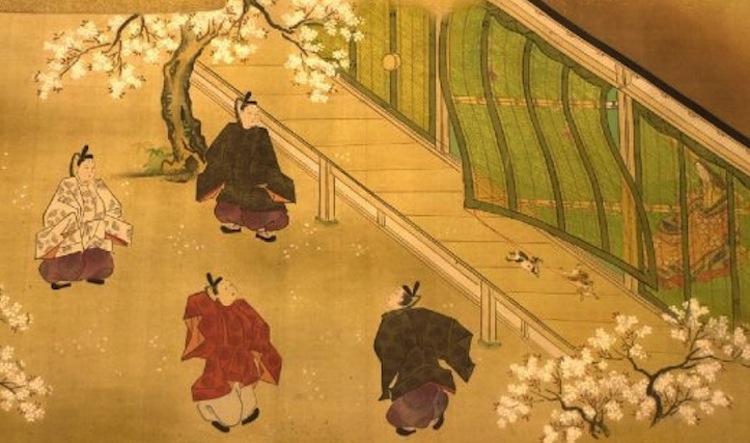
Illustrated scroll of the Tales of Genji, chapter 34, 17th century. Courtesy of Wikimedia Commons.
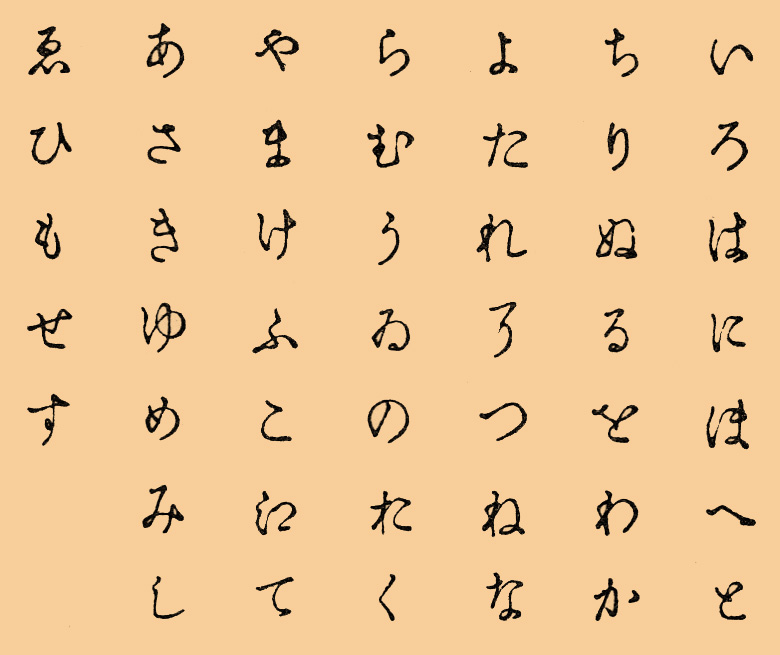
One of the most famous waka poems across Japanese history and even contemporary culture is a poem called the Iroha. The name “iroha” comes from the first three letters of the poem “i”, “ro” and “ha”. What makes this poem famous is that it uses each hiragana syllable exactly once, and still makes an intelligible, not to mention lovely, poem.
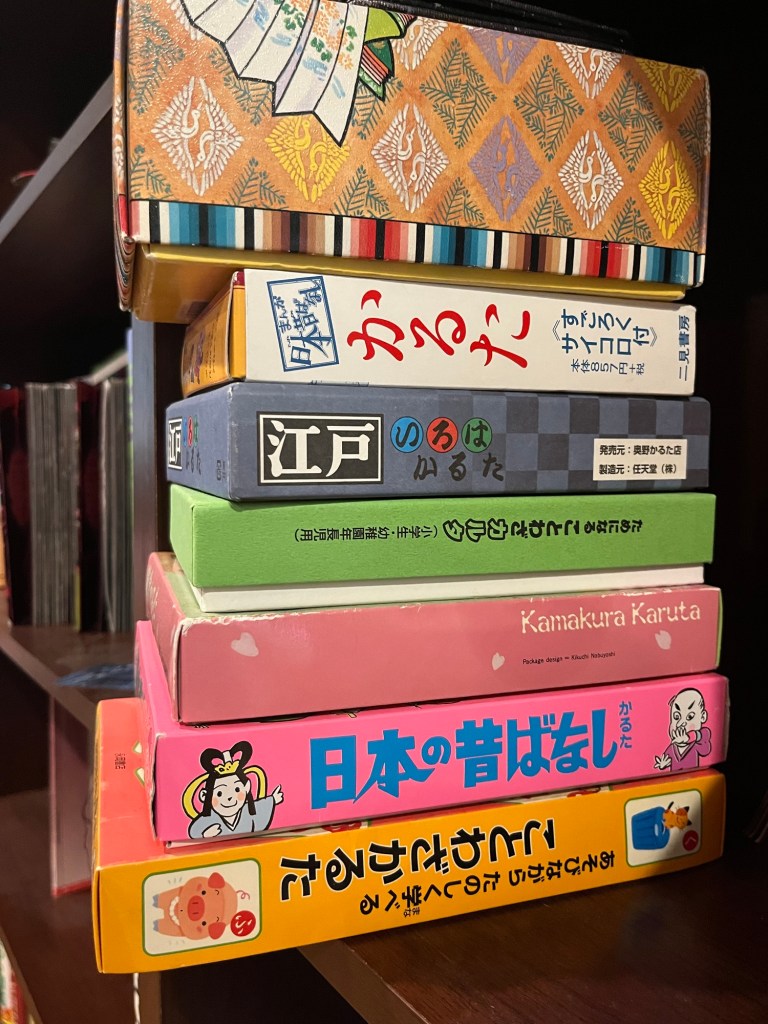
Because of this, it was often used in pre-industrial Japan as a way to organize things. Theater rows would be organized by the order in the Iroha letters, and so were firefighter brigades in pre-modern Tokyo (a.k.a. Edo). Even modern karuta sets are organized by iroha order. I don’t mean the Hyakunin Isshu karuta that I often discuss in the blog, but more informal karuta games that kids often play. We have a few sets here at home, given to us by my in-laws for the grandkids. You can see a nice selection of Iroha karuta sets on the Okuno Karuta online store, too.a
Various karuta sets my in-laws in Japan sent us. The top one is my wife’s original Hyakunin Isshu she had from grade-school.
But I digress.
The Iroha poem’s author is unknown (more on that later), but it was originally composed in old Manyogana script, like other poems of the early Manyoshu anthology, then later in hiragana. It includes many old spellings, so it’s a bit hard to render in modern Japanese.
The poem is as follows:
Manyogana
Modern Japanese
Romanization
Translation1
以呂波耳本部止
いろはにほへと
I ro ha ni ho he to
Even the blossoming flowers
千利奴流乎和加
ちりぬるをわか
chi ri nu ru o wa ka
will eventually scatter
餘多連曽津祢那
よたれそつねな
yo ta re so tsu ne na
Who in this world shall
良牟有為能於久
らむうゐのおく
ra mu u i no o ku
remain unchanged? Let us today2
耶万計不己衣天
やまけふこえて
ya ma kyo (ke fu) ko e te
cross the mountains of impermanence
阿佐伎喩女美之
あさきゆめみし
a sa ki yu me mi shi
and no longer have superficial
恵比毛勢須
ゑひもせす
e hi mo se su
dreams, nor be deluded
1 adapted translation from Wikipedia, plus a few modifications of my own 2 有為 (u i) meaning “viccisitudes of life” or the impermanence of all phenomena
This poem has strong Buddhist allusions to such concepts as samsara (“the aimless wandering lifetime after lifetime”), the delusions that bindus to this existence, awakening to these delusions (e.g. “enlightenment”), and finally nirvana (“unbinding”). The poem itself shows considerable familiarity with earlier Buddhist texts such as the Perfection of Wisdom sutras, including the Heart Sutra, as well.
But I digress. Again. 😅
There are some really interesting aspects of this poem that are worth sharing. First, authorship. Given the strongly Buddhist undertones of the poem, it’s often been attributed to a famous Buddhist monk named Kukai (a.k.a. Kobo Daishi) who was a talented poet and calligrapher. Another theory states that this poem may attributed to none other than the famous court poet Kakinomoto no Hitomaro, who composed poem 3 in the Hyakunin Isshu (あしびきの).
But things get even more interesting.
Scholars have noted that if you take the last syllable of each line (highlighted above for convenience) it spells another sentence: toka (ga) nakute shisu (咎[が]無くて死す) meaning “he/she died without fault or blemish”. Another theory, mentioned in my new book, points out that the 5th column spells out ho(n) wo tsu no ko me (本を津の小女), which could mean “deliver this book to my wife in the town of Tsu”, which if taken together with the 7th column implies that “I will die without blemish, please deliver this poem to my wife”.
So, is the poem a tribute to someone else? Perhaps Kukai or Hitomaro? If so, then who wrote it, and why? Was the poem a coded message to someone who was executed for political reasons? Or was the poem simply an attempt at word-play?
We will never know, but the impact of the Iroha on Japanese poem can still be easily seen today.
a Although things like Chihayafuru and this blog tend to emphasize the competitive karuta of the Hyakunin Isshu, in reality that’s only a small subset of karuta gaming culture. Most of it is much more informal stuff you play at home with family, much like board games in Western culture, and often times doesn’t even relate to the Hyakunin Isshu. Maybe I’ll post about it some time, but thanks to grandparents in Japan, we have 4-5 sets here ranging from such subjects as places in the city of Kamakura, old folks-sayings, Japanese fairy-tales, and just really basic words in Japanese. Most of these list the cards using iroha-order, and are not related to the Hyakunin Isshu. We’ve played them with our kids from time to time, and they’re much easier than competitive karuta, though it’s still assumed you know at least some basic Japanese.
As fall is approaching, I wanted to share an interesting anecdote provided by my book on the Manyoshu. It seems that throughout Japanese antiquity, poets frequently debated which is better: spring or fall.
The first example comes from Princess Nukata in the 7th century, whom we discussed here and here, she wrote a lengthy poem (a chōka poem, not the usual tanka poem) in the Manyoshu (poem 16). She discusses the pros and cons of spring and of fall:
Original Manyogana1
Japanese
Romanization
Rough Translation2
冬木成 春去來者
冬ごもり 春さり來れば
Fuyu gomori haru sari kureba
When winter passes and spring comes
不喧有之 鳥毛来鳴奴
鳴かざりし鳥も來鳴きぬ
Nakazarishi tori mo nakinu
Birds that didn’t sing before, now come and sing
不開有之 花毛佐家礼抒 山乎茂
咲かざりし 花も咲けれど 山を茂み
Sakazarishi hana mo sakeredo yama wo shigemi
Flowers that didn’t bloom before now bloom, but because the mountains grass is so thick
入而毛不取 草深 執手母不見
入りても取らず 草深み 取り手も見ず
Irite mo torazu kusabukami torite me mizu
One cannot go and pick flowers, let alone see them.
秋山乃 木葉乎見而者
秋山の 木の葉を見ては
Aki yama no ko no ba wo mite wa
When you look at the leaves in the mountains during fall,
黄葉乎婆 取而曾思努布
黄葉をば 取りてそしのふ
Momiji wo ba torite soshi no fu
collecting the yellow leaves is especially prized.
青乎者 置而曾歎久
青きをば 置きてそ歎く
Aoki wo ba okite so nageku
Leaving the green leaves as they are is regrettable.
曾許之恨之 秋山吾者
そこし恨めし 秋山われは
Sokoshi urameshi akiyama ware wa
In spite of that, autumn in the mountains is spectacular…
a – I am heavily indebted to this site for both the original text. Translation is based in part on that site, but also my Manyoshu book, but probably lots of mistakes. Translating a five-line poem in archaic Japanese is hard enough… 😅
Speaking of the Manyoshu, its compiler Otomo no Yakamochi (poem 6 of the Hyakunin Isshu, かさ) left us some very nice poetry about spring:
Original Manyogana1
Japanese
Romanization
Rough Translation2
春苑
春の苑
Haru no sono
Beneath
紅尓保布
紅にほふ
Kurenai ni hofu
the shining crimson
桃花
桃の花
Momo no hana
orchard of
下照道尓
下照る道に
Shita deru michi ni
peach blossoms
出立オ嬬
出で立つ少女
Idetatsu otome
a young maiden lingers.
Poem 4139, book 19
and about fall:
Original Manyogana1
Japanese
Romanization
Rough Translation2
秋去者
秋さらば
Aki saraba
When fall comes
見乍思跡
見つつ思へと
Mitsutsu shinoe to
think fondly of those
妹之殖之
妹が植ゑし
Imo ga ue shi
pink blossoms
屋前乃石竹
やどのなでしこ
Yado no nadeshiko
of days gone by
開家流香聞
咲きにけるかも
Saki ni keru kamo
and remember me.
Poem 464, book 3
Otomo no Yakamochi wrote both of these poems about his beloved wife, but the second was composed shortly after her parting. The word nadeshiko has special meaning in Japan and has a very feminine, demure3 meaning.
Returning to the debate between spring and fall, Ki no Tsurayuki (poem 35 of the Hyakunin Isshu, ひとは) took up the same topic centuries later. This is poem 509 from an imperial anthology, the Shuishu :
Japanese
Romanization
Rough Translation2
春秋に
Haru aki ni
Spring or Fall?
おもひみたれて
Omoi mitarete
My thoughts are a mess,
わきかねつ
Waki kanetsu
and I cannot decide.
時につけつつ
Toki ni tsuketsutsu
The more time passes,
うつるこころは
Utsuru kokoro wa
the more my heart shifts back and forth.
1 This is a rough translation, all mistakes are my own.
The debate was even cited in the famous 12th century novel Tales of Genji written by Lady Murasaki (poem 57 of the Hyakunin Isshu, め):
“Since antiquity, in the debate about spring versus fall, many people lean toward fall, and yet some very noteworthy people who view the Imperial gardens in spring may yet change their mind, as is the way of the world.”
Princess Nukata all the way back in the Manyoshu seemed to imply that autumn was preferable, and it seems that most of the aristocracy shared this view. In fact if we divide up the poems of the Hyakunin Isshu by season, there are more fall poems than spring:
Note: summer only has 4 poems, winter has 9 (same as spring).
But what do you think? Are you Team Spring, or Team Fall?
Edit: added Hyakunin Isshu poetry chart.
1 If you’re wondering why I post Manyogana for some poems, but not others, it depends on the era. The Manyoshu is the oldest anthology by far, and at that time, there was a brief writing system that took Chinese characters, but used them in a phonetic way for Japanese language (a.k.a. Manyogana). By the time of Ki no Tsurayuki and Lady Murasaki, centuries later, this had been replaced with hiragana script. This blog strives to both be accurate and accessible, so I try to balance both needs.
2 These are all rough translations on my part, and likely have mistakes. Any such mistakes are entirely my own.
3 Not to be confused with the “very demure, very mindful” meme. 😛
Although this blog is primarily about the Hyakunin Isshu, I enjoy when things overlap with other Japanese poetry anthologies, and history.
Let’s talk about two of the poets: Empress Jitō (poem 2, はるす) and Kakinomoto no Hitomaro (poem 3, あし). After Empress Jito ascended to the throne, she was visited by Hitomaro, the revered court poet at the time, who composed the following poem:
Original Manyogana
Modern Japanese
Romanization
Rough Translation1
皇者
大君は
Okimi wa
As my sovereign
神二四座者
神にしませば
Kami ni shimaseba
is a living kami, (see below)
天雲之
天雲の
Amakumo no
she builds a temporary
雷之上尓
雷の上に
Ikazuchi no ue ni
residence atop
廬為流鴨
廬りせるかも
Ioriseru kamo
Ikazuchi Hill.
1 I didn’t like any of the existing translations, so I tried to translate here. Any mistakes are my own.
At first, this poem seems like a simple case of a courtier sucking up to the new boss, but as we’ll see there’s more to it. This poem is very simple in some respects, and surprisingly difficult in others.
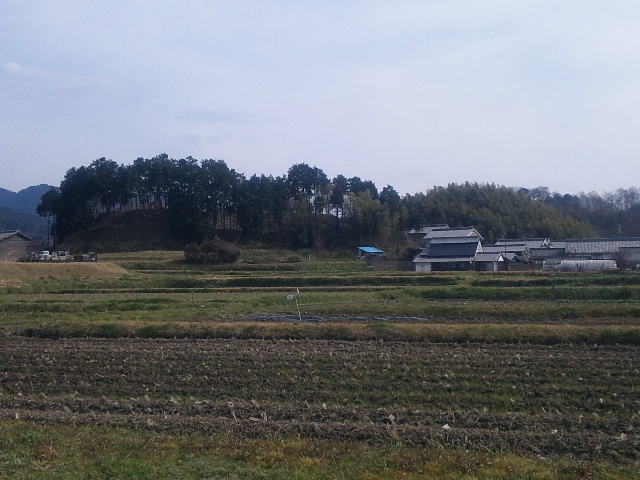
I had to check multiple sources to make sense of it, including my book on the Manyoshu, but the essence of the poem is that Kakinomoto no Hitomaro is describing Empress Jito as a living kami, and that because of her “supernatural abilities”, she can build a residence atop a small hill called Ikazuchi. Ikazuchi Hill, known as Ikazuchi no Oka (雷丘) can be seen in this photo, more information here.
But what the heck is kami? This is surprisingly tough to explain to Western audiences. It is deeply rooted in Shinto religion, and more closely matches something like ancient Greek religion where there were divine spirits both great and small. Small nature spirits would be worshiped as daimon (not to be confused with modern “demon”), and the Olympian gods were venerated too. Even the Olympian gods had “big forms” and small “household forms” worshiped at the hearth. It wasn’t unusual for Zeus, king to the gods, to also be venerated at a home shrine to protect the family assets, or a roadside marker.
In the same way, Shinto has countless kami. It’s not quite right to translate them as “gods” because the meaning is a little different, and “spirits” is not quite right either. But one could include both gods and spirits under the divine label kami. Just like in Greek religion, very talented people could also be venerated as kami after death, such as Hercules. I mention this because Sugawara no Michizane (poem 24 of the Hyakunin Isshu, この) was similarly venerated after death and became something like the Kami (god) of Learning.
This concept of great personages being kami is called arahito-gami (現人神) and that’s basically what Kakinomoto no Hitomaro is describing Empress Jito. Due to the divine ancestry of the Imperial family, this isn’t that surprising, but my book alludes to another reason for this. The turmoil caused by Emperor Tenji (poem 1 of the Hyakunin Isshu, あきの)’s family and his brother Emperor Tenmu’s family for control of the throne meant that Empress Jito (Tenmu’s wife/niece) ascended the throne on shaky ground. Female sovereigns were quite rare in Japanese history, and with the family fighting for control of the throne, Hitomaro was helping her reassert her divine status and legitimacy as the proper ruler of Japan.
The issue of arahito-gami comes up even as recently as 1946, when the reigning Emperor at the time (Emperor Showa, Hirohito), was requested to renounce his divine status after World War II. This declaration used some hair-splitting language about the Emperor’s divinity (or lack thereof), and various interpretations persist today.
…. but that’s something more knowledgeable people could explain better.
As for me, I find it fascinating (and a bit amusing) that these poets I know from the Hyakunin Isshu got embroiled in a succession dispute, but also that Hitomaro helped bolster Empress Jito’s credentials at a time when she was rebuilding the nation again while probably sucking up just a little too.
P.S. the featured photo above is Ikazuchi Hill, photo by Terumasa, CC BY-SA 3.0, via Wikimedia Commons
P.P.S. On a completely unrelated fact, while writing this post I learned that the Chinese characters for 雷丘 also mean “Raichu” as in the Pokemon.



 The Hyakunin Isshu

.jpg)
.jpg)
