Past Her Prime: Poem Number 9

For the first poem for March’s “women only” theme, I chose this poem, one of the earliest by a female author (after Empress Jitō, poem 2), but also one of the most famous:

JapaneseRomanizationTranslation
花の色はHana no iro waThe color of flowers
うつりにけりなUtsuri ni keri nahas faded indeed
いたらにItazura niin vain
わが身世にふるWaga mi yo ni furuhave I passed through
the world
ながめせしまにNagame seshi ma niwhile gazing at the
falling rains.
Translation by Dr Joshua Mostow

The author, Ono no Komachi (小野小町, dates unknown), is one of the most celebrated women of Japanese antiquity for both her reputed beauty and her poetry. She is one of the original Six Immortals of Poetry and the later Thirty-Six Immortals, and was said to have had relationships with various men, including Henjō (poem 12), and Fun’ya Yasuhide (poem 22) among others.

Reading this poem is something of an intimate look at the fear many women (and men, see poem 96) face then as much as now: the fear of getting old. For someone who was beautiful as Ono no Komachi, the loss may have been even more distressing.

Mostow describes this poem featured in the Hyakunin Isshu as a “technical tour-de-force”: the third line, meaning “in vain”, could technically modify either the previous line, or the one after, or both. Also, the poem uses word-play around furu which could mean to either “fall (as in rain)” or “to pass time”, while nagame could mean both “to gaze lost in thought” or “long rains” (長雨, naga-ame as Mostow explains). Further, this poem has been the object of much debate because of all the possible ways to interpret it, and is one of the most iconic in the anthology both for its technical prowess, but also it’s poignant message.

There are many legends that circulated in medieval Japan about Ono no Komachi’s good looks and her cruelty to men. In one famous story, she promised to love a certain suitor if he visited her 100 nights in a row. He completed 99 visits, but failed one night to visit her, and was so distraught that he fell ill and died. Ono no Komachi’s life and legends, including her decline, grew to become the subject of many Nō plays and art. Even 19th century woodblock prints depicted Ono no Komachi in her twilight years:
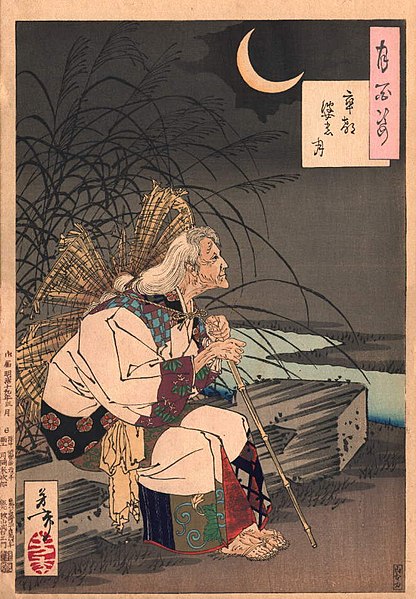
Yoshitoshi, One Hundred Aspects of the Moon, woodblock print #25, Public domain, via Wikimedia Commons

However, if you look at her other poems, mostly found in the Imperial anthology, the Kokin Wakashū, you can see she was more caring and sensitive than legend implies:

JapaneseRomanizationTranslation
思ひつつOmoitsutsuTormented by love
寝ればや人のNurebaya hito noI slept and saw him near me —
見えつらむMietsuranhad I known my love’s
夢と知りせばYume to shirisebavisit was but a dream I
覚めざらましをSamezaramashi oshould never have awakened.
Poem 552 in the Kokin Wakashū, translation by Laurel Rasplica Rodd and Mary Catherine Henkenius in Kokinshu: A Collection of Poems Ancient and Modern.

and:

JapaneseRomanizationTranslation
わびぬればWabinurebaI have sunk to the
身をうき草のMi o ukikusa nobottom and like the rootless
根を絶えてNe o taeteshifting water weeds
誘ふ水あらばSasou mizu arabashould the currents summon me
いなんとぞ思ふInan to zo omouI too would drift away
Poem 938 in the Kokin Wakashū, translation by Laurel Rasplica Rodd and Mary Catherine Henkenius in Kokinshu: A Collection of Poems Ancient and Modern.

So, Ono no Komachi wasn’t just a pretty face past her prime, she was a smart woman with a sharp wit, and a more sensitive side as well.

The Moon in the Hyakunin Isshu

The Moon is not surprisingly one of the most powerful images in the Hyakunin Isshu anthology, but the myriad ways it is used as imagery shows a remarkable variety and depth. There are 43 poems in the Hyakunin Isshu that cover topics of love and romance, but only 12 that pertain to the Moon.

However, within those twelve poems, and in Japanese waka poetry as a whole, the moon itself is a very popular subject and expressed in many ways. As one book on the subject points out, the Moon expresses different themes depending on the situation:

Print #98 from the One Hundred Aspects of the Moon by Yoshitoshi. This picture features Semimaru from the Hyakunin Isshu (poem 10, これ)
  • Being separated from home (poem 7)
  • Waiting for one’s lover (poem 21)
  • Melancholy (poem 23)
  • Parting one’s lover (poem 30) in the morning
  • The cool moon in Summer (poem 36)
  • The moon on a clear, beautiful Autumn night. (poem 79)
  • Two people passing in the night (poem 57)
  • Loneliness of a heart-broken women (poem 59)
  • The effervescence of life (poem 68)
  • Autumn vibes (poem 79)
  • Early dawn moon and the cuckoo’s call (poem 81)
  • Human grief (poem 86)

This is only for the Hyakunin Isshu of course. For larger anthologies like the Kokinshū and the vast corpus of Chinese poetry, the Moon is a persistent symbol of so many aspects of human emotion.

But also in Japanese language, many poetic terms for the moon and its phases have arisen over time:

  • ariake (有明) – moon visible during sunrise, appears in the latter half of the lunar cycle
  • misokazuki (晦日月) – the night before the new moon, the moon is a barely visible crescent.
  • shingetsu (新月) – new moon
  • tsugomori (つごもり) – last day of the moon (i.e. new moon)
  • mikazuki (三日月) – waxing crescent moon (lit. “third-day moon”)
  • nanokazuki (七日月) – seventh-day moon, waxing crescent
  • yōkazuki (八日月) – first quarter waxing moon
  • mangetsu (満月) – full moon
  • mochizuki (望月) – full moon, 15th day of the old lunar calendar.
  • izayoizuki (十六夜月) – moon on the 16th day, just after full moon.
  • tachimachizuki (立待月) – moon on the 16th day of the cycle.
  • fukemachizuki (更待月), also called hatsukazuki (二十日月) – the three-quarters waning moon. The implication of the first word is that the moon rises late in the evening.
  • fushimachizuki (臥待月) – waning half-moon
  • nemachizuki (寝待月) – another term for waning half-moon

A lot of these terms are pretty obscure (some I couldn’t find in a common dictionary), while a few like mangetsu and mikazuki are used in standard Japanese.

A Full Moon Night: Poem Number 7

As tonight is a Worm Moon, but also one where the moon is the closest in its orbit to Earth in 19 years, I thought this was a fitting poem, and also one of my favorite:

JapaneseRomanizationTranslation
天の原Ama no haraAs I gaze out, far
ふりさけ見ればFurisake mirebaacross the plains of heaven
春日なるKasuga naruah, at Kasuga,
三笠の山にMikasa no yama nifrom behind Mount Mikasa,
出でし月かもIdeshi tsuki kamoit’s the same moon that came out then!
Translation by Dr Joshua Mostow

According to historical accounts, Abé no Nakamaro (阿倍仲麻呂, 701 – 770), the author, went to China to study at the age of 16. This was part of the yearly mission made by Japan to the Imperial Tang Court in China. The missions to China from Japan (or Kentō-shi 遣唐使) were perilous undertakings due to poor ship construction and storms from the south, so they didn’t come often, and sometimes got shipwrecked.

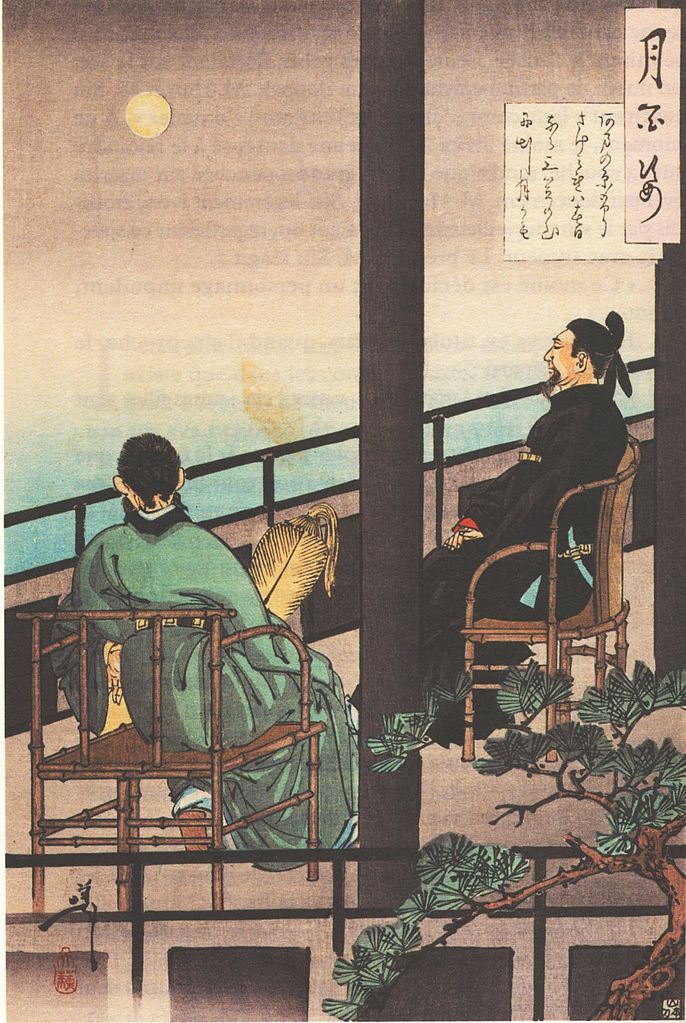
He spent many years in China and became friends with famous poets at the time such as Li Bo and Wang Wei, and was in the service of the Chinese emperor Xuan-Zong for a time. But after so many years of service, it was time for Nakamaro to return to Japan, and according to the story, on the night before he departed, his friends in China threw him a farewell feast. That evening, he looked up and saw a beautiful moon, and composed this poem. It was at Mount Mikasa many years before that Nakamaro prayed for safe return someday from China, and he remembered that same moon so many years ago. This is depicted in the featured photo above from a woodblock print collection (print number 64) called the One Hundred Aspects of the Moon by Yoshitoshi.

Sadly, his return trip failed, and the ship was blown off course to the land of Annam, where he then trekked back to China and eventually passed away never seeing his homeland again.

Pillow Words in the Hyakunin Isshu

Reading classical Japanese is hard enough as it is, what with its unusual spellings and archaic vocabulary, but what makes the Hyakunin Isshu interesting, among other things, is the colorful, poetic phrases sometimes used. These phrases are strictly literary, and tend to have a dramatic sound to them, but when translating to English sometimes the meaning is lost. These words are called makura kotoba (枕詞) or “pillow words”. The term “pillow” here has no romantic connotations whatsoever, but is simply a reference to poetry. Presumably, people in the old days sat in their rooms, leaning on a pillow, composing poetry in their idle time, I guess.

Anyway, pillow words can be thought of as “filler” phrases, because they don’t have much meaning themselves, but they dress up the poems a lot more. For example in this poem, number 17:

千早ぶる Chihayaburu
神代もきかず kamiyo mo kikazu
龍田川 Tatsutagawa
からくれないに karakurenai ni
水くくるとは mizu kukuru to wa

The pillow words “Chihayaburu” (千早ぶる) can mean something like “1,000 swift [swords]” or something, but really just dresses up the next word, 神 (kami, “a god”). So in modern English, it’s not just a god, but an awesome, awe-inspiring god. Likewise, in poem 2 we see another shining example.

春過ぎて Haru sugite
夏来にけらし natsu ki ni kerashi
白妙の shirotae no
衣ほすてふ koromo hosu chō
天の香具山 Ama no Kaguyama

Here again the pillow word shirotae no (白妙の) means something like gleaming white. The sheets being dried on Kaguyama mountain are not just white, but gleaming white, and a lovely contrast to the sunny, summer day in which they are being dried.

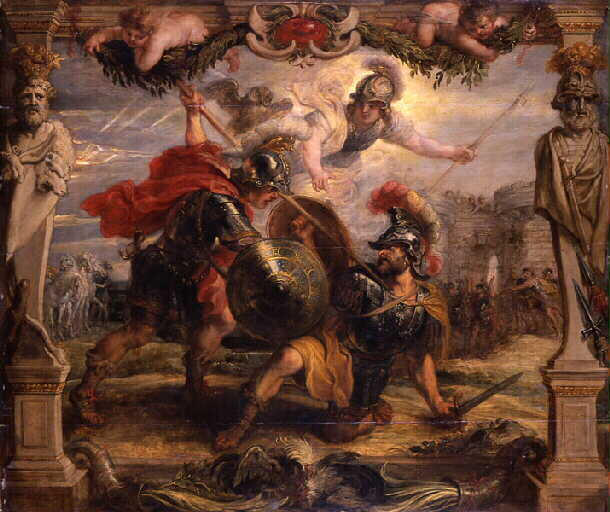
Such pillow-words don’t really exist in English, but they are very easy to find in classical Greek literature, especially the writings of Homer. Consider these epithets frequently used in the Iliad:

  • Agamemnon, son of Atreus: Ἀτρείδης (Atreídēs)
  • Swift-footed Achilleus: πόδας ὠκύς (podas ōkús)
  • Rosy-fingered Dawn: ῥοδο-δάκτυλος Ἠώς (rhodo-dáktylos Ēṓs)
  • Goddess of the white arms, Hera: θεὰ λευκώλενος Ἥρη (thea leukōlenos Hērē)

Whenever I read the Iliad, I always find that these epithets really bring out the drama in the text.

Peter Paul Rubens – Achilles slays Hector

In the same way, the pillow-words in the Hyakunin Isshu are frequently used in certain common combinations:

  • chihayaburu (千早ぶる) – used to describe the Shinto divinities or Kami (神). See iconic poem 17.
  • shirotae no (白妙の) – used to describe something white, in particular snow, clouds or cloth. Its literal meaning is taken from the color of fresh mulberry paper. See poem 2 and poem 4.
  • ashibiki no (あしびきの) – used sometimes to describe mountains (山, “yama”) and peaks. Its meaning is something like “foot-drawn”. See poem 3.
  • hisakata no (ひさかたの) – used to describe things like the sky (空, “sora”), moon (月, “tsuki”), rain (雨, “amé”), clouds (雲, “kumo”), light (光, “hikari”), night (夜, “yoru”), and even the capitol (都, “miyako”). Its meaning is something like peaceful, shining, and especially everlasting. See poem 33 and poem 76.

Some examples of pillow words used in Japanese waka poetry, but not found in the Hyakunin Isshu are:

  • ubatama no (烏羽玉の) – describes the color “jet-black” and often used to describe hair or night. An example is found in the Kokinshu anthology, poem 647.
  • aoniyoshi (あをによし) – used to describe the old capital of Nara itself. Poem 328 in the Manyoshu is one such example. The word aoni (青丹) refers to a high-quality bluish-black pigment that was derived from soil around the Nara area.
  • umasaké (味酒) – used to describe the sacred mountains around Nara (see poem 2 in the Hyakunin Isshu) implying the essence of delicious rice wine. Think Dionysus from Greek mythology. You can an example in the Manyoshu, poem 17.
  • yasumishishi (八隅知し, or 安見知し) – refers to the august reign of an Emperor, spanning the eight cardinal directions. Manyoshu poems 50 and 923 both contain this phrase.
  • isanatori (いさなとり), originally from an archaic word for “whale” (いさな) is used with words such as the ocean, beach, etc. Poem 3852 in the Manyoshu is an example.

Many of these phrases are 5-syllable phrases (sometimes 4), so they “slot” in seamlessly in a typical waka poem (5-7-5-7-7 syllables). In later ages, the number of pillow words increased to about 1,200 phrases, though many of them remain pretty obscure. Even in modern poetry, these stock phrases are still very much in use.

Interestingly, my book on the Manyoshu explains that some of these phrases do not appear until they are used in poetry by Kakinomoto Hitomaro (poem 3, あし), implying that he coined some of these phrases himself. Of the hundreds of documented pillow words, at least 50 are attributed to Hitomaro including some listed above.

Pillow words are hard to translate, but they are a fascinating window into Japanese culture in antiquity.