A Brief Introduction to Japanese Cherry Blossoms

As spring approaches, people eagerly anticipate when cherry blossoms (sakura in Japanese, 桜), but as I have learned recently in my book, the Hyakunin Isshu Daijiten, there are many types of sakura, some of them even referenced in the Hyakunin Isshu. Let’s explore a few and learn how to spot one versus another.

If you’re curious about how to even spot a cherry tree, my alma mater has a nice video introduction from the Pandemic era on spotting various trees in your own neighborhood:

A Brief History Lesson of Cherry Blossoms

Cherry blossoms have been a part of Japanese culture for a very long time, but were not always revered as they are now. In antiquity, the plum blossom, imported from China, were more highly revered as one can see in the Manyoshu, but over the centuries the roles reversed. The tradition of outings to view cherry blossoms is credited to Empress Jitō (poem 2). Nowadays, this tradition continues as ohanami (お花見), and can be a fun outing with friends and family or co-workers. In places like Ueno Park in Tokyo, the grounds are crowded with picnic blankets, visitors, and plenty of food and saké to go around.

The most famous, most iconic poem about cherry blossoms was composed by Ariwara no Narihara (who also wrote poem 17):

JapaneseRomanizationTranslation
世の中にYo no naka niIf in all the world
絶えて桜のTaete sakura nothere were of cherry blossoms
なかりせばKanarisebano trace anywhere
春の心はHaru no kokoro waah, how truly peaceful then
のどけからましNodokekaramashispring would be for everyone!
Translation by Dr Josha Mostow and Dr Royall Tyler from the Ise Stories, the poem is also number 53 in the Kokin Wakashū.

Varieties of Cherry Blossoms

Big thanks to this site for providing additional references. I also relied on some details from the Hyakunin Isshu Daijiten book I’ve used for the blog.

Yoshino Cherry

The most common, most well-known type are the Somei Yoshino (ソメイヨシノ) or “Yoshino Cherry” in English:
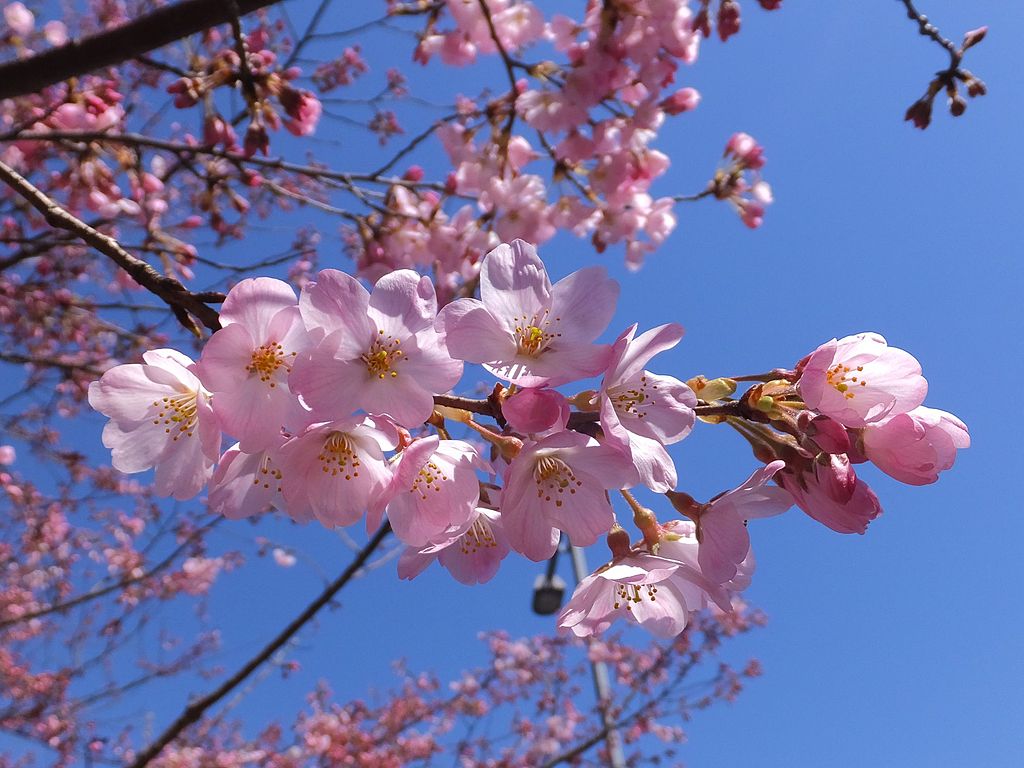
(Photo by Tak1701d, Public domain, via Wikimedia Commons)

This is a relatively recent variety that was bred for gardening, then gained popularity abroad. It is named after the famous village of Yoshino. For many, this is the classic “cherry blossom” and the one you’re most likely to see outside of Japan.

Yae-Zakura Cherry

Another famous example is the Yae-Zakura (ヤエザクラ):

(Photo by Raita Futo from Tokyo, Japan, CC BY 2.0, via Wikimedia Commons)

The term yae (八重) means something like “eight layers” or “eight levels”, which helps describe it’s thicker, multi-layered blossoms. It is also the subject of poem 61.

To be honest, yae-zakura are my personal favorite.

Kanzan Cherry

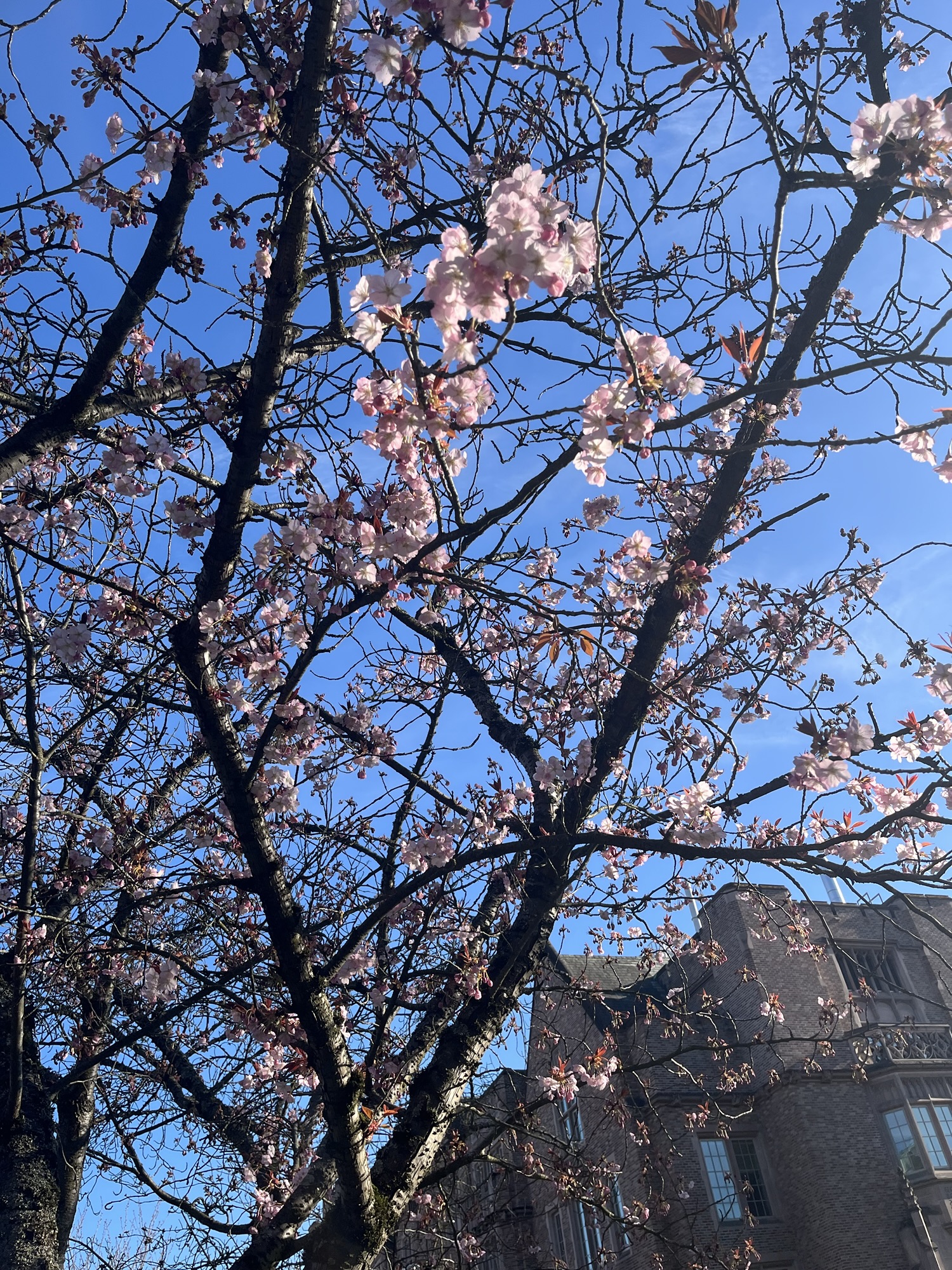
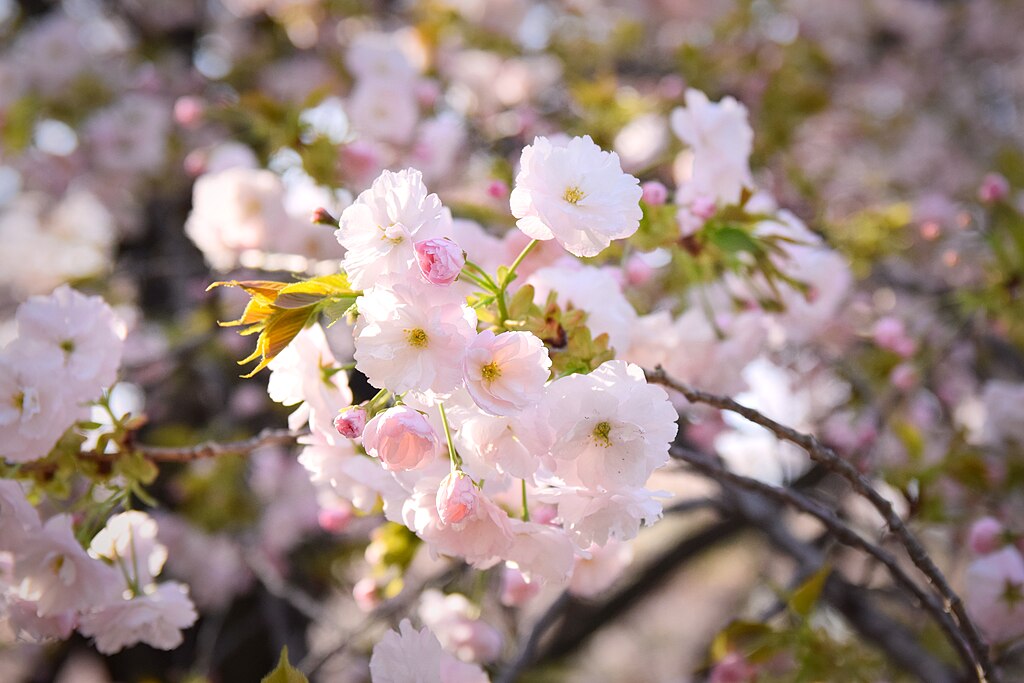
A popular variety that I only learned about recently is a hybrid variety called the kanzan (カンザン, sometimes archaically spelled Kwanzan). I didn’t find this one online at first, but was able to take a photo during a recent visit to the University of Washington.

This variety was, similar to the Yoshino, a relatively recent variety, and a result of hybrid breeding with Ōshima cherry. What makes this one interesting is the both the rich pink color, and the multiple layers of blossoms (similar to the Kasumi cherry below).

Mountain Cherry

Another example of cherry blossoms, that’s lesser-known in the West are the wild cherry trees, or yama-zakura (ヤマザクラ) also known as the “Mountain Cherry”:

(Photo by 阿橋 HQ, CC BY-SA 2.0, via Wikimedia Commons)

If you compare the Yama-zakura to the classic Yoshino Cherry, you can see the color is a little more faded, kind of whitish in comparison. I think I have also read somewhere that the leaves and blossoms of a mountain cherry sprout at the same time, compared to a Yoshino Cherry where the blossoms comes first.

In antiquity, when the nobility of the capitol would go on a cherry blossom viewing, these are the trees they would most likely go to see. They are the subject of poem 66 as well.

Shidaré-zakura Cherry

Another iconic variety of cherry blossoms are the shidaré-zakura (シダレザクラ), or Hanging Cherry:

(Photo by Sakaori, CC BY-SA 3.0, via Wikimedia Commons)

You often see these grown in very scenic places, as well as on the grounds of Buddhist temples or Shinto shrines. The way the hanging branches sway in the wind is a sight to behold.

Kasumi-Zakura

One interesting variety that I was unaware of, until researching for this blog was the kasumi-zakura (カスミザクラ):
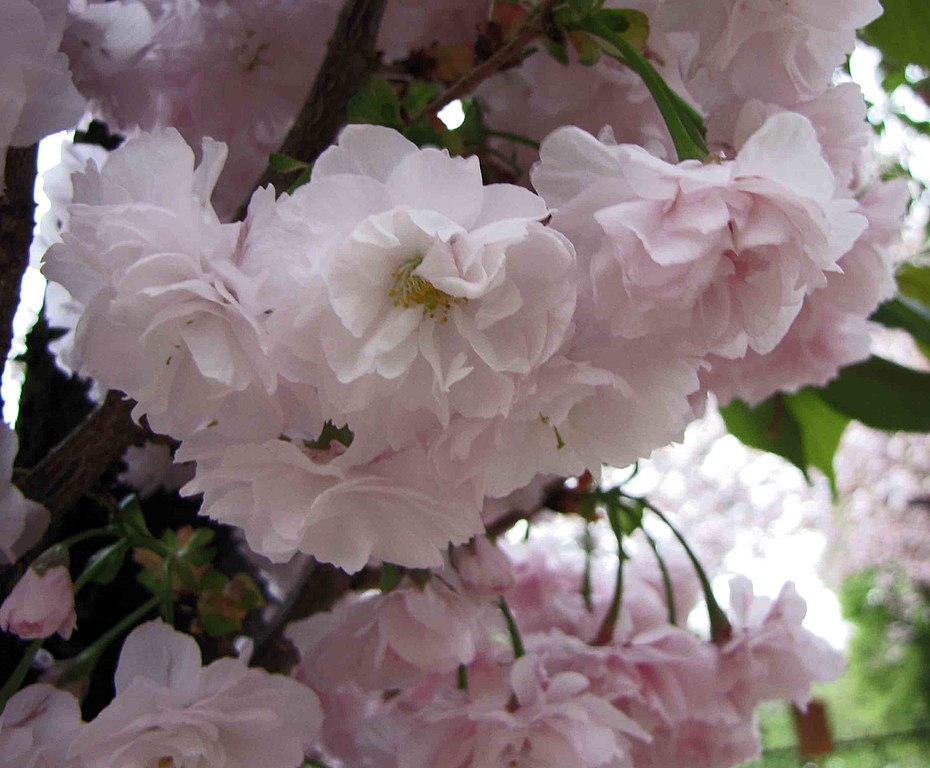
The word kasumi is a poetic term for haze or mist, especially a spring mist. You can see how the blossoms hang down somewhat, and are particularly large compared to other cherry blossoms varieties. They also seem to have a two-tone quality, where the edges are deeper color than the middle.

Fuyu-Zakura

Another example I wanted to share is an unusual variety that blooms in spring, and in winter, called the fuyu-zakura (フユザクラ):
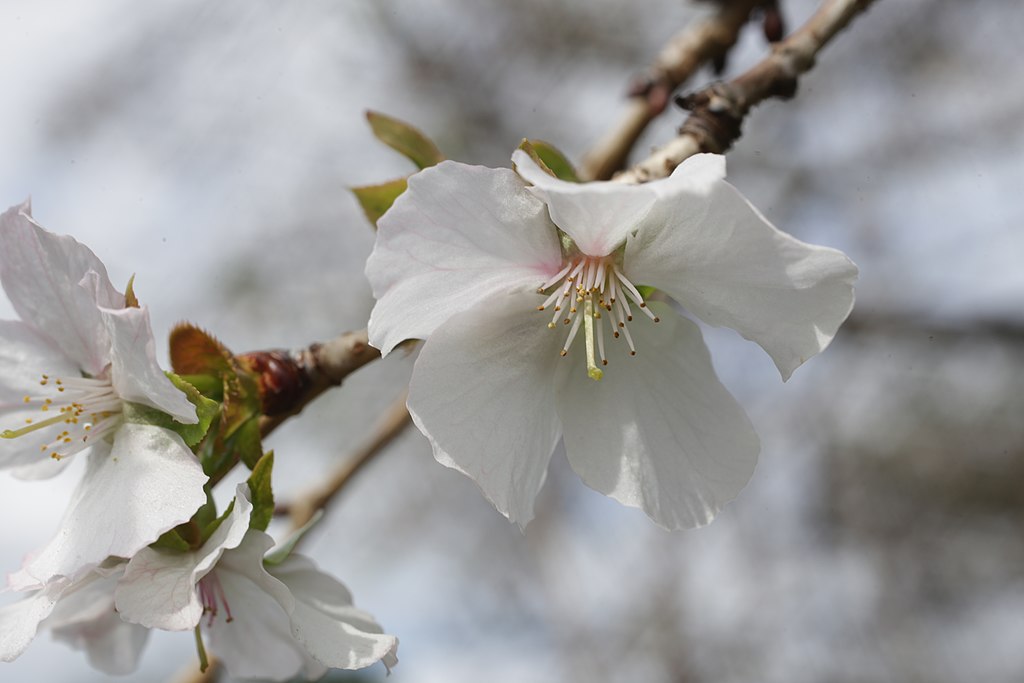
This cherry variety, also known as a gobazakura (コバザクラ) has white blossoms and blooms both in April, and also in December.

Kanhi-zakura
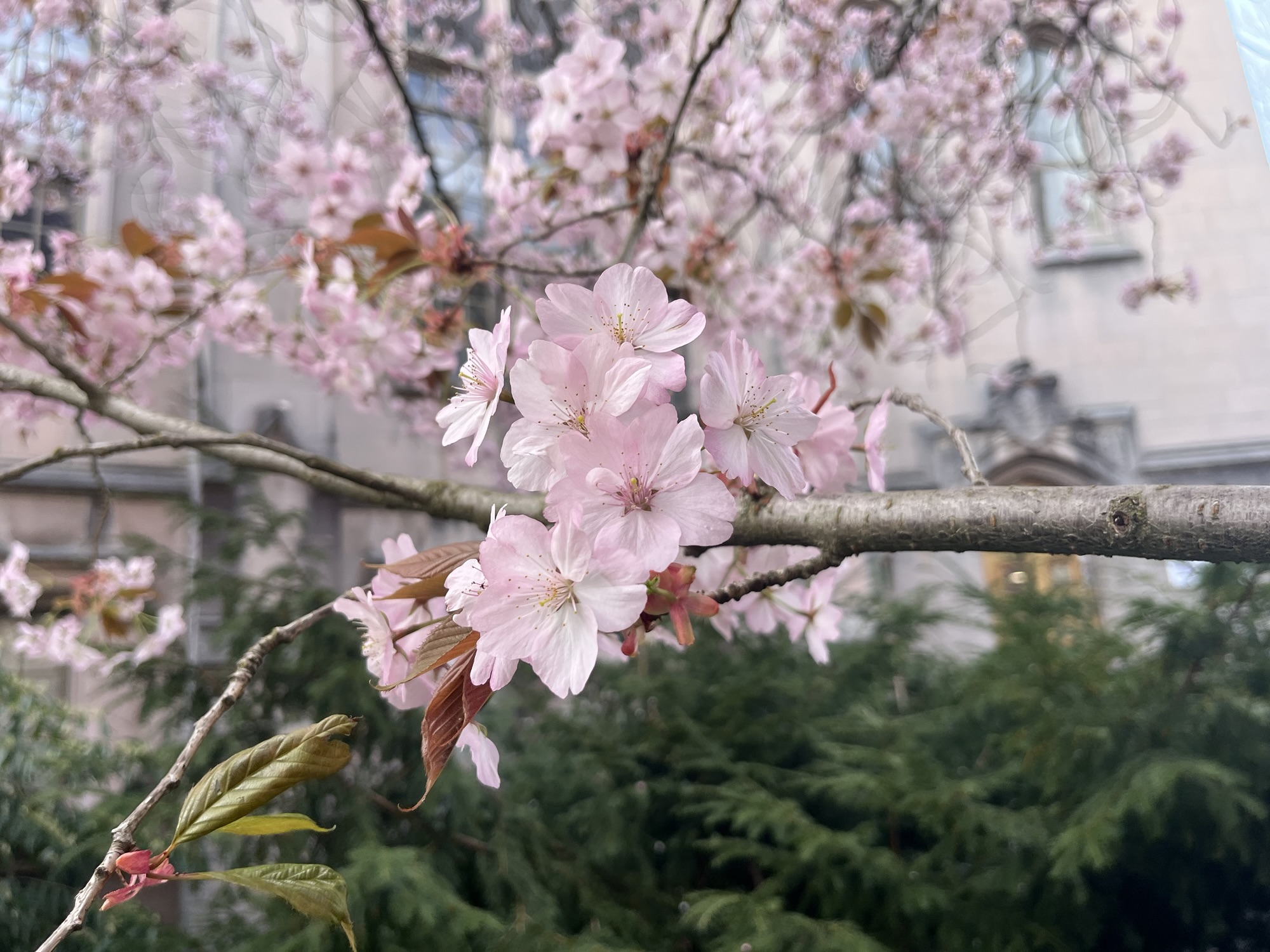
Taken by me at University of Washington in April 2025

While visiting the University of Washington in 2025, I found another variety I hadn’t noticed before. This variety is listed on UW maps as “Hisakura”, but in digging around in Japanese I found that a more common name is Kanhi-zakura (カンヒザクラ), also called Taiwan-zakura (タイワンザクラ) after the island of Taiwan. The name Hizakura (ヒザクラ) is also used. As the name implies (and according to Wikipedia), this variety is found all over East Asia, including Taiwan, and blooms somewhat early. Based on my visit to the UW I can confirm this as an amateur cherry blossom nerd.

Amanogawa Cherry
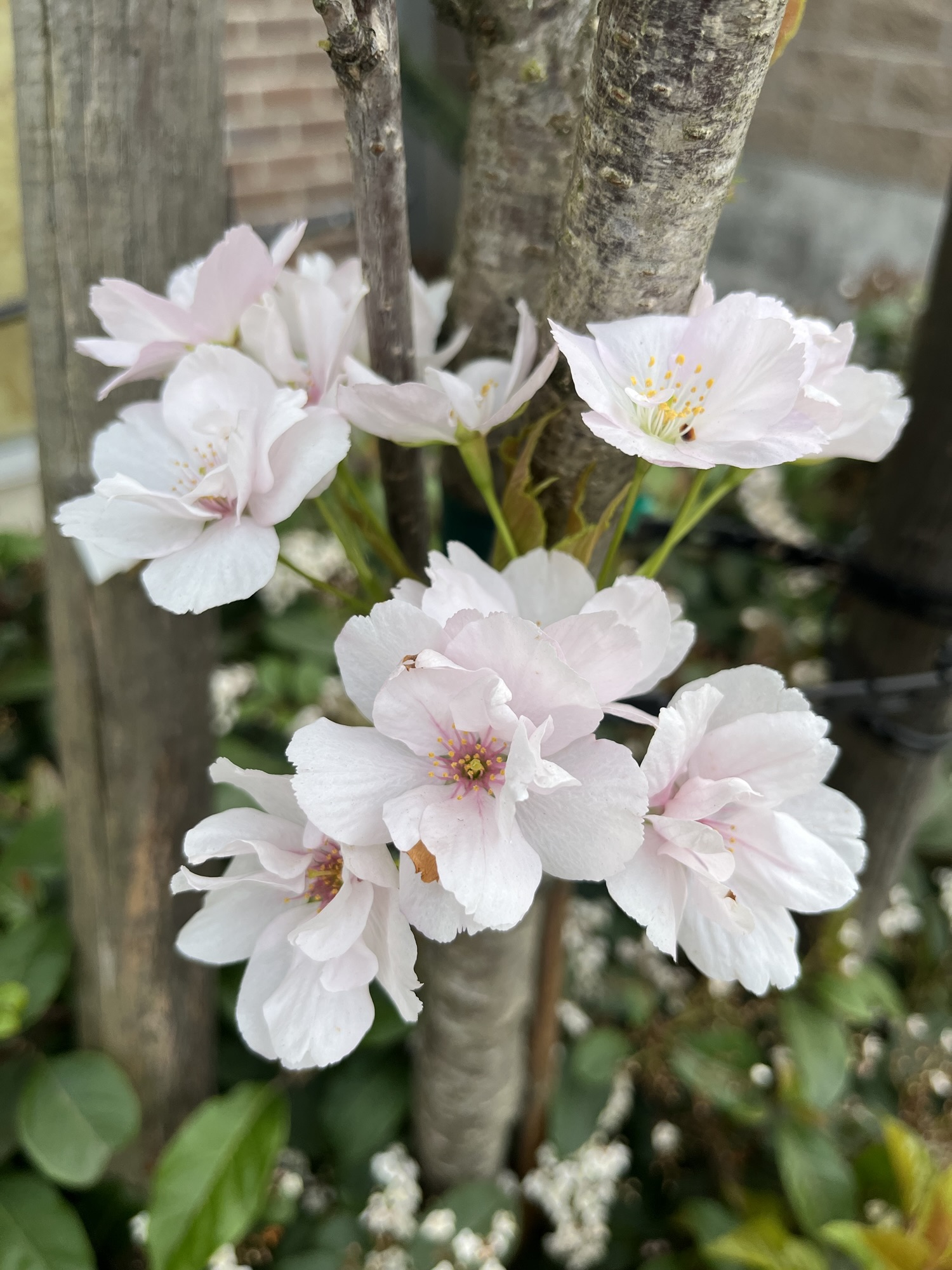
Taken by me in my neighborhood, April of 2025

Yet another variety I stumbled upon recently in 2025 is the Amanogawa (アマノガワ, “Milky Way”) variety. You can see an extra layer of petals in this one, similar to the Kanzan variety, but a lighter, softer color. I couldn’t find much detail about this variety but it appears to be a form of sato-zakura plants also known as the Ōshima cherry, similar to the Kansan variety.

Conclusion

There are many more varieties of cherry blossoms than listed here, but many are obscure or only known to botanists and experts. Also, it’s important to point out that Korea also has a venerable cherry blossom tradition, though I confess I don’t have much information.

In any case, when spring comes, see if you can identify the different cherry blossoms you see. You may be pleasant surprised.

The Manyoshu: Japan’s First Poetry Anthology

Centuries before the Hyakunin Isshu was compiled and before official Imperial anthologies such as the Kokin Wakashū were promulgated there was the Manyoshu (万葉集) or “collection of ten thousand leaves”.

Link to publisher here.

The Manyoshu is the oldest extant poetry collection, completed in 759 CE for the pious Emperor Shomu, and has much that resembles the Hyakunin Isshu, but also much that differs. I have been reading all about it in a fun book, which is in the same series as this one.

The Manyoshu was purportedly compiled by one Ōtomo no Yakamochi (大伴家持, 718-785), author of poem 6 (かささぎの) in the Hyakunin Isshu, but it’s also likely that he only compiled the collection toward the end, and that others were involved too.

Sadly, English translations are very few in number and usually quite expensive. Translating the Hyakunin Isshu hard enough, and this is even more true with a larger, more obscure volume like the Manyoshu.

Format

The Manyoshu is a collection of poems from a diverse set of sources, including members of the Imperial family and the aristocracy, but also from many provinces across the country and people from many walks of life. In fact, 40% of the poems in the collection are anonymous, with sources unknown. It also includes a few different styles of poetry:

  • 265 chōka (長歌), long poems that have 5-7 syllable format over and over (e.g. 5-7-5-7-5-7…etc), until they end with a 5-7-7 syllable ending. These are often read aloud during public functions. Kakinomoto no Hitomaro (柿本 人麻呂, 653–655, or 707–710?), who wrote poem 3 in the Hyakunin Isshu, was considered the foremost poet of this format, but the longest was composed by one Takechi no Miko (高市皇子) at 149 verses.
  • 4,207 tanka (短歌), short poems as opposed to the long poems above. The “tanka” style poems are usually 5-7-5-7-7 syllables long, and are what we see in later anthologies such as the Hyakunin Isshu. At the time, they were often included as prologues to long poems above. The Hyakunin Isshu is entirely tanka poetry, by the way.
  • One an-renga (short connecting poem),
  • One bussokusekika (a poem in the form 5-7-5-7-7-7; named for the poems inscribed on the Buddha’s footprints at Yakushi-ji temple in Nara),
  • Four kanshi (漢詩), Chinese-style poems often popular with male aristocrats that contrasted with more Japanese-style poetry.
  • 22 Chinese prose passages.

Additionally, these poems were often grouped by certain subjects:

  • Sōmonka (相聞歌) – Originally poems to enquire how someone was doing, but gradually involved into couples expressing romantic feelings for one another.
  • Banka (挽歌) – Funerary poems honoring the deceased.
  • Zōka (雑歌) – Miscellaneous poems about many topics. Basically everything else that is not included into the other two topics.

Manyogana

One of the interesting aspects of the Manyoshu compared to the later Hyakunin Isshu, and other related anthologies, is the written script used. When people think of karuta or Hyakunin Isshu, they think of the hiragana script, but the hiragana script didn’t exist in the 8th century when texts such as the Manyoshu, the Kojiki or Nihon Shoki were composed. Such texts were composed purely using Chinese characters, but in a phonetic style native to Japanese later called Manyogana. Confusing? Let’s take a look.

The book above explains that in Manyogana, Chinese characters such as 安 and 以 are read phonetically in the Manyoshu as “a” and “i” respectively. Even modern Japanese people can easily intuit this.

Then you get more difficult examples such as 相 (saga) and 鴨 (kamo) in Manyogana. These are more obscure, but still possible for native Japanese speakers to understand them.

Then you get much harder examples such as 慍 (ikari) and 炊 (kashiki).

And finally you get even more difficult examples such as 五十 (also read as “i“) and 可愛 (just “e“). My wife, who has an extensive background in Japanese calligraphy, struggled with these.

In any case, words in the Manyoshu were all spelled out using Chinese characters like this, with no phonetic guide. You just had to know how to read or spell them, and as you can imagine this was a clunky system that only well-educated members of the aristocracy could make sense of. However in spite of its issues, this system of phonetic Chinese characters is how the later hiragana script gradually evolved.

Technique

When we compare the Manyoshu with the Hyakunin Isshu, there are many similarities. Both have tanka poetry (5-7-5-7-7 syllables), and cover a variety of topics. Further, both collections make good use of pillow words. In fact the same pillow words you see in the Hyakunin Isshu, such as hisakata no (poems 33 and 76), also show up centuries earlier in the Manyoshu:

Original ManyoganaModern JapaneseRomanizationMy Rough Translation
和何則能尓  我が園にWaga sono niPerhaps
宇米能波奈知流梅の花散るUme no hana chiruthe plum blossoms will
比佐可多能ひさかたのHisakata noscatter in my garden
阿米欲里由吉能天より雪のAma yori yuki nolike gleaming snow
那何久流加母流れ来るかもNagarekuru kamofrom the heavens

This poem, incidentally was composed by Yakamochi’s father, Ōtomo no Tabito, when he organized a flower viewing party at his villa (book 5, poem 822).

Another commonality, the book explains, is the use of preface verses or jo-kotoba (序詞) where the first verses are just one long-winded comparison to whatever comes after. Poem 39 in the Hyakunin Isshu is a great example of this since the first 3 verses describe various grasses in order to make a point: that love is hard to hide.

The Manyoshu used this technique as well:

Original ManyoganaModern JapaneseRomanizationMy Amateur Translation
千鳥鳴千鳥鳴くChidori nakuJust as the plovers’ cries
佐保乃河瀬之佐保の川瀬のSabo no kawase noalong the wavelets
小浪さざれ波Sazare namiof the Sabo river
止時毛無やむ時もなしYamu toki mo nashinever end,
吾戀者我が恋ふらくはA ga ko furaku waso too are my feelings of love.
Author: Ōtomo no Saka no Ue no Iratsume (大伴坂上郎女), book 4, poem 526

Historicity

Similar to the Hyakunin Isshu, the Manyoshu covers a fairly broad span of history, but much of it is now pretty obscure to historians. Even so, the poems in the Mayonshu can be grouped somewhat reliably into 4 specific eras:

  • first half of 5th century to 672 CE, starting with the reign of Emperor Nintoku onward.
  • 672 to 710 CE
  • 710 to 733 CE
  • 733 to 759 CE

These periods mostly coincide with certain authors who contributed poetry, but also appear to have breaks due to historical events such as conflicts, temporary political upheavals, etc.

Differences with the Hyakunin Isshu

Although there are many commonalities between the Hyakunin Isshu and the Manyoshu, there are also differences. The most obvious is that the Manyoshu is a mixed-format collection, so it includes poetry other than Tanka style. Another difference is its broad sources for poetry, not just contributions by the elite aristocracy.

However, the book above notes that on a technical level there are other differences.

For example, the use of “pivot words” frequently used in the Hyakunin Isshu ( poems 16, 20, 27, and 88 for example) is a technique that is almost absent in the Manyoshu. Similarly, puns are also rarely used.

Legacy

As the largest and earliest extant poetry collection, it set the standard for Japanese poetry that people were still studying and emulating centuries later. Poems such as 22, 64, and 88 are all examples that use themes or poetic styles that closely resemble poems in the Manyoshu.

Further, compared to more polished anthologies that came later, the Manyoshu’s bucolic and unvarnished content has often been revered by later generations (including Japanese nationalists and Shinto revivalists in the 19th century) for getting to the “heart of Japanese culture”.

The book has been a great read, with amazing illustrations, and it helps show how the roots of the Hyakunin Isshu, including a few of its early authors, lay centuries earlier in the Manyoshu.

The Beautiful Village of Yoshino

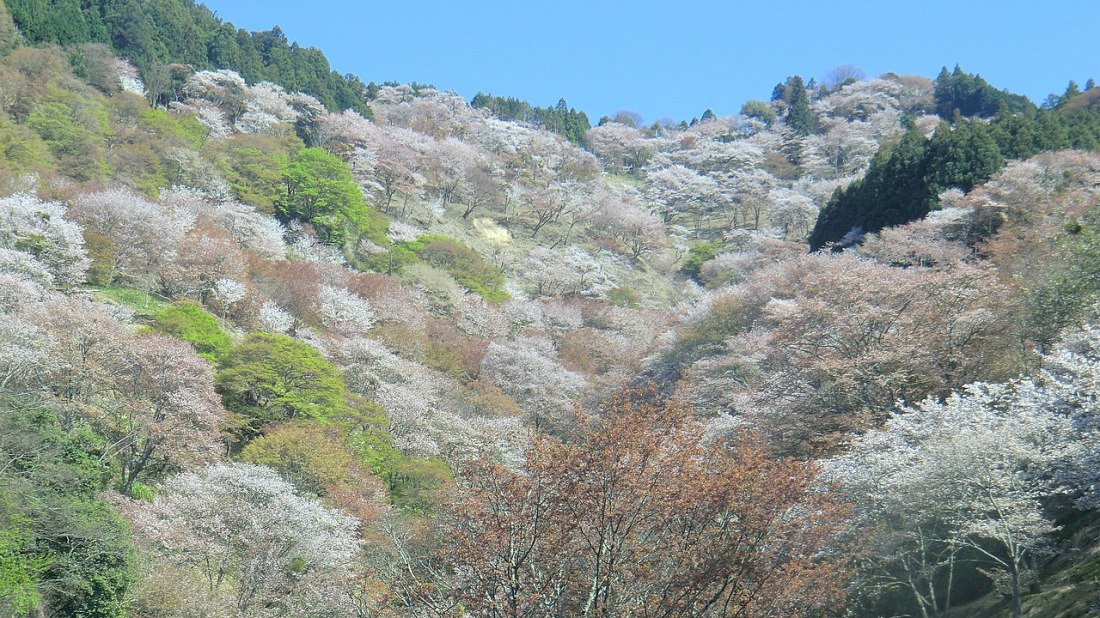
The small town of Yoshino (吉野, official site), near the old capitol of Nara, was a popular spot since ancient times and was often the subject of poetry in the Hyakunin Isshu anthology, for example poem 31 and poem 94. Further, according to the old Japanese historical account, the Nihon Shoki, visits to Yoshino to view the cherry blossoms went as far back as Empress Jitō (poem 2) and became a tradition ever since.

There is also a famous love story that takes place between the celebrated 12th century warrior Minamoto no Yoshitsune, and his mistress Shizuka Gozen. It was said that winter, while fleeing his jealous older brother, on the way to Oshu province in the north, they had to separate for her safety. In the snows of Yoshino, they parted, and Shizuka was sad to watch her beloved disappear in the snow.

Last spring, the Yasaka Taxi company in Japan posted a terrific photo of Yoshino (original link on Twitter):

Even to this day, cherry blossom viewing at Yoshino is a major tourism destination, and from what I hear, it’s pretty amazing.

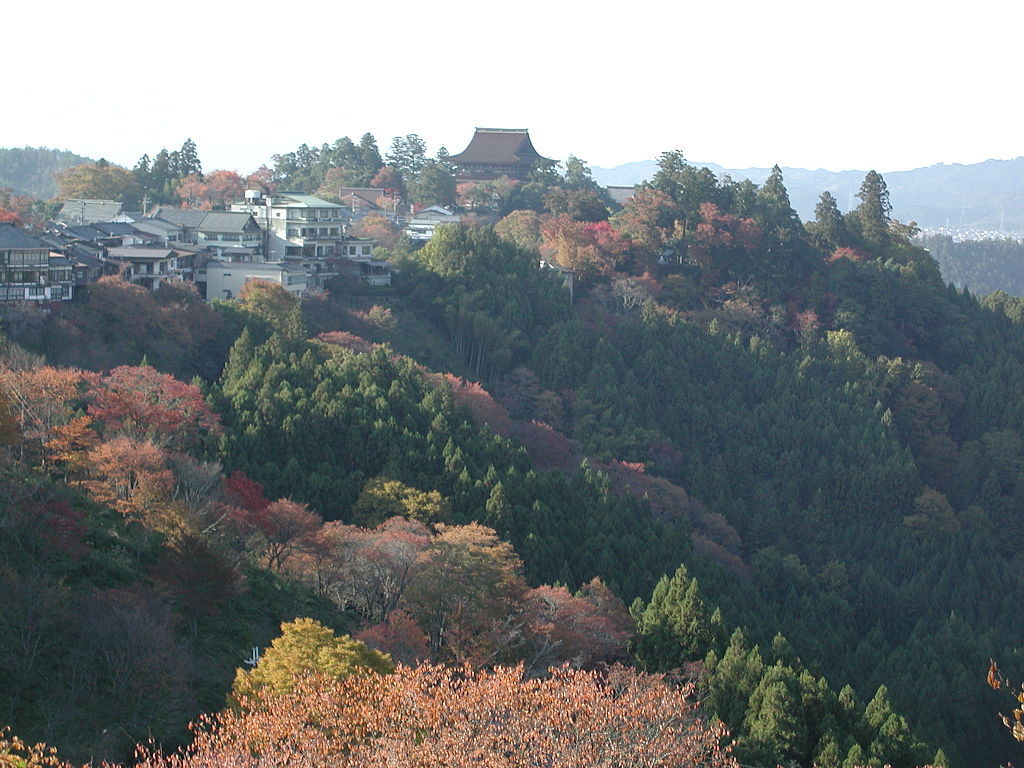
Yoshino is also lovely in Fall, by the way:

The mountains of Yoshino in Fall, photo by No machine-readable author provided. Outside147~commonswiki assumed (based on copyright claims)., CC BY-SA 3.0, via Wikimedia Commons

One can imagine why the aristocracy of early Japan valued this place so highly. 😄🌸

P.S. Featured photo is of the mountains surrounding Yoshino village in spring, photo by 8-hachiro, CC BY-SA 3.0, via Wikimedia Commons

The Fulling of Cloth: Poem Number 94

Although not a well-known poem in the Hyakunin Isshu, I rather like this one for some reason:

JapaneseRomanizationTranslation
みよし野のMiyoshino noFair Yoshino,
山の秋風Yama no aki-kazethe autumn wind in its mountains
さよふけてSayo fuketedeepens the night and
ふるさとさむくFurusato samukuin the former capitol, cold
衣うつなりKoromo utsu nariI hear the fulling of cloth
Translation by Dr Joshua Mostow

The author, Sangi Masatsune (参議雅経, “Counselor Masatsune”, 1170-1221), also as known as Fujiwara no Masatsune, was another editor of the Shin Kokin Wakashū like Yoshitsune (poem 91) and went on to found the poetic house of Asukai (also famous for calligraphy). He also studied under Shunzei (poem 83) earlier in his career.

I had to look up what fulling cloth meant, but apparently it’s the process of beating cloth, especially wool, to improve the texture, or in the case of Japan, give the cloth a nice glossy sheen. You can see an example of this above, in a painting made in the 1800’s, almost 700 years later. I can’t imagine the process changed much within that time. The process was to place the cloth on a wood or stone surface and pound it with a wooden mallet. In Japanese, the process called koromo utsu (衣打つ) just as it is mentioned in this poem.

Also, this poem, like other poems we’ve looked at recently (poem 90 and poem 91), alludes to a much older poem by Korenori (poem 31), which also mentions snow in the village of Yoshino (yoshino-chō, 吉野町), near the old capitol of Nara.

Interestingly, the “former capitol” is referred to by the poetic phrase furusato, which in modern Japanese means one’s hometown. Nara was the capitol of Japan during the early Nara Period, and personally my most favorite place to visit in Japan. The culture at that time was an interesting fusion of early Japanese culture, Chinese art and culture, and Indian Buddhism (via Silk Road). Even after the capitol was moved to Kyoto (another great place), there existed many euphemisms to the “former capitol” by later poets and authors (poem 61, for example) as a kind of nostalgia or the “good ol’ days”. Hence the use of the term furusato I believe.

P.S. Featured photo is Surimono, Woman Fulling Cloth in the Moonlight, by Shigenobu, Brooklyn Museum, No restrictions, via Wikimedia Commons

The Hyakunin Isshu as a Rough Historical Tour

As you may have started to notice, the Hyakunin Isshu anthology provides a subtle historical overview of the classical period in Japanese history. This may have been intention on the part of Fujiwara no Teika, or just reflects the sentiment of his time. Either way, it’s an interesting tour of Japan from the 8th to 12th centuries.

The anthology begins with poems in the Nara Period, when Japanese culture, flush with cultural imports from China (e.g. Confucian ethics, Buddhism, technology, administration, poetry, etc). It was an exciting time in Japanese history. And if you look at the poems from this era, you can see that they tend to feature benevolent rulers (poem 1), bright and happy natural scenes (poems 2 and poem 4), or just often dealt with frivolous issues of love (poem 3 and poem 12) or just life in general around the capitol (poem 10).

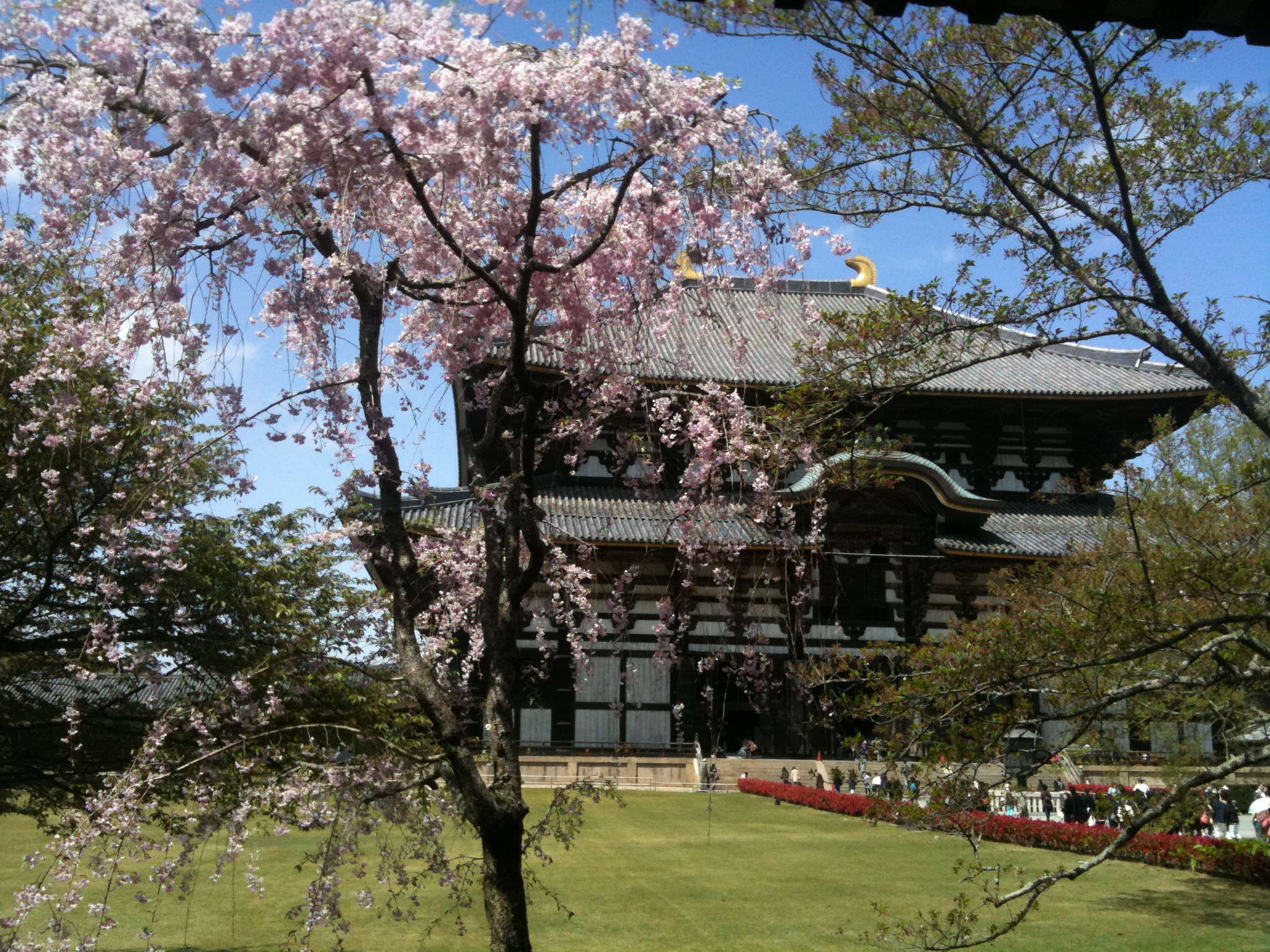
Todaiji Temple in Nara on a warm April day in 2010. Taken by author.

Even when the poems were more melancholy (poem 9, poem 11) they still reflected a more genteel time, and were probably included by Fujiwara no Teika to demonstrate the range of poetic skills of the nobility during that bygone time.

However, the Nara Period eventually gave way to the Heian Period, which was a 400-year flowering of Japanese culture that is still revered today. The transition was slow, and much remained the same generations later, but eventually things started to change:

  • Japan’s contact with China and the Asian mainland eventually stopped, and Japanese culture turned more and more inward for several centuries. Poetry and culture at this time reflected more “native” styles by and by.
  • Politically, the northern-branch of the Fujiwara clan gradually monopolized power around the Emperor through political marriages. In the early period, the nobility included several families who supported the family, but by the 11th century, the Fujiwara controlled every major position in government and most emperors were related to them in one way or another. This is what led in part to Sugawara no Michizan’e exile for example. You’ll notice too how many of the poets have the surname “Fujiwara” in the anthology as well, including Fujiwara no Teika the compiler himself.
  • Toward the end, conflict began to arise again and again, culminating in the famous Genpei War and the fall of the Heike clan. The new samurai class (originally bodyguards to the noble families) clashed with one another for control of Japan and ultimately swept aside the nobility, while still trying to imitate the courtly culture.

As such, if you look at poems toward the very end of the Hyakunin Isshu, they tend to be more dismal in tone. Starting with poem 77 onward, you get an increasing melancholy tone to many poems, culminating at the end when poets often speak of longing for the past (poem 100), complaints about life (poem 83, poem 99) or just expressions of people suffering (poem 95).

Indeed, by this time the flowering culture that started in the Nara Period and flourished in the Heian Period had declined, and war and politics had taken their toll on society. The final few poems begin in the militaristic Kamakura Period, and reflect both nostalgia and unease by people of that era. Small wonder that Fujiwara no Teika, who took tonsure after Emperor Go-Daigo was exiled, decided to compile the Hyakunin Isshu the way he did.

No Refuge In This World: Poem Number 83

This is a well-known poem in the Hyakunin Isshu, and I felt worth posting here:

JapaneseRomanizationTranslation
世の中よYo no naka yoWithin this world
道こそなけれMichi koso nakerethere is, indeed, no path!
入るOmoi iruEven deep in this mountains
山の奥にもYama no oku ni moI have entered, heart set,
鹿ぞ鳴くなるShika zo naku naruI seem to hear the deer cry!
Translation by Dr Joshua Mostow

The author, Kōtai Gōgū no Daibu Toshinari (皇太后宮大夫俊成, 1114 – 1204), or “Master of the Grand Empress’s Palace, Shunzei”. He is also known as Fujiwara no Shunzei, or Fujiwara no Toshinari (俊成 can be read either way), the father of Fujiwara no Teika . Additionally, a surprising number of other poets in the Hyakunin Isshu were associated with (poem 81, 86 and 87), studied under Shunzei (poem 89 and 98), or were directly in opposition to him (poem 79). Shunzei is probably the second most important person in the Hyakunin Isshu after his son of course. 😏

This poem is both moving and technically strong. For example, according to Mostow, the phrase omoi iru is a “pivot word”, meaning that both the words before and after hinge on its double meanings: omoi-iru “to set one’s heart on” and iru “to enter”.

Again, as Mostow explains, the poem generates quite a bit of debate because it’s not clear what concerned him so much. Was it melancholy, a sense of his mortality, or was the state of society at the time (i.e. the decline of the Heian Period)?

Speaking of a deer’s cry, I found this video one of the famous “Nara deer”:

The Nara deer are more domesticated versions of the wild deer in Japan, but it gives you an idea what Shunzei must have heard deep in the woods 900 years ago.

P.S. See poem 5 for something similar.

Memories of the Old Capitol: Poem Number 61

Sorry for the lengthy hiatus everyone. Been a long couple of weeks, but I am excited to post this poem in honor of women poets this month, and timely because of the coming of spring:

JapaneseRomanizationTranslation
いにしInishie noThe eight-petalled cherries
奈良の都のNara no miyako nofrom the Nara capital
Yae-zakuraof the ancient past
けふきょうKyo kokonoe nitoday nine layers thick
ほひおいぬるかなNioi nuru kanahave bloomed within your court!
Translation by Dr Joshua Mostow

Isé no Tayū (伊勢大輔, dates unknown), also known in English as “Lady Ise” was another lady in waiting for Empress Shoshi, as was Lady Murasaki (poem 57) and Lady Izumi (poem 56), but was the newbie apparently.

According to Lady Ise’s own diary, she had to present a poem on the fly to the Bishop from the ancient capital of Nara and its Buddhist institutions, who had brought a lovely eight-petaled cherry blossom as a gift. This variety of cherry blossom is known as yae-zakura (八重桜) in Japanese. Further, the capitol of Japan had moved to Kyoto centuries earlier, but people in Kyoto still looked back to Nara at times for nostalgic reasons. Empress Shoshi’s father, Fujiwara no Michinaga (the same one mentioned in Lady Murasaki’s diary) had asked Lady Murasaki to compose the poem, but for reasons not understood, she deferred to Lady Ise because she was new. 

Thankfully, her poem was a success. As Professor Mostow notes, it does a really nice job balancing the “ancient” with the modern, and the eight petals of the blossom with the metaphorical nine-layers of the Imperial court.

No wonder she made the inner-circle of Empress Shoshi. 😌

Happy Spring everyone!

P.S. Nara is a pretty awesome place to visit in Japan, definitely recommend.

P.P.S. Featured photo is of cherry blossoms at the University of Washington in 2022, taken by me

A Thousand Swift Swords: Poem Number 17

One of the most famous and recognizable poems in the Hyakunin Isshu is poem 17:

JapaneseRomanizationTranslation
千早ぶるChihayaburuUnheard of
神代もきかずKamiyo mo kikazueven in the legendary age
龍田がわTatsuta-gawaof the awesome gods:
からくれなKarakurenai niTatsuta River in scarlet
みずくくるとはMizu kukuru to waand the water flowing under it.
Translation by Dr Joshua Mostow

The poet, Ariwara no Narihara Ason (在原業平朝臣, 825 – 990) or “Sir Ariwara no Narihara”, was the closest thing to a poetic genius during his time, and this poem is a prime example. Originally published in the Imperial anthology, the Kokin Wakashū, as poem number 294, it is considered one of the most iconic of the one-hundred Hyakunin Isshu poems.

Narihara is also credited for writing what is considered the greatest Waka poem on cherry blossoms (桜, sakura) ever composed:

JapaneseRomanizationTranslation
世の中にYo no naka niIf in all the world
絶えて桜のTaete sakura nothere were of cherry blossoms
なかりせばKanarisebano trace anywhere
春の心はHaru no kokoro waah, how truly peaceful then
のどけからましNodokekaramashispring would be for everyone!
Translation by Dr Josha Mostow and Dr Royall Tyler from the Ise Stories, the poem is also number 53 in the Kokin Wakashū.

Not surprisingly, Narihira was thus considered one of the Six Immortals of Poetry.

Returning to this poem, there is a lot to unpack. The imagery of red, autumn leaves flowing along the river provides a very memorable contrast. The Tatsuta-gawa River can be found in modern-day Nara Prefecture, and is a scenic, gentle flowing river near the town of Ikaruka. I’d love to see it someday. I cover more about the Tatsuta-gawa River and iconic Mt Mimuro in poem 69, but several poems in the Kokin Wakashū anthology also refer to fall leaves floating on it.

Also, it should be noted that the fourth line is an example of a traditional Japanese color word.

Lastly, the opening line of this poem, chihayaburu, is a prime example of “pillow words” in Japanese poetry. It literally means something like “a thousand swift swords”, but really is an honorific epithet when referring to the gods, similar to how Homer used to use special epithets for each of the Olympian gods. Nevertheless, it’s a famous line, and can be found in Waka poetry written even in modern times, and is also the title of the popular manga exploring the Hyakunin Isshu card game.

If there is one poem worth learning in all the Hyakunin Isshu, I would argue, it is this one.

Summer Weather: Poem Number 2

One of my favorite poems in all the Hyakunin Isshu is also one of the first:

JapaneseRomanizationTranslation
春過ぎてHaru sugiteSpring has passed, and
夏来にけらしNatsu ki ni kerashisummer has arrived, it seems
白たShirotae noHeavenly Mount Kagu
衣ほすてふちょうKoromo hosu chōwhere, it is said, they dry robes
あまの香具山Ama no Kaguyamaof the whitest mulberry!
Translation by Dr Joshua Mostow

The author of this iconic poem was Jitō Tennō (持統天皇, 645 – 702) known in English as Empress Jitō. Originally Princess Unonosarara, she was the daughter of Emperor Tenji (poem 1), and later his sister-in-law after Tenji forced her to marry his brother (later Emperor Tenmu). In any case, she became the Empress after her husband Tenmu died, and reigned for 11 years. Female emperors were quite rare in Japanese history, by the way, so her reign was pretty noteworthy. Empress Jito proved to be a powerful and effective empress, a patron of the arts who promoted cherry-blossom viewing, completed the new capital of Fujiwara-kyō, but also ruthless toward potential political rivals as well as in the case of her step-son/nephew Prince Otsu.

This poem in general causes a lot of headaches for commentators and translators over generations because of the confusing relation between certain lines. Further, a second slightly different version of the poem exists in the Manyoshu poetry anthology (book 1, poem 28), with differences highlighted:

Original
Manyogana
JapaneseRomanizationTranslation adapted
from Dr Mostow’s1
春過而春過ぎてHaru sugiteSpring has passed, and
夏来良之夏来るらしNatsu kitaru rashisummer is coming, it seems
白妙能白たShirotae noHeavenly Mount Kagu
衣乾有衣干したりKoromo hoshitariwhere, it is said, they are drying robes
天之香来山あめの香具山Ame no kaguyamaof the whitest mulberry!
1 Special thanks to “Cameron” for helpful insights in making sense of the alternate version. Also, any translation mistakes are my own, not Dr Mostow’s.

According to Mostow, there’s a lot of uncertainty about what’s being dried, what does it stand for, and whether the scene is directly observed or not. One further note about the pillow word shirotae (白妙) in the third line, Mostow explains that the word tahe/tae refers to a kind of Paper Mulberry plant. So this is not just paper, but gleaming white paper.

Also, where is this famous Mount Kagu? Mount Kagu, more formally known as Amanokagu in Japanese,2 is one of three peaks called the Yamato Sanzan (大和三山, Three Peaks of [old] Yamato) or the Sanrinzan (三輪山) which are pictured here. These mountains are:

  • 畝傍山, Unebi-yama
  • 耳成山, Miminashi-yama
  • 天香具山, Ama-no-kaguyama (e.g. Mount Kagu)

Yamato is among the oldest parts of Japan as we know it, so these mountains, while small by standards of Mt. Fuji, have held important cultural significance since the beginning. Since antiquity, it was believed that all three mountains were inhabited by Shinto kami,3 and thus sacred spaces. Miminashi-yama and Ama-no-kaguyama were said to be inhabited by male kami, who competed for the affection of Unebi-yama, a female kami.

Ama-no-kaguyama with purple Cosmos flowers in the foreground. The remnants of the ancient capital of Fujiwara-kyo can also be seen to the right. Photograph by Ajax, CC BY-SA 4.0, via Wikimedia Commons

The ancient imagery of such a venerable old mountain, couple with such vivid imagery of a sunny, warm summer day are among the reasons why I like this poem so much. 🙂

2 The Manyoshu version of the poem alternatively spells it as ame-no-kaguyama, which is an obscure though valid way to read 天. I am not sure why both versions of the poem are read slightly differently.

3 Although kami is usually translated as a “god” in English, it helps to think of them more like ancient Greek gods, than the modern concept. Ancient Greek religion had gods both large and small, so the English word “divinity” might be more accurate?