The Hyakunin Isshu anthology, the subject of this blog, is not known for bawdy subjects as Japanese poetry by that time had become increasingly refined and codified in style. By contrast, the much older Manyoshu included a wider variety of poems and topics. This includes drinking poetry.
In fact, the compiler of the Manyoshu, Ōtomo no Yakamochi (大伴家持, 718 – 785) who also composed poem 6 in the Hyakunin Isshu (かさ), was the son of a famous literati and booze-hound: Ōtomo no Tabito (大伴旅人, 665 – 731). Tabito was a contemporary of Hyakunin Isshu poet Hitomaro (poem 3, あし), though not quite as successful.
Tabito was dispatched by the Imperial bureaucracy at the time to serve a term as governor of Daizafu in western Japan, and while there he formed a poetry circle called the Tsukushi Kadan (筑紫歌壇, “Tsukushi Poetry Circle”), where Tsukushi is the name of an old district in Dazaifu. Of Tabito’s 50+ poems in the Manyoshu, 13 of them were contributed by Tabito, known as the Sake wo Homuru Uta Ju-san-shu (酒を讃むる歌13首) or “The Thirteen Poems Praising Saké [rice wine]”.
Although I joke about Tabito’s possible alcoholism, the poems are not necessarily meant to be taken as literal. My book on the Manyoshu points out that these poems may have intended to imitate a famous 3rd century literati group in China called the Seven Sages of the Bamboo Grove, sometimes known as the Seven Sages of the Western Jin [Dynasty]. In Japanese they are called the chikurin-shichiken (竹林七賢). The enduring image of these seven musicians, poets and scholars is a band of bohemian, drunken geniuses, and Tabito and his poetry circle was likely inspired by them. You can see other examples of artistic inspiration in this post from my other blog. Between this collection of poems, and the Zen artwork in my other blog, I had no idea that the Seven Sages were such a popular topic in art.
But I digress.
There is another side to this poetry as well : evidentially on the move from the capital (Kyoto) to Dazaifu to the west, Tabito’s wife apparently fell ill and died. So, my book alludes to the idea that Ōtomo no Tabito took up drinking not just as a literati trend, but also to deal with the grief of losing his wife. Marriages at this time were often political as various noble families vied for position in the tightly stratified hierarchy in the Imperial Court. However, even political marriages could be happy ones at a personal level, so Tabito may have genuinely been grieving for a wife that he loved, plus the isolation from the capital.
Tabito’s poems, celebrating the virtues of rice wine, are technically very good poems, but also cover a subject that is omitted in later anthologies where style and form were pretty much codified by then. So, by the time the Hyakunin Isshu was compiled, 4 centuries later, no one would write such crass poetry about booze and girls (atleastnotopenly). Further, while the Manyoshu lacks the refinement of the Hyakunin Isshu, it does have a raw, visceral tone that’s often missing in later anthologies, and resonates differently with readers. Personally, I love both anthologies, but for different reasons.
P.S. I’m finally back, and have a few upcoming topics. Please enjoy.
1 This kind of rice wine seems to be a style from China, where the fluid is cloudy rather than clear.
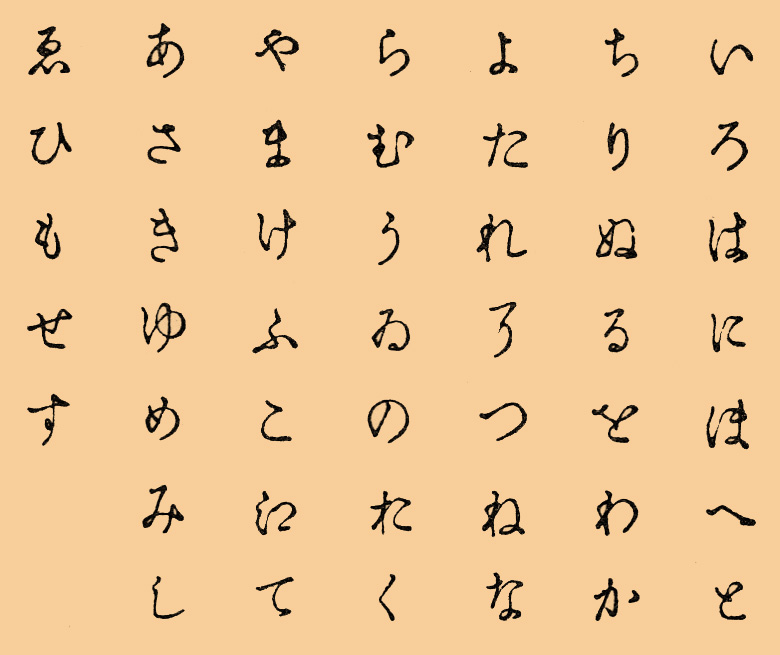
One of the most famous waka poems across Japanese history and even contemporary culture is a poem called the Iroha. The name “iroha” comes from the first three letters of the poem “i”, “ro” and “ha”. What makes this poem famous is that it uses each hiragana syllable exactly once, and still makes an intelligible, not to mention lovely, poem.
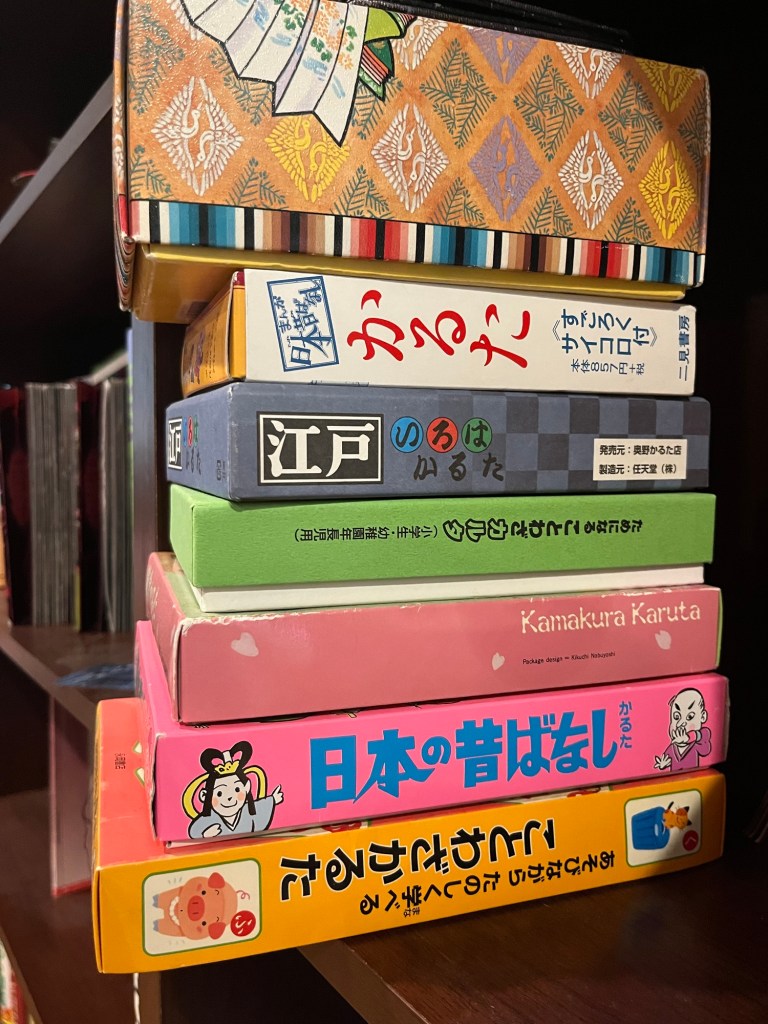
Because of this, it was often used in pre-industrial Japan as a way to organize things. Theater rows would be organized by the order in the Iroha letters, and so were firefighter brigades in pre-modern Tokyo (a.k.a. Edo). Even modern karuta sets are organized by iroha order. I don’t mean the Hyakunin Isshu karuta that I often discuss in the blog, but more informal karuta games that kids often play. We have a few sets here at home, given to us by my in-laws for the grandkids. You can see a nice selection of Iroha karuta sets on the Okuno Karuta online store, too.a
Various karuta sets my in-laws in Japan sent us. The top one is my wife’s original Hyakunin Isshu she had from grade-school.
But I digress.
The Iroha poem’s author is unknown (more on that later), but it was originally composed in old Manyogana script, like other poems of the early Manyoshu anthology, then later in hiragana. It includes many old spellings, so it’s a bit hard to render in modern Japanese.
The poem is as follows:
Manyogana
Modern Japanese
Romanization
Translation1
以呂波耳本部止
いろはにほへと
I ro ha ni ho he to
Even the blossoming flowers
千利奴流乎和加
ちりぬるをわか
chi ri nu ru o wa ka
will eventually scatter
餘多連曽津祢那
よたれそつねな
yo ta re so tsu ne na
Who in this world shall
良牟有為能於久
らむうゐのおく
ra mu u i no o ku
remain unchanged? Let us today2
耶万計不己衣天
やまけふこえて
ya ma kyo (ke fu) ko e te
cross the mountains of impermanence
阿佐伎喩女美之
あさきゆめみし
a sa ki yu me mi shi
and no longer have superficial
恵比毛勢須
ゑひもせす
e hi mo se su
dreams, nor be deluded
1 adapted translation from Wikipedia, plus a few modifications of my own 2 有為 (u i) meaning “viccisitudes of life” or the impermanence of all phenomena
This poem has strong Buddhist allusions to such concepts as samsara (“the aimless wandering lifetime after lifetime”), the delusions that bindus to this existence, awakening to these delusions (e.g. “enlightenment”), and finally nirvana (“unbinding”). The poem itself shows considerable familiarity with earlier Buddhist texts such as the Perfection of Wisdom sutras, including the Heart Sutra, as well.
But I digress. Again. 😅
There are some really interesting aspects of this poem that are worth sharing. First, authorship. Given the strongly Buddhist undertones of the poem, it’s often been attributed to a famous Buddhist monk named Kukai (a.k.a. Kobo Daishi) who was a talented poet and calligrapher. Another theory states that this poem may attributed to none other than the famous court poet Kakinomoto no Hitomaro, who composed poem 3 in the Hyakunin Isshu (あしびきの).
But things get even more interesting.
Scholars have noted that if you take the last syllable of each line (highlighted above for convenience) it spells another sentence: toka (ga) nakute shisu (咎[が]無くて死す) meaning “he/she died without fault or blemish”. Another theory, mentioned in my new book, points out that the 5th column spells out ho(n) wo tsu no ko me (本を津の小女), which could mean “deliver this book to my wife in the town of Tsu”, which if taken together with the 7th column implies that “I will die without blemish, please deliver this poem to my wife”.
So, is the poem a tribute to someone else? Perhaps Kukai or Hitomaro? If so, then who wrote it, and why? Was the poem a coded message to someone who was executed for political reasons? Or was the poem simply an attempt at word-play?
We will never know, but the impact of the Iroha on Japanese poem can still be easily seen today.
a Although things like Chihayafuru and this blog tend to emphasize the competitive karuta of the Hyakunin Isshu, in reality that’s only a small subset of karuta gaming culture. Most of it is much more informal stuff you play at home with family, much like board games in Western culture, and often times doesn’t even relate to the Hyakunin Isshu. Maybe I’ll post about it some time, but thanks to grandparents in Japan, we have 4-5 sets here ranging from such subjects as places in the city of Kamakura, old folks-sayings, Japanese fairy-tales, and just really basic words in Japanese. Most of these list the cards using iroha-order, and are not related to the Hyakunin Isshu. We’ve played them with our kids from time to time, and they’re much easier than competitive karuta, though it’s still assumed you know at least some basic Japanese.
In a lesser-known Imperial poetry anthology called the Shui Wakashu (拾遺和歌集), poem 1342, is recorded what is believed to be Lady Izumi’s1 final poem:
Japanese
Romanization
Translation
暗きより
Kuraki yori
The way I must enter
暗き道にぞ
Kuraki michi ni zo
leads through darkness to darkness —
入りぬべき
Irinu beki
O moon above the mountains’ rim
はるかに照らせ
Haruka ni terase
please shine a little further
山の端の月
Yama no wa no tsuki
on my path.
Translation by Jane Hirshfield and Mariko Aratani in “The Ink Dark Moon“
This poem was addressed to a Buddhist monk named “Shoku” and includes several Buddhist allusions. The most important is the phrase “darkness to darkness”, which comes from chapter seven of the Lotus Sutra:
….from darkness they [living beings] enter into darkness, to the end never hearing the Buddha’s name [hear the Dharma].
This refers to the Buddhist notion of Samsara, the near-infinite, aimless wandering that living beings undergo lifetime after lifetime, like a cosmic rat race. Such beings, who have yet to hear the Dharma [the teachings] of the Buddha, will continue to wander lifetime after lifetime without rest.
Thus, Lady Izumi is asking Shoku to help shine a light in the darkness for her, so that she may find the way [follow the Buddhist path].
I had trouble deciding which blog to put this in, since it covers both themes, but I decided to post here since the poem was introduced in the new historical drama about Lady Murasaki, Izumi’s contemporary.
Lady Izumi was, to put it mildly, a complex woman. She had incredible talent, and found herself in one scandal3 after another as powerful men fell at her feet, plus she earned scorn from other women such as Lady Murasaki. And yet, she was also very kind, devout and struggled to balance both the religious and worldly aspects of her life, while raising her orphaned granddaughter.
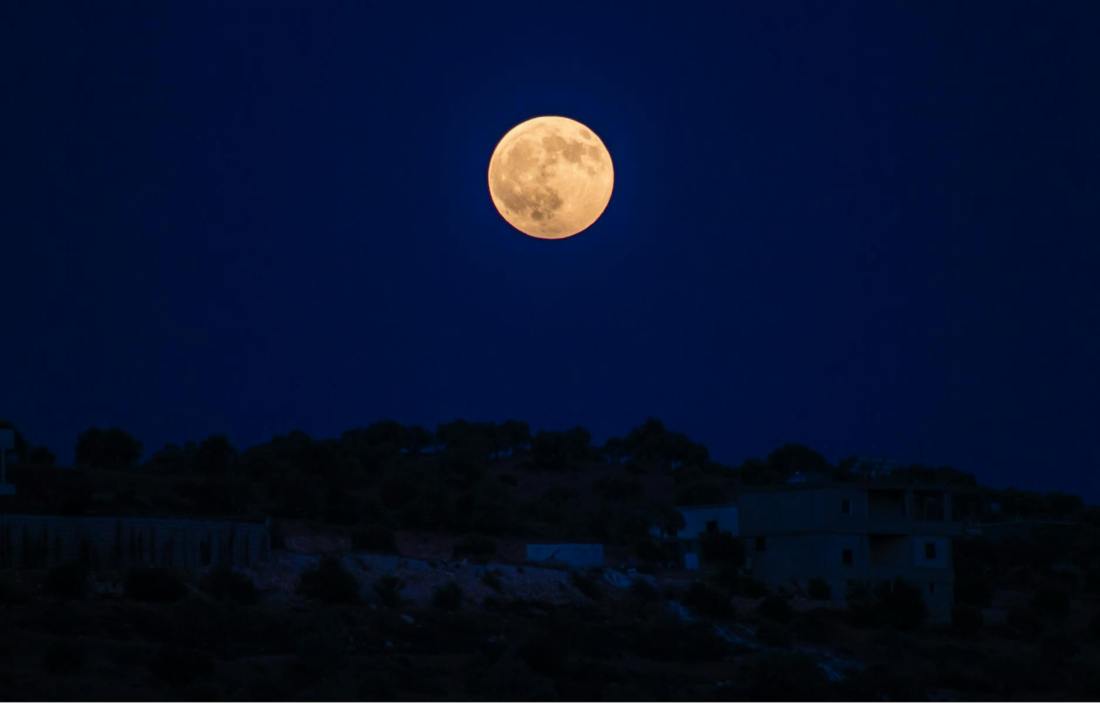
Hirshfield and Aratani note that if this poem is indeed her last, the final word she ever wrote was tsuki (月), “moon”.
2 alternate translation by Murano reads: …they go from darkness to darkness, and do not hear of the names of the Buddhas.
3 this was a conservative, narrow, aristocratic society where men frequently had affairs, but it was much more scandalous if women did. The idea that women could want, and enjoy sex, was not something people really accepted at the time.
I’ve written before about Empress Teishi, the ill-fated first wife of Emperor Ichijō, and patron of Sei Shonagon who wrote poem 62 of the Hyakunin Isshu (よを). Her family lost a power-struggle to a rival faction of the Fujiwara clan, and under pressure Ichijō took a second wife from the winning faction: Empress Shoshi. Teishi was sidelined, and although she did give birth to an heir, she soon died from illness and presumably humiliation and stress.
While watching the historical drama about Lady Murasaki, it showed Teishi’s untimely death, and revealed that she had left a final deathbed poem to her beloved husband. The poem really exists and is actually recorded in an imperial anthology, the lesser-known Goshūishū (後拾遺), number 536:
Japanese
Romanization
Rough Translation
夜もすがら
Yo mo sugura
If you should remember
契りしことを
Chigirishi koto wo
that vow we made
忘れずは
Wasurezu wa
in the deep of night,
恋ひむ涙の
Koimu namida no
then I long to see
色ぞゆかしき
Iro zo yukashiki
the color of your tears…
In the drama, Emperor Ichijo and Teishi are portrayed as being sincerely in love, yet ultimately they are a victim of politics and forced apart more and more over time. The vow alluded to here was portrayed in the drama as a promise by Emperor Ichijo to always love Teishi no matter what.
Rokuharamitsu-ji Temple in Kyoto, where Teishi was laid to rest. Photo by 663highland, CC BY-SA 3.0, via Wikimedia Commons
Later, Teishi was buried (not cremated in typical Buddhist fashion) at a temple called Roku-haramitsu-ji, near an area of Kyoto called Toribeno no Misasagi (鳥戸野陵). Legend says that on the night of her funeral it snowed. Emperor Ichijo, who was unable to attend, was said to have stayed up all night mourning for her at the palace. Later he composed a poem for her, preserved in the Eiga Monogatari, which is as follows:
Japanese
Romanization
Rough Translation
野辺までに
Nobe made ni
My heart yearns
心ばかりは
Kokoro bakari wa
for you all the way
通へども
Kayoe domo
in Toribeno,
わが行幸とも
Waga miyuki tomo
and yet I worry if
知らずやあるらん
Shirazuya aruran
you are aware of my coming.
Later, Sei Shonagon who retired from the Court, was said to have taken up residence near Toribeno no Misasagi, particularly near a temple named Sennyu-ji. You can see some photos of these places in the video posted here. It was looking back in her later years that Sei Shonagon wrote the Pillow Book as a subtle memorial to her beloved patron, looking back fondly on happier days together.
Lady Murasaki, one of the most famous women of Heian-period Japan, and the first novelist in Japan, wrote many wonderful romantic scenes through the Tales of Genji, yet her real life marriage was anything but.
The latest episode historical drama on NHK about the life and times of Lady Murasaki (poem 57, め) covers her marriage to her second-cousin Fujiwara no Nobutaka (藤原宣孝, ? – 1001), who was around 20 years her senior. Yes, this was not that unusual for the time, but still gross.
Sadly, the marriage quickly turned sour. Nobutaka slept around a lot, and had other hidden wives and children. Lady Murasaki did not take this lying down and the two of them fought frequently. Nobutaka for his part, enjoyed bragging about his trophy wife.
In the poems preserved in Lady Murasaki’s own private collection is this poem addressed to her husband:
Japanese
Romanization
Rough Translation1
言ひ絶えば
Ii taeba
If you saw you’re going to
さこそは絶えめ
Sa koso wa taeme
stop writing me, then fine!
なにかその
Nanika sono
You can’t even
みはらの池を
Miwara no ike wo
stand by the bank
つつみしもせむ
Tsutsumi shimo sen
of Miwara pond properly.
1 Apologies for any mistakes, or for the roughness of this translation
The backstory of this poem is that Nobutaka had taken one of Lady’s Murasaki’s private letters addressed to him, and shown off that letter to friends (apparently bragging about how smart his young bride was). She was justifiably angry and told him to knock it off. Nobutaka was angry with her and threatened to stop writing. Her reply above, was a clever way of saying “fine, don’t bother writing me”. The allusion to Miwara pond was a pair of puns:
Miwana pond (mihara) is also a pun for anger.
The word tsutsumi is also pun for a bank (as in riverbank), and self-restraint.
Contrary to Lady Murasaki’s reply, Nobutaka was so impressed by the reply that he ended up bragging about it to his friends anyway. 🤦🏼♂️
Another letter is as follows:
Japanese
Romanization
Rough Translation2
忘るるは
Wasururu wa
Forgetting others is
うき世のつねと
Uki yo no tsune to
a part of this ephemeral world,
思ふにも
Omou ni mo
Even so,
身をやるかたの
Mi wo yarukata no
being forgotten myself,
なきぞわびぬる
Naki zo wabinuru
I cannot help but cry.
2 Apologies for any mistakes, or for the roughness of this translation
The married nobility of the Heian Period frequently lived in separate estates, and the husband would visit his wife as needed, but not the other way around. It seems by this point, Lady Murasaki was forgotten by her philandering husband, and lamented her unhappy marriage. One can’t help but recall the Gossamer Years generations earlier.
It is sad that such a talented woman was relegated to an unhappy marriage with a faithless, not to mention narcissistic husband, especially in a society where women had little recourse. I also wonder how much this motivated her to write her novel, The Tales of Genji, as a coping mechanism.
P.P.S. For folks who are visiting Kyoto, there are many excellent locations associated with the life of Lady Murasaki and the Tales of Genji. The featured photo above is the “Genji Garden”, part of the Buddhist temple of Rozan-ji, courtesy of PlusMinus, CC BY-SA 3.0, via Wikimedia Commons. This blog includes an excellent photo-tour of Rozan-ji.
Waka poetry, including the Hyakunin Isshu has a lot of conventions and symbols used to express certain seasons or sentiments. This is not so unusual. For example, if someone in the US writes a poem about the smell of cinnamon, it definitely brings to mind late autumn or winter.
One common example in the Hyakunin Isshu of poetic symbolism are birds. Birds have distinctive calls, and different species tend to be prominent at different times of year, among other things. For this post, I included a lot of poetry from the Imperial anthology, the Kokin Wakashu, which is much larger than the 100 poems of the Hyakunin Isshu, and thus easier to find examples.
Spring
The most prominent bird in Spring is the uguisu, the Japanese Bush Warbler, also called the Japanese Mountain Thrush:
The uguisu’s distinctive bird call is very emblematic of the season.
The bird call of the uguisu sounds like ho-ho-ke-kyo, which to Japanese people sounds similar to a famous Buddhist text called the Lotus Sutra (hokekyo in Japanese). I’ve written much about the Lotus Sutra in my other blog, so I do not need to repeat here. Needless to say, when Spring comes, people in Japan inevitably hear this lovely sound, even in urban areas.
Oddly, there are no poems in the Hyakunin Isshu about the uguisu, however, I found many poems in the official anthology, the Kokin Wakashu. Here are a few of my favorites thus far. This first one is poem 4 by Fujiwara no Takako (藤原高子; 842–910) later Nijo-kisaki (二条后, “Nijō Consort”):
Apparently, the bird was highly praised during the aristocratic court culture of the Heian Period, and Sei Shonagon (poem 62) mentions an expedition in her Pillow Book:
[94] …it had been overcast and tending to rain since the first day of the [fifth] month. Some of us were sitting about at a loose end, when I came up with the suggestion that it would be fun to go off on an expedition to hear the hototogisu….
[ later ] … and as for the hototogisu, they were indeed calling back and forth, so loudly in fact that they made almost too much of a din for comfort.
Translation by Dr Meredith McKinney
The anecdote is quite long, but Sei Shonagon and the other ladies-in-waiting do encounter the hototogisu, and meant to write poetry about them, but then through a series of interactions forgot the poetry entirely and came back to the Empress empty handed, followed by various witty comments back and forth.
Autumn
Unlike the Spring, where the call of the bird is highly praised in poetry, in the Autumn, theHyakunin Isshu Daijiten lists a few birds that were revered in poetry. For example, migratory birds, such as the Wild Goose (kari):
I had some trouble finding poems for the fall birds listed in either the Hyakunin Isshu or the Kokin Wakashuanthology, but there seems to be a lot in the later Shin-Kokin Wakashu anthology. I don’t have a reliable translation of the Shin-Kokin Wakashu, so I may update later.
I did find this poem under the section “Miscellany 2” in the Kokin Wakashu, poem 497 by an anonymous poet:
The birds associated with winter, were birds whose cries were melancholy and said. First and foremost is the plover, which we saw in poem 78 (あわじ) of the Hyakunin Isshu:
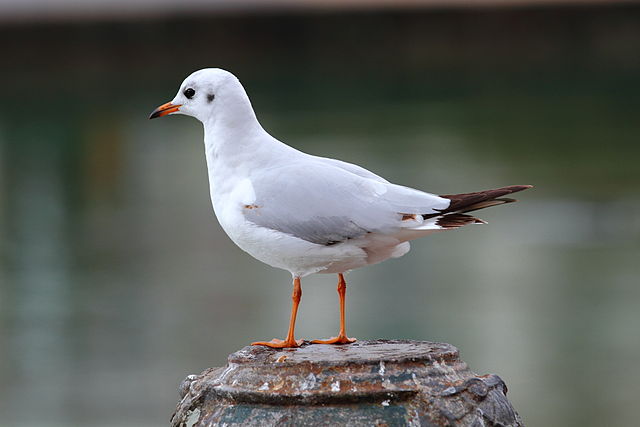
Or the Black-headed Gull (miyako-dori, meaning “bird of the capital”):
The miyakodori in particular stood out due to its unusual name. The Hyakunin Isshu Daijiten lists a poem from the official Kokin Wakashu anthology of note, poem 411 under the section “Travel Poems”:
The headline for this poem explaining the backstory is unusually long, but basically the poet, Ariwara no Narihira (who also wrote poem 17, ちはやふる, in the Hyakunin Isshu) was away in eastern Japan with some companions, and longing for home in the capital, they saw a miyako-dori bird (lit. “capital bird”) and recited this poem.
The Mallard in particular had dual-association with romance and with the melancholy of winter. This poem in the Kokin Wakashu, number 533, by an anonymous author illustrates this:
Certain birds were also used in Japanese poetry for symbolic purposes, but not necessarily for seasonal expression.
We’ve talked about birds associated with seasons thus far, but there’s a couple worth calling out that are an important part of Japanese poetry, but not related to seasons. The first is the Copper Pheasant, called yamadori, which we saw in poem 3 of the Hyakunin Isshu (あしびきの).
In antiquity, it was thought that Copper Pheasants mated for life (true), but slept in separate nests at night. Thus, the poet Kakinomoto no Hitomaro likened himself to a Copper Pheasant sleeping alone at night part from his lover.
And finally we come to the magpie. In poem 6 of the Hyakunin Isshu (かさ), the poet Chūnagon Yakamochi describes frost growing under moonlight on the so-called Magpie Bridge of the Imperial Palace. The magpie (kasasagi) was associated with a Chinese myth that evolved into the Qīxī Festival (七夕), celebrated as Tanabata in Japan.
In this tale, two star-crossed lovers, a celestial princess and a cowherd, were forcibly separated in the heavens by her father the Jade Emperor, but allowed to reunite one night a year. It was said they would reunite by crossing a bridge made of magpie birds who put their outstretched wings together. Thus, the magpie was always associated with this famous tale.
A while back I wrote about a famous poem in the Manyoshu anthology by Princess Nukata addressed to her ex-husband Prince Oama (later Emperor Tenmu). It seems that the story of this forbidden encounter in a field of grass did not end there, because Prince Oama replied back…
Before we discuss the poet and the context, I wanted to briefly explain the plant described: murasaki (紫草). I had some trouble finding information on this plant, but it seems to be the species Lithospermum erythrorhizon which in English has a variety of names: purple gromwell, red stoneroot, red gromwell, etc.
Princess Nukata was Prince Oama’s ex-wife, but had remarried his older brother, Emperor Tenji (poem 1 in the Hyakunin Isshu), while the emperor had compelled Prince Oama to marry his own niece (Tenji’s daughter) Princess Unononosasara to strengthen the family line. Relations in the family were complicated. Later after Emperor Tenji died, Prince Oama went to war against Tenji’s son, and overthrew him to become Emperor Tenmu. Game of Thrones, Japanese ediiton.
Yet what makes this exchange of poems surprising is that both Princess Nukata’s poem, and Prince Oama’s were recited not in secret, but at a big public banquet in front of Emperor Tenji.
So, what’s going on here? Are they professing their love in defiance of the Emperor?
Well … no. My book on the Manyoshu strongly suggests that given the circumstances these poems were likely recited in jest. Maybe they did still have lingering feelings for one another, but the poems were not meant to reflect real life; they were meant to paint a beautiful, but surreal scene. The imagery is fantastic, and a testament to their poetic skills, but the scene described likely did not happen. This is not unusual with the poetry we’ve seen thus far on the blog: many poems paint idealistic scenes that might be based on real life, but didn’t necessarily happen.
Then again…. what if they recited their poems in jest in order to hide true feelings after all?
While re-reading the Pillow Book lately, one of the people in Sei Shonagon’s anecdotes recites a poem from an Imperial anthology: the Kokin Wakashu (Kokinshu for short).1 When I looked up the poem, it really struck me when I read it. Since I have an English translation of the Kokin Wakashu, and since many of the poems from the Hyakunin Isshu were originally published in the Kokin Wakashu, I figured it would be fun to post other poems from the same anthology.
This poem, poem number 52 of the Kokin Wakashu, reads as follows:
Japanese
Romanization
Translation
年ふれば
Toshi fureba
As the years stream by
よはひは老いぬ
Yowai wa oinu
my own life passes from me
しかはあれど
Shika wa aredo
still I am renewed
花をし見れば
Hana oshi mireba
when I but see the blossoms
物思もなし
Mono omoi mo nashi
my heart’s sorrows disappear
Translation by Laurel Rasplica Rodd and Mary Catherine Henkenius
The headline of this poem reads “seeing cherry blossoms in a vase before the Somedono Consort [Empress]“.2
The author of the poem, Fujiwara no Yoshifusa (藤原良房, 804 – 872), was the first member of the Fujiwara clan to assume the post of Regent to the emperor. This was at a time when the Fujiwara were a rising star in the Imperial court, had married into the Imperial family, and Yoshifusa was the grandfather of the young Emperor Seiwa. So, he had much to celebrate. However, even the powerful grow old and die, and Yoshifusa was no exception.
What I really like about this poem is that in spite of his own fears of growing old, he still can enjoy life here and now and feel young again.
I am at the age where I can definitely start to feel my age, and the years ahead of me are likely fewer than the years behind me, and yet I am rarely bothered by it. I often find moments of joy in life, playing with my kids, enjoying nerdy fandom, and savoring poetry like this, so I know how Yoshifusa feels.
1 Nowadays, people quote movies, TV shows and such. I can quote more gags from The Simpsons than I care to admit. Back then, people quoted poetry from earlier generations.
2 Many poems in the Kokin Wakashu included a headline to explain the scene of the poem, or provide some background. These were not carried over when the poems were collected in the Hyakunin Isshu since they were already well-known poems, or possibly just for the sake of brevity.
If you’ve been following this blog for a while, and gotten to know some of the authors of the Hyakunin Isshu, then you may have noticed some patterns with the names of the authors. The authors are rarely listed by their birth name, and instead are listed under a sobriquet, or just their official title in the Imperial Court.
Why was this done?
My book, the Hyakunin Isshu Daijiten, explains that this was because in this period of Japanese history, names were thought to be tied to one’s life. People at this time, both the Nara (8th c.) and increasingly in the Heian (9th – 12th c) periods, were often worried about curses, evil spirits, and such, and went to elaborate lengths to avoid spiritual calamities (see background for poem 24 for example). So, to avoid risk of one’s name (and thus one’s life) being subject to evil magic, people often hesitated to share their personal names with others.
It’s unclear how commoners in the Nara/Heian Period named themselves; there is just not enough information, but for the nobility who all belong to the hierarchical Imperial Court, certain naming conventions developed.
Men
Men with important titles, or positions in the court often used their titles as their sobriquet. Lower-ranking men in the Hyakunin Isshu did not have this privilege.
Titles for members of the Imperial Family – Emperor Tenji, (poem 1), Retired Emperor Go-toba (poem 99), and Prince Motoyoshi (poem 20).
Positions in the Imperial Court – Sanjō Minister of the Right (poem 25), Major Counselor Fujiwara no Kintō (poem 55), and Master of the Grand Empress’s Palace (poem 83)
Clerical names – Dharma Master Jakuren (poem 87) and Former Major Archbishop Gyōson (poem 66)
Due to the Confucian, paternalistic culture of the Japan in antiquity, women were not given titles wihtin the Imperial Court (though they did earn rank just as men did), and seldom used their real name. Instead, they used a different naming convention.
Male relatives or spouses – Lady Ise (poem 19), whose husband served as governor of Ise Province, Lady Izumi (poem 56) whose tenure as governor of Izumi Province, “The Mother of Michitsuna, Major Captain of the Right” (poem 53), Taiyu of the Household of Princess Ryōshi (poem 90), and Ukon (poem 38) named after her father’s position as Captain of the Guards.
Poetic sobriquets – Lady Murasaki (poem 57) named after a character from her own novel the Tales of Genji, Akazome Emon (poem 58).
Because women were more often kept out of sight than men in the Imperial Court, biographical information about women authors of the Hyakunin Isshu is often much thinner than the men (except lower-ranking men). This makes learning about women like Lady Murasaki or Lady Izumi difficult.
In any case, the idea that names are tied to one’s lifespan is a fascinating cultural belief, and it’s likely you would find this in other pre-modern cultures as well.







 The Hyakunin Isshu
.jpg)

.JPG)

.jpg)


_W_IMG_0104.jpg)


